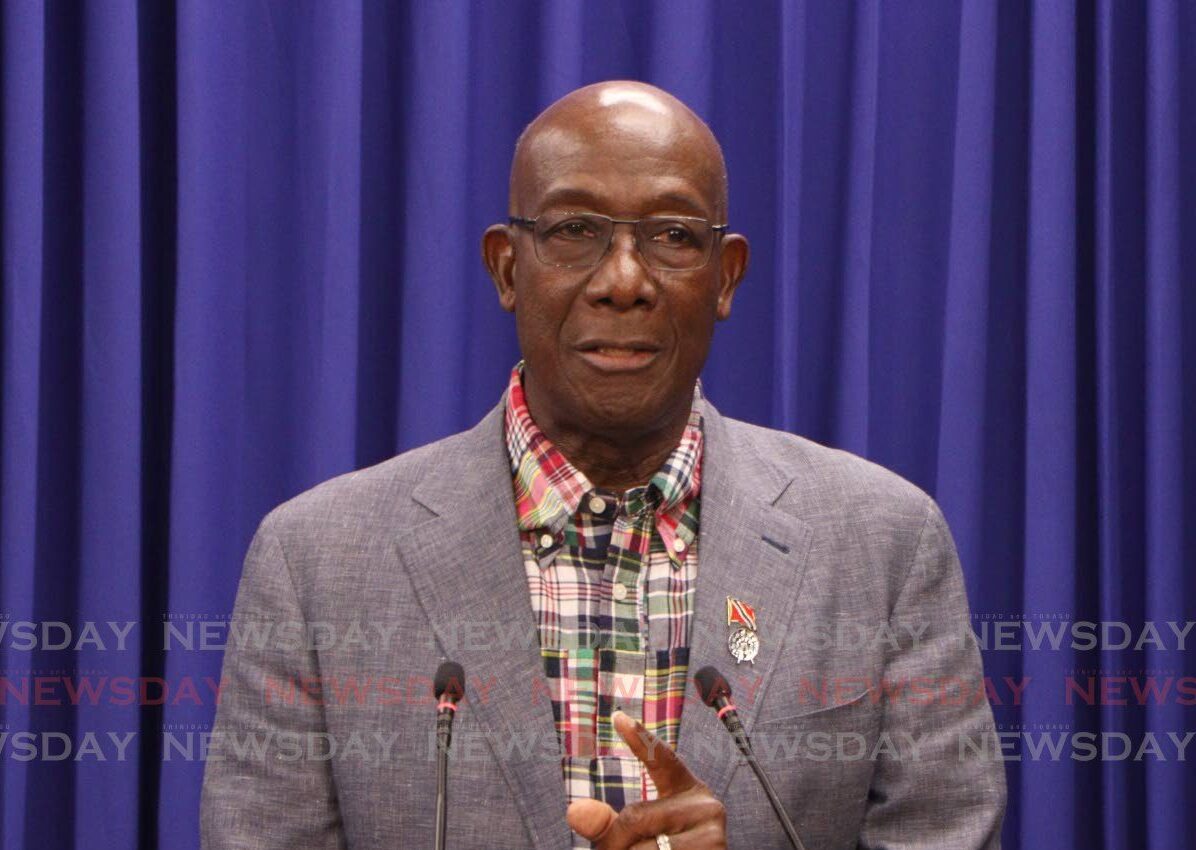
Former Trinidad and Tobago Prime Minister Dr. Keith Rowley has announced a public forum to address growing concerns regarding the recent installation of a US military radar system at Tobago’s Arthur NR Robinson International Airport. The meeting is scheduled for December 7 at the Mason Hall Community Centre, commencing at 6:30 PM.
In a December 5 Facebook post, Rowley stated, “Tobago, the conversation continues. In a time of uncertainty, our island deserves clarity.” The former leader pledged to confront difficult questions surrounding the radar system, the Status of Forces Agreement (SOFA) signed with the United States in December 2024 during his administration, and the genuine implications of these developments for Tobago’s security and future.
The radar installation first came to public attention when current Prime Minister Kamla Persad-Bissessar disclosed its existence on November 27 following a laptop distribution ceremony in Penal. Persad-Bissessar characterized the equipment as essential for enhancing surveillance capabilities against narcotics traffickers operating in regional waters.
This development occurs within the broader context of increased US military presence throughout the southern Caribbean. Beginning in August, the United States deployed three guided missile destroyers—USS Gravely, Jason Dunham, and Sampson—to the region. The naval contingent has since expanded to include the nuclear attack submarine USS Newport News, amphibious assault vessels, special forces command vessels, the 22nd US Marine Expeditionary Unit, and the aircraft carrier USS Gerald R Ford with its strike group.
Prime Minister Persad-Bissessar has repeatedly emphasized that Trinidad and Tobago will not serve as a base for military operations against Venezuela, despite having expressed willingness to permit US troop operations if Venezuela encroaches on Guyanese territory. The Prime Minister has publicly endorsed the US military deployment as an anti-narcotics initiative, notwithstanding international criticism of US strikes on alleged drug vessels as extrajudicial killings.
The situation has revealed political tensions, with Tobago House of Assembly Chief Secretary Farley Augustine claiming exclusion from security discussions despite arguably warranting membership on the National Security Council. Constitutional questions have emerged regarding Augustine’s eligibility for such membership, as former national security minister Gary Griffith contends that only cabinet ministers may participate.
Meanwhile, Tobago East MP David Thomas has aligned with the government’s position that the radar primarily addresses narcotics trafficking concerns. This alignment occurs despite the absence of a formal coalition between Thomas’s Tobago People’s Party and the governing UNC, highlighting the complex political dynamics surrounding this security development.