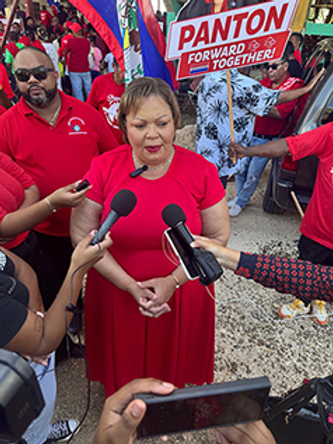
Belizean politics has entered a transformative era with Tracy Panton’s groundbreaking election as the first female leader of a major political party in the nation’s history. On November 30th, at the UDP National Leadership Convention held at Bird’s Isle, Panton received unanimous endorsement from party delegates, marking a definitive turning point after five years of internal strife that had weakened the United Democratic Party’s foundation.
In her acceptance speech as Opposition Leader, Panton struck a resonant chord of gratitude and determination, addressing thousands of supporters with a powerful message: ‘Rock bottom is not the tomb. It is, my friends, the turning point.’ Her ascent represents not merely a personal achievement but a fundamental disruption of Belize’s longstanding ‘old boys’ club’ political culture.
The convention results demonstrated overwhelming support for Panton’s leadership slate. Attorney Sheena Pitts achieved a historic victory as the first female party chairman, decisively defeating former National Security Minister John Saldivar (326 votes to 99) and long-serving party member Roosevelt Blades. Businessman John Castillo similarly secured victory over former Labour Commissioner Ivan Williams with 300 votes to 183.
This political milestone arrives three decades after Belize signed the Beijing Declaration and Platform for Action, which identified twelve critical areas for advancing gender equality. While progress has been made in several domains, two areas remain particularly challenging: eliminating violence against women and increasing female representation in decision-making roles.
The current parliamentary composition underscores this gender imbalance—only three women sit among 28 elected representatives. Analysis reveals that even when women achieve electoral success, they frequently receive ministerial appointments that don’t reflect their capabilities. Historical patterns show female representatives consistently appointed as ministers of state rather than full ministers, a trend established by former PUP Prime Minister Said Musa in 1998 and continued by UDP leaders including the late Sir Manuel Esquivel and Rt. Hon. Dean Barrow.
Panton’s leadership embodies the culmination of decades of advocacy by Belize’s Women’s Movement. As a graduate of the Women in Politics (WIP) Project’s third cohort—an initiative that trained 100 women for political participation—she represents the tangible results of systematic investment in female leadership development.
Regionally, Panton’s achievement aligns with a growing Caribbean trend of female political leadership. From Dominica’s late Prime Minister Dame Eugenia Charles (1980-1995) to contemporary leaders like Trinidad and Tobago’s Kamla Persad-Bissessar and Barbados’s Mia Amor Mottley, women have demonstrated exceptional governance capabilities. Mottley, now serving her second term, has particularly distinguished herself through policy effectiveness and decisive leadership.
Panton’s leadership philosophy, which she describes as ‘competent, capable and compassionate,’ offers Belize an opportunity to embrace transformative governance that values equality, incorporates diverse perspectives, and champions family-centered policies. Her historic election signals that after thirty years of gradual progress since the Beijing Declaration, Belize may finally be ready to fully embrace women’s leadership in the political sphere.