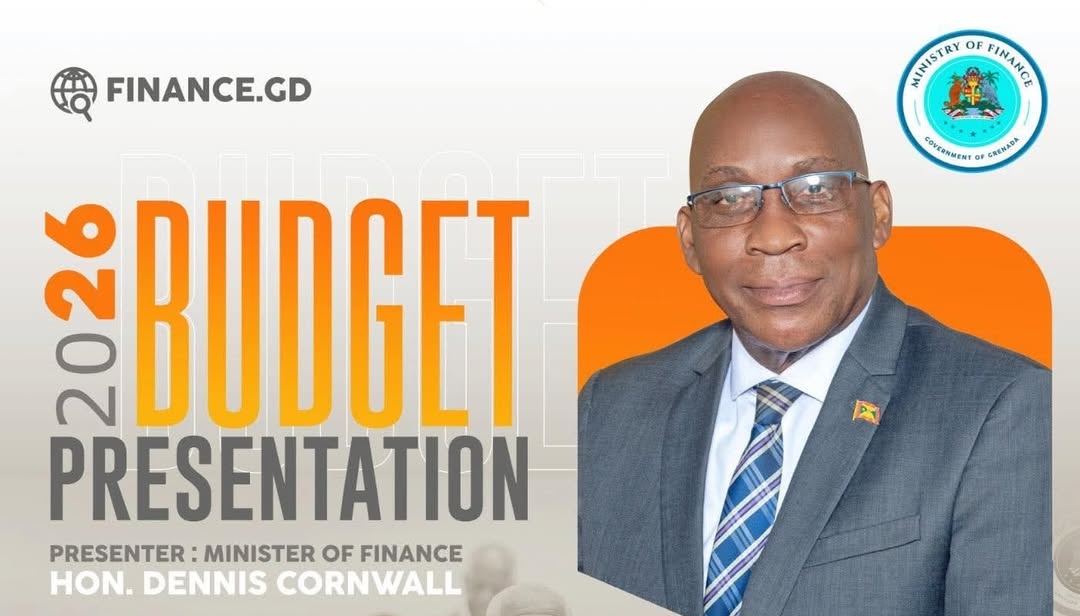
In a landmark address to Parliament on December 1, 2025, Grenada’s Finance Minister Honourable Dennis Cornwall unveiled a comprehensive $1.96 billion budget for 2026, marking the fourth fiscal plan under the current administration. The budget, themed “Towards Vision 75: Powering Progress Through People’s Participation and Innovation,” represents a strategic blueprint for national development as the nation approaches its 75th independence anniversary.
The fiscal framework allocates $1.3 billion in recurrent revenue against $1.1 billion in recurrent expenditure, with a substantial $370.4 million dedicated to capital projects and $206.7 million for strategic initiatives. Despite projecting an overall deficit of $309.8 million, Minister Cornwall emphasized the budget’s full financing through a drawdown of $257.3 million from government deposits complemented by limited domestic and external financing.
Economic performance indicators reveal remarkable progress, with GDP growth reaching 6.2% in 2025—significantly exceeding IMF projections—and unemployment dropping to a historic low of 7.5% from 16.6% in 2021. Youth unemployment saw dramatic improvement, falling from 42% to 20.2% over the same period.
The budget outlines transformative investments across twenty-two strategic sectors, including healthcare modernization through Project Polaris—a state-of-the-art teaching hospital—and significant advancements in renewable energy transition featuring geothermal development and solar initiatives. Education receives $179.6 million with expanded scholarship programs, while housing initiatives address longstanding deficits through Project 500 and climate-resilient rebuilding post-Hurricane Beryl.
Notable allocations include $155.7 million for health and mental wellness, $187.2 million for infrastructure development, $64.8 million for Carriacou and Petite Martinique recovery, and $53.1 million for tourism and creative economy development. The budget maintains cost-of-living relief measures valued at $47 million, including transportation subsidies, VAT exemptions on essential goods, and energy support programs.
Minister Cornwall highlighted the administration’s commitment to fiscal responsibility while temporarily suspending Fiscal Resilience Act targets to support reconstruction efforts. The address emphasized tangible progress across all sectors, countering critics with evidence of transformative achievements since assuming office three and a half years earlier.
The budget represents a holistic approach to national development, balancing economic growth with social inclusion, environmental sustainability, and institutional strengthening, positioning Grenada as a regional leader in progressive governance and sustainable development.