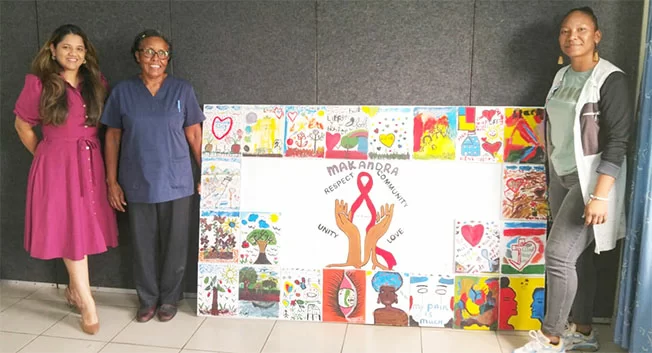
In a poignant ceremony marking World AIDS Day 2025, the Diakonessen Hospital received a distinctive mosaic artwork created by individuals living with HIV. The collaborative piece, developed under the guidance of artist Ruth-Rachel Joeroeja, was presented to internist and HIV specialist Marja van Eer as a powerful symbol of solidarity, awareness, and stigma reduction.
The artistic initiative emerged from the HIV Awareness Program led by Lianne Cremers of Vrije Universiteit Amsterdam, in partnership with Anton de Kom University, Paramaribo Academic Hospital, multiple researchers, and artist Joeroeja. The Raining Colors Foundation organized a creative workshop in Paramaribo where participants—all affected by HIV—first attended a motivational session facilitated by Erika Van Der Mark, followed by a painting workshop. Their individual artistic expressions were subsequently integrated into a unified collective artwork.
During the presentation ceremony, Dr. Van Eer addressed the persistent challenges in achieving a world free of HIV-related complications. “Numerous setbacks mark the path toward eliminating HIV as a public health threat,” she stated. “The World Health Organization’s sustainable development goals for 2030 require that HIV/AIDS no longer constitutes a public health emergency.”
She highlighted concerning trends, noting that diminishing international support for HIV prevention and treatment programs has complicated early detection of new infections. Simultaneously, stigma and discrimination continue to pose significant barriers to effective HIV management.
The current epidemiological landscape in Suriname reveals alarming statistics: approximately 7,900 people are living with HIV, with only half aware of their status. Annual new infections approach 460 cases, representing 1.6% of the population. Disparities emerge across demographics: 0.9% among tested women compared to 2.4% among tested men, with many men presenting late with increased complication risks. Pregnant women show a 1.1% prevalence rate.
Particularly vulnerable populations face dramatically elevated rates: men who have sex with men (31%), transgender individuals (26%), female sex workers (2.1%), and male sex workers (52%). Additionally, teenagers, adolescents, and young pregnant women are increasingly presenting with sexually transmitted infections including HIV, creating risks for both mothers and children.
Dr. Van Eer emphasized the critical importance of accessibility, testing, and treatment: “Individuals with risks from unprotected sexual contact must have access to education, counseling, and testing. Modern HIV inhibitors enable people with HIV to lead healthy lives.” She issued a compelling call to action: “We must leave no one behind in our HIV response—this is our collective responsibility.”
The Diakonessen Hospital, which has provided care and support for people living with HIV and their loved ones since 1995, expressed honor in granting the artwork a prominent permanent location within their facilities.