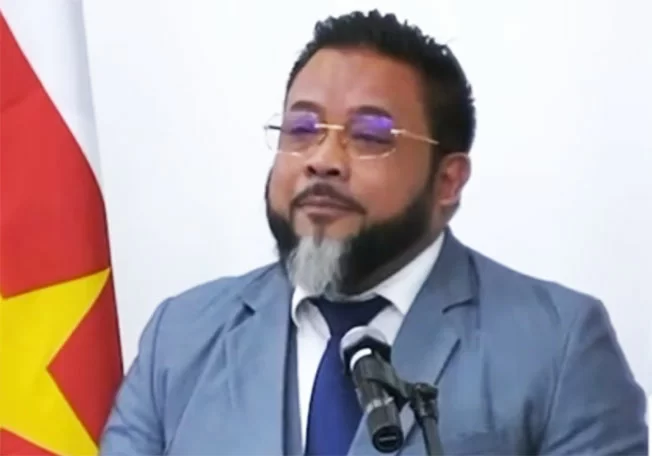
In an extraordinary public session of De Nationale Assemblée, Pertjajah Luhur faction leader Bronto Somohardjo delivered a remarkably personal address to King Willem-Alexander that redefined Suriname’s relationship with its former colonial ruler. The speech emphasized generational change, mutual equality, and Suriname’s sovereign right to determine its own future.
Somohardjo opened with personal greetings to the king and Surinamese citizens in the Netherlands, revealing his own background as a former Dutch citizen after his family was forced to flee to the Netherlands decades ago. He acknowledged difficult historical periods marked by political turmoil and acknowledged that his father ‘didn’t make it easy for you either,’ referencing occupations, protests, and incidents broadcast live on Dutch television.
Despite this contentious past, Somohardjo noted his family received fair treatment from the Netherlands and was naturalized by the king’s mother, Queen Beatrix, whom he described as ‘a warm and human woman remembered fondly by many here.’ He clarified that his voluntary exchange of a Dutch passport for a Surinamese one was ‘not out of ingratitude, but conviction’—wanting to be ‘buried in the same soil as my combaté.’
Addressing Queen Máxima directly, Somohardjo humorously noted her South American background, suggesting ‘a South American woman deserves extra attention.’
The core of his speech delivered a powerful message: ‘Suriname is not a paragraph in Dutch history. Suriname writes its own book.’ He described this ongoing narrative as being written by ‘Surinamese students in your cities, Dutch interns in my cities, and especially by families separated by thousands of kilometers yet remaining connected.’
Adopting what he called ‘Dutch bluntness’ learned during his upbringing in the Netherlands, Somohardjo stated plainly: ‘You are not here because our sun shines so pleasantly. You are not here for our beautiful nature or that delicious Parbo beer you can now find in Albert Heijn. You are here because you are Dutch. And Dutch people see opportunities—especially in trade.’
He issued a significant warning: ‘The generation your mother dealt with is not the generation facing you today. We are different. We dare more. We know our worth. And we will let no one—friend, partner, or country—take the cheese from our bread.’
The central message called for a completely redefined relationship based on equality: ‘We, King, do not walk behind you. But walk beside you. And that must be the new chapter between Suriname and the Netherlands.’ He advocated for mutual rediscovery without subservience or confrontation: ‘Not with bowed heads. Not with clenched fists. But out of respect for each other.’
Somohardjo concluded by welcoming the royal couple while firmly asserting Suriname’s self-determination: ‘Welcome to Suriname. The country that knows and acknowledges its history. But will write its own future.’