标签: Suriname

苏里南

  • Kinderen in Gaza keren terug ‘naar school’ te midden van ruïne en trauma

    Kinderen in Gaza keren terug ‘naar school’ te midden van ruïne en trauma

    After more than two years of suspended education in Gaza due to war and destruction, thousands of children have begun returning to classrooms—or what remains of them. According to the United Nations Relief and Works Agency (UNRWA), approximately 300,000 students and 8,000 teaching teams are resuming education. However, the situation remains precarious, with over 85% of school buildings reportedly damaged or destroyed. Many children are returning to makeshift learning spaces, such as tents, remote shelters, or emergency government facilities, transforming the traditional classroom setting into improvised environments. For many, this return marks the beginning of recovery—restoring routine, hope, and a sense of childhood that was stripped away. Yet, the scars of war persist, with widespread trauma, hunger, malnutrition, and the loss of parents or educators. The resumption of schooling is seen as an act of resilience and a critical step toward rebuilding. Education is not merely about lessons; it represents safety, normalcy, and the promise of a future.

  • Column: Etnische zuivering is geen vraag; het is taal van oorlog

    Column: Etnische zuivering is geen vraag; het is taal van oorlog

    On Monday, Suriname celebrated Diwali, a festival symbolizing light, harmony, and spiritual purity. The nation prides itself on being a “mini United Nations,” yet ethnic tensions persist, particularly in politics. Suriname’s strength lies in its diversity, where no single group dominates another. However, during a recent government press conference, President Jennifer Simons faced a contentious question: whether the removal of individuals from key positions appointed by the previous administration amounted to “ethnic cleansing.” The president responded sharply, emphasizing that such terminology is inappropriate in a democracy, especially in a nation nearing 50 years of independence and celebrated for its ethnic coexistence. She clarified that Suriname’s governance is built on reality, not ethnic chess games. Her pointed question to the journalist—”Did you understand my answer?”—highlighted the need for responsible language in public discourse. A free press is essential, but critical questions must not devolve into misleading narratives. No political party in Suriname represents a single ethnic group. The country is a mosaic of minorities, and suggesting otherwise undermines its foundation. The real issue is not “Whose people are these?” but “How do we design a system where state positions are not seen as personal property?” As Suriname approaches its 50th anniversary of independence, it must move beyond ethnic politics. Those who stoke ethnic tensions in a nation built on peace are playing with fire.

  • STVS-directeur Abisoina ontkracht miskenning Frits Pengel

    STVS-directeur Abisoina ontkracht miskenning Frits Pengel

    Raoul Abisoina, the director of the Surinamese Television Foundation (STVS), has responded to claims that Frits Pengel, the founder of STVS, was not invited to the 60th anniversary celebration of television in Suriname. Abisoina expressed surprise at the allegations, emphasizing that the organization deliberately chose not to hold a festive event due to current challenges. ‘From the beginning, it was clear that we would keep it modest. There was no celebration at all. That’s why I didn’t invite any former directors or retirees, including Mr. Pengel,’ Abisoina told Starnieuws.

    Abisoina clarified that all retirees, including Pengel, were financially acknowledged. ‘An amount was deposited into his account in recognition of 60 years of STVS. He was personally informed by the secretariat that there would be no celebration.’ The director also highlighted that he had increased Pengel’s pension twice out of respect since taking office. ‘The son who wrote this article knows this personally. I met him along with his father. That contact has paused in recent months for other reasons—out of decency, I’ll leave it at that for now.’

    Abisoina noted that during the previous major celebration—the 55th anniversary—Pengel was officially invited and honored with a Grantangi Award. ‘At that time, there was a festive celebration, and it was appropriate. Now, that’s not the case.’ He concluded, ‘I find it misplaced that my name is being dragged into a false narrative. Anyone who knows the full story understands that this is not about disrespect but a deliberate choice for modesty.’

  • Tsang: Strijd tegen corruptie is ook een strijd van licht tegen duisternis

    Tsang: Strijd tegen corruptie is ook een strijd van licht tegen duisternis

    During the Divali celebration at the Kwatta Sports Complex, Minister Stephen Tsang of Public Works & Spatial Planning delivered a powerful message on behalf of President Jennifer Simons, emphasizing the government’s unwavering resolve to eradicate the ‘darkness of corruption and fraud.’ Drawing parallels between the festival’s symbolism of light overcoming darkness and the administration’s fight for justice and transparency, Tsang declared, ‘We will dispel this darkness with the bright light of accountability.’

    The event, marked by vibrant festivities, included two Divali processions along the Kwattaweg, culminating at the sports complex. Attendees were treated to spectacular fireworks, live music, and a vegetarian feast, creating a festive atmosphere. Tsang underscored the broader significance of Divali, stating that its light could illuminate not only homes but also national governance, provided there is collective political and societal will.

    Addressing the deep-rooted issue of corruption, Tsang acknowledged the government’s relentless efforts to revitalize the economy, public services, and state institutions. However, he stressed that success hinges on the active participation of every Surinamese citizen, calling for responsibility and love for the country. He also issued a cautionary note on the fragility of national unity, warning against the rising polarization in the multi-ethnic, multicultural, and multi-religious society.

    Concluding his speech, Tsang invoked a quote from former minister Soewarto Moestadja: ‘It is time to move from unity in diversity to diversity in unity,’ urging a collective commitment to harmony and progress.

  • President Simons: Chinese gemeenschap onverbrekelijk deel van Surinaamse identiteit

    President Simons: Chinese gemeenschap onverbrekelijk deel van Surinaamse identiteit

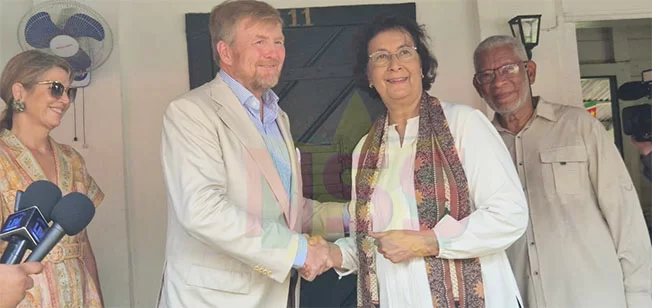
    The Suriname Chinese United Association (SCUA), in collaboration with the Chinese Embassy, commemorated the 172nd anniversary of Chinese immigration to Suriname today. The event, marked by a solemn wreath-laying ceremony at the Friendship Monument on Trefossa Square in Paramaribo, saw President Jennifer Simons and Vice President Gregory Rusland express their gratitude for the enduring contributions of the Chinese community to Surinamese society. President Simons highlighted the deep integration of the Chinese community since the 19th century, stating, ‘The first Chinese immigrants became deeply embedded in our communities, building relationships, supporting their surroundings, and becoming an integral part of our families and culture.’ She emphasized that their contributions extend far beyond trade and entrepreneurship, with Surinamese of Chinese descent now active in all professional fields, from business to politics. The President also announced the establishment of a national Heritage Month starting next year, honoring all ethnic groups within the broader narrative of nation-building. Chinese Ambassador Lin Ji praised the role of the Chinese community in Suriname’s development, noting their hard work and resilience. He announced plans to build a new commemorative pavilion in Friendship Park as a lasting symbol of the bond between the two nations. Looking ahead to the 50th anniversary of diplomatic relations in 2026, Ambassador Lin Ji reaffirmed the commitment to deepening cooperation, stating, ‘The relationship between China and Suriname is deeply rooted and steadfast. May our friendship continue to flourish and contribute to the prosperity of our peoples.’

  • CUS: Divali 2025 in het teken van eenheid, liefde en nationale trots

    CUS: Divali 2025 in het teken van eenheid, liefde en nationale trots

    The Cultural Union Suriname (CUS) inaugurated the 18th National Divali Celebration on Saturday evening with grandeur and dignity, attended by President Jennifer Simons, Vice President Gregory Rusland, ministers, members of the National Assembly, diplomatic representatives, and numerous citizens. In his welcoming address, CUS Chairman Anielkumar Manurat emphasized that Divali transcends a mere religious festival, embodying a universal message of light, hope, and unity. He stated, ‘Tonight, we light thousands of small lamps, but each flame represents a greater fire—the fire of unity, humanity, and national pride.’ The CUS urged the populace to ignite the light of Divali not just externally but internally, symbolizing solidarity, respect, and spiritual strength. ‘Divali teaches us that darkness never has the final word. Where love and understanding prevail, evil dissipates. Where people respect one another, misunderstanding vanishes. And where a nation lives in harmony, prosperity flourishes.’ This year’s celebration was particularly significant, marking 50 years of Suriname’s independence. The CUS highlighted that this milestone is not only a moment of pride but also a call to responsibility. ‘Fifty years ago, our people chose freedom, self-determination, and faith in their own strength. Fifty years of building, falling, rising, and moving forward—as one people, with one heart.’ The CUS offered prayers to Maha Laxmi Mata, the Goddess of prosperity, love, and harmony, wishing her blessings upon all Surinamese—leaders, families, and everyone striving for a better future. ‘Divali is not merely a festival of lights but an invitation to ignite the light within ourselves. When we act in love and see each other as brothers and sisters, Suriname becomes not just a country on the map but a living nation of hope, strength, and harmony. Subh Divali to the entire Surinamese people. May the light of Divali continue to shine over our beloved Suriname.’

  • Zestig jaar Surinaamse Televisie Stichting – en de man die vergeten werd

    Zestig jaar Surinaamse Televisie Stichting – en de man die vergeten werd

    On October 20, the Surinamese Television Foundation (STVS) marked its 60th anniversary, a milestone celebrated with champagne, music, speeches, and a touch of nostalgia. The event, held on October 17, was attended by the President, Vice President, and the Minister of Home Affairs. However, amidst the festivities, a poignant question circulated: ‘Where was Frits Pengel, the man behind the first broadcast?’ The answer was simple yet painful—he was not invited. Frederik Johan (Frits) Pengel, the visionary who founded STVS in 1965, was absent from the celebration of the institution he brought to life. Pengel, a pioneer in Surinamese television, introduced color TV, satellite broadcasting, and live World Cup coverage in 1982. Despite his monumental contributions, including restoring STVS within 24 hours after a 1993 arson attack, Pengel was overlooked. His son, Julian Pengel, emphasized the importance of recognizing those who laid the foundation for the nation’s progress. As Suriname approaches its 50th Independence anniversary in 2026, there is a call for moral integrity and gratitude towards its pioneers. Frits Pengel, now 93, remains a symbol of vision and perseverance, deserving of the nation’s respect and acknowledgment.

  • Directoraat Cultuur en AJLA Frans-Guyana tekenen intentieverklaring

    Directoraat Cultuur en AJLA Frans-Guyana tekenen intentieverklaring

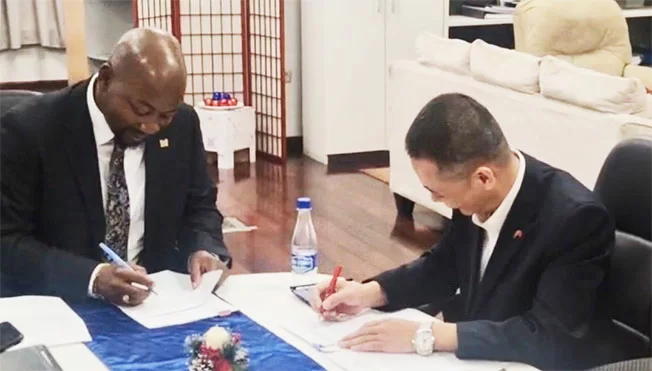
    In a landmark move to foster cultural and community development, Roseline Daan, Cultural Director, and Patrick Burnet, President of the NGO Young Leaders in Action (AJLA), have announced a collaborative initiative in Cayenne, the capital of French Guyana. The partnership, formalized through a Memorandum of Understanding (MoU), aims to unite government ministries, non-governmental organizations, and the private sector in a series of impactful activities. These include promoting traditional culinary practices, organizing art and educational programs, mobilizing families and schools for community engagement, and sharing resources for project execution. Additionally, the collaboration will focus on cross-border environmental efforts, such as cleaning the Marowijne River and establishing a training center in Albina and Saint-Laurent for knowledge exchange. Burnet emphasized, ‘The Marowijne River is not a border; it is a bridge. By uniting the strengths of both sides, we are sowing the seeds for a future-oriented human, cultural, and economic partnership.’ The MoU is initially valid for two years, with the possibility of extension. Daan highlighted that while the agreement provides a framework for cooperation, it does not impose legally binding obligations. ‘We are neighbors, and it is crucial to strengthen bilateral relations at all levels,’ she stated.

  • Burgers leven in angst na nieuwe luchtaanvallen in Afghanistan

    Burgers leven in angst na nieuwe luchtaanvallen in Afghanistan

    Recent drone and aerial bombardments in Afghanistan have plunged the nation into heightened tension, with residential neighborhoods and bustling markets becoming primary targets. Reports from Kabul and southern provinces such as Kandahar and Paktika detail significant civilian casualties and extensive property damage. Families have fled en masse, while others remain confined indoors, paralyzed by fear. The Afghan government has accused neighboring Pakistan of orchestrating these attacks, a claim Pakistan vehemently denies, though it acknowledges “military threats along the border.” The ambiguity surrounding the perpetrators has only deepened public anxiety. Witnesses recount that the explosions occurred unexpectedly in densely populated areas, leaving children too terrified to venture outside. Schools have shuttered, and markets operate at reduced capacity. In border villages, residents seek refuge in mosques and basements, bracing for further violence. International mediators have brokered a temporary ceasefire between Afghanistan and Pakistan, but observers caution that the situation remains precarious. Aid organizations struggle to access affected regions, warning of a rapidly worsening humanitarian crisis if the violence persists. For the Afghan populace, feelings of insecurity and helplessness dominate, with the fear of renewed violence permeating daily life. Calls for international protection and political stabilization grow louder as the crisis deepens.

  • Column: Het verlangen naar vreugde die nooit kwam…

    Column: Het verlangen naar vreugde die nooit kwam…

    In recent weeks, intense clashes have erupted along the border between Pakistan and Afghanistan, leaving devastation in their wake. Danish, a 26-year-old Pakistani man, shared his harrowing experiences with his colleague Indra Toelsie. Born in 1999, Danish has never known a day of peace. His hometown, once filled with towering buildings, now lies in ruins, bombed beyond recognition. He showed Indra a video of a rocket strike in a residential area near his home, a stark reminder of the fragility of life in his war-torn region. For Danish and millions like him, uncertainty is the norm, a daily reality they’ve come to accept.

    Now, in Beijing, Danish is experiencing peace for the first time. Here, he can walk freely without fear of bombs or the need to seek shelter. When Indra encouraged him to enjoy this newfound tranquility, Danish’s response was poignant: ‘I just hear enjoying, enjoying, but what is enjoy and enjoyment? I literally don’t know.’ His words reveal a deep hunger to understand what it means to truly live without fear. Danish’s journey to China, made possible by a program, has opened his eyes to a world where peace is not a luxury but a possibility.

    For Indra, a native of Suriname where life is celebrated and cherished, Danish’s story is a stark reminder of the privileges often taken for granted. While many complain about minor inconveniences, Danish dreams of a life free from violence. His aspirations are not for wealth but for peace—a basic human right that remains elusive for millions. Danish’s story serves as a call to action: to appreciate the peace we have and to strive for a world where it is accessible to all. As Indra reflects, perhaps it’s time to shift from complaints to gratitude, recognizing the value of the peace we often overlook.

    On Divali, Indra urges everyone to light an extra lamp—not just for Danish but for all those who live without the gift of peace.