标签: Belize

伯利兹

  • BDF Safely Destroys 20.6 Metric Tons of Aging Ammunition

    BDF Safely Destroys 20.6 Metric Tons of Aging Ammunition

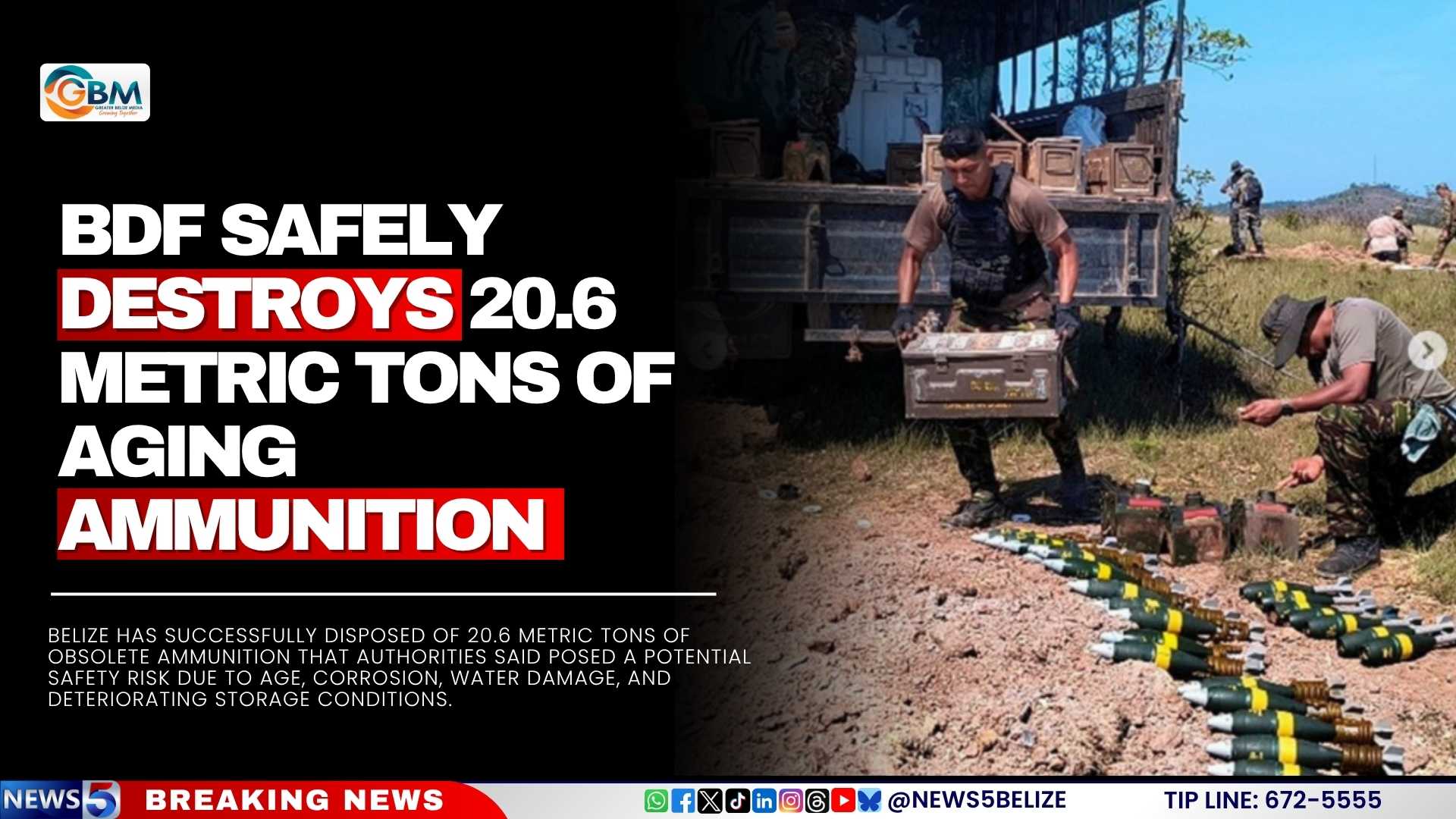
    In a milestone operation focused on eliminating public and military safety threats, the Belize Defence Force (BDF) has announced the successful disposal of 20.6 metric tons of aging, hazardous ammunition that had been deemed a critical risk due to decades of degradation. Carried out over five weeks between April 13 and May 22, 2026, the project brought together multiple national security agencies to address the longstanding danger posed by deteriorating military stockpiles.

    Beyond the BDF’s lead coordination, personnel from the Belize Police Department and Belize Coast Guard joined the operation to support site security and operational logistics, reflecting a whole-of-government commitment to mitigating unexploded ordnance risks across the country. In total, crews safely destroyed 2,088 individual munitions that had become unstable after years of exposure to corrosion, water damage, and inadequate long-term storage conditions.

    A key secondary outcome of the initiative is the upskilling of Belize’s national security personnel: 16 officers completed specialized, internationally certified training covering everything from identifying at-risk obsolete munitions to applying best-practice handling and controlled disposal protocols. This training is expected to build long-term domestic capacity, allowing Belize to conduct similar safety operations independently in the future.

    The project also included critical infrastructure upgrades to prevent future safety hazards. Workers completed structural improvements to the BDF Logistic Support Brigade ammunition depot located in Ladyville, creating a more secure environment for the storage and management of the country’s remaining active military stockpiles.

    International support was central to the operation’s success. The Program for Assistance in Conventional Weapons Destruction (PACAM) provided end-to-end support, contributing specialized technical expertise, necessary safety materials, and official certification that all disposal procedures aligned with global standards for conventional weapons destruction. Officials from the BDF noted that the collaboration has set a benchmark for future weapons management efforts in Belize, reducing the risk of accidental detonation and harm to nearby communities.

  • World Cup 2026 Kicks Off. Here Is Everything You Need to Know

    World Cup 2026 Kicks Off. Here Is Everything You Need to Know

    The 2026 FIFA World Cup, the most expansive and groundbreaking edition in the tournament’s 96-year history, is set to get underway this week, marking a new chapter for global football. For the first time since the World Cup’s inception in 1930, three North American nations – the United States, Mexico and Canada – will co-host the event, after their unified “United As One” bid secured FIFA’s hosting approval back in 2018.

    The opening match will kick off at 1 p.m. local time on Thursday, June 11 at Mexico City’s legendary Estadio Azteca, a venue steeped in World Cup history. The matchup will see Mexico face off against South Africa, a rematch of the two nations’ 2010 World Cup opening game held in Johannesburg, which ended in a 1-1 draw. An estimated sellout crowd of 80,000 fans is expected to pack the iconic stadium for the tournament’s opening clash.

    A 90-minute opening ceremony will precede the first kickoff, headlined by global music superstars. Four-time Grammy Award winner Shakira will top the bill, joined by Colombian reggaeton icon J Balvin and breakout South African hitmaker Tyla, bringing a cross-continental celebration of culture to the opening of the tournament.

    Expanded from the previous 32-team format, the 2026 World Cup features a record 48 competing nations and will host a total of 104 matches across the three host countries. That marks 40 more matches than the 2022 tournament held in Qatar, making this the largest World Cup ever staged. Beyond the on-pitch action, the event is projected to be the most lucrative sports competition in history: the World Trade Organization estimates the tournament will generate a combined $80.1 billion in gross output across the United States, Mexico and Canada. For football fans around the globe, this historic tournament delivers an unprecedented celebration of the world’s most popular sport.

  • How Geraldine Hyde’s Property in Democracia Was Given Away

    How Geraldine Hyde’s Property in Democracia Was Given Away

    For over three decades, Geraldine Hyde, a Belize City resident who has long leased a 23.5-acre plot of land near La Democracia Village, was inches away from securing full ownership of the property she maintained and paid for consistently — until a shocking bureaucratic misstep threatened to take it all away. This case, which has now forced the Belizean Lands Commission to reverse course and return the land to Hyde, has thrown a spotlight on deep-rooted systemic gaps in the country’s land allocation and oversight processes, particularly after revealing the same individual who was at the center of a 2025 land dispute is once again linked to the controversial transfer.

    Hyde first launched her application for the long-term lease of the La Democracia parcel back in 1993 alongside her husband. For 29 years, she faithfully paid all required lease fees, invested in developing the property, and patiently worked through government administrative steps, with officials repeatedly assuring her that her purchase application was moving forward, most recently telling her the final paperwork was awaiting ministerial signature. That changed in 2022, when a routine check-in revealed a bombshell: the land she had spent decades nurturing had already been allocated to a third party.

    That third party is Charles Anthony Price, a name already well-known in Belizean land dispute circles. In 2025, Price made headlines when he received same-day approval for a land application that seized a plot another long-term claimant, Independence resident Sherene Garbutt, had already been pursuing. Just like in Garbutt’s case, Hyde was never notified that her application had been rejected or that the land was being reassigned, leaving her to discover the unauthorized transfer by accident.

    “I followed every rule, every step, every request from the department. Every time I checked in, they said it was progressing, that it was at the minister’s desk for signature,” Hyde explained in an interview with News Five. “When an official hinted the land might already be titled, I couldn’t believe it. I’d been paying for this land for 30 years — how could it just be given away without a word to me?”

    Holding a government lease traditionally grants leaseholders right of first refusal to purchase the property when the lease term ends. While this right is not legally binding, standard procedure requires officials to notify existing leaseholders before reallocating their plots, a step that was skipped entirely in Hyde’s case. After exhausting internal complaint channels with the Lands Department that brought no results, Hyde took her story to local media, which prompted a formal response from the commission.

    Paul Thompson, Chief Executive Officer of the Belize Lands Commission, acknowledged the error in a statement to News Five. “When Hyde’s lease expired, the Ministry incorrectly assumed the property was undeveloped and available for reassignment,” Thompson explained. “After reviewing her complaint and verifying her decades of documentation, we have concluded the land should be returned to her. We will offer her the opportunity to purchase the two parcels as she originally requested, and we will compensate Charles Anthony Price with an alternate plot of land. We do not always get it right, but we work to correct errors when they are brought to our attention.”

    This is not the first time a misallocation linked to Price has been reversed. Back in 2025, after Garbutt contested the allocation of her claimed land to Price, he returned the plot to government control to resolve the dispute. Even though Hyde has now secured a promise that her land will be returned, the repeated nature of these errors has raised serious questions about systemic failures in Belize’s land management framework.

    Hyde has made clear that she remains cautiously optimistic, and has pledged to take legal action against the Government of Belize if the commitment to return her land is not fulfilled. For many Belizeans who have faced similar bureaucratic delays or wrongful land seizures, this case is just the latest example of a broken oversight system that disproportionately harms long-term small-scale land claimants. As the country works to resolve this latest dispute, advocates are calling for sweeping reforms to increase transparency in land allocation, prevent repeated wrongful transfers, and protect the rights of leaseholders who have maintained and invested in public land for decades.

  • Ethnic Leaders Assert Rights But Reject Division

    Ethnic Leaders Assert Rights But Reject Division

    Long one of Belize’s most politically and socially charged policy flashpoints, disputes over customary land ownership and ancestral territorial rights have reemerged as a central national conversation, with three of the country’s largest ethnic groups advancing formal claims rooted in centuries of cultural and historical connection to their traditional lands.

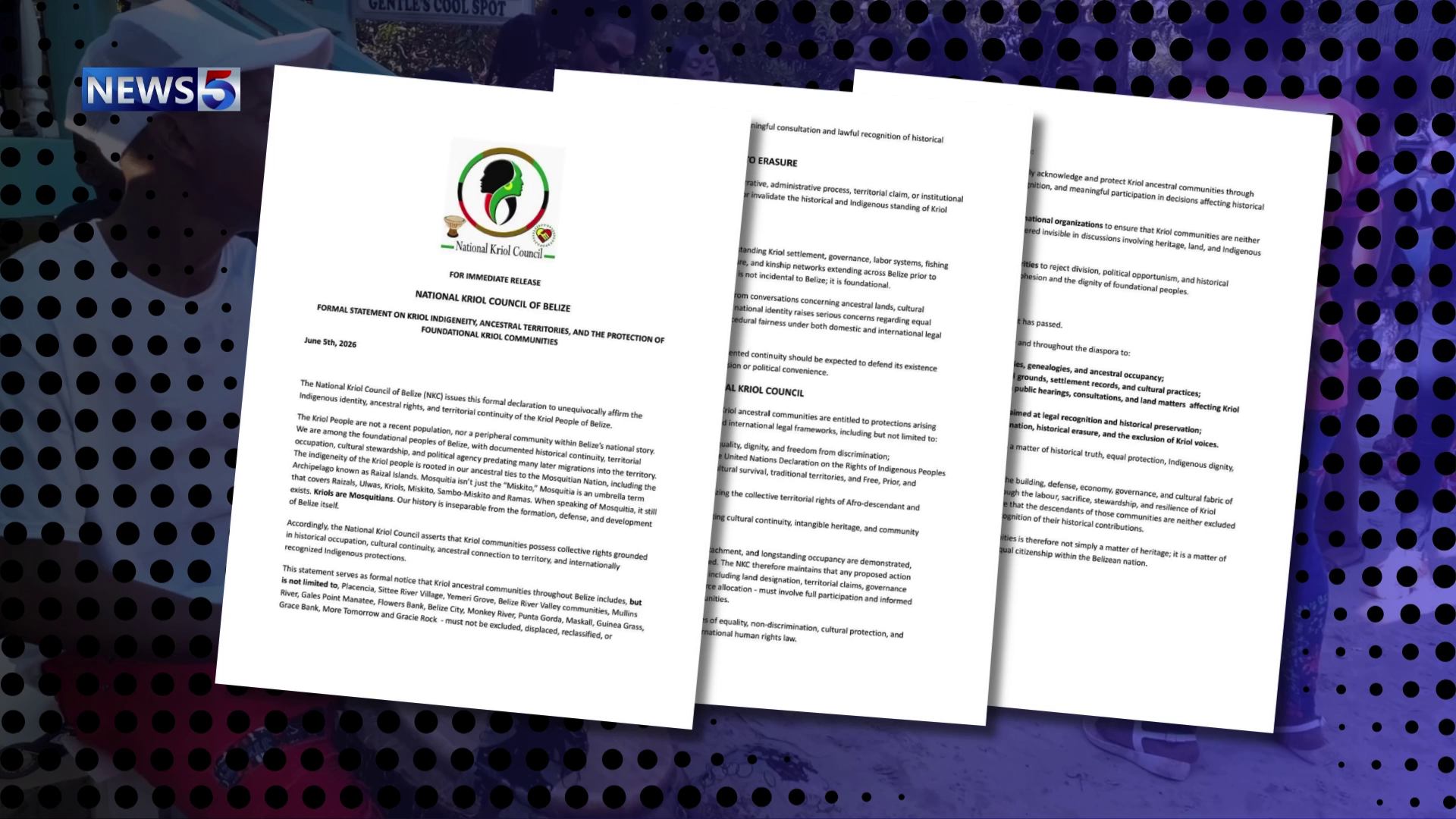
    The debate kicked off most recently when the National Kriol Council released an official statement formally asserting traditional land rights for Kriol (Creole) Belizeans, identifying culturally significant historic Kriol settlements stretching across the country from Belize City and the Belize River Valley to Placencia, Seine Bight, Punta Gorda, and Yemeri Grove. In his remarks outlining the group’s position, National Kriol Council President Wilford Felix emphasized the unique ancestral origins of Kriol culture in Belize, arguing that unlike other ethnic groups whose cultural traditions developed outside Belize before migration, Kriol culture emerged indigenously within Belize’s borders. With a continuous presence dating back roughly 200 years before the arrival of other major ethnic groups, Felix says it is only logical that Kriol communities be included in national conversations around indigenous land recognition, a status already granted to Maya communities and claimed by the Garifuna people.

    Parallel to the Kriol Council’s assertion of rights, the Maya communities of southern Belize’s Toledo District continue their multi-year process of demarcating customary lands, and are preparing to return to the Caribbean Court of Justice to seek clear enforcement of existing rulings against the national government. Cristina Coc, spokesperson for the Maya Leaders Alliance, explained that the court has already formally confirmed that Maya customary land tenure carries the same legal weight as any other form of property recognized under Belizean law. Critically, Coc noted, the court has also ruled that existing land titles granted to third parties, both before and after the 2015 affirmation of Maya rights, do not invalidate long-held customary claims. “Our property rights as Maya people did not begin in 2015,” Coc emphasized, acknowledging that the current landscape leaves overlapping competing claims to the same parcels of land.

    For the Garifuna people, who have long sought formal recognition of their ancestral rights to coastal communities including Hopkins and Seine Bight, the movement has now taken institutional form: the National Garifuna Council recently launched a dedicated Legal Defense Fund to support formal court action to defend their territorial claims. Ifasina Efunyemi, Assistant Treasurer of the National Garifuna Council, pushed back against public misunderstanding of the group’s claim to indigenous status, noting that indigenous status refers to presence in a territory prior to colonization, a standard Garifuna communities meet on Belize’s southern coast. “We were the first to occupy the southern coast of Belize from the Sibun to the Sarstoon, and it is our presence that made it possible for the British to expand its boundary to the Sarstoon because we were here,” Efunyemi stated, challenging any parties seeking to contradict the group’s ancestral history.

    Nearly three decades ago, former Belizean Prime Minister Said Musa famously declared he would not oversee the balkanization of Belize along ethnic or territorial lines, a framing that hangs over the current national conversation. What unites all three groups in this moment is a shared demand for formal recognition of ancestral rights – but all parties have emphasized they do not seek national division. As Belize continues to navigate the tangled intersections of ancestry, cultural identity, and property ownership, the core challenge extends beyond simply defining legal land rights: the country must now find a way to address these longstanding historical claims without deepening ethnic divides among the communities that all call Belize home. In the coming months, negotiations and court proceedings will test whether Belize can reconcile these competing interests while preserving national unity. News Five will continue to provide updates as this story develops.

  • Will Ethnic Land Rights Fight Divide Belize

    Will Ethnic Land Rights Fight Divide Belize

    As national debate over customary indigenous land rights gains momentum across Belize in June 2026, leaders from the country’s three largest Indigenous groups — the Kriol, Garifuna, and Maya communities — are pushing back against a growing public narrative that frames the land rights movement as an ethnic conflict pitting marginalized groups against one another.

    In joint public remarks, the community leaders emphasized that their shared advocacy is not a competition between ethnic groups for limited land resources. Instead, it centers on demands for systemic fairness, expanded equitable access to national territory, and legal recognition of ancestral land ties that have bound each community to Belize’s soil for hundreds of years. While each group maintains distinct historical claims to specific lands across the country, they have aligned on a core unifying message: the land justice movement must not divide ordinary Belizeans.

    Wilford Felix, president of the National Kriol Council, explained that his organization’s advocacy is first and foremost a public assertion of Kriol indigenous identity tied to land, not a conflict with other Indigenous groups. “Many people wrongly assume Kriol communities are only rooted in Belize District,” Felix noted. “But the historical record shows that Kriol settlements emerged alongside every river and waterway across the entire country. We are calling for recognition of that long history, not a fight against other communities.”

    Ifasina Efunyemi, assistant treasurer of the National Garifuna Council, expanded on this framing, urging the public to look past false divides. “People want to frame this as Garifuna versus Maya, or Creole versus Mestizo, but that’s a misrepresentation of what’s really happening,” Efunyemi said. “We all need to step back and recognize who the actual barrier to justice is: the systemic disenfranchisement that has held back ordinary working Belizeans of all ethnic backgrounds for generations. That is the shared challenge we face, not conflict with one another.”

    Cristina Coc, spokesperson for the Maya Leaders Alliance, echoed this solidarity, noting that the fight for Maya land rights aligns with the needs of all low-income Belizeans. “What we are demanding as Maya Belizeans benefits every ordinary person in this country,” Coc explained. “Across the nation, working Belizeans are fighting to keep a roof over their heads — many can’t even secure a small residential lot to build a home. At the same time, a small handful of wealthy elites hold thousands of acres of unused land for their own benefit. That is a clear injustice that the government cannot ignore. Our movement for ancestral land recognition is part of a broader fight for all Belizeans to claim their birthright to this country.”

    The current debate emerged after the Government of Belize established an Independent Commission on Village Boundary Disputes to resolve overlapping geographic claims between Indigenous communities. While the commission was intended to de-escalate local conflicts, recent public consultations around the body’s work have inadvertently fueled racial tension, with some public commentary framing the land rights push as an inter-ethnic conflict.

    This report is a transcribed excerpt from an evening television newscast, with Kriol-language statements rendered using a standardized spelling system for accessibility.

  • Belizeans Angered over BWS Cut-Offs

    Belizeans Angered over BWS Cut-Offs

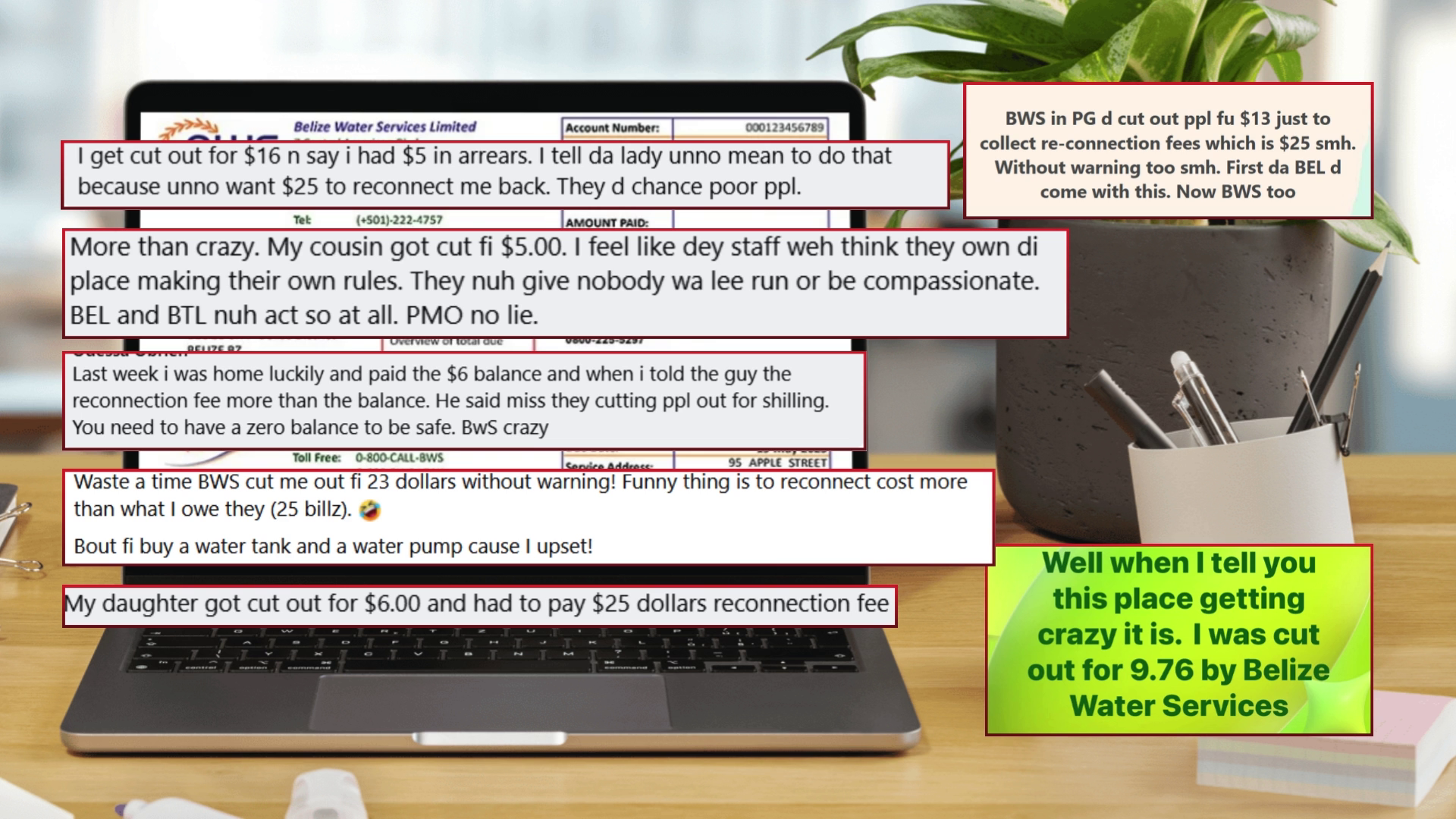
    As of June 9, 2026, a widespread public anger is spreading across Belize, directed at Belize Water Services Limited (BWSL) over the company’s controversial practice of cutting running water to residential and commercial customers over extremely small unpaid balances. Residents across the country have come forward with shocking accounts of disconnections, with some reporting their service was halted for amounts as little as a few cents, and others citing unpaid balances between just five and 15 Belize dollars. Compounding the public’s frustration is the steep 25-dollar reconnection fee that customers are forced to pay to restore their access to this essential utility — a charge that in most cases far exceeds the original outstanding amount on the bill. The controversy has escalated beyond neighborhood complaints to reach the highest legislative body of the country, the National Assembly, where opposition United Democratic Party (UDP) Senator Sheena Pitts recently brought the growing volume of public grievances to light, highlighting the unfair financial burden that this policy places on ordinary consumers. Senator Pitts shared her own first-hand experience with the punitive policy during the assembly debate, which brought the issue into sharp relief. Even though her office consistently pays its water bills in advance, drawing down the pre-paid balance over time, an accidental missed payment for a total outstanding balance of just 10 dollars and 51 cents resulted in an immediate full disconnection of service. To restore running water to the office, she was required to pay 25 dollars in reconnection fees alone, on top of an additional mandatory security deposit that the company demanded before service could be reinstated. “For the life of me, as Belizeans experience, for ten dollars and fifty-one cents the service was disconnected and twenty-five dollars had to be repaid,” Pitts stated during her address, echoing the frustration that thousands of ordinary Belizeans have already expressed privately and in public complaints. Local reporters reached out directly to BWSL leadership multiple times to request a formal comment on the widespread complaints and the policy behind the cut-offs. However, as of the publication of this newscast, the company has not responded to any requests for comment or clarification on its billing and disconnection policies. This report is a transcribed version of an evening television newscast, with Kriol language phrases rendered into standard spelling for clarity in the text format.

  • The True Cost of Belize’s Road Chaos

    The True Cost of Belize’s Road Chaos

    A devastating weekend of road accidents that claimed seven lives across Belize in early June 2026 has pulled back the curtain on a far larger, underreported crisis plaguing the nation’s roadways, one that imposes a quiet but steep financial burden on ordinary taxpayers. While the seven fatalities from five separate collisions dominated local news cycles, official data shows these tragic deaths represent only the most visible portion of a persistent public safety issue that costs the public millions annually in uncompensated emergency care.

    Investigative reporter Shane Williams from local outlet News Five conducted an in-depth probe into the hidden costs of Belize’s persistent road chaos, revealing that fatal crashes are just the tip of the iceberg. Full-year 2025 traffic data from national law enforcement records more than 3,300 recorded road traffic accidents across the country – only 94 of which resulted in fatalities. The vast majority of non-fatal collisions never make regional or national headlines, but they still generate cascading costs that ultimately fall to the public.

    When reached for comment following the fatal June 2026 weekend, Assistant Commissioner of Police Hilberto Romero, head of the National Crime Investigation Branch, noted that no “major incidents” beyond the fatal crashes were reported during the holiday period, a framing that underscores how non-fatal collisions are routinely sidelined in official and public discourse.

    Most non-fatal crashes with serious injuries require emergency treatment at Belize’s largest public healthcare facility, the Karl Heusner Memorial Hospital (KHMH). Data obtained by News Five from KHMH for the first two months of 2026 lays bare the growing financial strain these accidents place on the public health system. Between January and February alone, the hospital treated 150 patients injured in road traffic accidents, running up a total treatment cost of more than $95,000 Belize dollars – $54,000 in January and $41,000 in February.

    Worryingly, hospital officials have only managed to collect roughly 45% of that total amount, equal to $43,200. That leaves more than $51,000 in uncompensated care from just two months, a deficit that accumulates over the course of the year and is ultimately covered by public tax revenue. For Belizean residents, that means every unreported road collision indirectly adds to the tax burden that comes out of their own household budgets, even when they are not involved in a crash themselves.

    The deadly June weekend has reignited public calls for targeted road safety reforms to address the growing crisis, which claims nearly 100 lives annually and drains millions from public coffers each year through uncompensated emergency care. Advocates argue that the hidden financial cost of road accidents makes systemic safety improvements not just a public health imperative, but a fiscal necessity for the small Caribbean nation.

  • From Ombudsman Office to Legal Showdown

    From Ombudsman Office to Legal Showdown

    Six months after former Ombudsman Gilbert Swaso’s contract expired in December 2025, one of Belize’s most critical government oversight bodies remains without permanent leadership — a vacancy that has now escalated into a full legal confrontation between the retired major and the ruling Briceño Administration.

    When Swaso’s appointment was confirmed by the House of Representatives in early 2023, Prime Minister John Briceño framed the pick as a bipartisan consensus, telling lawmakers that the nomination carried Cabinet backing and had already secured support from the Senate. Swaso was formally sworn in that February, and quickly positioned the Office of the Ombudsman as a champion for marginalized Belizeans seeking redress against government injustice.

    “We exist for people who suffer injustice, people who are vulnerable, people who essentially are not getting the service that they believe that they deserve,” Swaso said in a 2023 address. “No need to suffer in silence.”

    Swaso’s commitment to transparency ultimately put him on a collision course with the administration. In 2025, prominent social activist Jeremy Enriquez filed a formal complaint with the Ombudsman’s office after the Attorney General’s Ministry refused to fulfill a Freedom of Information Act (FOIA) request. The request sought details on how much taxpayer funding the government was paying private law firms for representation in the high-stakes, controversial redistricting case.

    Swaso rejected the government’s refusal to disclose the information, publicly recommending that at least a portion of the requested records be released to the public. Shortly after that ruling, the administration announced it would not renew Swaso’s contract when it expired at the end of 2025.

    Enriquez, the activist who filed the original FOIA complaint, said the non-renewal sends a clear chilling message to independent oversight. By standard convention, Belize’s Ombudsman serves a renewable term of up to nine years, making the early end to Swaso’s tenure deeply unusual. “The government has destroyed the credibility of the office, and we are watching very closely to see who will replace him and if there is that level of commitment to the constitution and laws of Belize,” Enriquez noted in comments earlier this year.

    Opposition lawmakers have echoed those concerns. Last week, United Democratic Party Senator Sheena Pitts raised the vacancy in the Senate, pointing out that the Ombudsman is a constitutionally enshrined position designed to deliver critical checks and balances on executive power for all Belizean people. “We are here in June 2026 without having to deal with any great efficiency the appointment of an ombudsman,” Pitts said.

    Now, Swaso is hitting back with legal action, arguing that administration officials violated constitutional protections for the independent Ombudsman role and mishandled the end of his tenure. In comments from earlier this week, Swaso acknowledged his FOIA ruling likely created friction with the government, but stood by his commitment to upholding accountability. “The FOIA, the act in itself is there for accountability and when citizens are denied of their constitutional right and remember also that the government of Belize is working for and on behalf of the people of Belize who placed them in office to govern on our behalf,” he said.

    Swaso also criticized Prime Minister Briceño for comments made in the National Assembly, where Briceño attacked Swaso for supporting a plan to expand the Ombudsman’s mandate to function as a broader national human rights institution. Swaso countered that the expansion aligned with a previous commitment the government itself made to establish a national human rights institute within the Ombudsman’s office.

    As of June 9, 2026, the administration has given no public indication of when it intends to fill the vacant Ombudsman post, leaving the key watchdog institution effectively dormant half a year after Swaso’s departure.

  • What’s the Status of Belize’s Solar Energy Project?

    What’s the Status of Belize’s Solar Energy Project?

    Three years after securing a $77 million development loan from the Saudi Fund for Development, Belize’s ambitious utility-scale solar energy initiative has yet to break ground, prompting a major restructuring of the original project design to enhance long-term energy performance. The funding agreement for the planned 60-megawatt solar facility was first finalized by the Belizean government in August 2023, but as of late May 2026, construction has not commenced, leaving stakeholders waiting for updates on the nation’s renewable energy expansion goals.

    In response to public inquiries about the project’s stalled progress, Minister of Public Utilities Michel Chebat recently confirmed that the original plan, which focused exclusively on solar power generation, is being reworked to integrate a large-scale battery energy storage system, creating a hybrid solar-battery facility. The revised design is expected to adjust generation and storage capacities: what was initially proposed as a 60MW solar-only plant will now shift toward a mixed configuration, with adjustments to solar output allocation paired with 40MW and 20MW battery storage capacity to balance grid supply and demand.

    Chebat emphasized that despite the restructuring and delays, the $77 million Saudi-backed investment remains a top priority for the Belizean government, framed as a critical foundational investment to strengthen the country’s long-term energy security and scale up its domestic renewable energy generation capacity. The shift to a hybrid model is intended to address one of the key limitations of standalone solar power: inconsistent output tied to daylight hours, which creates reliability challenges for national grid operations. By adding battery storage, the project will be able to store excess solar energy generated during peak sunlight hours and discharge it when demand is high or sunlight is unavailable, greatly improving the stability of Belize’s energy supply.

    This overhaul of the project’s design comes as many small island developing states across the Caribbean are re-evaluating their renewable energy roadmaps, increasingly prioritizing hybrid renewable systems over standalone generation to build more resilient, low-carbon energy networks that reduce reliance on costly imported fossil fuels.

  • Belize, Mexico Deliver Humanitarian Aid to Cuba

    Belize, Mexico Deliver Humanitarian Aid to Cuba

    In a coordinated display of regional solidarity, Belize and Mexico have jointly dispatched a large humanitarian aid shipment to Cuba, arriving at the island nation on Sunday last week, as the Caribbean country struggles through one of the deepest economic downturns in recent decades.

    The aid cargo, carried by a joint vessel, contains 1,700 tons of food staples and other critical relief supplies, targeted to reach vulnerable Cuban communities directly amid worsening conditions driven by long-standing U.S. energy sanctions. Ana Luisa Vallejo Barba, Mexico’s ambassador to Belize, reaffirmed Mexico’s unwavering commitment to standing with Cuba through the crisis, framing the current hardship as a clear humanitarian emergency that demands collective cross-border action.

    “From our perspective, this is a humanitarian crisis, and we have always stepped forward to assist in such situations,” Vallejo Barba told reporters, referencing the departure of the aid vessel from Belize last Saturday ahead of its Sunday arrival. She added that Mexico has partnered closely with Belize and other Caribbean nations to streamline the delivery process, cutting red tape to ensure the supplies reach the Cuban people who need them most rather than being held up by bureaucratic hurdles.

    When asked about the risk of pushback from the United States over the joint aid effort, Vallejo Barba emphasized that Mexico’s support for Cuba is a long-standing, principle-driven position that will not change. She noted that Mexico was the only country in the region that openly opposed Cuba’s expulsion from the Summit of the Americas, a stance the nation has maintained consistently for decades.

    Cuba has continued to face crippling economic strain since the tightening of U.S. energy sanctions and a broader trade embargo that has restricted access to fuel, medical imports, and essential goods for years. The ongoing energy blockade has exacerbated existing inflation, food shortages, and infrastructure gaps, pushing the country into what analysts describe as one of the most severe crises it has experienced since the 1990s. This joint delivery from Belize and Mexico marks one of the largest coordinated regional aid shipments to reach Cuba in recent months, highlighting growing regional support for the island amid ongoing international pressure.