标签: Bahamas

巴哈马

  • COI 100 day play would end naturalization in first few weeks

    COI 100 day play would end naturalization in first few weeks

    A small Bahamian political party, the Coalition of Independents (COI), has laid out an aggressive 100-day plan to reshape the nation’s immigration system, border security, and citizenship policies — a proposal that would kick off with a dramatic move to end naturalization just seven days after the party takes office, if elected.

    Under the blueprint shared by the opposition group, a COI administration would first table amendments to the Bahamas Nationality Act to remove the legal framework for naturalization. Within the first 12 months in office, the party would hold a public referendum to embed this change permanently in the national constitution. Legal analysts have already flagged a critical procedural inconsistency in this timeline: since Bahamian citizenship is ultimately governed by constitutional provisions, full elimination of naturalization would require a constitutional amendment and popular vote before any legislative change can take effect, not after.

    Notably, the party has left key details of the policy unaddressed. It has not clarified what pathways to citizenship would be available to replace naturalization, nor has it outlined how the backlog of pending naturalization applications would be resolved if the policy is scrapped. Competing as a third party in a political system long dominated by two major parties, the COI faces steep odds to secure power in upcoming elections.

    A central structural reform laid out in the plan merges the portfolios of immigration and national security into a single cabinet ministry, which would be led directly by COI leader Lincoln Bain. The consolidation would bring all relevant enforcement agencies under a unified command structure, with the goal of aligning planning, interdiction, applicant processing, and enforcement actions to a single coordinated national timeline.

    The proposal also includes a 30-day national amnesty program for individuals currently residing in The Bahamas without legal status. During this window, all undocumented people would be required to complete biometric registration, employment confirmation, housing verification, and full security background checks. Individuals found to meet basic compliance requirements would be granted temporary legal status, while those who fail checks or do not come forward would be processed for deportation.

    To streamline status verification for the public and private sectors, the plan calls for the launch of a centralized digital Legal Immigrant Portal. Employers and landlords would be required to check a migrant’s legal status via the platform before extending a job offer or signing a rental agreement. Entities that fail to comply with the verification requirement would face financial penalties, potential suspension of operating licenses, or court action.

    One of the plan’s most controversial planks is an immediate suspension of all new work permit applications from Haitian nationals, effective from day one of a COI administration. All existing work permits held by Haitian workers would also be subject to individual review as part of a broader audit of the entire work permit system. Legal experts have noted that a blanket suspension based solely on nationality could raise significant constitutional questions, as national policy is required to avoid arbitrary or discriminatory treatment under existing law.

    Strengthened border enforcement is a core priority of the plan. The COI proposes creating a layered “sea wall” of security around the island of Inagua, deploying marine patrol vessels, surveillance drones, radar systems, and rapid response teams to both the eastern and western coasts to intercept boats suspected of carrying undocumented migrants.

    Within the first 30 days of taking office, the COI says it will launch a public commission of inquiry to investigate longstanding allegations of corruption and abuse in the processing of passports, work permits, and residency approvals. The party also plans to declare a targeted state of emergency focused exclusively on illegal immigration and border security starting on day one.

    Additional proposed measures include clearing unregulated shanty towns that house large numbers of undocumented migrants, building purpose-built regulated housing for migrant workers with legal status, and mandating that all immigrants hold approved private health insurance to reduce strain on the country’s public healthcare system.

    The plan also introduces a volunteer deputization pilot program, which would allow thoroughly vetted civilian volunteers to assist law enforcement with surveillance and reporting in high-risk border areas, operating under the direct supervision of official security personnel. For serving immigration officers, the COI calls for a comprehensive modernization push, including higher pay and improved benefits, upgraded operational equipment, advanced specialized training, cross-agency intelligence sharing systems, and mental health and wellness support.

    In the final phase of the 100-day plan, between day 61 and day 100, the party intends to introduce new legislation targeting the hiring of undocumented workers and the provision of unregulated housing to migrants, as well as stricter anti-smuggling laws, rules allowing for the confiscation of smuggling vessels, and formal regulatory frameworks for the digital portal, regulated worker housing, mandatory health insurance, and anti-fraud protections.

    Party representatives say the entire plan is designed to return full control of The Bahamas’ borders to the national government, improve compliance with immigration laws, and expand the country’s enforcement capacity. However, the proposal leaves two critical gaps unaddressed: the COI has not outlined a funding plan for the wide-ranging series of reforms, nor has it confirmed that all measures — particularly large infrastructure projects such as a new national immigration headquarters and a dedicated enforcement base in Inagua — can be fully delivered within the ambitious 100-day timeline.

    The party says progress will be assessed at the 100-day mark based on three core metrics: increased border and internal enforcement activity, the completion of a fully verified national immigration database, and active repatriation of undocumented people found non-compliant. A full national public report will then be released to outline initial results and lay out the next phase of policy implementation.


  • American woman missing after falling overboard

    American woman missing after falling overboard

    A multi-agency search and rescue mission is actively ongoing after a 56-year-old American woman went missing overboard from a small dinghy during a night voyage in the waters off Abaco, The Bahamas, with authorities from both The Bahamas and the United States coordinating their response efforts.

    The incident unfolded on Saturday evening, when Lynette Hooker and her 58-year-old husband Brian Hooker departed from Hope Town at approximately 7:30 p.m. The pair, confirmed by international media reports to be residents of Onsted, Michigan, were traveling on an 8-foot dinghy en route to their personal yacht, named Soulmate, anchored near Elbow Cay.

    According to official statements from Bahamian law enforcement, accounts from Brian Hooker indicate that Lynette fell overboard while she was holding the vessel’s ignition keys. The accidental fall cut power to the dinghy’s engine immediately, leaving the craft adrift as strong ocean currents pulled Lynette away from the boat before her husband could intervene. Brian quickly lost sight of her in the dark night conditions.

    Stranded without a working engine, Brian Hooker was forced to paddle the small dinghy to shore manually, a journey that took more than eight hours. He did not reach the Marsh Harbour Boat Yard until around 4 a.m. on Sunday, where he immediately notified on-site staff, who in turn contacted Bahamian police to launch the official response.

    Since receiving the alert, multiple Bahamian agencies have joined the search effort, including local police units, the Royal Bahamas Defence Force, and the Hope Town Fire & Rescue department. Search teams have been combing the surrounding coastal and open waters near the incident site for any sign of Lynette Hooker.

    A spokesperson for the U.S. Department of State confirmed that U.S. authorities are aware of the incident and are actively working alongside Bahamian counterparts to provide all necessary assistance to the operation. As of the latest update, investigations and search efforts remain ongoing, with no new information on Lynette Hooker’s status released to the public.

  • Family holds out hope a year after father vanishes at sea

    Family holds out hope a year after father vanishes at sea

    It has been 365 days since 32-year-old Emmanuel Bain, a father of two young boys, vanished off the waters of the Bahamas, and his loved ones have refused to let go of the belief that he will come home alive.

    Bain, who owned a local car wash and was an experienced jet ski enthusiast with a lifelong passion for the ocean, was last spotted on April 6, 2025, near Coral Cay. According to family accounts, he went missing while attempting to recover his drifting jet ski. In the 12 months that have followed, his relatives have been trapped in agonizing uncertainty, with no clear answers about the circumstances that led to his disappearance.

    A core point of conflict has emerged between the family and law enforcement: a senior family member, who requested anonymity to speak freely about the sensitive case, claims that Bahamian police never launched an official search operation for Bain. The relative explained that Bain’s mother filed a missing person report with the Central Detective Unit just 24 hours after he was last seen, but the family has yet to receive any formal updates on the case’s progress from authorities. Even basic missing person outreach steps were never taken, the family alleges: “They never even posted a picture of him,” the relative said, referencing Royal Bahamas Police Force’s standard missing person public notices.

    Frustrated by the lack of official action, Bain’s relatives took matters into their own hands, organizing multiple independent search missions across coastal areas near Saunders Beach and the surrounding waters. Despite weeks of combing the shoreline and ocean, these private efforts turned up no clues that could help locate Bain or shed light on what happened to him the day he went missing.

    Before his disappearance, Bain led a quiet, rooted life in the community: he leaves behind a fiancé and two sons, aged five and seven. The endless uncertainty of his case has inflicted a devastating emotional toll on the entire family, a weight that has only grown heavier as the one-year anniversary passed without answers.

    Even after a full year without any sign of Bain, his family’s hope remains unshaken. They continue to gather daily to pray for his safe return, holding onto the dream that he will walk back into their lives. “Every day we sit down through here we pray he come walking through,” the relative shared. “We always say we pray he come walking through Nassau Street. That’s the things we asked for, we just want to see him.”

    When asked if the family has accepted the possibility that Bain may not have survived, the relative rejected that idea outright. “I don’t even want to believe that even though it’s been a year,” she said, emphasizing that the family will hold out hope until they have definitive answers.

    In response to the family’s allegations, The Bahamas Tribune reached out to Royal Bahamas Police Force press liaison Chief Superintendent Sheria King for comment. King stated that she had been advised the missing person case was never formally reported to police, a claim that Bain’s family continues to firmly dispute.

  • Mother turns own tragedy into Easter hope for grieving children

    Mother turns own tragedy into Easter hope for grieving children

    For children navigating the devastating grief of losing a father to homicide, the Easter holiday can feel like an empty, painful reminder of what they have lost. This year, however, a community-driven collaboration between a local entrepreneur and a support organization turned that emptiness into a tangible expression of care, delivering hand-prepared Easter baskets to 30 grieving families to lift their spirits.

    The project grew from personal heartache turned purpose. Back in September 2023, Shantavia Cooper-Rolle’s twin daughters faced an unimaginable upheaval as they prepared to start their final year of high school: their father was killed in a murder. The tragedy plunged the teenagers into a dark period of grief, but with consistent support from their family, they slowly found a way to move forward. Today, both young women attend college on multiple academic scholarships, a testament to their resilience.

    Drawing from her own family’s experience, Cooper-Rolle, who owns the small gift and snack business 2S Snacks & More, felt called to give back to other families walking this same path this Easter. She partnered with Families of All Murder Victims (FOAM), a grassroots organization led by president Khandi Gibson that supports people impacted by homicide, to curate and distribute 30 special Easter baskets for children who lost their fathers to murder.

    As Cooper-Rolle delivered the baskets to homes across the community, she was met with tears of gratitude and shared vulnerability. Many of the single mothers receiving the gifts asked her how she had managed to cope after her own daughters’ loss. In response, Cooper-Rolle offered gentle, honest perspective that rejected the idea that grief can be fully “overcome.” She encouraged the mothers to take advantage of school counseling services for their children, and to extend grace to themselves as they navigate each day. “It’s nothing to be overcome. You learn every day. It’s something you take with you. It’s not something that’s going to go away,” she explained. “We just have to learn how to deal with this, hopefully, try to remember the memories.”

    One moment in particular stuck with Cooper-Rolle: when a young child was brought outside to receive her basket, her face lit up with unfiltered excitement. “That filled my heart,” Cooper-Rolle said of the interaction.

    For Gibson and the FOAM organization, moments like that highlight why small, intentional gestures of care matter so much, especially during holidays when families traditionally gather. Gibson noted that childhood is shaped by small, joyful holiday traditions, and no child should be left out of that joy because of tragedy. “I thought it was very important because, you know, children look up to their fathers and their mothers. Everybody expect Christmas baskets, especially if you’re a child, that’s what we grew up on,” Gibson said. Through initiatives like this Easter basket drive, FOAM aims to remind every grieving child that they are seen, loved, and appreciated, even in the middle of overwhelming pain.

  • DPP Frazier insists long-running corruption cases haven’t stalled

    DPP Frazier insists long-running corruption cases haven’t stalled

    More than half a decade after the first corruption allegations emerged against two high-ranking former Bahamian public officials, the country’s top law enforcement official has pushed back against claims that the cases have been abandoned. Director of Public Prosecutions Cordell Frazier confirmed this week that the high-profile prosecutions of former Cabinet minister Lanisha Rolle and ex-Urban Renewal director Michelle Reckley remain ongoing, even as their trial dates have been pushed back years from the initial filing of charges.

    Frazier also provided an update on Christopher Symonette, one of Reckley’s co-accused in the Urban Renewal scandal, noting that his constitutional challenge to the proceedings has already been heard by the courts, though no ruling has yet been announced.

    Court records clearly show the significant delays that have plagued both cases, a situation that has drawn public scrutiny over the pace of justice in high-level public corruption matters. Rolle, who was formally charged in 2022, faces a total of 16 criminal counts: three counts of bribery and 13 counts of conspiracy to commit fraud by false pretences. She and her husband, Vontenken Rolle, face additional conspiracy charges connected to a $168,000 government contract awarded for renovation work at the Kendal GL Isaacs Gym. Prosecutors further allege that Rolle accepted a bribe worth $48,303.74 in exchange for awarding a construction contract at the Grand Bahama Sporting Complex to local firm G&C Landscaping. Two other co-defendants, Wilfred Rolle and Godfrey Burrows, face conspiracy charges related to a separate $34,600 contract for upgrades at the South Beach community pools, with Burrows additionally charged with obtaining the public funds through fraudulent pretences.

    The Reckley case stretches back even further, with the former Urban Renewal head and five co-accused first arraigned in 2019. Prosecutors allege the group conspired to defraud the Bahamian government of more than $1.2 million through fraudulent claims submitted to the Urban Renewal Small Homes Repair Programme, an initiative designed to fund repairs for low-income homeowners on Grand Bahama following hurricane damage.

    The case has faced a string of unprecedented setbacks that have delayed its trial for nearly five years. It was first assigned to Magistrate Ambrose Armbrister, but all court proceedings ground to a halt when the COVID-19 pandemic shut down most judicial operations across the country. When Armbrister resigned from the bench in 2020, the case was shuffled between multiple magistrates before then-Chief Magistrate Joyann Ferguson-Pratt took over management of the prosecution.

    A new controversy emerged in May 2022, just as the trial was scheduled to get underway. Prosecutors filed a motion to recuse Ferguson-Pratt over unsubstantiated claims that she had privately visited Reckley in the courthouse cell block and prayed with the defendant ahead of the trial. The chief magistrate forcefully denied the allegations, and prosecution withdrew the recusal application just two days later, issuing a formal public apology to the magistrate over the claim.

    Most recently, the case hit another delay when Senior Magistrate Shaka Serville, the latest judge assigned to the matter, announced he could not locate the complete physical case file, forcing another adjournment of proceedings. Reckley and all of her co-defendants have repeatedly maintained their innocence on all charges, and all defendants have been released on bail while they await trial.

  • Bahamian captain given deadline to strike plea in $4m drug case

    Bahamian captain given deadline to strike plea in $4m drug case

    A Bahamian vessel captain facing allegations of smuggling nearly $4 million in cocaine into the United States has been granted an extension to decide whether to accept a plea deal or proceed to a public trial, court documents confirm. Malcolm Goodman, who has professional ties to former Bahamas National Security Minister Marvin Dames, was arrested by U.S. law enforcement in Florida on February 11, and entered an initial not guilty plea last month to two federal charges: possession of a controlled substance with intent to distribute and illegal importation of narcotics.

    Goodman’s legal representation, lead defense attorney Jay White, recently filed a formal motion with the court requesting additional time to hold plea negotiation talks with federal prosecutors. On Wednesday, U.S. District Judge Melissa Damian approved the motion, setting May 4 as the new deadline for Goodman to formally change his plea. The judge also rescheduled the original two-week jury trial, initially set to begin April 15, to May 18, pending the outcome of the plea discussions.

    In her ruling, Judge Damian concluded that the public interest in pursuing a fair justice process through the continuance outweighed the general priority of a speedy trial. According to court affidavits filed by U.S. authorities, acting agents discovered approximately 200 kilograms of cocaine stashed on Goodman’s 45-foot vessel, the M/V Reel Xperience, during the stop that led to his arrest. Law enforcement officials stated the illicit narcotics were left “in plain view” on the boat, and that Goodman allegedly acknowledged he was aware of the drugs’ presence on the vessel.

    Goodman, an experienced boat captain based out of Eleuthera, Bahamas, confirmed his business partnership with the former cabinet minister. Following the arrest, Dames released a public statement acknowledging that he and his wife entered into a formal business arrangement with Goodman in early 2024. The former minister strongly denied any connection to the alleged smuggling operation, asserting that neither he nor his spouse had any prior knowledge of, involvement in, or financial benefit from any illegal activity tied to the case. Dames also emphasized that he never authorized, participated in, or approved any criminal conduct connected to the vessel or business partnership.

  • Election May 12

    Election May 12

    Bahamas’ Prime Minister Philip Davis made a landmark announcement on [date of announcement], confirming that the country’s next general election will be held on May 12, kicking off a high-stakes electoral battle that will shape the nation’s political trajectory for the coming term. This closely watched contest will put two of the country’s major political parties to critical tests: the incumbent Progressive Liberal Party (PLP) will fight to secure an uncommon back-to-back term in office, while the opposition Free National Movement (FNM) will seek to stage a comeback after its crushing defeat in the 2021 general election.

    In his official statement, Davis outlined the formal electoral timeline, confirming that he will recommend that the Governor General dissolve the national Parliament on April 8. Writs of election, which formally launch the official campaign period, will be issued the very next day. This timeline aligns with long-standing Bahamian electoral practice, creating a compressed five-week campaign sprint that leads directly to polling day on May 12.

    This upcoming vote marks the third and most consequential electoral test for the Davis administration since the PLP swept into power in September 2021. During that election cycle, the party secured a landslide victory over the FNM, which was reduced to a tiny opposition bloc in Parliament after just one term leading the country. If the PLP wins re-election this May, it will become the first incumbent political party to secure a consecutive second term since 1997, a milestone that would cement the party’s recent political momentum.

    Beyond the political race, Davis used his announcement to urge all eligible Bahamians to complete their voter registration before the legal deadline, which coincides with Parliament’s dissolution on April 8. He clarified that voters already registered do not need to reapply to cast a ballot, noting that any voter holding a valid purple voter’s card retains an active, valid registration under Bahamian law. “The law provides that if you are on the current register of voters, you are entitled to vote,” Davis emphasized.

    For first-time registrants, voters who have relocated between constituencies, or those who need to update their personal registration information, Davis stressed the urgency of acting immediately to meet the deadline. The prime minister’s reminder comes amid reports of surging activity at official voter registration centres across the country, where long lines have formed in recent days as Bahamians rush to finalize their registration before the cutoff.

    As the official campaign period gets underway, Davis called for a respectful, constructive electoral contest, stressing that national unity should transcend temporary political divides. “As we move through this election season, I ask every Bahamian to remember one simple truth: wherever we may fall politically, we all love this country,” he said. “Long after the campaign is over, we will still be one people, sharing one home, with one future to build together. I encourage every eligible Bahamian to take part in this process with seriousness, respect, and faith in our democracy.”

  • Shoppers see ‘little to no change’ in their grocery bill

    Shoppers see ‘little to no change’ in their grocery bill

    One day after the Davis administration in the Bahamas implemented a flagship policy cutting value-added tax (VAT) on unprepared grocery items from 5% to zero, early consumer feedback across major retail locations in New Providence reveals a deeply uneven impact, with most shoppers reporting little to no immediate savings at checkout and growing concerns over transparency, pricing fairness, and inconsistent retailer implementation.

    The zero-VAT initiative, which took effect April 1, is a core plank of the Progressive Liberal Party-led government’s strategy to alleviate persistent cost-of-living pressures facing Bahamian households. Economic Affairs Minister Michael Halkitis has publicly committed to keeping the policy in place for as long as his party holds office, noting that projected economic growth will allow the government to absorb the roughly $15 million in annual lost revenue from the tax cut.

    But early on-the-ground interviews with consumers across multiple New Providence grocery stores suggest gaps between the policy’s goals and its real-world outcomes. At Harbour Bay’s Fresh Market, Ortland Bodie Jr. said he broadly welcomes the intent of the VAT cut, but saw no meaningful reductions to his overall grocery bill. “VAT has gone down, but it seem like the prices ain’t going down,” Bodie explained, noting that the cut only shaved a few cents off his total purchase. He also raised questions about whether small, independent “mom and pop” retailers, which lack the sophisticated pricing infrastructure of larger chain stores, will apply the tax cut consistently across their inventory.

    Similar skepticism emerged at Oakes Field’s Xtra Value location, where executive chef Noel Claude said his total grocery spend remained largely unchanged despite the policy shift. Claude echoed widespread consumer concern that many retailers are not passing the full benefit of the VAT cut on to shoppers, with some potentially inflating base prices to protect their own profit margins. “I honestly feel like certain things are overpriced,” he said. “I believe sometimes people do inflate it so they could get something at the end of the day too. Because the more they make, the better life is for them, and the sad thing is, it’s the consumer that suffers.”

    Lisa Williams, another shopper at the same Xtra Value location, said she detected no noticeable difference to her checkout total. Comparing current grocery prices to decades past, she noted that even when economic conditions were tight under previous administrations, consumers saw clearer price adjustments aligned with policy changes. Williams pointed to broader systemic cost pressures, including rising gas prices and soaring rent, that are pushing overall grocery costs higher regardless of the VAT cut, and suggested some retailers are raising base prices specifically to offset the elimination of VAT.

    While most shoppers reported no meaningful savings, a small number saw modest reductions to their bills. At Nassau Street’s Super Value location, Diane Jones said she saved roughly $25 on her large grocery order, a reduction she called welcome relief for households navigating widespread price increases. But not all shoppers at that location shared her positive experience: Tashantae Gibson said she encountered far higher prices than expected for staple items including ground beef, which typically retails for $7 to $9 per package but was priced between $10 and $15 on the day of the VAT cut. Gibson added she had not even heard of the new VAT policy before arriving to shop. One anonymous shopper at the same location also confirmed they had spotted price increases on multiple items following the policy rollout.

    Even among consumers who support the policy in principle, widespread concern remains that broader external economic pressures will erase any benefits from the VAT cut. Multiple shoppers pointed to global market volatility and rising fuel costs as ongoing drivers of grocery price inflation that will outpace any savings from the zero-VAT measure.

    Worries over a rocky rollout were not limited to consumers: even before the policy took effect, retailers warned that updating price tags across tens of thousands of individual inventory items would take significant time, even if point-of-sale checkout systems are programmed to apply the zero-VAT rate immediately. That delay has contributed to consumer confusion and distrust in the early days of the policy’s implementation.

  • Parents oppose teen boy’s ‘SURE’ Programme placement

    Parents oppose teen boy’s ‘SURE’ Programme placement

    A viral campus brawl at Doris Johnson Senior High School has sparked a heated dispute between the families of two student defendants and Bahamas’ Ministry of Education, over a controversial decision to reassign the teens to a specialized behavioural intervention program. The two 16-year-old eleventh graders, Kenaj Bain and Durell Farrington, were officially charged with disorderly fighting following the altercation that was filmed and spread widely across social media last month.

    After the pair entered guilty pleas, the court handed down a sentence that included mandatory conflict resolution counselling and a set number of community service hours. Bain was also given a two-week out-of-school suspension, with both students cleared to return to their regular classes once the suspension term was completed. But when the teens arrived back on campus, they received an unexpected notification: instead of resuming their normal studies, they would be reassigned to Programme SURE for a six-month term.

    Programme SURE is a Ministry of Education initiative created to support students who struggle with persistent behavioural challenges, offering instruction in a smaller, more tightly structured learning environment tailored to their specific needs. However, the mothers of both students are vehemently opposing the placement, arguing it is an unfair and inappropriate penalty that does not fit their children’s records or roles in the brawl.

    Farrington’s mother, Anya Taylor, claims her son was not an active participant in the fight at all — he only stepped in to protect Bain when the altercation turned violent. She emphasized that her son has never faced disciplinary action during his time at the school, noting, “If you check his record, he never got in problems in school. I just drop him to school and pick him up. I does be there before the bell even ring so he don’t even have time to be idle.”

    For Bain’s mother, nurse Kelda Forbes, the situation is even more distressing. She says her son only fought back in self-defense after he was struck with a rock by another student. Like Taylor, she insists Bain is not a problem student — teachers regularly praise his academic performance, and he is on track to graduate next year, with ambitions of becoming an orthopaedic surgeon. Last year, Bain completed the competitive Doctor’s Hospital STEM program, ranking among the top male participants in his cohort. Forbes has raised serious questions about how a six-month placement in the alternative program will derail his final year of high school, noting the term spans more than half of his grade 12 studies.

    Forbes also alleges that the decision to place Bain in the program stems from a long-running strained relationship between her son and a senior school administrator, not his role in the recent brawl. She traced the tension back two years, when Bain transferred to the school from the United States while grieving the death of his father. She claims that in a 2024 incident, a school security officer struck Bain first, injuring him, but the school initially moved to suspend Bain. After the family escalated the issue to the Ministry of Education, a review cleared Bain, the officer was removed from the school, and a formal apology was issued.

    Later that same year, Forbes says another unfair incident saw Bain suspended and accused of drug dealing after he picked up a small bag from the school bleachers that a female friend opened and consumed from, leading to the friend falling ill. Even after toxicology tests found no traces of drugs in Bain’s system, the suspension stood. Then, in March 2025, Bain was suspended for leaving a campus fight to seek safety in the school administrative office, charged with skipping class. Forbes adds that even in the current brawl case, Bain was initially arrested and charged, then later cleared of any involvement — yet the school still refused to readmit him until Forbes took the issue to the Ministry of Education.

    Since the latest placement decision, Bain has remained at home, and his mental health has deteriorated sharply. Forbes says her son has grown increasingly depressed, has experienced significant unexplained weight loss, and often breaks down crying uncontrollably. She also claims school administrators have privately labeled Bain as a drug dealer and a “bad seed” to other parents, and she has been repeatedly denied a direct meeting with senior Ministry of Education officials to resolve the dispute.

    When contacted for comment, Education Director Dominique McCartney-Russell explained that placement recommendations for Programme SURE are not made by individual school campuses, but by a centralized cross-functional team within the Ministry of Education. Principals submit referrals that include full disciplinary reports, and the team reviews each referral on an individual, case-by-case basis. While McCartney-Russell declined to comment on the specifics of Bain and Farrington’s cases, she confirmed that three students connected to the viral brawl have been recommended for the program.

    McCartney-Russell outlined the official process for parents raising concerns about placement decisions, advising that families should first raise their objections with the school principal. If the issue remains unresolved after that step, parents can then escalate the complaint to the district superintendent. “We like to go up the chain because they are on the ground and they are more aware of what’s going on so you always want to start from there,” she said.

  • Govt signs $6.8m contracts for two Exuma cays airport upgrades

    Govt signs $6.8m contracts for two Exuma cays airport upgrades

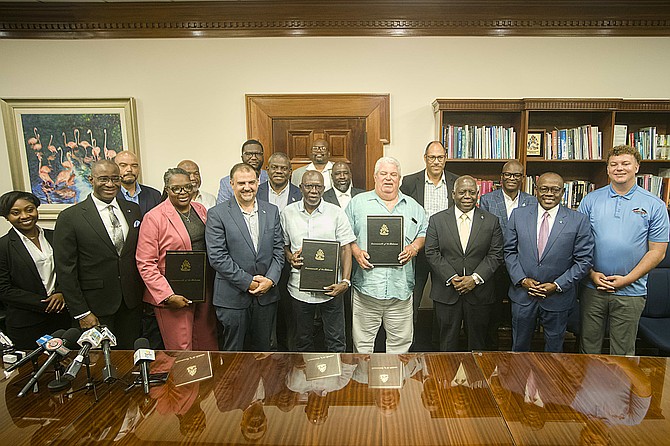
    The Bahamas government has given formal approval to a $6.8 million infrastructure upgrade project for airports located on Farmers Cay and Staniel Cay, two popular tourist destinations in the country’s Exuma island chain. Construction work is scheduled to break ground by the end of April and will take approximately eight months to complete, according to senior government officials.

    Of the total investment budget, $5.7 million is allocated directly to the construction and upgrade works. Two local Bahamian contractors have secured the contracts for the project: Rowdy Boys Construction will handle all airside improvements across both airports, while A and E Construction has been tapped to build a brand-new passenger terminal at the Farmers Cay site.

    The initiative forms a core part of the national administration’s Family Island Airport Renaissance program, a long-term strategy designed to boost inter-island connectivity, strengthen the country’s vital tourism sector, and expand inclusive economic opportunity across less developed outer islands. Minister of Works Clay Sweeting detailed the scope of the planned upgrades, noting that works will include full reconstruction and resurfacing of existing runways, plus modernization of apron and ground pavement areas at both facilities. When complete, the Farmers Cay runway will measure 2,170 feet long and 50 feet wide, while Staniel Cay’s upgraded runway will stretch 2,827 feet by 70 feet wide.

    The new Farmers Cay terminal will feature passenger-focused amenities including a dedicated ticket counter, private passenger waiting area, modern restrooms, administrative office space, seating capacity for at least 20 travelers, and covered outdoor verandas. Once upgrades are finalized, both airports will be able to accommodate larger, more modern aircraft: Farmers Cay will be able to handle Cessna Caravan planes, while Staniel Cay will support Cessna 408 SkyCourier operations. The improvements are also expected to boost service reliability for major domestic carriers including Flamingo Air and Titan Air.

    Deputy Prime Minister and Minister of Tourism Chester Cooper emphasized that the investment is a targeted move to strengthen critical infrastructure across the Family Islands, where tourism growth has outpaced existing facility capacity. “Demand without infrastructure will ultimately lead to frustration, and that is why we are creating improved infrastructural conditions to facilitate more flights, more consistent service, and greater confidence from airlines and operators,” Cooper explained. “Today is not just a signing of contracts. It is about unlocking potential, advancing opportunity and driving economic growth.”

    For Rowdy Boys Construction, the project marks a return to the site the firm originally developed more than two decades ago. The company built the original Farmers Cay Airport back in 2002, and has previously completed road and water main projects across both cays. Jaylan Knowles, Chief Financial Officer of Rowdy Boys Construction, noted the contract is a major milestone for the local firm, and the company plans to prioritize hiring local workers for the project — including potentially re-engaging workers who participated in the original 2002 construction. Construction will kick off first at Farmers Cay before the team shifts operations to Staniel Cay, with mobilization set to begin once final administrative approvals are secured.

    Cooper also addressed public concerns about repeated contract awards to a small pool of local firms, noting that airport runway construction requires specialized engineering and operational expertise that few domestic companies possess. “There are not many companies in The Bahamas with the capacity to build runways, and therefore you may see a few companies repeated across the islands,” he said, adding that all contracts for the initiative were awarded through a fully transparent, competitive public procurement process.

    In addition to the Farmers Cay and Staniel Cay projects, Cooper provided updates on other ongoing airport modernization efforts across the country. Expansion works at Exuma International Airport are progressing, with construction of the expanded departure lounge now reaching the second floor. Once complete, the upgraded lounge will be able to accommodate up to 400 passengers. At North Eleuthera Airport, preliminary upgrade works have already been finished, and airside improvement activities — including land clearing at the eastern end of the runway — are now underway. Additional development works at the site will move forward once required environmental and geotechnical assessments are completed.