博客

  • Chief Magistrate Carette-George breaks down court cases for 2025

    Chief Magistrate Carette-George breaks down court cases for 2025

    The magistracy courts faced a significant challenge in managing caseloads throughout 2025, with Chief Magistrate Candia Carrette-George revealing a substantial disparity between filed and resolved cases. According to year-end statistics presented at Thursday’s press conference, the courts received 3,765 new matters while only disposing of 2,053 cases, resulting in a concerning increase in judicial backlog.

    The case breakdown reveals distinct patterns across different legal domains. Traffic violations dominated the docket with 1,324 filings and 653 dispositions, representing the highest volume category. Criminal matters followed as the second most numerous with 866 new cases and 581 resolutions. The civil division handled 897 filings against 360 completed cases, while family court addressed 182 maintenance and affiliation matters alongside 278 dispositions.

    Notably, the juvenile court demonstrated exceptional efficiency by disposing of 33 cases despite receiving only 19 new filings. However, other specialized courts showed less favorable ratios: domestic violence cases saw 188 filings against 58 resolutions, domestic relationships matters had 46 new cases with only 7 completed, and child protection cases recorded 40 filings with 21 dispositions.

    Financially, the court system generated substantial revenue through enforcement actions, collecting $788,715.80 in fines and ticket payments between July and December 2025.

    To address mounting backlogs, the judiciary has implemented several operational reforms. Night court sessions resumed in September 2025, operating from 2 PM to 9 PM to handle both criminal and civil trials. Additionally, case management hearings are scheduled to commence in January 2026 following the return of the assigned magistrate from vacation. These pretrial assessments will evaluate case readiness and determine suitability for night court proceedings, aiming to minimize unnecessary adjournments and maximize judicial efficiency.

    The Coroners’ Court has expanded its schedule to three weekly sessions (Mondays, Wednesdays, and Thursdays) while establishing a dedicated courtroom for daily operations from Monday through Friday. Chief Magistrate Carrette-George expressed particular concern about inquest cases, where 183 filings yielded only 62 dispositions in 2025, citing juror procurement and summons service challenges as primary obstacles to timely resolutions.

  • Resurfacing Of West Indies Oil Road To Proceed After APUA Pipeline Replacement

    Resurfacing Of West Indies Oil Road To Proceed After APUA Pipeline Replacement

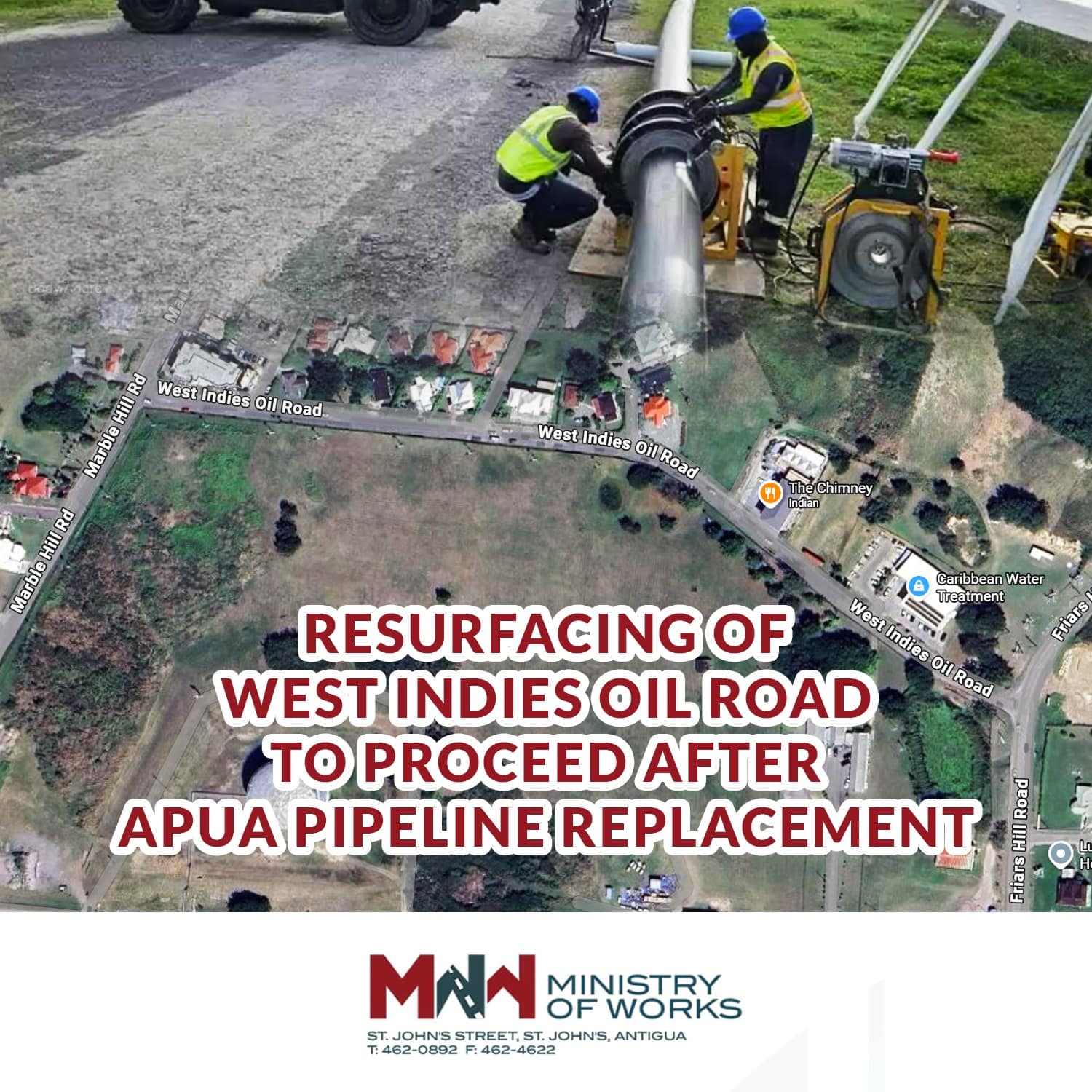
    A vital infrastructure enhancement project on Antigua’s West Indies Oil Road is advancing through a coordinated inter-agency effort. The Ministry of Works has initiated comprehensive repairs on the crucial thoroughfare connecting Friars Hill Road and Marble Hill Road, unveiling a critical need for simultaneous utility upgrades.

    During preliminary roadwork assessments, construction crews identified multiple compromised sections of the water distribution network. These defects were promptly reported to the Antigua Public Utilities Authority (APUA), triggering an immediate technical evaluation. Utility engineers conducted thorough inspections that revealed extensive corrosion and structural deterioration in the existing pipelines, rendering them operationally unreliable.

    APUA has consequently prioritized the complete replacement of these aging water lines before road resurfacing can commence. This proactive approach ensures long-term infrastructure stability by addressing subsurface utility integrity prior to surface restoration. The sequenced operational timeline mandates that Public Works crews will execute final road resurfacing operations only after APUA successfully completes all pipeline installation and testing procedures.

    Government officials have publicly acknowledged the temporary inconvenience caused by these essential works, emphasizing their critical importance to community infrastructure resilience. The Ministry of Works and APUA have jointly requested public cooperation and patience throughout the project duration, highlighting that the temporary disruption will yield significant long-term benefits for water service reliability and transportation safety in the region.

  • BWU tells GAIA to shape up or face industrial action

    BWU tells GAIA to shape up or face industrial action

    The Barbados Workers’ Union (BWU) has declared an uncompromising position regarding unresolved labor disputes at Grantley Adams International Airport (GAIA), warning that persistent violations of workers’ rights will provoke severe industrial responses. Deputy General Secretary Dwaine Paul conveyed to Barbados TODAY that the union stands prepared to authorize additional work stoppages if longstanding employee concerns remain unaddressed.

    Paul emphasized that commercial and operational priorities must not override fundamental worker health, safety, and welfare protections. The union is currently engaged in active negotiations with Goddard Catering Group (GCG) ground services management regarding multiple staff complaints, primarily concerning outstanding wage payments. While some constructive dialogue has occurred, both parties have scheduled a crucial meeting on January 19 to pursue final resolutions.

    The labor representative revealed that the BWU intends to convene comprehensive meetings with all airport divisions to assess working conditions throughout the facility. Paul noted that problematic conditions—including excessive heat exposure, substandard facilities, and inadequate working environments—represent systemic failures rather than isolated incidents. He stressed that employers bear both legal and moral responsibilities to address these issues promptly.

    Tensions previously escalated on November 27 when approximately 50-75 GCG employees initiated industrial action during the airport’s peak traffic day, disrupting services for nearly 8,000 passengers. The stoppage concluded after management provided written commitments addressing key negotiation points. Paul cautioned that similar actions could spread across other airport employers if systemic issues persist, emphasizing that worker welfare cannot be sacrificed for financial considerations.

  • Prime Minister Presses ECAB on Long-Delayed Share Conversion Plan

    Prime Minister Presses ECAB on Long-Delayed Share Conversion Plan

    Prime Minister Gaston Browne of Antigua and Barbuda has escalated his administration’s campaign to transform the ownership structure of Eastern Caribbean Amalgamated Bank (ECAB). The government is pushing for the conversion of preference shares into ordinary shares, a strategic move designed to facilitate wider public ownership among Antiguans and Barbudans.

    In a direct appeal to the financial institution’s leadership, Browne accused ECAB’s directors and shareholders of systematically obstructing this policy initiative. “You have been frustrating this policy initiative of our government,” stated Browne, emphasizing that the conversion would enable the subsequent divestment of shares to local citizens.

    The core objective behind this persistent effort is to democratize ownership within key economic enterprises. The administration believes that broadening local participation in major institutions like ECAB will create more direct economic benefits for citizens and foster greater financial inclusion.

    Despite prolonged discussions spanning several months, the initiative has encountered significant resistance from the bank’s current leadership and shareholder base. The Prime Minister indicated that this opposition has stalled progress, necessitating continued engagement between government officials and bank representatives to break the deadlock.

    This initiative aligns with Browne’s previously stated economic philosophy that expanding domestic equity participation is fundamental to building sustainable national wealth. The government views local ownership stakes in critical financial institutions as a cornerstone for long-term economic resilience and community empowerment.

  • Claudius King Charged in Connection with Multiple Property Damage and Larceny Offences

    Claudius King Charged in Connection with Multiple Property Damage and Larceny Offences

    ST. JOHN’S, ANTIGUA AND BARBUDA – January 17, 2026 – Law enforcement authorities have formally charged Claudius King, a 24-year-old resident of Hatton, following his arrest in connection with a series of criminal incidents involving property damage and theft. The Royal Police Force of Antigua and Barbuda confirmed multiple charges against the suspect related to events occurring on January 13, 2026.

    According to official reports from the Office of Strategic Communications, King faces allegations spanning three distinct criminal incidents. The first case involves the theft of an automotive battery valued at $475 and the deliberate destruction of a rear panel window worth $300, belonging to a resident of Tindale Road.

    In a separate occurrence on Kentish Road, the accused stands charged with stealing two side mirrors with a combined value of $1,000 and a car jack priced at $100. This incident also includes charges for malicious damage to two quarter panel glasses valued at $600.

    An additional charge involves the intentional destruction of a toilet bowl valued at $700, marking another facet of the property damage allegations. The cumulative financial impact of the alleged crimes exceeds $3,000 across the various incidents.

    Police authorities have indicated that their investigative efforts remain active as they continue to examine the circumstances surrounding these offenses. The accused is scheduled to make an appearance in court proceedings, though specific dates for the judicial process have not yet been formally announced. The Royal Police Force has reaffirmed its commitment to addressing property crimes and maintaining public safety throughout the community.

  • Barbados and Caribbean Science Foundation launch major partnership to advance STEM

    Barbados and Caribbean Science Foundation launch major partnership to advance STEM

    Barbados has embarked on a transformative scientific partnership that promises to reshape the Caribbean’s technological landscape. The nation’s Ministry of Innovation, Industry, Science and Technology (MIST) has entered into a groundbreaking collaboration with the Caribbean Science Foundation (CSF), establishing a comprehensive framework for regional STEM advancement.

    Spearheading this initiative is Professor Cardinal Warde, the CSF’s Executive Director and MIT electrical engineering professor of Barbadian heritage. The partnership will introduce two landmark programs: a region-wide Caribbean STEM Olympiad for secondary students and the inaugural Caribbean SEED Summit scheduled for June 26-28, 2026.

    The SEED Summit (STEM Engine for Economic Development) will convene Caribbean innovators, diaspora experts, and global thought leaders for three days of intensive collaboration. The event will feature a STEM Startup Challenge connecting entrepreneurs with funding opportunities, visionary keynote addresses, and cutting-edge research presentations spanning climate resilience, artificial intelligence, biotechnology, fintech, and educational reform.

    Minister of Innovation Senator Jonathan Reid emphasized the strategic alignment between CSF’s ‘Science and Engineering for Economic Development’ approach and Barbados’ economic transformation agenda. “This partnership positions Barbados at the forefront of regional innovation-driven growth,” stated Minister Reid. “The SEED Summit represents a pivotal milestone in accelerating our national STEM strategy.”

    Beyond the summit, the collaboration will implement comprehensive educational reforms enhancing teacher training and curriculum development. Professor Warde highlighted Barbados’ emerging role as a Caribbean STEM catalyst: “We’re bringing decades of expertise to work hand-in-hand with government and young innovators to build a future grounded in science and driven by imagination.”

    The initiative supports Barbados’ broader digital development and reindustrialization goals, aiming to create attractive opportunities for skilled workers, entrepreneurs, and global businesses. Minister Reid noted CSF’s proven track record in developing Caribbean talent for world-leading universities, stating the partnership would “leverage global scientific networks aligned with national priorities for sustainable growth and competitiveness.”

    This strategic alliance represents a significant step in Barbados’ mission to become a hub for high-skilled global talent, encouraging diaspora professionals to return while transforming the nation into a regional innovation powerhouse.

  • Breaking: Barbadians head to the polls next month as PM calls elections

    Breaking: Barbadians head to the polls next month as PM calls elections

    Barbados Prime Minister Mia Mottley has officially declared February 11, 2026 as the date for the nation’s next general election. The announcement came during a formal ceremony on Saturday evening, setting in motion the democratic process for the Caribbean nation.

    In her address to the nation, Prime Minister Mottley confirmed she has advised President Sandra Mason to dissolve Parliament on Monday, January 19, effectively concluding the current parliamentary session. The administration has simultaneously initiated comprehensive preparations for the upcoming electoral process, with Nomination Day scheduled for January 27, when candidates will formally register their participation.

    This election marks the first parliamentary contest since Mottley’s Barbados Labour Party achieved an unprecedented political victory in 2022, securing all 30 seats in the House of Assembly. The previous election represented a historic moment in Barbadian politics, delivering the first clean sweep in the nation’s electoral history.

    The upcoming vote will test whether Prime Minister Mottley maintains her extraordinary popularity following her party’s constitutional reform agenda and economic management. Political analysts are closely watching whether any opposition parties can break the ruling party’s parliamentary monopoly in this forthcoming election.

    Barbados, a stable democracy within the Commonwealth, continues its tradition of peaceful political transitions as it prepares for this significant electoral event amidst ongoing regional and global challenges.

  • Nicholas acknowledges public frustration over water, pushes back on criticism

    Nicholas acknowledges public frustration over water, pushes back on criticism

    Antigua’s Utilities Minister Melford Nicholas has publicly recognized mounting citizen frustration over persistent water disruptions while simultaneously defending his administration’s handling of the crisis. Speaking at the commissioning ceremony for the new Barnacle Point reverse osmosis water plant, Nicholas acknowledged that public anger reflects water’s essential role in daily life, though he contends criticism frequently overlooks complex technical challenges.

    The minister articulated that current water production levels now adequately meet national demand, with ongoing outages primarily stemming from transmission and distribution deficiencies rather than insufficient supply. Nicholas emphasized that decades of infrastructure neglect and underinvestment have created systemic weaknesses that cannot be immediately resolved.

    Nicholas identified public expectation management as particularly challenging during infrastructure transitions, noting that criticism often intensifies even amid measurable progress. He referenced the newly operational Barnacle Point facility—contributing two million imperial gallons daily—and the earlier Fryes Beach plant as evidence of production improvements achieved through collaboration between Antigua Public Utilities Authority and Seven Seas Water Group.

    Looking forward, Nicholas outlined upcoming modernization efforts focusing on automated distribution systems and large-scale pipeline replacements. While acknowledging these projects won’t yield instantaneous results, he characterized them as essential for achieving islandwide service consistency. The minister concluded that government must simultaneously advance infrastructure improvements while maintaining transparent communication about achievements and ongoing challenges, cautioning against dismissing progress merely because transformation remains incomplete.

  • Nicholas warns low standards pose greatest risk at APUA

    Nicholas warns low standards pose greatest risk at APUA

    In a stark warning against institutional mediocrity, Antigua’s Minister of Public Utilities Melford Nicholas has identified complacency—not ambition—as the most severe threat facing the Antigua Public Utilities Authority (APUA). Delivering his remarks during the commissioning ceremony of the new Barnacle Point reverse osmosis water plant, Minister Nicholas outlined a rigorous leadership philosophy built upon discipline, accountability, and the relentless pursuit of elevated performance benchmarks. He emphatically stated that the true danger lies not in setting overly ambitious goals, but in establishing low standards and comfortably meeting them. Since assuming oversight of the public utilities portfolio, Nicholas has adopted an intentionally hands-on approach, maintaining frequent communication with APUA’s senior management to closely monitor operational progress and institutional performance. He directly linked this drive for higher standards to public accountability, noting that failures in essential services like water distribution rapidly escalate into political crises. The minister stressed that utility leadership must be prepared with concrete data and effective solutions rather than excuses, particularly as new infrastructure like the Barnacle Point plant—a collaborative project with Seven Seas Water Group adding two million imperial gallons daily to the national system—comes online. Nicholas concluded that the next phase of reform must focus on transmission upgrades, automation, and a fundamental shift in institutional culture, aiming to build a utility capable of sustaining high performance under pressure and meeting public expectations.

  • Nicholas: Antigua now has enough water, but distribution flaws still leave gaps

    Nicholas: Antigua now has enough water, but distribution flaws still leave gaps

    Antigua and Barbuda has successfully resolved its water production deficit, yet significant distribution challenges persist, leaving numerous communities without reliable access. Utilities Minister Melford Nicholas confirmed the nation now possesses adequate production capacity to meet national demand, attributing ongoing supply interruptions to an aging and inefficient transmission network. The remarks were delivered during the commissioning ceremony of the new reverse osmosis plant at Barnacle Point.

    The recently activated Barnacle Point facility contributes an additional two million imperial gallons per day to the national supply. This development follows the earlier launch of a one-million-gallon-per-day plant at Fryes Beach. These expansions are the result of a collaborative partnership between the Antigua Public Utilities Authority (APUA) and the Seven Seas Water Group, substantially boosting the country’s overall production capabilities.

    Minister Nicholas delineated a clear distinction between the solved issue of production and the persistent problem of distribution. He openly acknowledged public frustration, noting that residents experiencing outages are typically unconcerned with technical explanations. This frustration places considerable political and social pressure on utility providers during service interruptions.

    The government’s strategy is now squarely focused on the next critical phase: modernizing the transmission and distribution infrastructure. This comprehensive plan includes the large-scale replacement of decades-old pipelines and the integration of automation systems to enhance operational efficiency and response times. APUA Chief Executive Officer John Bradshaw has previously emphasized that these upgrades are indispensable for equitable water distribution across the island, even as production records are being surpassed.

    Nicholas characterized the achievement in production as the completion of ‘the first leg of the relay.’ The remaining and more complex challenge involves ensuring that the increased water volume consistently reaches every household through a robust and modernized delivery network, while simultaneously managing public expectations throughout this transitional period.