
博客

  • NCB’s Cayman transfer completes balance sheet clean-up

    NCB’s Cayman transfer completes balance sheet clean-up

    NCB Financial Group Limited has executed a significant internal restructuring through the acquisition of its Cayman Islands subsidiary by majority-owned Clarien Bank Limited. While presented as an organizational realignment, this transaction culminates a multi-year balance sheet optimization initiative that has fundamentally reshaped the group’s offshore operations.

    The transfer, pending regulatory approval, will transition select wealth and investment management relationships from NCB (Cayman) Limited to Clarien Bank, with the Cayman entity subsequently rebranding under the Clarien name. Group leadership has assured stakeholders of seamless client continuity and no material impact on capital adequacy, liquidity, or ownership structures.

    This stability is anchored by exceptionally robust capital metrics. Regulatory filings reveal NCB (Cayman) maintained a Total Capital Ratio exceeding 30%—more than double the 12% regulatory requirement—with nearly all capital derived from internally generated retained earnings. The entity’s Net Tier 1 capital, a core measure of financial strength, stood at US$35.5 million, characterized by simplicity without complex subordinated debt structures that typically complicate financial transfers.

    Despite these capital strengths, operational challenges persist. A recent rating agency downgrade highlighted a US$1 million net loss for fiscal 2024 and a fourth consecutive year of deposit base contraction. This funding decline reflects both strategic divestments and client migration to higher-yielding alternatives, indicating ongoing profitability pressures despite improved balance sheet stability.

    The transaction represents the culmination of a deliberate cleanup process that included addressing the substantial Sandy Bay loan facility in Barbados, which previously constituted approximately 75% of the subsidiary’s non-performing loans (NPLs). While its removal to National Commercial Bank Jamaica Limited in Q3 2025 significantly improved headline NPL ratios, the Cayman unit’s NPL ratio remained elevated at 25.8% as of June 2025, suggesting persistent credit quality concerns within the remaining portfolio.

    Group CEO Robert Almeida characterized the move as “a deliberate strategic internal realignment designed to strengthen focus and operational coherence across our regional businesses.” The consolidation simplifies the group’s offshore narrative for regulators and investors following its US$300 million return to international capital markets last year, reducing the number of separate entities requiring scrutiny.

    For Clarien Bank, the acquisition supports strategic expansion in selective offshore markets with emphasis on operational continuity, according to CEO Ian Truran.

    Ultimately, this transaction represents the strategic tidying of a stabilized but still recovering operation. While major surgical interventions have addressed the most critical issues, the transferred entity continues to navigate profitability and funding challenges within a cleaner, simplified operational structure.

  • Salada profits rise, but cash falls as costs and climate risks bite

    Salada profits rise, but cash falls as costs and climate risks bite

    Jamaican coffee and beverage manufacturer Salada Foods Jamaica Limited has reported strengthened profitability in its fiscal year ending September 2025, despite facing significant operational challenges from inflationary pressures, currency fluctuations, and climate-related disruptions.

    The company achieved a net profit of $171.5 million, representing solid financial performance as revenue climbed 7.9% to approximately $1.6 billion. Gross profit reached $487.9 million, with margins maintaining stability at around 30.5% despite persistent cost pressures throughout the supply chain.

    Beneath the surface of these positive earnings indicators, the company’s financial position reveals strategic adaptations to a volatile operating environment. Cash reserves declined substantially to $154.6 million from $272.5 million year-over-year, while inventories surged to $552.5 million from $420.6 million. This inventory accumulation reflects a deliberate corporate strategy to secure essential inputs amid rising global coffee prices and supply chain uncertainties.

    The company’s defensive posture proved prescient when Hurricane Melissa struck Jamaica shortly after the fiscal year end, damaging agricultural infrastructure and supply networks. Salada’s advanced procurement strategy has shielded immediate production from disruption, though long-term agricultural impacts remain under assessment.

    Capital investment continued throughout the period with $67.1 million allocated to machinery, equipment, and work-in-progress assets, elevating the net book value of property, plant and equipment to $165.9 million. The company also distributed $130.9 million in dividends to shareholders, further impacting liquidity positions.

    Market performance revealed contrasting trends between domestic and international operations. Local sales demonstrated robust growth, advancing to $1.30 billion from $1.16 billion, while export revenues declined to $304.3 million from $322.1 million despite concerted efforts to expand regional and UK market presence.

    Looking forward, management emphasizes product diversification as a cornerstone of long-term strategy. Recent expansions into functional beverages utilizing locally sourced ingredients like ginger, turmeric, sorrel, and hibiscus target health-conscious consumers and aim to reduce dependence on volatile coffee markets. These innovations, coupled with established brands and operational efficiency focus, provide optimism despite the challenging trade-offs between financial resilience and cash generation in an increasingly unpredictable manufacturing landscape.

  • Jamaica remittance inflows rise in November as sector shows signs of consolidation

    Jamaica remittance inflows rise in November as sector shows signs of consolidation

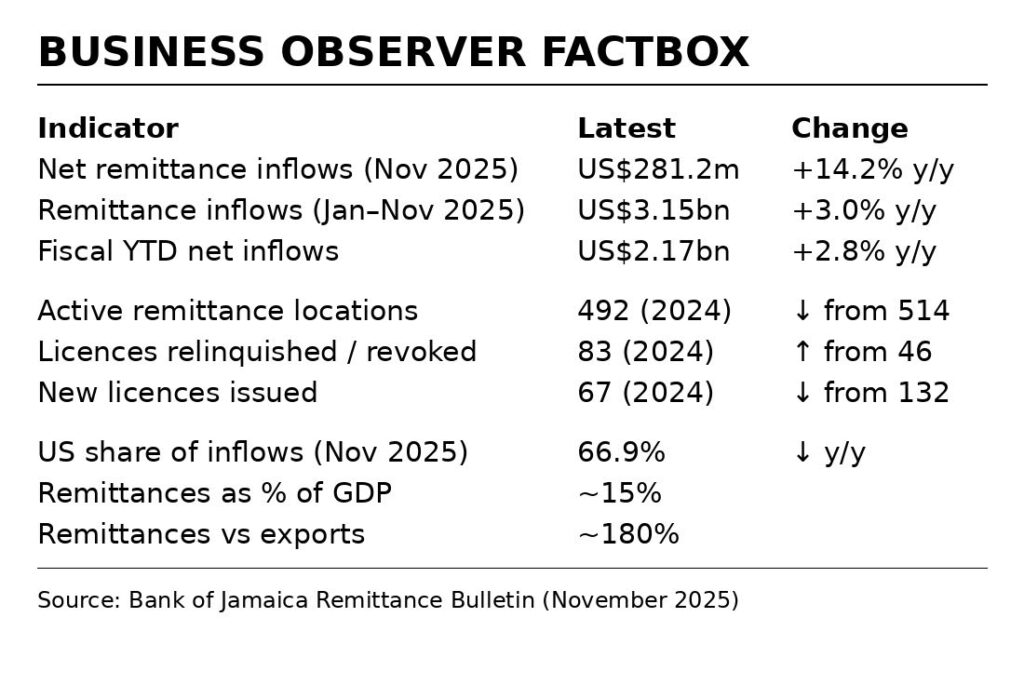
    Jamaica’s remittance landscape is undergoing significant transformation as new data from the Bank of Jamaica reveals both substantial financial growth and structural consolidation within the industry. According to the latest Remittance Bulletin published by the central bank, November 2025 witnessed remarkable growth in net remittance inflows, which surged to US$281.2 million – representing a robust 14.2 percent increase compared to the same period in the previous year.

    The impressive performance was primarily fueled by heightened activity through formal remittance companies, though partially tempered by an accompanying rise in outbound transfers. Cumulative figures for the current fiscal year demonstrate sustained growth, with net inflows reaching US$2.17 billion, marking a 2.8 percent year-over-year increase. Total incoming remittances grew by 2.9 percent, while outflows experienced a more pronounced uptick of 5.3 percent.

    Parallel to these financial developments, the industry’s operational framework is evolving dramatically. The number of active remittance locations contracted significantly from 514 in 2023 to 492 in 2024, indicating a trend toward market consolidation. This restructuring is further evidenced by licensing patterns: revoked or relinquished licenses nearly doubled to 83 from 46 year-over-year, while new licenses issued plummeted from 132 to 67. Complete 2025 structural data remains pending publication.

    From January through November 2025, total remittance inflows reached US$3.15 billion, maintaining a steady 3 percent annual growth rate. This performance positioned Jamaica favorably against regional counterparts, with some Central American nations experiencing stronger growth while Mexico recorded declines.

    The United States continues to dominate as Jamaica’s primary remittance source, accounting for 66.9 percent of total inflows in November – though slightly diminished from previous levels. The United Kingdom, Canada, and the Cayman Islands followed as significant contributors.

    Remittances remain a cornerstone of Jamaica’s economy, providing crucial foreign exchange equivalent to approximately 15 percent of GDP, nearly 80 percent of tourism earnings, and exceeding 180 percent of export values, according to the central bank’s macroeconomic indicators.

  • Coach elated as U-17 Reggae Girlz advance to Concacaf Qualifiers final round

    Coach elated as U-17 Reggae Girlz advance to Concacaf Qualifiers final round

    Jamaica’s Under-17 women’s national football team secured a hard-fought 1-0 victory against Honduras on Monday, advancing to the next stage of the 2026 CONCACAF Women’s Under-17 Qualifiers. The decisive moment came just before halftime when Elizabeth Miller expertly headed home a precisely delivered corner kick from Shennell Walters in the 44th minute at Aruba’s Stadion Guillermo Prospero Trinidad.

    The match presented significant challenges for the young Reggae Girlz, who demonstrated remarkable resilience after playing most of the second half with only ten players following Ricquanna Richards’ red card in the 57th minute. Despite being numerically disadvantaged, the Jamaican squad maintained tactical discipline and defensive organization to preserve their narrow lead.

    Head Coach Marlon Hylton expressed immense pride in his team’s performance, highlighting their exceptional composure under pressure. “It’s a proud moment for the players and staff and a reward for the hard work and commitment shown throughout the campaign,” Hylton told the Jamaica Observer. “The players stayed organized and trusted the game plan even under pressure.”

    Hylton revealed his team employed a compact mid-block strategy designed to exploit Honduras’ defensive vulnerabilities with balls played over the top. The tactical approach proved successful due to what the coach described as “great discipline and communication” from his players, who executed the game plan with “maturity beyond their years.”

    While celebrating the victory and qualification, Hylton acknowledged areas needing improvement, particularly offensive efficiency. “Going forward, we must be more clinical in front of goal,” he stated. “I will continue to say this and improve our decision-making in key moments.”

    The team now shifts focus to recovery and preparation for next month’s qualification round, with ambitions of making history by qualifying for Jamaica’s first youth Women’s World Cup. Hylton emphasized the importance of maintaining perspective despite the achievement: “This win gives the group confidence and belief, but we remain grounded and focused on continuous improvement.”

  • Guilty of ruthless slaying

    Guilty of ruthless slaying

    MANCHESTER, Jamaica — A three-year judicial pursuit reached its culmination on Tuesday as the Manchester Circuit Court convicted taxi operator Kevon Lesley for the brutal murder of his partner, Shadae Brown. The verdict, delivered by a seven-member jury after a rigorous two-week trial, brought profound relief to the victim’s family who had endured immense emotional trauma since the March 2023 incident.

    Presiding Judge Grace Henry McKenzie oversaw the proceedings that concluded with Lesley’s murder conviction. The sentencing hearing is scheduled for February 26, with the defendant’s legal representative, Attorney Norman Godfrey, declining commentary pending judicial determination.

    The case involved particularly distressing circumstances as Brown’s eleven-year-old son witnessed his mother’s violent death. Court records indicate Lesley employed three separate knives during the sustained attack, ignoring desperate pleas for mercy from both the victim and her young son. Testimony revealed the perpetrator had threatened to stab the child when he attempted to intervene during the assault.

    Family matriarch Millicent Laird expressed collective relief outside the courthouse: “We obtained justice today after carrying this heavy burden for three years. Her son can finally live without fear, as this man is permanently removed from our lives.” The grandmother emphasized the psychological impact on the children who were confined with Brown’s body for hours before alerting neighbors.

    Previously documented accounts from Brown’s mother, Donna Walker-Ellis, detailed a pattern of domestic abuse preceding the murder. Despite separating from Lesley in January 2023 after a violent incident involving thrown furniture, Brown had permitted his return to their Newport residence two weeks before her death due to her compassionate nature.

    Walker-Ellis described her daughter as an exceptionally humble and industrious surgical assistant who maintained employment at a medical facility until her tragic demise. Community members characterized Brown as a jovial, honest individual who embodied kindness in all interactions.

    Both families referenced spiritual fortitude throughout the judicial process, with Walker-Ellis noting: “I remained hopeful through sleepless nights because I believe no tears go unnoticed and no sin goes unpunished by the Almighty.” The conviction represents significant symbolic importance for Newport residents who remembered Brown as an exemplary community member whose life ended through unimaginable violence.

  • ‘Take responsibility’

    ‘Take responsibility’

    A startling financial discrepancy of $28.96 million has exposed significant governance failures within Jamaica’s parliamentary accounting systems, triggering intense scrutiny during Tuesday’s Public Accounts Committee (PAC) hearing. The controversy centers on a massive credit card transfer that remained undetected for four months, revealing critical weaknesses in financial oversight protocols.

    Manchester Southern MP Peter Bunting spearheaded the criticism, directly challenging Parliament Clerk Colleen Lowe to accept institutional responsibility for what he characterized as a catastrophic breakdown in basic financial controls. Bunting, drawing on his banking background, presented a detailed analysis demonstrating that the error originated entirely from ambiguous wording in Parliament’s own instruction letter to the financial institution.

    The special audit from the Auditor General’s Department, while finding no evidence of personal misuse of government funds, documented concerning deficiencies including poor monitoring mechanisms, delayed reporting procedures, and the extraordinary transfer error that allowed millions to move between accounts without prompt detection. The audit revealed that the $28.96 million withdrawal occurred after Parliament requested a substantially smaller payment related to credit card operations, with the massive overpayment remaining unnoticed for several months before eventual reversal.

    Committee Chairman Julian Robinson pressed Lowe on how such a substantial discrepancy could evade detection, questioning whether regular account reconciliations were consistently performed before the appointment of a new principal finance officer. Lowe conceded that existing systems were inadequate, noting that proper oversight protocols were not consistently maintained.

    The clerk attempted to shift partial blame to the banking institution, highlighting that the credit card had a modest $5,000 limit and questioning how such an enormous transfer could be processed without verification. She referenced standard banking practices where unusual transactions typically trigger confirmation calls to authorized officials.

    However, Bunting systematically dismantled this defense, reading directly from the problematic instruction letter that clearly requested debiting the recurrent expenditure account with a Jamaican equivalent amount to be credited to the US dollar account. He emphasized that any competent banking professional would interpret such wording literally, placing responsibility squarely on Parliament’s administrative leadership for both the erroneous instruction and the subsequent failure to detect the transaction through regular reconciliations.

    The hearing concluded with broader concerns about financial governance standards within Jamaica’s highest legislative body, with committee members demanding immediate implementation of strengthened controls and accountability measures.

  • 13-y-o Jazmin Headley’s collab tops Canadian chart

    13-y-o Jazmin Headley’s collab tops Canadian chart

    In a remarkable musical achievement, 13-year-old Canadian artist Jazmin Headley has ascended to the pinnacle of the Reggae North Canada Top 20 Reggae and Dancehall chart with her inspirational single “The Fire Inside.” The Toronto-based singer, whose parents originate from St. Elizabeth, Jamaica, collaborated with dancehall icon Bounty Killer (Rodney Price) and veteran reggae artist Richie Stephens on the chart-topping track.

    Headley revealed to the Jamaica Observer that the song’s creation was fueled by her observations of everyday life and personal experiences. “It was also inspired by the will to motivate others and encourage my peers,” the ninth-grade student explained, expressing surprise at the track’s overwhelming popularity within the Jamaican diaspora community in Canada.

    The young artist acknowledged the significant role Bounty Killer has played in her musical development, noting that he initiated her career at just nine years old. “He has been a very effective figure in my music career and treats me with love and respect. He’s family,” Headley stated. She similarly praised Richie Stephens as “amusing, very positive, and encouraging.”

    Meanwhile, the Canadian reggae charts showcase other notable movements: Jah Cutta’s “How Sweet It Is” maintains its position at number two, while Sone G’s “Rescue Me” descends from first to third place. New York’s reggae scene witnesses George Nooks claiming the top spot with “Your Grace and Mercy,” and Bob Marley’s “Legend” continues its historic dominance on the Billboard Reggae Albums chart for an unprecedented 316 non-consecutive weeks.

    In parallel developments, Shaggy’s collaborative track “Boom Body” featuring Akon and Aidonia demonstrates upward mobility across multiple charts, advancing on both the South Florida Reggae chart and Billboard’s Rhythmic Airplay chart, signaling the continued cross-genre appeal of dancehall-inspired music.

  • House clerk blames robbery for fleet breach

    House clerk blames robbery for fleet breach

    A parliamentary investigation into the unauthorized off-site use of a government vehicle has revealed extraordinary circumstances involving an employee’s safety following a late-night robbery. During Tuesday’s tense Public Accounts Committee hearing, Clerk to the Houses of Parliament Colleen Lowe disclosed that verbal permission was granted for vehicle retention due to “extenuating circumstances” after the facilities manager was robbed while leaving work late.

    The controversy emerged weeks after Auditor General Pamela Monroe Ellis reported that a 2022 Toyota Prado was kept off parliamentary premises on 173 occasions between June and December 2024 without documented approval. The audit found the vehicle was parked at the employee’s residence overnight on all 173 instances, including weekends and holidays, with log entries frequently listing “meetings” as the purpose.

    Lowe explained the employee, a part-time University of the West Indies student, often worked late and became “the victim of crime” in downtown Kingston. “Permission was granted to him that he could have access to the vehicle to ensure his safety in those extenuating circumstances,” she testified, while emphasizing that no approval was given for personal use or false log entries.

    However, the auditor general’s report presented conflicting evidence, substantiating private use including transportation to university classes. Monroe Ellis expressed surprise at Lowe’s testimony, noting her office had found “no evidence that permission was granted” during their investigation.

    The hearing revealed a critical procedural failure: while the robbery circumstances were reportedly disclosed to auditors, the safety exemption remained undocumented. Lowe acknowledged this weakness, stating “there was no written permission” but maintained that verbal approval was given strictly for security purposes.

    Following the hearing, Parliament’s administration issued a statement committing to transparency and institutional reforms, including establishing an audit committee, improving procurement planning, and implementing stricter fleet management controls under a newly appointed transport manager.

  • What is the prime minister’s agenda for 2026?

    What is the prime minister’s agenda for 2026?

    In a landmark address at the Jamaica Stock Exchange conference, Prime Minister Andrew Holness unveiled a transformative economic strategy signaling a decisive pivot from Jamaica’s post-crisis policies of the past quarter-century. The comprehensive vision encompasses energy sector reform, financial regulatory modernization, and enhanced regional integration to position Jamaica for sustained growth in a volatile global landscape.

    The government has initiated critical negotiations with the Jamaica Public Service Company (JPSCo) ahead of its license expiration in 2027, targeting substantial reductions in electricity costs through expanded renewable energy capacity and improved grid resilience. This energy initiative forms a cornerstone of Jamaica’s productivity enhancement agenda, particularly crucial for small island economies facing disproportionate energy constraints.

    Most significantly, Prime Minister Holness articulated a fundamental philosophical shift in financial regulation, arguing that Jamaica’s post-Finsac framework—originally designed for risk containment—must now evolve to enable opportunity and innovation. Emphasizing that regulatory frameworks shouldn’t be ‘frozen in time,’ he proposed recalibrating financial architecture to support expansion while maintaining stability as a ‘non-negotiable’ foundation.

    This regulatory modernization is justified by Jamaica’s dramatically improved macroeconomic position, characterized by substantially reduced public debt, robust external reserves, and credible fiscal anchors. The prime minister noted that Jamaica’s deeper, more sophisticated capital markets now require regulations aligned with evolving risk profiles and financial innovation, advocating for ‘smart regulation’ that unlocks capital while preserving financial soundness.

    Concurrently, Jamaica is asserting leadership within regional economic forums, recently standing out as the only CARICOM nation highlighted at the International Investment Forum in Panama—the region’s equivalent of Davos. Former Inter-American Development Bank executive Gerard Johnson observed that Jamaica’s ministers effectively showcased the nation’s successful risk management policies and recovery strategies from external shocks.

    The forum highlighted both challenges and opportunities for Latin American and Caribbean (LAC) nations, which risk being left behind due to slow growth, low productivity, and high debt vulnerability. Prime Minister Holness joined regional leaders in calling for reduced trade barriers and new economic alignments, particularly relevant for CARICOM’s Single Market and Economy, which may require reassessment to ensure it doesn’t hinder diversification and sustainable growth.

    This comprehensive economic repositioning occurs against a backdrop of what academics term a ‘global polycrisis’—where climate events, geopolitical tensions, supply-chain disruptions, and financial volatility overlap and reinforce one another. Jamaica’s strategy represents a proactive adaptation to this fractured global environment, seeking to transform stability into a platform for expansion rather than treating it as a developmental ceiling.

  • MORE THAN MONEY

    MORE THAN MONEY

    Mount Pleasant Football Academy, frequently perceived as Jamaica’s wealthiest football entity due to its substantial financial undertakings, is actively challenging this characterization. Sporting Director Paul Christie has publicly rejected the ‘cash-rich’ label, arguing it misrepresents the club’s reality and hinders broader progress within the nation’s football landscape.

    Since English businessman Peter Gould acquired the club in 2016, Mount Pleasant has undergone a transformative investment program. This strategic infusion of capital has yielded significant on-field success, including capturing both the Jamaica Premier League and the prestigious Concacaf Caribbean Cup titles. Their ambitious projects extend beyond player transfers and staff hiring; the club pioneered the Caribbean’s first multi-million-dollar football academy in St. Ann and established strategic partnerships with England’s Charlton Athletic and Belgian side R.A.E.C. Mons.

    These ventures, while breeding envy and accusations of unfair advantage among local stakeholders, are portrayed by Christie as essential components of a larger vision dubbed ‘Project Jamaica.’ He emphasizes that the driving force is not limitless wealth but the singular commitment of owner Peter Gould, who believes fervently in the potential of Jamaican football. Christie laments the lack of unified support, stating that divergent efforts within the island’s football community ultimately damage the overall product.

    Despite acknowledging a deficiency in systemic and emotional support, the club leadership remains undeterred. Their mission is described as twofold: to elevate competitive performance and to fundamentally reshape football’s cultural status in the region from a mere pastime into a viable professional business enterprise. This involves changing deep-seated mindsets and instilling a professional work ethic, a challenge Christie admits is difficult but necessary.

    The commitment is being tested by a grueling schedule. Qualification for the Concacaf Champions Cup Round of 16 has compounded their domestic duties, resulting in 12 matches over two months. Christie frames this heavy workload not as a burden, but as the inevitable price of ambition and a standard experience for elite clubs globally. He asserts that embracing this challenge is crucial for building a resilient football culture and achieving long-term success for Jamaican and Caribbean football on the world stage.