博客

  • FROM THE GROUND UP

    FROM THE GROUND UP

    Kingsmen Sports Enterprise has officially acquired the Jamaican franchise for the Caribbean Premier League (CPL), marking the team’s return after a two-year hiatus. The United States-based organization, represented by Faisal Mirza, successfully concluded bidding negotiations to secure ownership of the team previously known as Jamaica Tallawahs.

    Mirza revealed that expanding into Jamaican cricket represented a strategic evolution for Kingsmen, which recently added the Hyderabad franchise in the Pakistan Super League to its growing sports portfolio. He emphasized that Jamaica’s rich cricketing heritage and cultural resonance with the Kingsmen brand made this acquisition an obvious choice for the organization.

    The new ownership group plans to implement a self-reliant operational model, distinguishing their approach from previous ownership concerns about government support. While acknowledging the Jamaican government’s cooperative stance, Mirza stressed that Kingsmen intends to drive success primarily through internal resources rather than external dependencies.

    Beyond fielding a competitive team, Kingsmen has committed to substantial long-term investments in Jamaica’s cricket infrastructure and grassroots development. The organization aims to revitalize youth cricket programs and school-level participation, seeking to cultivate future talents comparable to Jamaican legends like Andre Russell and Chris Gayle.

    Mirza outlined a comprehensive vision that extends beyond immediate sporting success, targeting positive impacts on Jamaica’s tourism sector and broader economy. The ownership group recognizes this venture as a decades-long investment that balances financial returns with social development, particularly through youth cricket initiatives that may not generate direct sponsorship revenue but contribute significantly to national cricket development.

    The return of CPL cricket to Jamaica in August represents both a sporting homecoming and an economic opportunity, with government ministers already expressing support for the franchise’s revival and its potential benefits for Jamaican tourism and national pride.

  • Eastern Caribbean Judges Complete Three-Day Orientation in St. Lucia

    Eastern Caribbean Judges Complete Three-Day Orientation in St. Lucia

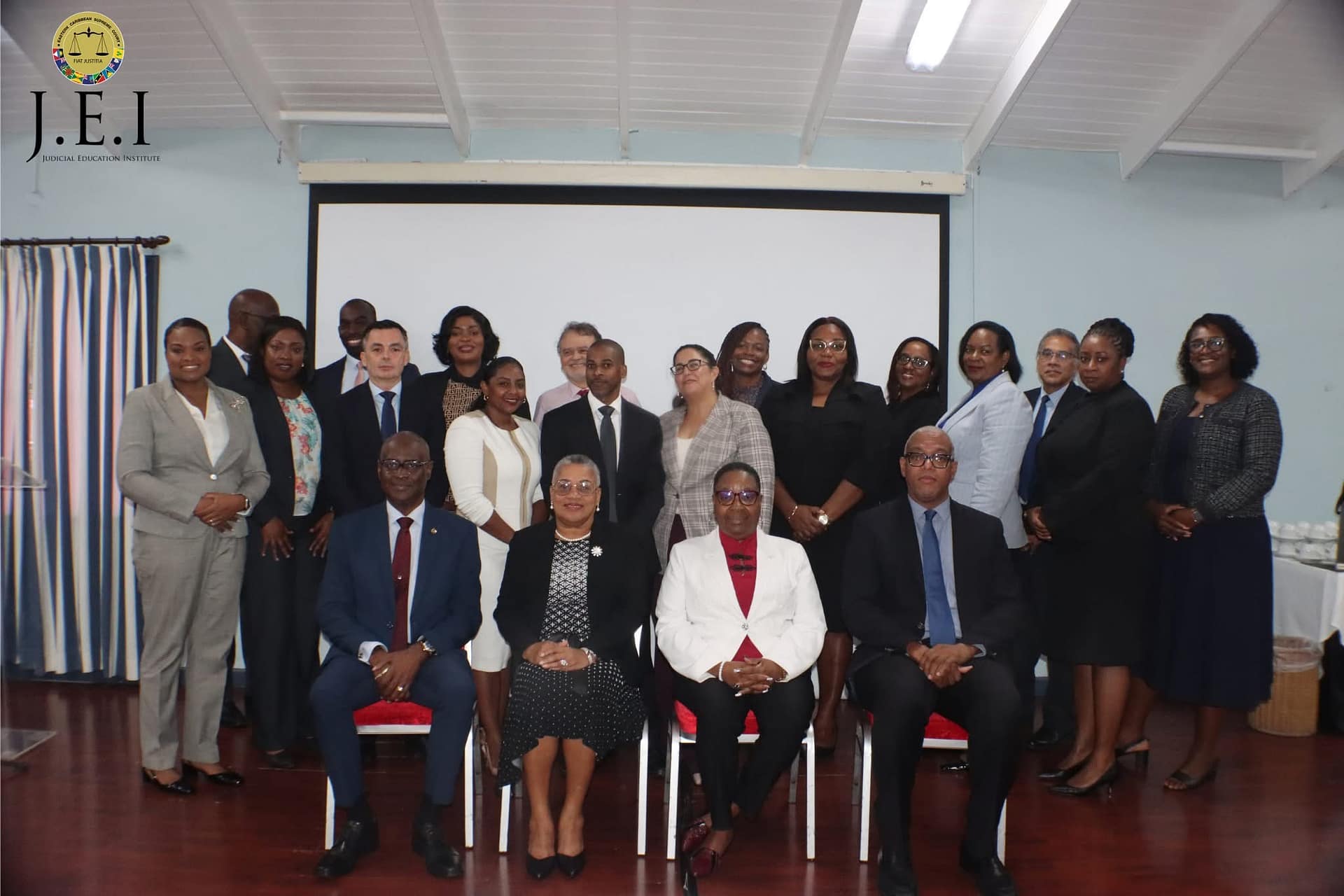
    The Eastern Caribbean Supreme Court’s Judicial Education Institute (JEI) has successfully completed its comprehensive Judicial Officers’ Orientation 2026, a transformative three-day training event held in Saint Lucia from February 2-4, 2026. This intensive program brought together recently appointed judges and masters to advance their professional capabilities and reinforce the integrity of the regional judicial system.

    The inaugural day established foundational principles, featuring Ms. Myrtene Cenac’s compelling analysis on statistical applications in judicial operations, demonstrating how data-driven methodologies can bolster transparency and accountability. Justice Agnes Actie followed with practical guidance on active case management strategies to ensure timely and cost-effective resolution of legal matters. The afternoon sessions culminated with retired Chief Justice Dame Janice Pereira’s authoritative address on building public trust through strict adherence to the ECSC Code of Conduct, while Justice Alvin Pariagsingh provided expert analysis of the updated Costs Regimes under the Civil Procedure Rules 2023.

    Day two embraced contemporary challenges through examinations of digital transformation and implicit bias. Mr. Mark Ernest delivered a comprehensive overview of technological integration in judicial processes, highlighting artificial intelligence applications, digital recording systems, electronic case management, and virtual courtroom technologies. In a particularly impactful session, Justice Peter Jamadar of the Caribbean Court of Justice addressed unconscious prejudices in judicial decision-making, presenting effective strategies to mitigate bias and promote equitable proceedings. Additional sessions covered interim remedies and the critical functions of court registrars, with Justice of Appeal Eddy Ventose concluding the day with an authoritative discussion on public law claims.

    The final day focused on practical judicial skills with Dame Janice Pereira leading an interactive workshop on precision in judgment writing, emphasizing clarity in reasoning and effective communication techniques for oral judgments. Justice of Appeal Trevor Ward conducted an in-depth exploration of sentencing principles, including proportionality and reasoned decision-making, complemented by scenario-based exercises to enhance sentencing consistency. Justice Ventose, as JEI Chair, formally closed the orientation, acknowledging participants’ active engagement and the collective success of the program.

    This landmark event reaffirms the ECSC’s commitment to judicial excellence through continuous professional development. Participants departed with enhanced capabilities in technological adaptation, ethical standards, and practical judicial skills essential for navigating the evolving legal landscape. The judiciary expressed profound gratitude to all speakers, facilitators, and participants whose dedicated engagement strengthens the rule of law throughout the Eastern Caribbean.

  • Investment scams advisory

    Investment scams advisory

    The Grenada National Cyber Security Incident Response Team (CSIRT-Gnd) has issued an urgent public alert regarding a significant escalation in sophisticated investment fraud schemes targeting citizens across Grenada and neighboring Caribbean islands. These fraudulent operations are primarily disseminated through prominent social media platforms, including Facebook and Instagram, often appearing as sponsored content or advertisements strategically embedded within legitimate posts.

    According to cybersecurity experts, these investment scams employ deceptive tactics where perpetrators deliberately conceal crucial information or present outright falsehoods to lure victims into transferring funds. The schemes typically promise exceptionally high financial returns with minimal or nonexistent risk—a classic hallmark of fraudulent investment operations.

    The scammers utilize complex financial terminology and technological jargon that appears credible superficially but lacks substantive meaning upon closer examination. CSIRT-Gnd has identified several red flags that characterize these fraudulent schemes:

    Potential investors should exercise extreme caution when encountering promises of unrealistically high returns within implausibly short timeframes, such as offers to transform $100 into $5,000 within 24-48 hours. Fraudsters frequently minimize perceived risks, falsely claiming that previous investors have universally profited without losses.

    Additional warning indicators include guarantees of returns, pressure to migrate conversations to private messaging platforms like WhatsApp or Telegram, aggressive persuasion tactics, avoidance of voice communication, and inability to provide verifiable business credentials or regulatory documentation.

    CSIRT-Gnd emphasizes that encountering any of these warning signs should immediately trigger suspicion. The agency strongly advises against transferring funds, sharing identification documents, or granting remote access to personal devices under these circumstances.

    The cybersecurity team has made multiple communication channels available for citizens seeking assistance, including WhatsApp and Telegram at (473) 423-2478, email at [email protected], and social media platforms under the handle @csirtgnd.

  • National Solid Waste Authority Presses Ahead With Five Islands Cleanup

    National Solid Waste Authority Presses Ahead With Five Islands Cleanup

    The National Solid Waste Management Authority has issued an urgent advisory to residents of the Five Islands community, calling for immediate preparation of bulk waste materials ahead of scheduled cleanup operations. According to the authority’s latest update, municipal cleanup teams will conclude their intensive waste collection efforts in the area on February 25, marking the final opportunity for residents to dispose of accumulated bulk items.

    The waste management authority emphasized that all large, non-regular waste items must be properly placed outside residential properties well before the scheduled departure date to ensure collection. This community-wide initiative represents part of ongoing efforts to maintain environmental sanitation and proper waste disposal practices across the region.

    Municipal authorities have coordinated this specialized bulk waste removal operation to address the unique disposal needs of island communities, where waste management presents distinct logistical challenges. The February 25 deadline serves as a critical cutoff point for residents seeking to utilize these specialized collection services.

    The cleanup campaign reflects broader national efforts to enhance waste management infrastructure and promote sustainable disposal practices among island communities. Residents requiring additional information or assistance with bulk waste preparation have been encouraged to contact local waste management representatives for guidance on proper disposal procedures and acceptable materials.

  • Resilient green and affordable housing initiative launched

    Resilient green and affordable housing initiative launched

    Grenada has embarked on an ambitious initiative to transform its housing sector through climate-resilient and sustainable solutions. On February 17, the Government of Grenada and the Global Green Growth Institute (GGGI) officially launched the ‘Scaling-Up Resilient, Green, and Affordable Housing’ program, marking a significant step toward addressing both housing needs and climate challenges.

    The initiative represents a strategic component of Grenada’s flagship Project 500 housing intervention, receiving financial backing from the Government of Ireland and Agence française de développement (AFD) as part of a broader Eastern Caribbean regional program.

    Gloria Thomas, Grenada’s Minister of Social and Community Development, Housing and Gender Affairs, emphasized the critical nature of this partnership: “As a small island developing state on the frontlines of climate change, we must build homes that can withstand increasingly severe weather events while remaining accessible to vulnerable families.” She noted that the collaboration would integrate climate resilience and green building principles into the national housing strategy.

    The program will focus on developing innovative financial models, strengthening planning frameworks, and accelerating the delivery of quality housing that aligns with long-term national development goals. Rachel Fitzpatrick, SIDS Lead in Ireland’s Department of Foreign Affairs and Trade, highlighted the alignment with Ireland’s strategic partnership with Small Island Developing States, particularly in expanding climate support to vulnerable regions.

    The launch event featured expert panel discussions examining pathways, barriers, and partnerships for scaling up resilient housing solutions. Representatives from government, financial institutions, construction sectors, and civil society explored policy reforms, financing mechanisms, and technical approaches to overcome existing challenges.

    Daniel Muñoz-Smith, GGGI’s Caribbean Representative, stated: “Investing in resilient and sustainable housing can contribute to safeguarding livelihoods and supporting inclusive economic growth. GGGI partners with countries like Grenada to translate ambition into lasting development outcomes for people and local communities.”

    The regional program extends technical assistance to St. Lucia and St. Vincent and the Grenadines, creating a coordinated approach to housing resilience and sustainable green growth across the Eastern Caribbean.

  • T&T’s KestheBand featured on ABC News for Black History Month

    T&T’s KestheBand featured on ABC News for Black History Month

    In a significant moment for Caribbean music, Trinidad and Tobago’s acclaimed ensemble Kes the Band received prominent recognition from ABC News during Black History Month. The special feature, broadcast on ABC News Live, was filmed at the prestigious Jazz at Lincoln Center in New York City, symbolizing the genre’s ascending cultural stature.

    The segment, released strategically on Carnival Tuesday, February 17, provided an in-depth exploration of Soca music’s rich heritage and evolving global footprint. Lead vocalist Kees Dieffenthaller engaged in a meaningful dialogue with ABC journalist Morgan Norwood, tracing Soca’s origins to post-Emancipation celebrations and its vital function as an artistic medium for cultural identity within the African diaspora.

    Dieffenthaller offered personal reflections on his Trinidadian upbringing and Kes the Band’s two-decade musical evolution, highlighting their innovative fusion of styles that has propelled Soca onto international platforms. The discussion revealed how profound personal experiences, including periods of grief, have fundamentally shaped his songwriting methodology and creative perspective.

    The feature has achieved viral status across digital platforms, underscoring both the growing appreciation for Caribbean musical traditions within major cultural institutions and Kes the Band’s pivotal role as ambassadors bringing Soca rhythms to worldwide audiences. This mainstream media recognition marks a watershed moment for the genre’s visibility beyond its traditional Caribbean strongholds.

  • Asabina erkent fouten rond bezoldigingswetten: Corrigerend optreden nodig

    Asabina erkent fouten rond bezoldigingswetten: Corrigerend optreden nodig

    In a striking admission of institutional failure, BEP parliamentary leader Ronny Asabina has publicly acknowledged that Suriname’s National Assembly severely mishandled controversial legislation governing financial provisions for the three branches of government. The assemblyman described the situation as “a blow to public trust” and called for immediate consultations to rectify the widely criticized arrangements.

    Asabina conceded that parliament has become the target of intense societal criticism and distrust, noting that the experience feels “sometimes hurtful and intimidating” for elected representatives. The laws originally intended to harmonize financial provisions across the legislative, executive, and judicial branches have instead created a public perception of self-enrichment and excessive benefits rather than achieving synchronization and balance.

    While rejecting suggestions of bad faith, Asabina stated unequivocally: “We have failed miserably. No branch excluded. Society rightly feels misled.” He expressed particular regret about the compensation structure for the judiciary, which has provoked widespread public outrage. The politician acknowledged that his own BEP faction couldn’t have anticipated how disproportionately and inappropriately the decisions would unfold.

    Asabina revealed critical flaws in the legislative process, noting that parliament didn’t serve as the first stop in the lawmaking process and that certain elements escaped notice during legal translation and formulation of articles. He questioned whether designers and direct stakeholders fully comprehended the scope of the controversial provisions.

    The assemblyman highlighted unmet promises regarding financial transparency, revealing that commitments to share the financial consequences with parliament remain unfulfilled. He also criticized the lack of substantive depth during parliamentary deliberations, which were often overshadowed by mutual accusations and populist rhetoric.

    Asabina called for emergency consultations among the three branches of government, followed by thorough review and repair of financial provisions, including budgeting for the financial implications. He emphasized this isn’t pressure tactics but a call for shared responsibility within the separation of powers framework.

    Additionally, he proposed broader reforms including establishing an independent Integrity Chamber to promote governance integrity and considering international examples that implement maximum income limits for top officials to reduce legal inequality. Asabina stressed that transparency, accountability, and restored trust must form the foundation of the recovery process.

  • Education Spending Across CARICOM Ranges From Under 3% to Over 6% of GDP

    Education Spending Across CARICOM Ranges From Under 3% to Over 6% of GDP

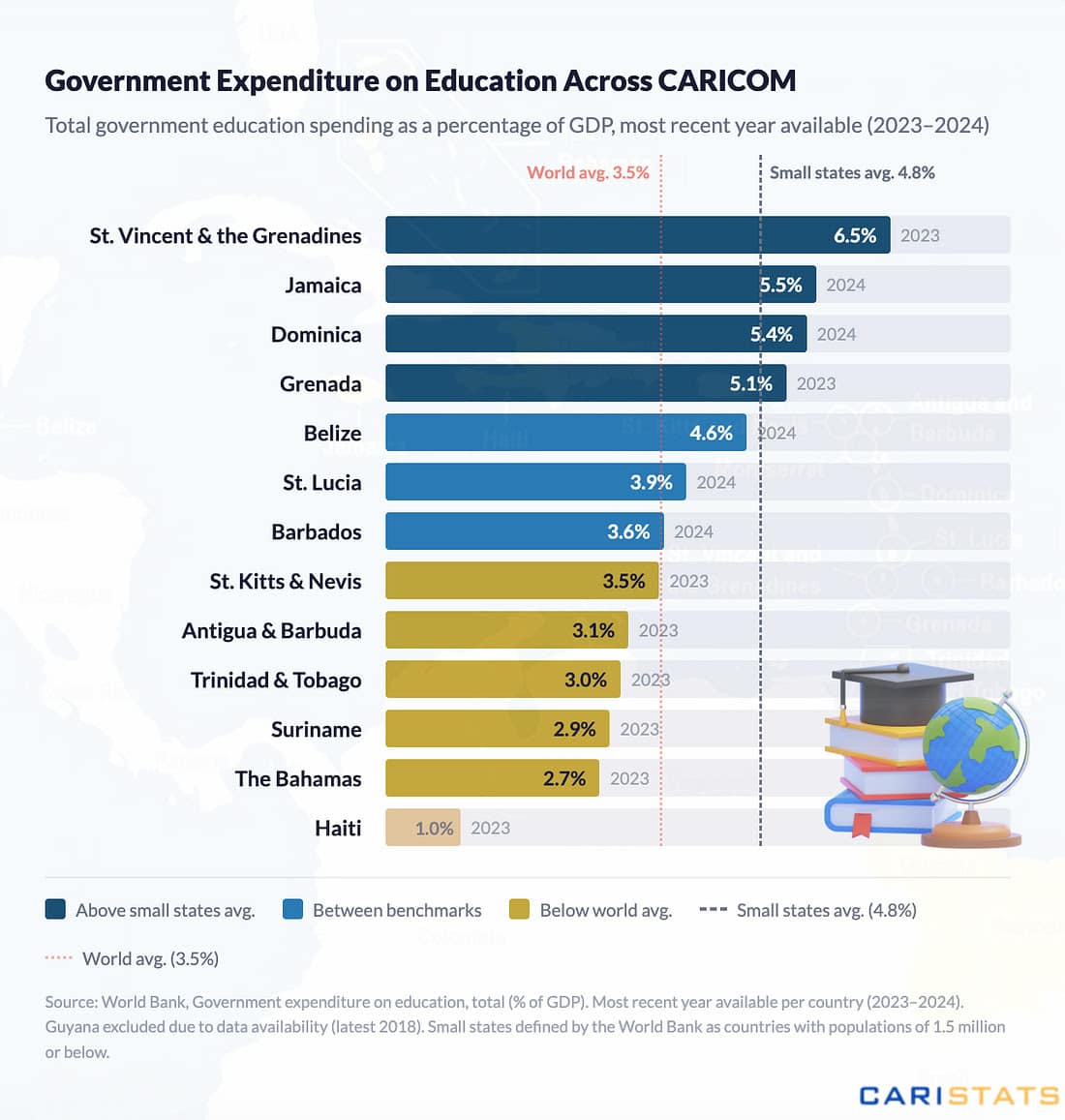
    A comprehensive analysis of education funding across CARICOM member states reveals significant disparities in governmental commitment to educational development. While seven nations exceed the global average expenditure of 3.5% of GDP, six member states plus Haiti—which allocates less than 1%—fall substantially below this international benchmark.

    Leading the regional education investment ranking is St. Vincent and the Grenadines with a notable 6.5% of GDP dedicated to education, followed closely by Jamaica (5.5%), Dominica (5.4%), and Grenada (5.1%). A middle cohort comprising Belize, St. Lucia, and Barbados maintains spending above the world average but below the 4.8% threshold recommended for small states facing structural challenges comparable to Caribbean nations.

    The lower investment tier includes St. Kitts and Nevis, Antigua and Barbuda, Trinidad and Tobago, Suriname, and The Bahamas, all falling short of the global average. Particularly concerning is Suriname’s dramatic education budget reduction, which has nearly halved from 5.5% to 2.9% since 2015 amid mounting fiscal constraints. Barbados and Trinidad and Tobago have similarly witnessed declines exceeding one percentage point during the same period.

    In contrast, Dominica and St. Vincent and the Grenadines have demonstrated increased educational investment since 2015. This financial data emerges as regional discussions have predominantly centered on educational outcomes including examination results, curriculum development, and instructional quality. The new expenditure analysis suggests that resource allocation and funding mechanisms warrant equivalent consideration in policy dialogues.

    Data sourced from World Bank records on government education expenditure (most recent 2023-2024 figures) excludes Guyana due to insufficient current statistics. The World Bank defines small states as nations with populations under 1.5 million, representing a relevant comparison group for Caribbean development strategies.

  • Bad Bunny and agriculture

    Bad Bunny and agriculture

    During one of the world’s most watched sporting events, the American football championship halftime show traditionally showcases technological marvels and consumer spectacle. However, this year’s performance by global artist Bad Bunny took a profoundly different approach, opening with powerful imagery of sugarcane fields and agricultural workers laboring under the sun.

    This visual statement on the global stage connected millions of viewers to a fundamental question that rarely receives prime-time attention: Who actually sustains the economic stability and daily functioning of our societies? The agricultural sector, despite being an economic and social pillar, typically remains invisible in dominant cultural narratives that prioritize urban perspectives.

    The symbolic choice of sugarcane imagery carries particular significance for Latin America and the Caribbean, where this crop embodies economic history, cultural identity, and social memory. Throughout the region, agriculture employs over 40 million people—approximately 14% of total regional employment—while serving as a critical source of food security, export revenue, and territorial sustainability.

    This cultural gesture arrives at a crucial moment when global supply chain vulnerabilities, price shocks, and trade tensions have elevated food production from a sectoral concern to a central component of international stability discussions. The performance highlighted the growing recognition that agri-food systems represent critical components of global economic resilience.

    The presentation also addressed a pressing generational challenge facing rural communities. Latin America experiences rapid aging of agricultural workers and persistent youth migration to urban centers, compounded by unequal access to financing, innovation, and connectivity for rural youth. Without generational renewal, productive continuity becomes compromised and social gaps widen.

    By placing agricultural workers at the center of his narrative, Bad Bunny challenged entrenched cultural hierarchies that equate modernity exclusively with urban development. The performance expanded agriculture’s symbolic space in popular culture, initiating conversations about work dignity, territorial inequality, and productive futures.

    This was not technical discourse or ideological proclamation but a powerful visual statement that resonated deeply in our stimulus-saturated society. For many viewers, it may have seemed merely an aesthetic introduction, but it fundamentally brought typically overlooked realities into the global frame, reminding audiences that contemporary wellbeing maintains rural, often invisible origins.

  • Police Warn Unlocked Doors and Poor Lighting Leave Homes, Businesses Vulnerable

    Police Warn Unlocked Doors and Poor Lighting Leave Homes, Businesses Vulnerable

    The Royal Police Force of Antigua and Barbuda has released a comprehensive security advisory urging heightened vigilance among residents and business operators amid concerns over preventable property crimes. Law enforcement officials emphasized that a significant majority of burglaries occur through unsecured entry points, with unlocked doors representing the most common vulnerability exploited by offenders.

    The advisory outlines a multi-layered approach to security enhancement, recommending the installation of robust deadbolt locking systems, solid-core or metal exterior doors, and specialized security rods for sliding doors. Beyond physical barriers, police highlighted the critical importance of strategic outdoor lighting equipped with motion sensors around all entry points and property perimeters as a primary deterrent against criminal activity.

    For commercial establishments, authorities prescribed additional protective measures including cash management protocols limiting on-premises currency storage, utilizing certified safes, and avoiding public cash counting. Business operators are further advised to implement comprehensive staff training programs covering emergency procedures, strict opening/closing protocols, and vigilance against suspicious individuals.

    The police framework emphasizes community collaboration as fundamental to crime prevention, encouraging neighborhood watch participation, mutual awareness among residents, and prompt reporting of unusual activities. This initiative forms part of ongoing community policing efforts designed to strengthen public awareness and reduce opportunities for criminal exploitation through coordinated preventive measures.