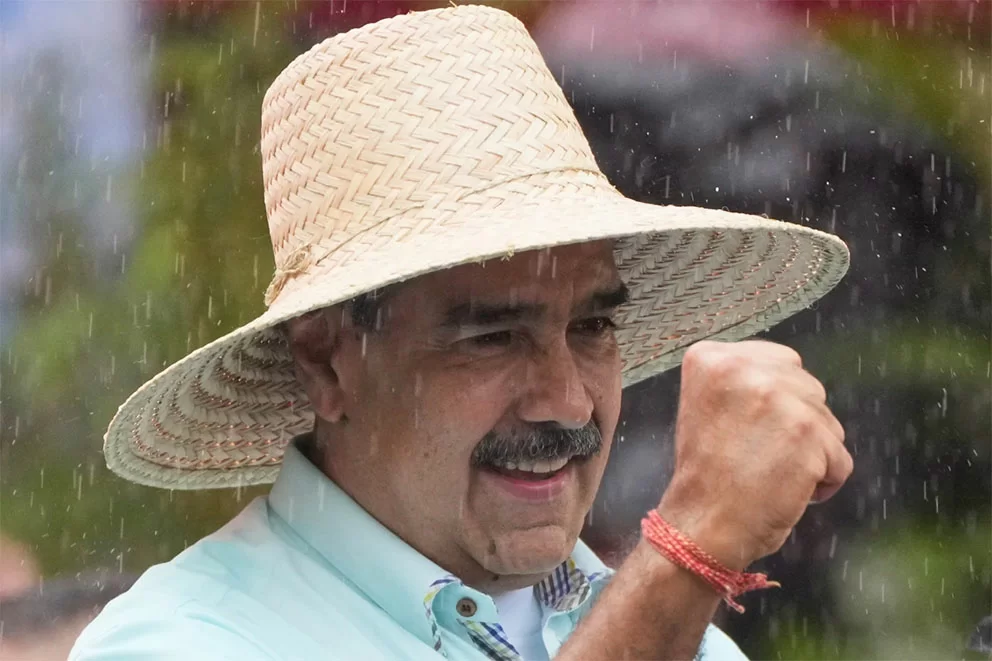
The United States is set to conduct a five-day military exercise in Trinidad and Tobago, beginning this Sunday, as confirmed by the Caribbean nation. This announcement follows last month’s deployment of a guided-missile destroyer to the region for training purposes, a move that Venezuela labeled as a ‘military provocation.’ According to the Financial Times, Trinidad and Tobago’s Attorney General indicated that the US plans to ‘intensify’ its military activities in the twin-island nation, located just miles off Venezuela’s coast. Foreign Minister Sean Sobers has denied that these exercises are a prelude to potential US military action in Venezuela, despite growing global concerns over US activities in the region. Prime Minister Kamla Persad-Bissessar has supported the US presence, contrasting sharply with Venezuela’s socialist leader Nicolas Maduro, with whom she has had public disputes. The drills will involve the US Marine Corps’ 22nd Marine Expeditionary Unit, which is already in the region to aid in disrupting illicit drug trafficking. Trinidad and Tobago’s government stated that the exercises aim to enhance tactical familiarity between US and local troops and to train local forces in handling domestic issues like drug-related crime and gang violence. The US has recently bolstered its naval presence in the Caribbean, including the deployment of the USS Gerald R. Ford aircraft carrier, prompting Venezuela to announce a ‘massive mobilization’ of its military in response. This escalation has led to fears of a potential larger conflict between the two nations. While the US claims its military buildup is aimed at combating drug trafficking, experts question the necessity of such significant firepower, noting that the USS Gerald R. Ford represents the largest US military presence in the region since the 1989 invasion of Panama. President Donald Trump has expressed that he believes Maduro’s days are numbered and has not ruled out the possibility of US land strikes on Venezuela. Earlier this week, Trump was reportedly presented with options for military operations within Venezuela, though he has yet to make a decision and has previously expressed reservations about military action aimed at ousting Maduro. Maduro has urged the US against conflict, emphasizing a message of peace to Trump.
分类: world
-

US Embassy: US Military ties run deep in Trinidad and Tobago
As US military personnel arrived in Trinidad and Tobago (TT) for a week-long training mission with the TT Defence Force (TTDF), concerns over escalating tensions with neighboring Venezuela have surfaced. The US Embassy, however, has sought to allay fears, emphasizing the longstanding security cooperation between the US and TT, which it claims benefits both nations and the broader region. This marks the second visit by the 22nd Marine Expeditionary Unit (MEU), deployed in the Caribbean since late August to combat suspected narco-trafficking. Their previous visit in October saw the USS Gravely, a guided missile destroyer, dock in Port of Spain, sparking accusations from Venezuela of provocation and collusion with US intelligence agencies. Foreign Minister Sean Sobers announced the return of the 22nd MEU for exercises in urban and rural settings, including nighttime helicopter operations. The rapid succession of US military activities in the region, coupled with recent airstrikes targeting drug smugglers, has raised eyebrows. While Washington frames its presence as a counter-narcotics effort, Venezuela’s President Nicolas Maduro views it as a threat. US President Donald Trump has hinted at further actions against Venezuela, though specifics remain undisclosed. TT’s government, led by Prime Minister Kamla Persad-Bissessar, has expressed strong support for US military actions, citing the country’s vulnerability to illegal drug and weapons trade from Venezuela. The US Embassy highlighted recent collaborations, including infrastructure upgrades and donations to a local school, as well as joint training exercises aimed at enhancing regional security. These efforts, the embassy asserts, underscore the enduring partnership between the US and TT, rooted in shared values and mutual defense goals.
-

Post-treaty tensions in Tobago
The Treaty of Paris in 1763 marked a significant moment for British control over Tobago, yet the aftermath was far from peaceful. The British administration faced immediate challenges, as France, though subdued at the negotiation table, harbored intentions to reclaim the island. Recognizing the precariousness of their position, the British prioritized security, understanding that their survival hinged on robust defenses. Their initial strategy involved increasing the British landowning population to bolster loyalty and defense against potential French incursions. However, this plan faltered, as the number of resident British landowners remained insufficient. The administration also established a militia to counter external threats, including French privateers and pirates, as well as internal resistance from the growing enslaved population. Despite these efforts, the island’s vulnerability persisted, particularly due to its numerous bays, which served as entry points for slavers and hideouts for pirates. The British sought to enhance security by appointing military ranks to defend the bays, but this proved inadequate given the limited human resources. Simultaneously, the administration focused on land division, creating plantations but neglecting essential infrastructure like roads. This oversight was later addressed through the imposition of a land tax and the enlistment of enslaved laborers for road construction. The ambitious plan aimed to connect the island’s parishes and improve communication, but progress was slow and hampered by resistance from enslaved Africans and the limited availability of qualified white men. Ultimately, the British administration’s inability to fortify Tobago’s defenses and establish effective communication networks left the island vulnerable. In 1781, France capitalized on these weaknesses, recapturing Tobago and dealing a significant blow to the British planting community.
-

World’s largest military aircraft carrier now in Caribbean Sea
The USS Gerald R Ford, the world’s largest military aircraft carrier, has arrived in the southern Caribbean Sea as part of a significant U.S. military build-up in the region. The deployment, led by the Gerald R Ford Carrier Strike Group (CSG), marks the largest military presence in the Caribbean in decades. While the U.S. government has framed the operation as a mission to combat narco-trafficking and dismantle transnational criminal organizations, it has also intensified pressure on Venezuelan President Nicolas Maduro, whom Washington views as an illegitimate leader facilitating illicit trade. The arrival of the CSG was confirmed in a November 16 statement, emphasizing its role in supporting the U.S. Southern Command’s (SOUTHCOM) efforts to counter narco-terrorism and protect the Homeland. Admiral Alvin Holsey, SOUTHCOM commander, highlighted the group’s readiness to address transnational threats destabilizing the region. The CSG will join forces already stationed in the Caribbean, including the Iwo Jima Amphibious Ready Group and the 22nd Marine Expeditionary Unit, as part of Joint Task Force Southern Spear. Rear Admiral Paul Lanzilotta, commander of Carrier Strike Group 12, described the USS Gerald R Ford as the most capable and lethal platform globally, deployed to safeguard national security and prosperity. The fleet’s presence coincides with the 22nd Marine Expeditionary Unit’s second visit to Trinidad and Tobago (TT) for joint training with the TT Defence Force (TTDF) from November 16 to 21. While TT’s Foreign Minister Sean Sobers defended the collaboration as essential for combating illegal drugs and weapons, Venezuelan President Maduro condemned the military exercises, warning they threaten regional peace. Maduro has accused the U.S. of seeking to overthrow him and called for public protests against the drills. This deployment follows the 22nd MEU’s first visit in October, which sparked similar condemnation from Caracas, leading to halted petrochemical deals with TT and the labeling of TT’s Prime Minister Kamla Persad-Bissessar as persona non grata.
-

Historic Capitals Unite: Tainan Signs Sister-City Pact with Basseterre
In a landmark event on November 14, 2025, Tainan City, Taiwan, and Basseterre, the capital of St. Kitts and Nevis, solidified their partnership by signing a sister-city agreement. The ceremony, held in Tainan, was attended by Prime Minister Hon. Dr. Terrance Drew of St. Kitts and Nevis, alongside Lady Drew, and Tainan Mayor Huang Wei-che. The agreement, signed by Mayor Huang and Ambassador Donya L. Francis, marks a significant step in fostering bilateral ties between the two historic cities. Prime Minister Drew lauded Tainan’s cultural heritage, emphasizing shared historical landmarks such as forts and the mutual appreciation for world-renowned mangoes. He also highlighted the educational exchange, with numerous students from St. Kitts and Nevis pursuing engineering studies in Tainan, contributing to their nation’s development. This pact paves the way for enhanced collaboration in culture, education, governance, and economic initiatives, strengthening the bond between Taiwan and St. Kitts and Nevis.
-

Security : «The GSF is dangerously underfunded» says Marco Rubio
During a regional security briefing in Canada on January 12, 2025, U.S. Secretary of State Marco Rubio highlighted the critical underfunding of the Kenyan-led security mission in Haiti. The mission, authorized by the United Nations Security Council Resolution 2793 on September 30, 2025, has deployed only 1,000 officers out of the required 5,500. Rubio emphasized the urgent need for increased financial and military support from the international community, stating that Kenya cannot manage the escalating violence in Haiti alone. The U.S. has funded the initial phase of the mission but called on other nations to contribute to the remaining months and provide additional personnel. Rubio described the situation as a ‘hemispheric crisis’ requiring shared responsibility, urging countries in the Caribbean and Latin America to step up. He also noted the establishment of a new United Nations Support Office and logistical structures managed by the Organization of American States (OAS), but stressed that the mission is now hindered by a significant funding gap. Rubio reiterated that the U.S. is in daily contact with potential troop-contributing countries and expressed gratitude for Kenya’s leadership while calling for greater regional participation to prevent Haiti from further descending into crisis.
-

Guatemala Issues Guidance on “Correct Use” of National Map Including Belize
In a significant move addressing a long-standing territorial dispute, Guatemala’s Ministry of Foreign Affairs has issued official guidelines on the ‘correct use’ of the national map, particularly in relation to Belize. The guidelines emphasize the representation of the Adjacency Line, which separates Guatemala from the territory currently administered by Belize, while the dispute remains unresolved at the International Court of Justice (ICJ).
The ministry mandates that all official maps must include the Adjacency Line, represented by a dotted line, accompanied by a safeguard note stating: ‘Diferendo territorial, insular y marítimo pendiente de resolver’ (‘Territorial, insular, and maritime dispute pending resolution’). This measure underscores the ongoing nature of the dispute and the need for accurate representation.
Furthermore, the guidelines specify the terminology to be used, prohibiting terms such as ‘border,’ ‘limit,’ ‘dividing line,’ ‘border zone,’ and ‘Belizean territory.’ Instead, the ministry instructs the use of ‘Línea de Adyacencia’ (Adjacency Line), ‘Zona de Adyacencia’ (Adjacency Zone), and ‘territorio administrado por Belice’ (territory administered by Belize). These directives aim to maintain clarity and neutrality in official communications.
The issuance of these guidelines reflects Guatemala’s commitment to formalizing its stance on the territorial dispute while awaiting the ICJ’s resolution. The move is expected to influence public and institutional practices, ensuring consistency in how the national map is portrayed.
-

FLASH : Terrorists killed and wounded, weapons and ammunition seized, PNH helicopter set on fire
On November 14, 2025, a significant police operation unfolded in Haiti’s Cul-de-Sac plain, involving specialized units, armored vehicles, and three troop transport helicopters. The operation, which began on the evening of November 13, led to intense clashes between law enforcement and terrorists, causing widespread panic among the local population. According to Divisional Inspector Garry Desrosiers, spokesperson for the Haitian National Police (PNH), at least seven terrorists were killed, and numerous others were injured. Authorities also confiscated several assault weapons and ammunition, including a high-precision .50 caliber American Barrett sniper rifle, known for its ability to penetrate thick steel plates at long distances. Notably, there were no casualties among the PNH officers. However, a PNH helicopter was destroyed during the operation. The aircraft, which was supporting ground units in the Croix-des-Bouquets area, experienced a suspected mechanical failure, prompting a forced landing. The eight officers on board were safely evacuated, and the helicopter was intentionally set on fire to prevent it from falling into terrorist hands. This operation underscores the ongoing challenges Haiti faces in combating terrorism and maintaining public safety.