分类: sports

  • World Cup nears kick-off after pre-tournament turbulence

    World Cup nears kick-off after pre-tournament turbulence

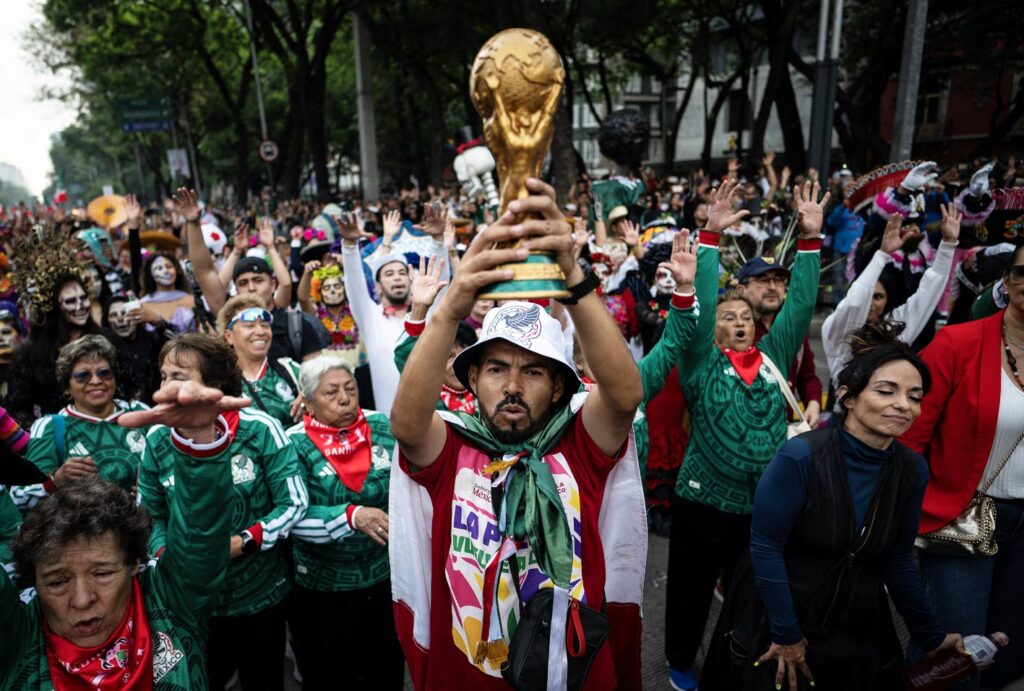
    MEXICO CITY — As the 2026 FIFA World Cup prepares to kick off Thursday, global football’s governing body is betting the tournament’s timeless global appeal will overcome mounting public anger over exorbitant ticket costs, tense political currents in the United States, and the lingering shadow of Middle East conflict. This edition makes history as the first World Cup co-hosted by three countries — the United States, Canada, and Mexico — drawing a record 48 competing nations and expected to attract millions of traveling fans. It is also the largest and most logistically challenging iteration of the tournament ever organized.

    The opening match will kick off at Mexico City’s legendary Estadio Azteca, where co-host Mexico will face South Africa to launch the nearly six-week event. The tournament will conclude with the final match on July 19 at MetLife Stadium, the 82,500-seat venue in New Jersey.

    Football fans around the world are already fixated on the season’s biggest unanswered questions. Will 38-year-old Lionel Messi cement his widely debated legacy as the greatest player of all time by leading Argentina to a back-to-back World Cup title? Can his long-time rival 41-year-old Cristiano Ronaldo defy age to lift Portugal to its first-ever World Cup championship? Or will Harry Kane lead England to end a 60-year drought, delivering the nation’s second major international title following its solitary 1966 World Cup win?

    FIFA President Gianni Infantino has aggressively promoted the tournament, touting it as “the greatest show that the planet has ever seen”. But his unbridled optimism has collided with fierce public skepticism in the months leading up to kickoff, as persistent concerns over affordability, political friction, and global conflict have overshadowed pre-tournament celebrations.

    The most dramatic point of contention has been the unprecedented spike in ticket prices, which sparked a widespread global backlash that has left FIFA and Infantino struggling to defend their pricing model to the public. For comparison, the highest face-value ticket for the 2022 World Cup final hovered around $1,600. For 2026, FIFA’s priciest face-value final ticket reaches a staggering $32,970. This dramatic price inflation runs across all 104 tournament matches: despite widespread reported demand for the event, many seats remain unsold on secondary resale platforms.

    Even Donald Trump, the U.S. president and a public ally of Infantino, has publicly pushed back on the costs. He expressed surprise when informed that tickets for the U.S. men’s national team’s opening match against Paraguay — the first World Cup match to be held on U.S. soil — carry a $1,000 price tag. “I wouldn’t pay it either, to be honest with you,” Trump told the *New York Post*.

    Beyond sticker shock for fans, critics have raised alarms that the tense political climate in the United States could cast a pall over the global tournament. Human Rights Watch argues that Trump’s administration’s crackdowns on immigration, public protest, and press freedom could shape this World Cup as an event defined by “exclusion and fear”.

    Those concerns gained new traction this week when FIFA removed Somali referee Omar Artan from the tournament roster after U.S. authorities denied him entry to the country. Artan was set to make history as the first Somali match official to officiate at a World Cup finals, but he was turned away upon arrival at Miami International Airport Saturday. FIFA confirmed it could not reverse the decision and announced Artan would be cut from the 52-person referee team.

    The February joint U.S.-Israeli military strikes against Iran have also created ongoing uncertainty, as Iran is scheduled to play three group stage matches in the United States, starting with an opener against New Zealand on June 15. Trump initially prompted outcry by suggesting Iran should withdraw from the tournament for their own “life and safety”, before later walking back the controversial comment.

    In response to the tensions, Iran has relocated its team base camp from Tucson, Arizona to Tijuana, Mexico, where the squad arrived early Sunday. While Iranian players retain the right to travel in and out of the U.S. for their scheduled matches, approximately 15 Iranian administrative and management staff have been denied visas by U.S. authorities. Iranian officials have decried the move as “deliberate and discriminatory treatment”.
  • The first 48-team World Cup — more opportunities, less jeopardy?

    The first 48-team World Cup — more opportunities, less jeopardy?

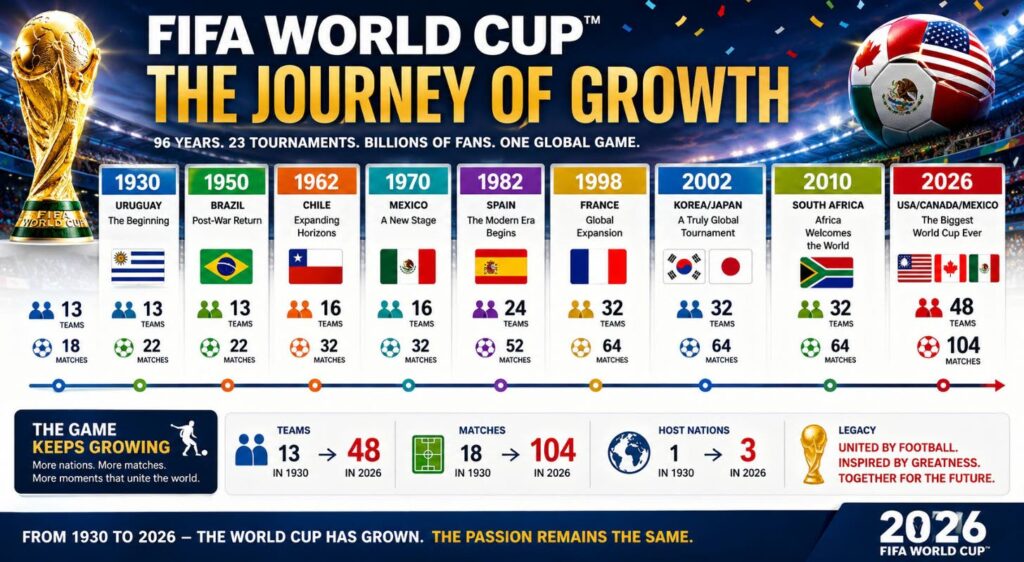
    When the 2026 FIFA World Cup kicks off across North America, it will make history as the first edition of football’s biggest global tournament to welcome 48 competing nations. The expansion, a years-long flagship pledge of FIFA President Gianni Infantino dating back to shortly after he took office in 2016, is reshaping the very fabric of the World Cup — opening doors for long-overlooked underdog nations while sparking fierce debate over whether the changes will erode the high-stakes tension that has defined the competition for decades.

    Infantino has long framed the expansion as more than a simple adjustment to tournament format: it is a mission to turn the World Cup into a truly inclusive global celebration, rather than a competition dominated by a handful of traditional powerhouses. For most of the tournament’s history, that criticism has held weight. From its early decades through the 16-team era, European and South American nations monopolized nearly all qualifying spots, leaving African, Asian and North American confederations with barely any representation. Even after expansion to 24 teams in 1982 and 32 teams in 1998, the imbalance persisted: 13 European nations qualified for the 2022 Qatar World Cup, while just five African nations secured spots, despite Africa being home to more than 50 FIFA member associations.

    The new 48-team format rebalances distribution of spots without stripping places from existing European qualifiers, boosting Europe’s total from 13 to 16, while Africa now claims 10 spots, Asia nine, South America and the North/Central American and Caribbean Confederation (Concacaf) six each, plus an additional spot for Oceania representative New Zealand. Most notably, the expansion clears a path for dozens of smaller nations to qualify for their first ever World Cup finals, opening a once-in-a-generation opportunity that many could only dream of before.

    Among these first-time qualifiers is tiny Caribbean island nation Curaçao, home to a population of just 160,000 — less than the capacity of many large European club stadiums. “Once every decade or every four years, a small country gets to spring a surprise,” said Curaçao head coach Fred Rutten, who told reporters he is already planning to pull off major upsets against the tournament’s traditional giants. Cape Verde, Jordan and Uzbekistan will also make their World Cup debuts in 2026, and the new format even gives these underdogs a far better shot at advancing beyond the group stage.

    Under the revised structure, the 48 teams are split into 12 groups of four, with the top two from each group plus the eight highest-ranked third-place teams advancing to a new 32-team knockout round. That means a single win in the group stage can often be enough to progress, a far lower bar than the 32-team format where only group winners and runners-up moved on. It is this change that has ignited the fiercest criticism from long-time football observers.

    Proponents, including FIFA’s head of global football development Arsène Wenger, argue the expansion is a natural step for a sport that continues to grow across every continent. “It’s a natural evolution. We want to make football global all over the world,” Wenger stated late last year, noting that 48 teams still represent less than 25 percent of FIFA’s 211 member associations, making it a far from unmanageable expansion.

    But critics warn the lower bar for advancement will eliminate the do-or-die tension that has produced some of the World Cup’s most iconic moments. In the 2022 Qatar World Cup, eventual champion Argentina suffered a shocking opening defeat to Saudi Arabia, throwing the team into a panic that turned into one of the most dramatic title runs in tournament history. Similarly, traditional giants Germany were eliminated in the group stage in both 2018 and 2022, producing heart-stopping drama for fans. Many analysts argue these upsets and early exits will become a thing of the past, as big teams can afford an early loss and still advance comfortably.

    Beyond the lost tension, the expanded format also adds extra strain on players, who already navigate a packed calendar of club and international competitions. The tournament now requires any team that wins the title to play eight matches, one more than the seven required under the 32-team format, with the 2026 tournament set to be played in the heat of a North American summer, raising the risk of fatigue and injury for top players who already compete dozens of times a season for their clubs.

    “The biggest problem with this is not really the quality, it’s the dilution of spectacle in the first round with eight third-placed teams to go through,” explained Jonathan Wilson, acclaimed author of *The Power and the Glory: A New History of the World Cup*, arguing the longer group stage could test fans’ patience and encourage more conservative, defensive play as top teams look to avoid injury and secure advancement without risk. Despite the criticism, top managers including England head coach Thomas Tuchel say teams are already adjusting to the new format, focusing primarily on navigating the expanded group stage safely to reach the knockout rounds.

    As the 2026 tournament approaches, the debate continues: is this the moment the World Cup finally becomes the truly global event it has always claimed to be, or has FIFA traded the competition’s signature drama for broader representation? Only matches on the pitch will answer that question.

  • FIVE-YEAR PUSH

    FIVE-YEAR PUSH

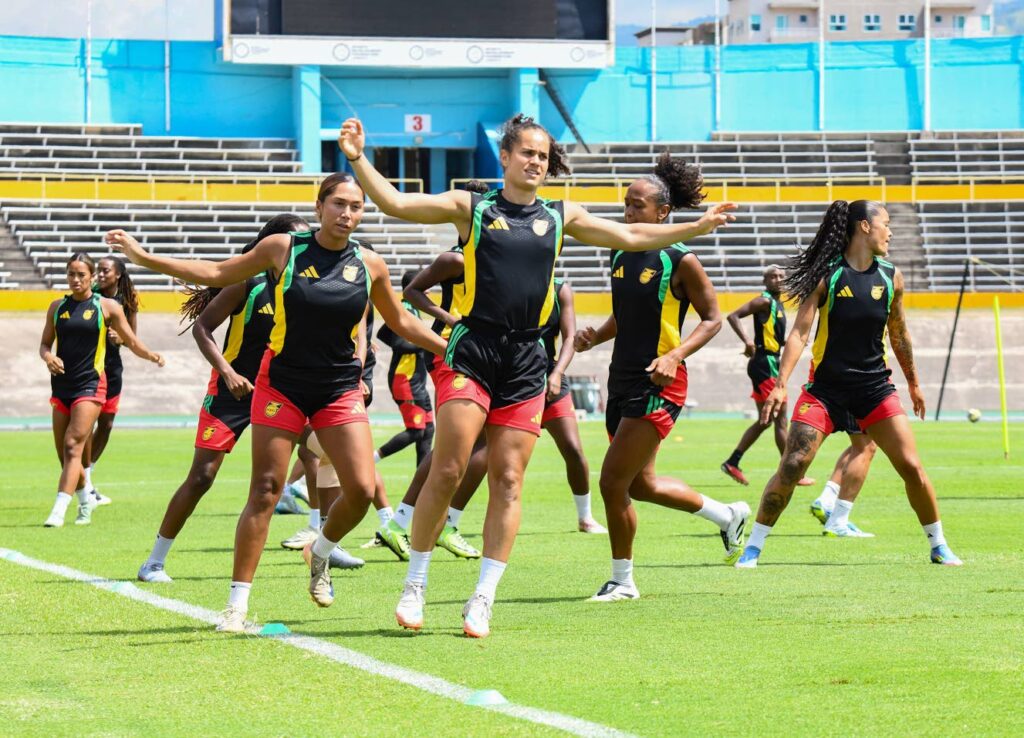
    Jamaica has launched a transformative five-year strategic framework to overhaul and grow women’s football across the country, with key leaders optimistic that the initiative will build a more robust, inclusive ecosystem for the sport by 2031 — the year Jamaica is set to co-host the FIFA Women’s World Cup.

    Unveiled this Monday in Kingston, the plan is a collaborative effort between the Jamaica Football Federation (JFF), global governing body FIFA, and Professional Women’s Football Jamaica Limited. Beyond outlining clear development targets, the strategy opens the door for Jamaica to access fully resourced support programs from FIFA to kickstart and implement each phase of the work.

    The strategic plan is structured around seven core focus areas: governance and leadership, grassroots youth development, competitive pathways for emerging players, technical skill building, national team advancement, long-term commercial sustainability, and workforce capacity building alongside athlete welfare.

    Carlene Edwards, who chairs the JFF’s Projects Committee for Women’s Programmes, has led much of the plan’s development. Edwards, a respected figure in Jamaican women’s football who previously served two years as chair of the Jamaica Women’s Premier League’s Marketing and Commercialisation Affairs Committee, was appointed to FIFA’s own Women’s National Competitions Committee in October 2024. She says a December 2024 FIFA Council meeting in Qatar was the catalyst that pushed her and JFF President Michael Ricketts to prioritize a comprehensive local strategy.

    “While working with the Jamaica Women’s Premier League, I realized we were not tapping into the full range of development programs FIFA offers,” Edwards explained in an interview with the Jamaica Observer. “I told Ricketts I would lead this work because strengthening the national strategy will directly lift up our domestic league too.”

    Edwards expressed visible enthusiasm for the milestone, noting that the plan incorporated feedback from a broad range of stakeholders during a dedicated workshop held weeks before the launch, with FIFA encouraging and pushing for the official public rollout. “To see this work go from initial documentation to a public launch has been incredibly rewarding,” she said.

    Across its seven pillars, the plan includes more than 50 distinct actionable initiatives, with three headline targets to achieve by 2031: a 50% increase in the number of registered female players nationwide, licensing for more than 200 new female coaches, and official qualification for 120 new female referees.

    Edwards acknowledged that systemic gaps remain — particularly a lack of age-group competitions that create a clear pathway for young female players to transition to the senior national level. But she emphasized that FIFA’s support, which includes direct funding for programs, removes many of the financial barriers that have held back development in the past. She also pointed to growing private sector engagement as a positive sign, noting that corporate sponsors have increasingly reached out to support the domestic women’s league following recent improvements. “It’s still challenging, and we are not where we need to be yet,” Edwards said. “But step by step, we will get there.”

    In total, Jamaica is set to receive more than US$265,000 in funding from FIFA through its targeted women’s development programs, a major injection of resources for the initiative. Andres Portabella, a FIFA consultant supporting the plan, expressed full confidence in Jamaica’s ability to meet its ambitious targets after meeting with local stakeholders.

    “What makes the difference here is people — you can see a dedicated team ready to leverage FIFA’s development programs and turn this strategy into real action,” Portabella said. “They are ready to turn this moment into impact for the domestic league, for grassroots players, and for coaches across the country. More women will get more opportunities, and over time we will see a far stronger women’s football ecosystem in Jamaica.”

    Elaine Walker-Brown, JFF Vice-President and Head of Women’s Football, has issued a call to action for all Jamaican football stakeholders to prioritize women’s development. Many volunteers leave the sport because it does not pay a full salary, Walker-Brown explained, noting that she herself works out of passion for the game. “Our parish associations already run men’s football effectively with volunteer leaders — there is no reason they cannot do the same for women’s development in every parish,” she said. “I am counting on local leaders to step up, and the JFF will hold parishes accountable for contributing to the growth of women’s programs.”

    To keep implementation on track, the JFF has announced plans to appoint a dedicated head of women’s football development before the end of the calendar year, who will oversee day-to-day execution of the 2026-2031 strategic plan.

  • BABA Premier League finals postponed again

    BABA Premier League finals postponed again

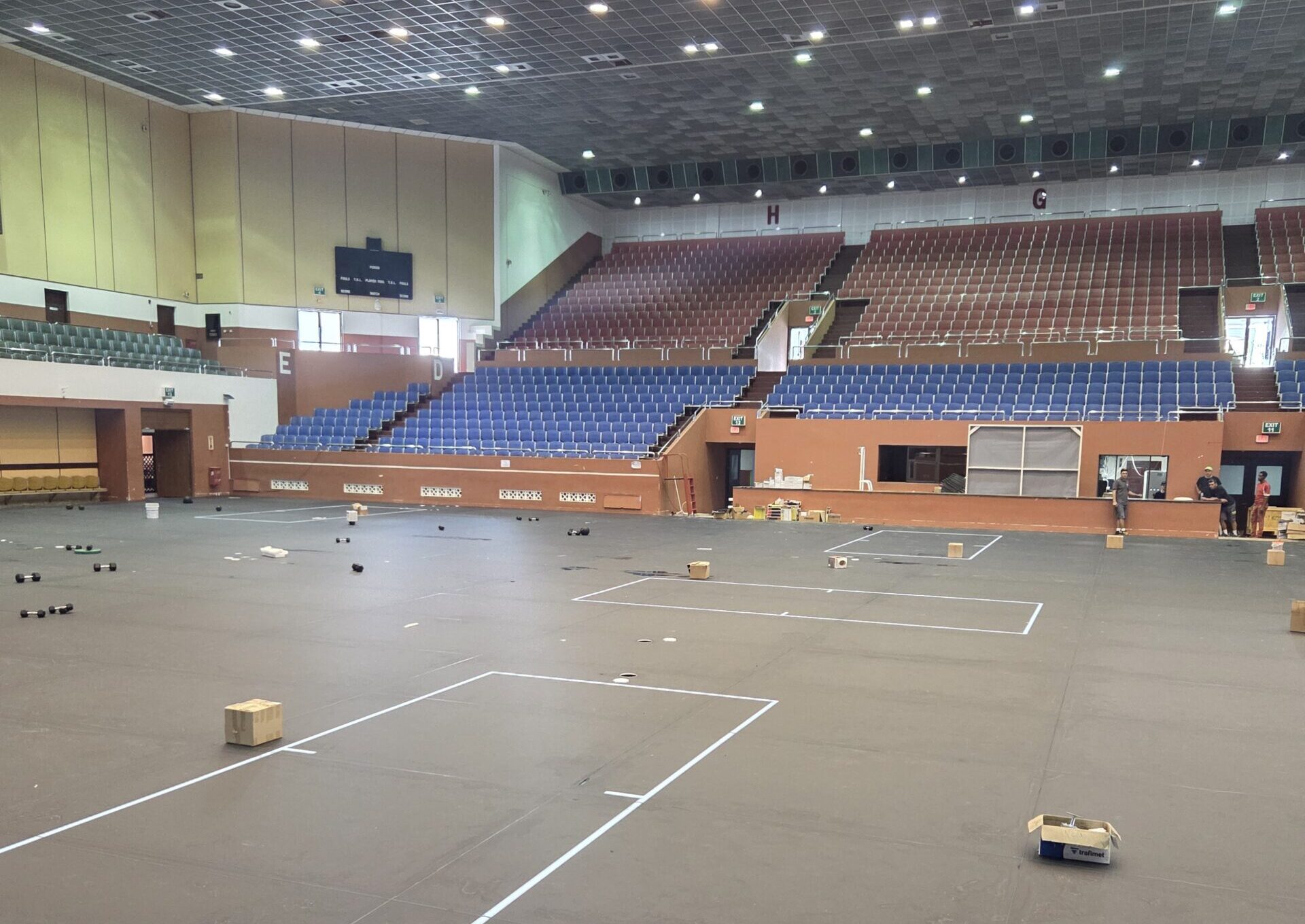
    One of the Caribbean’s most hotly anticipated domestic basketball championships has hit another roadblock, with organizers confirming a second major postponement of the Barbados Amateur Basketball Association (BABA) Co-Operators General Insurance Premier League finals. In an official public statement issued on June 8, the governing body announced the scheduling shift was explicitly designed to give the country’s senior men’s national squad uninterrupted time to gear up for the FIBA AmeriCup Pre-Qualifiers, a high-stakes regional tournament set to run from July 6 to 13, 2026 in Georgetown, Guyana. The domestic title round will not tip off until the entire national delegation returns to Barbados after the pre-qualifier event. This latest delay marks the third hold-up for the 2026 season, which has been plagued by logistical issues at the island’s only two purpose-built indoor basketball facilities: the Wildey Gymnasium and the Barbados Community College court. After the semi-final matchups wrapped on April 25, two teams punched their tickets to the championship: defending title holders Burger King Clapham Bulls and challengers CAM Smart Assurance City United Celtics. But the first scheduling hold-up came almost immediately, sparked by disputes over the newly installed playing surface at Wildey Gymnasium. Officials at the Celtics organization raised formal objections to the court markings on the new electronic floor, noting that key lines including the three-point arc were aligned to the dimension standards used in the U.S. National Basketball Association rather than the official measurements mandated by FIBA, the global governing body of the sport. Once those issues were partially addressed, organizers shifted the opening finals game to the Barbados Community College venue, but another technical problem derailed plans: a sudden total lighting failure left the court unplayable, crushing the expectations of fans and athletes who had already waited weeks for the championship round. With this latest postponement, the basketball community across Barbados is now left waiting again for a new official start date for the finals, which is expected to be announced once the national team’s pre-qualifier campaign concludes. Sports analysts across the region note that while the delay is frustrating for domestic fans, prioritizing the national team’s international qualifying push aligns with long-term goals for Barbadian basketball, which has been pushing to qualify for its first major FIBA continental tournament in recent years.

  • Barbados defeats Guyana in men’s rugby XVs

    Barbados defeats Guyana in men’s rugby XVs

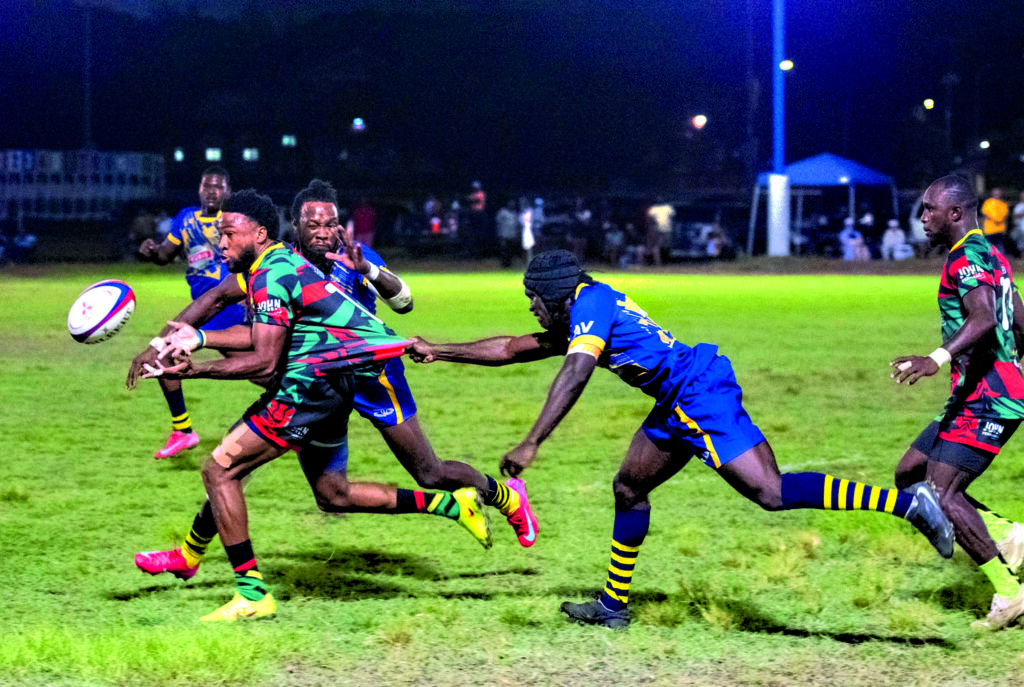
    On a blustery Saturday night under bright floodlights at the iconic Historic Garrison Savannah, Barbados’ men’s XV rugby team secured a dominant 21-3 win over Guyana, extending their winning streak against the regional opponent to two consecutive years.

    From the opening whistle, Guyana adopted an aggressive, physically intensive game plan, aiming to capitalize on any small mistake from the home side. This approach quickly resulted in a penalty try for Barbados’ Tyrese Prescod, putting the hosts on the scoreboard early. Unpredictable gusty winds turned every kicking attempt into a high-risk challenge for both squads, but neither side let the conditions slow their competitive pressure.

    Sixteen minutes into the matchup, Barbados’ Nicholas Daniel broke through Guyana’s defensive line to score a conventional try, pushing the home side into a 5-3 lead. Shortly after, a rule infringement by Guyana allowed D’Andre Phillips to slot a penalty, extending Barbados’ advantage to 8-3 – a margin that held through halftime.

    The second half opened with a series of determined offensive pushes from both teams, but strong defense and uncooperative winds kept the scoreboard unchanged for nearly 40 minutes. Even after Guyana received two consecutive yellow cards that left them short-handed, blustery conditions foiled every Barbadian penalty attempt. It was not until the 67th minute, when Guyana’s Renaldo Niles was sent off for an infringement, that Barbados finally added to their lead, with a successful penalty pushing the score to 11-3.

    Winger Sean Ward extended the home side’s lead shortly after, crossing the try line to put Barbados up 16-3, though the wind once again blocked the conversion attempt. With just 10 minutes left on the clock, substitute Daniel Ramsay entered the match, and four minutes later he sealed the victory with a late try, bringing the final score to 21-3.

    This win marks the second consecutive victory for Barbados over Guyana, following a far more lopsided 45-5 win in 2024. While Saturday’s margin of victory was far less dramatic than the previous matchup, the result still delivers a meaningful boost to Barbados’ standing in global rugby, moving the national side up to 59th place in the World Rugby Men’s rankings. Local fans turned out in strong numbers to support the home team at the historic venue, capping off a successful night for Barbadian rugby.

  • Cricket West Indies Announces Squad for T20 Series Against Sri Lanka in Jamaica

    Cricket West Indies Announces Squad for T20 Series Against Sri Lanka in Jamaica

    On Tuesday, June 9, 2026, Cricket West Indies (CWI) officially announced its 15-player squad for the upcoming three-match T20 International series against Sri Lanka, set to take place between June 11 and 14 at Kingston’s iconic Sabina Park in Jamaica. This home series marks the Caribbean side’s first T20I outing since their impressive run at the ICC Men’s T20 World Cup earlier this year, and it serves as a critical building block for long-term preparations ahead of the 2028 ICC T20 World Cup co-hosted by Australia and New Zealand.

    Three new faces have earned call-ups to the squad that competed in the 2026 World Cup, held across India and Sri Lanka, where the West Indies, popularly known as the Men in Maroon, narrowly missed out on a semi-final berth. Young batting prospects Ackeem Auguste and Jewel Andrew, alongside versatile all-rounder Shamar Springer, are the three inclusions that bring fresh depth to the side. Star fast bowler Alzarri Joseph has been rested from the series as part of CWI’s structured workload management strategy; he will remain in training to prepare for the upcoming two-match Test series scheduled to be held in Antigua.

    West Indies head coach Daren Sammy expressed optimism about the upcoming contests, noting that the series provides a valuable platform for emerging and established players alike to connect with home fans while displaying the aggressive, entertaining brand of cricket the region is known for. “This series is an important one for us as it’s our first since the World Cup in India, where the team played with passion, fight and the togetherness that West Indies cricket is built on,” Sammy said in the official announcement. “Our focus now is to build on those foundations, continue growing as a team and make our fans proud with the way we compete against Sri Lanka.”

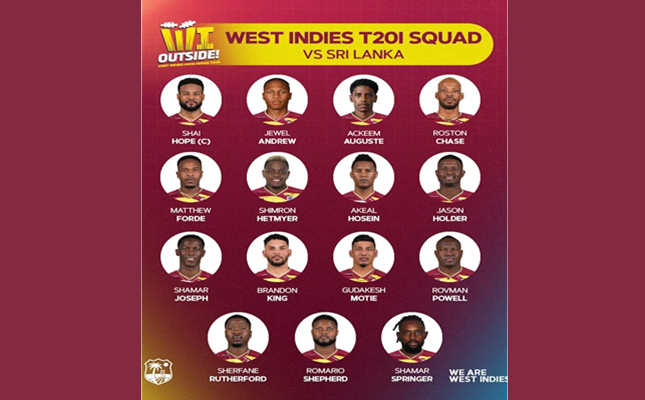
    Fast bowler Shamar Joseph, who exited the Caribbean side’s recent ODI tour of Sri Lanka early to attend to personal matters, is confirmed to rejoin the squad ahead of the series opener on June 11. The full 15-member squad led by captain Shai Hope includes: Jewel Andrew, Ackeem Auguste, Roston Chase, Matthew Forde, Shimron Hetmyer, Jason Holder, Akeal Hosein, Shamar Joseph, Brandon King, Gudakesh Motie, Rovman Powell, Sherfane Rutherford, Romario Shepherd, and Shamar Springer.

    Alongside the player squad, CWI also confirmed the full team management unit for the series, with Rawl Lewis serving as team manager, Floyd Reifer as assistant batting coach, Ravi Rampaul as assistant bowling coach, Rayon Griffith as fielding coach, Dr Denis Byam as physiotherapist, Darc Browne as strength and conditioning coach, Harone Jackson as massage therapist, Avenesh Seetaram as performance analyst, and Jerome Foster as content and media officer.

    All three matches of the series will be hosted at Sabina Park, with the first T20I kicking off at 7:30 pm local time (8:30 pm Atlantic Standard Time) on June 11. The second match will follow on June 13 at the same time, with the third and final series decider scheduled for June 14, also under lights at the Jamaican venue.

  • Football, Fans and Big Cash: The Rise of Belize’s ‘K Match’ Phenomenon

    Football, Fans and Big Cash: The Rise of Belize’s ‘K Match’ Phenomenon

    Belize’s sports landscape is undergoing a dramatic shift, driven by a fan-focused, cash-prize football innovation that has quickly captured the attention of young audiences across the country. The concept, dubbed the ‘K Match’, blends high-stakes amateur football competition with entertainment spectacle, creating a wholly new experience that stands out from traditional local sports events. This week’s *Sports Monday* broadcast breaks down how the trend took root and where it is heading, alongside updates on other major regional and local sports action.

    The K Match model draws inspiration from the high-viewership, big-payout structure of professional boxing exhibition bouts, reimagined for 11-a-side football. Instead of multi-tournament schedules, the format centers on a single, high-energy match between amateur teams, with a large cash prize awarded directly to the winning side. This stripped-back, high-stakes structure has proven to be a hit with spectators, packing stadiums and drawing crowds that far outpace attendance at typical local amateur football matches.

    The brainchild of Belmopan-based organizer Richie Galvez, the flagship 6K Match – named for its $6,000 top prize – was built around a deliberate focus on attracting young Belizeans, who make up nearly 70% of the event’s fanbase. Galvez explained that the 6K Match was designed to meet young audiences where they are, blending their love of sports, social media culture, public gathering, and personal expression into one accessible event. Unlike more expensive concerts or high-profile entertainment outings that are out of reach for many young Belizeans, the 6K Match offers an affordable space for attendees to showcase their personal style, create social media content, and participate in a growing cultural movement. What started as a single event has now evolved into a cultural staple for young sports fans across the country, Galvez noted.

    The runaway success of the 6K Match has inspired a wave of copycat events across Belize. One of the country’s most well-known football figures, Ian “Yellowman” Gaynair, recently launched a 4K Match – a $4,000 prize event held in Belize City – that drew 1,200 attendees, a number local observers called unprecedented for an amateur exhibition football match. Gaynair emphasized that Galvez’s model fills a gap in local sports, offering a safe, welcoming space for fans and giving amateur players a rare chance to feel like elite professional athletes for the day. Gaynair also noted that even long-time local football organizers have never seen such a large turnout for a standalone amateur match, confirming the broad appeal of the K Match format.

    Galvez’s most recent 6K Match at Belmopan’s FFB Stadium also drew a record crowd, prompting the organizer to formalize the brand: he has officially registered 6K Match as a legal business and secured a trademark for the name. While Galvez confirmed that the trademark means any unlicensed use of similar “K Match” branding could face legal action, he emphasized that his core mission is growing the sport of football across Belize, not blocking opportunity for young athletes and organizers. He also acknowledged that he personally provided guidance to Gaynair ahead of his 4K Match, supporting efforts to expand the model to new regions of the country.

    Beyond the rise of the K Match phenomenon, *Sports Monday* also shared results from several recent major sports competitions. At the 2026 Central America Senior Track and Field Championships held in Managua, Nicaragua, Belize’s 10-person delegation secured four bronze medals. Two bronze medals came on the first day of competition: one in the men’s 4x100m relay, where the Belize team finished in 45.8 seconds, and a second in the men’s 4x400m relay. On the second day of competition, Belizean sprinter Brandon Jones won two individual bronze medals: first in the 200m sprint with a time of 21.73 seconds, followed by a bronze in the triple jump with a 15.8-meter leap.

    In other local sports action, the annual Marconi Leal Fastpitch Softball Tournament continued over the weekend, with the Rednecks women’s team notching a lopsided 10-2 victory over Sand Hill De Trop in Friday night’s matchup. In national basketball, the NEBL playoffs officially tipped off over the weekend, with the Orange Walk Running Rebels securing an opening 86-68 win over the Cayo Western Ballers in their home opener. The playoff schedule continues this coming weekend, with Cayo hosting Orange Walk on Friday night and the Tiger Sharks facing off against the Defenders on Sunday.

  • Derde helft WK 2026: Welke sub-Sahara Afrikaanse landen maken de beste kans?

    Derde helft WK 2026: Welke sub-Sahara Afrikaanse landen maken de beste kans?

    For decades, North African nations have dominated African success at both the Africa Cup of Nations (AFCON) and the FIFA World Cup. But when Morocco made history in 2022 as the first African country ever to reach a World Cup semifinal, a new question began to dominate football discourse across the continent: could a sub-Saharan African nation finally break through to the latter stages of football’s biggest tournament at the 2026 World Cup, kicking off June 11?

    To date, Morocco’s 2022 run remains the best performance by any African side at a World Cup. Before that, only three other African nations had ever reached the quarterfinal stage of the tournament – and while three of those four quarterfinalists (Cameroon, Senegal and Ghana) are from sub-Saharan Africa, North African countries still hold the edge in major regional and global tournament success. Egypt leads all AFCON champions with seven titles, and Morocco, Tunisia and Algeria rank among the top five African nations for total World Cup qualifications. Ahead of the 2026 tournament, we break down the chances of top sub-Saharan contenders to outperform their North African rivals and make history this summer.

    ### Senegal
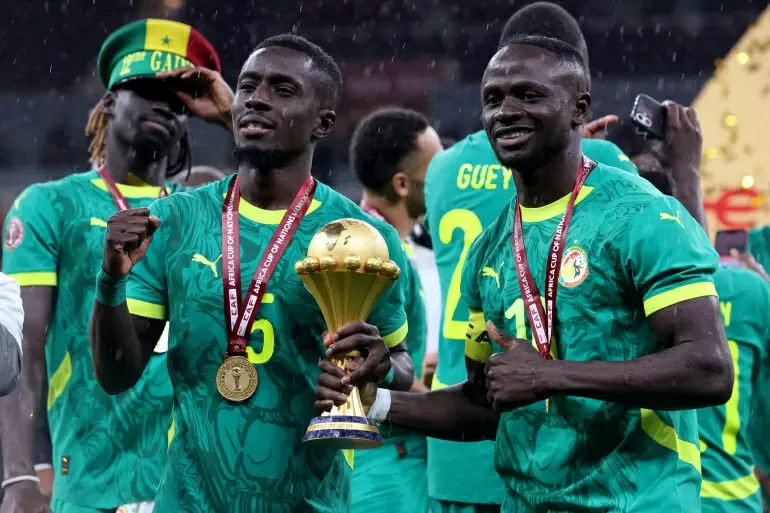
    With four prior World Cup appearances (2002, 2018, 2022, 2026) and a quarterfinal finish as their best result, Senegal currently ranks 14th in the FIFA global rankings, and analysts are predicting another quarterfinal exit for the Teranga Lions this year. But the side enters the 2026 tournament with a fiery chip on their shoulder: the team was stripped of their 2025 AFCON title after abandoning the January final over an on-pitch dispute, with the Confederation of African Football (CAF) ruling the match forfeit and awarding the title to Morocco. Stars Idrissa Gueye and Sadio Mane have openly stated the team is hungry to take revenge for that controversial outcome with a deep run in 2026.

    Senegal first shocked the world on their World Cup debut in 2002, storming to the quarterfinals. More than two decades later, expectations for the side are higher than for any other African nation competing this year. Senegal’s biggest strength is its squad depth, led by a roster of world-class talent including forward Sadio Mané, midfielder Pape Gueye, goalkeeper Edouard Mendy and captain Kalidou Koulibaly – all of whom were born in France. Their head coach, Pape Bouna Thiaw, who also grew up in France, has left no question about his team’s ambition: “If I ever lose even a moment of belief that we can win the World Cup with Senegal, I will step down immediately.” Senegal will open their Group I campaign against defending champion France on June 16 in New York, with Iraq and Norway rounding out the group.

    ### Ghana
    Ghana is making its fifth World Cup appearance (2006, 2010, 2014, 2022, 2026) after missing only one tournament since its 2006 debut. The Black Stars reached the quarterfinals in 2010, becoming just the third African nation to hit that milestone, and currently hold the 74th spot in the FIFA rankings, with analysts forecasting a quarterfinal exit this cycle.

    Ghana’s road to qualification was rocky, marked by a late managerial change after a string of poor results. Veteran Portuguese coach Carlos Queiroz – who has previously managed national sides South Africa and Egypt, and held top jobs at European giants Real Madrid and Manchester United – stepped in to lead the side, marking his fifth consecutive World Cup at the helm of a national team. Ghana has been drawn into Group L, widely labeled a “group of death” alongside Panama, England and Croatia. Despite the tough draw, the side’s attacking firepower, led by Manchester City’s Antoine Semenyo, has given fans hope they can advance out of the group. Unfortunately for Ghana, star midfielder Mohammed Kudus will miss the entire tournament due to injury.

    ### Ivory Coast
    Ivory Coast is returning to the World Cup after a 12-year absence, having last competed in 2014. The side fell into a rebuilding period after the retirements of legendary stars Yaya Touré and Didier Drogba, but that rebuild has already yielded two AFCON titles since their last World Cup appearance. The Elephants have made four total World Cup appearances, with their best result being an early group stage exit, and currently rank 34th in FIFA rankings, with analysts projecting a quarterfinal exit in 2026.

    Ivory Coast’s young, dynamic attack, featuring emerging talents Yan Diomande, Brighton’s Simon Adingra and Manchester United’s Amad Diallo, is expected to carry the side this year. The team proved its ability to turn adversity into success two years ago, when they hosted AFCON and looked set for an early group stage exit before a mid-tournament coaching change sparked a miracle run to the title. Now, head coach Emerse Fae says the side has its sights set on another historic run: “Why not aim for the final?”

    ### Cape Verde
    Cape Verde is making its World Cup debut in 2026, and with a population of just under 600,000, it will go down as one of the smallest nations ever to qualify for the tournament. The side only made its AFCON debut in 2013, and reached the quarterfinals of the regional tournament in 2023. Cape Verde currently ranks 69th in FIFA rankings, and analysts predict an early exit in the group stage, where they will face Uruguay, Saudi Arabia and European champion Spain in what is widely viewed as one of the toughest groups of the 2026 tournament. Despite the odds, the side has grown in confidence in recent years, says head coach Bubista, who was named 2025 African Coach of the Year: “We now truly believe in our potential, and that has given us the courage to take on any opponent.”

    ### South Africa
    South Africa is making its fourth World Cup appearance (1998, 2002, 2010, 2026), with a quarterfinal finish never yet on its resume. The side has struggled through a decades-long slump after qualifying for its first tournament in 1998, so its 2026 return after 16 years away from the World Cup has been a long-awaited moment for South African football. South Africa currently ranks 60th in FIFA rankings, with analysts projecting an exit in the round of 16. The squad draws deep experience from its core of players from top domestic clubs Mamelodi Sundowns and Orlando Pirates, and head coach Hugo Broos says the recent African Champions League title success for Sundowns has given the entire side a major confidence boost. South Africa has been drawn into a second “group of death” alongside Czech Republic, South Korea and co-host Mexico, who they will face in their opening match.

    ### DR Congo
    The Democratic Republic of Congo, formerly known as Zaire, made history as the first sub-Saharan African nation to compete at a World Cup back in 1974, but left that tournament with three lopsided defeats. Now, 52 years later, the side is back at the World Cup for just its second appearance, entering the 2026 tournament as the reigning AFCON champion. DR Congo currently ranks 46th in FIFA rankings, with analysts forecasting a quarterfinal exit this year. Most of the squad’s players were born and raised in Europe, including Manchester United defender Aaron Wan-Bissaka, and the side heads to the tournament with high hopes. For head coach Sebastien Desabre, just qualifying is already a generational milestone: “We are extremely proud that a generation now gets to experience the World Cup.”

    As the 2026 tournament approaches, all eyes will be on these sub-Saharan sides to see if one can finally surpass the historic benchmark set by North African teams and become the first African nation to reach a World Cup final.

  • Wesley Hall secure big win in NSC Football competition

    Wesley Hall secure big win in NSC Football competition

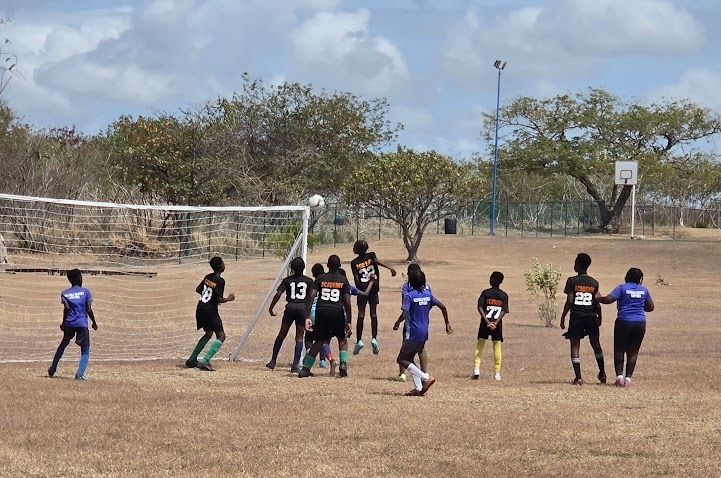
    The annual National Sports Council BICO Primary School Football Competition has advanced into its next phase, with thrilling matches played across four zonal brackets this week, delivering a mix of lopsided blowouts and tense, last-minute finishes from youth squads across the country.

    In the Keith Grell Griffith Zone, Wesley Hall Primary put on an offensive masterclass, netting five unopposed goals to secure a dominant 5-0 shutout victory over Al Falah School. The zone’s second fixture was a far more tightly contested affair, with Westbury Primary holding off a late comeback push from Trinity Academy to claim a narrow 3-2 win.

    Matches in the Reginald Haynes/Victor Gas Clarke Zone, hosted at the Blenheim playing grounds, opened with St Giles Primary securing a solid 2-0 win against George Lamming Primary. Wilkie Cumberbatch Primary followed that performance with a 4-0 shutout of St Patrick’s Roman Catholic School, while Belmont Primary outscored Charles F Broome Memorial 4-2 in a high-scoring back-and-forth clash. Two other fixtures in the zone ended in all-square results: Belmont Primary and St Ambrose Primary split points after a 1-1 draw, and neither St Cyprian’s Boys nor Luther Thorne Memorial managed to find the back of the net, finishing with a 0-0 stalemate.

    The Kenville Kab Layne Zone produced the tournament’s joint-biggest win of the matchweek, as St George Primary cruised to a comfortable 5-1 victory over a outmatched St Judes Primary. Mount Tabor Primary turned in a clinical defensive and offensive performance to beat Ellerton Primary 3-0, while Hitz 106.1 FM Bay Primary pulled off a narrow 3-2 upset win over Eagle’s Academy.

    Down at the Briar Hall playing fields for matches in the Ricardo Mickey Gibson Zone, three fixtures ended in drawn results. Wills Primary and St Christopher’s Primary finished level at 1-1, while last year’s tournament runners-up Arthur Smith Primary also tied 1-1 against Milton Lynch Primary. St Lawrence Primary and People’s Cathedral Primary similarly split points with a 1-1 result. In other zone matches, Shirley Chisholm Primary notched a clean 3-0 win over St Bartholome’s Primary, and St Winifred’s School edged out St Gabriel’s Primary by a 2-1 final score.

    At King George V Park, three matches kicked off in the Adrian Donovan/Michael Foster Zone. St Martin’s Mangrove Primary received a default 3-0 win after Bayley’s Primary was unable to field a full squad for the fixture. Blackman & Gollop Primary and Hilda Skeene Primary played to a 1-1 draw, while Gordon Walters Primary and Reynold Weekes Primary also finished all-square with an identical 1-1 result to close out the week’s matchday action.

  • Preparation for Brazil 2027 : Victory for Grenadières [3-1] against Equatorial Guinea (video)

    Preparation for Brazil 2027 : Victory for Grenadières [3-1] against Equatorial Guinea (video)

    On June 9, 2026, Haiti’s senior women’s national football team, the Grenadières, picked up a confidence-boosting 3-1 victory over Equatorial Guinea’s Nzalang in their final preparation friendly at Spain’s El Mauli Stadium, located in Antequera, Malaga Province. The fixture marked the second and last warm-up match for the Grenadières ahead of the final round of qualifiers for the 2027 FIFA Women’s World Cup hosted by Brazil, which will run from June 24 to July 25 next year.

    Sweden’s Pia Sundhage, who recently took the helm as head coach of the Grenadières, fielded a adjusted starting XI for the clash, making four changes from the side that defeated New Zealand 2-1 in the first warm-up fixture. In defense, Bethina Petit-Frère and Milan Pierre-Jérôme replaced Kethna Louis and Tabita Dougenie Joseph; attacker Chelsea Domond came in for Darlina Florsie L. Joseph, while midfielder Anyssa Ibrahim earned a starting spot in place of Sherly Jeudy. The full starting lineup featured goalkeeper Oceane Toussaint of Paris Saint-Germain, defenders Betina Petit-Frère (En Avant Guingamp), Claire Constant (DC Power FC), Jennyfer Limage (RC Lens), and Milan Pierre-Jérôme (UNGERN), midfielders Anyssa Ibrahim (Le Man FC) and Melchie Daëlle Dumornay (OL Lyonnes), and attackers Chelsea Domond (En Avant Guingamp), Roseline Eloissaint (FC Nantes), Nerilia Mondesir (Seattle Reign FC), and Lourdjina Étienne (FC Fleury).

    Ranked 47th in the global FIFA rankings, the Grenadières dominated the 90-minute fixture from the opening whistle against their 90th-ranked opponents. The first half saw Haiti take a commanding lead by halftime: rising star Melchie Daëlle Dumornay, popularly known by her nickname “Corventina”, broke the deadlock in the 25th minute to put Haiti up 1-0. Just five minutes later, Lourdjina Étienne converted a rebound to double the Grenadières’ lead, sending the side into the halftime break with a comfortable 2-0 advantage.

    After the interval, the Grenadières extended their lead in the 55th minute, when Étienne’s through ball set up Dumornay for her second goal of the match, putting Haiti up 3-0. Equatorial Guinea avoided a shutout in the 85th minute, when Reina Nñegue scored a late consolation goal to lock in the final 3-1 scoreline.

    Team analysts note this victory carries meaningful weight for Haiti’s preparation ahead of the final qualifying phase, which kicks off in November. The friendly allowed Sundhage and her staff to test new lineup combinations, assess the team’s current progress, and identify areas for improvement ahead of the high-stakes qualifying matches, helping the side maintain positive momentum as they continue their World Cup journey.