
The Bendals community breathed a collective sigh of relief as 28-year-old Merlissa Jhero, who had been missing for nearly three weeks, was confirmed safe and in good health. Jhero was last seen on October 14, sparking widespread concern and prompting extensive search efforts led by both the community and local authorities. On Saturday, a family member shared the welcome news on social media, stating, ‘Merlissa Jhero has reached out confirming she is safe… We are very grateful that she is safe.’ The family also took the opportunity to encourage others to communicate their whereabouts to loved ones if they ever need time away, emphasizing the importance of sparing relatives from unnecessary worry and stress. While police are expected to conduct routine follow-up inquiries, the focus for now remains on the joy and gratitude felt by the community. Residents expressed their relief, simply thankful that Jhero has been found unharmed.
分类: society
-
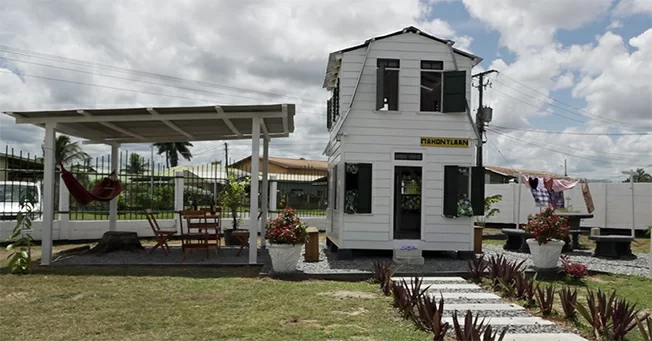
Traditioneel miniatuurhuis wordt ontmoetingsplek bij SAO
The Foundation for Labor Mobilization and Development (SAO) has inaugurated a cultural-historical meeting space on its premises in Geyersvlijt, Suriname. The centerpiece of this new community hub is a miniature wooden house, ‘SAO Oso Tori Oso,’ crafted by students from the Construction and Mechanical Woodworking Vocational School. The house, previously managed by the cultural organization NAKS, was officially dedicated during a festive ceremony. This initiative is part of a newly designed plaza intended to serve as a central gathering spot for local residents, students, and visitors. The space showcases traditional Surinamese artifacts (fosten sani), offering a glimpse into the nation’s cultural heritage. The project was realized in collaboration with the foundation Under the Blue Surface and funded with support from the Netherlands. Deputy Minister Raj Jadnananding (Health, Welfare, and Labor) and SAO Director Joyce Lapar presided over the opening ceremony, as reported by the Suriname Communication Service. During the event, ten senior residents were honored for their contributions to the community, receiving gift packages and snacks courtesy of the Lions Club Parwani. ‘This building is a piece of our history,’ remarked one of the honorees. The SAO, which will celebrate its 45th anniversary in 2026, provides vocational training for youth, adults, and seniors. Lapar emphasized that the new meeting space aims to foster community connections and spark interest in educational opportunities. The venue can accommodate gatherings of up to thirty people and will host workshops and themed events, including a Mental Health Day on October 22. ‘With knowledge, you build not just a house but also yourself,’ Lapar stated, urging the public to take advantage of SAO’s retraining and upskilling programs.
-

Matthew: Derelict Properties Are ‘Havens for Criminals and Rodents’
In a passionate address during Thursday’s parliamentary debate on the Tax Administration and Procedure (Amendment) Bill 2025, St. John’s Rural South MP Daryll Matthew highlighted the urgent need to tackle abandoned and decaying buildings across the island. Describing these structures as ‘havens for criminals and rodents,’ Matthew emphasized their detrimental impact on public health and community safety. He revealed that a recent survey in the Lower Ottos area of his constituency identified 151 abandoned properties, many of which are overrun with vegetation, vermin, and criminal activity. ‘These properties have become havens for criminals and hotels for rodents,’ Matthew stated. ‘We have an opportunity to turn what is now decay into development — to turn a nuisance into something nice.’ The MP argued that the new legislation provides the government with the necessary tools to address derelict properties, which have long been eyesores and public health hazards. He proposed that properties acquired through the process could be converted into green spaces, playgrounds, or housing lots, particularly for residents living near the abandoned sites. Matthew also suggested the introduction of an escrow system to protect the proceeds of property sales in cases where an owner or heir later reappears, and recommended waiving stamp duty for buyers who purchase derelict lots through public auction to encourage redevelopment. ‘This is a chance to improve the quality of life for everyone,’ Matthew concluded. ‘We have been elected to solve problems, not allow them to rot in our neighborhoods.’ The Tax Administration and Procedure (Amendment) Bill 2025 passed later that day with the government’s majority support, marking a significant step toward community revitalization and public safety.
-
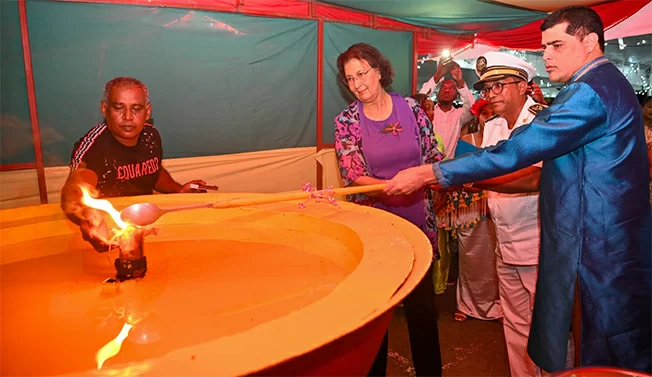
President roept op tot nationale verbondenheid bij Diváliviering in Saramacca
On Friday, President Jennifer Simons inaugurated the Diváli celebrations in the Saramacca district by lighting a symbolic dia at the district commissioner’s office in Groningen. The ceremony was attended by prominent figures, including Parliamentary Chairman Ashwin Adhin, Minister Lalinie Gopal, District Commissioner Aniel Ramautar, Assembly Member Jayant Lalbiharie (NDP), and Indian Ambassador Subhash Gupta. Diváli, the Festival of Lights, is globally recognized as a celebration of light triumphing over darkness. In her address, President Simons urged society to translate this symbolism into social unity. ‘Although Suriname observes multiple light festivals, there is one source: divine light. Let us be a light for one another. Our nation needs direction, connection, and inner strength,’ she emphasized. The dia was jointly lit by President Simons, Chairman Adhin, and Commissioner Ramautar. Speakers unanimously highlighted the importance of reflection, love, and community spirit during times of societal challenges. Commissioner Ramautar described the flame as ‘a symbol of hope and collective willpower,’ while Ambassador Gupta called for spiritual purification and the renewal of moral values. The National Diváli Manifestation will take place tonight at Independence Square.
-
Traffic management for the Oistins We Gatherin’ jump
The National Cultural Foundation, in partnership with ‘We Gathering’ Christ Church, is set to host a vibrant Nighttime Concert and Street Party along Oistins Main Road in Christ Church on Saturday, October 18. To accommodate the event, significant traffic adjustments will be implemented starting at 5:40 pm and lasting until the event concludes. Key road closures will be in effect from 5:40 pm to 10:30 pm, specifically on Oistins Main Road from its intersection with Oistins Hill to the junctions of Keizer Hill and Thornbury Hill. Exemptions will be granted to Transport Board Buses, Public Service Vehicles, and individuals conducting business at the fish market, though exiting vehicles must turn right onto Oistins Road. Motorists traveling east along Oistins from Maxwell Road are required to turn left at Oistins Hill, right onto Church Hill, and proceed to Thornbury Road. Those heading west along Keizer Hill must turn right at Thornbury Hill and Oistins Road, then left onto Church Hill, continuing to Canevale Road. Parking restrictions will be enforced on Oistins Road, Oistins Hill, Church Hill Road, and Thornbury Road, with exceptions only for passenger pick-up or drop-off. Violations of these rules may result in a $500 BDS fine or up to three months of imprisonment. Emergency vehicles and those operated by the Barbados Police Service, Barbados Defence Force, and Barbados Fire Service are exempt. Police officers will be stationed to manage traffic, and the Barbados Police Service has expressed gratitude for the public’s cooperation and understanding, apologizing for any inconvenience caused.
-

Domestic Violence in Belize: Recognising the Red Flags Before It’s Too Late
Domestic violence remains a pressing issue in Belize, with alarming statistics revealing 1,453 reported cases as of August 2025. Among these, over 1,000 involved intimate partner violence, with 1,089 victims identified as women. Young adults aged 25 to 29 were the most affected, highlighting the vulnerability of this demographic to abusive relationships. Sheena Gentle, First Vice President of Haven House, a prominent organization dedicated to supporting survivors and advocating for systemic change, is urging individuals to recognize the early signs of abuse. Haven House has been actively working to improve the handling of domestic violence cases in courts, enhance survivor support, and ensure perpetrator accountability. Gentle outlined five critical red flags indicative of abusive relationships. The first is excessive control, where a partner monitors your movements and demands constant updates. The second is isolation, where a partner criticizes or severs your connections with family and friends. Jealousy and possessiveness, the third sign, involve frequent accusations and overreactions to harmless interactions. Emotional manipulation, including gaslighting, is the fourth red flag, where a partner undermines your confidence by distorting your thoughts and feelings. The final sign is love bombing, where a partner overwhelms you with affection initially, only to later withdraw it and exert pressure. Gentle emphasized that these are just a few of the many warning signs in unhealthy relationships. She advised individuals to trust their instincts and seek support if something feels off. For those in need of assistance, resources are available through Haven House, the National Women’s Commission, and the Gender-Based Violence Unit.
-
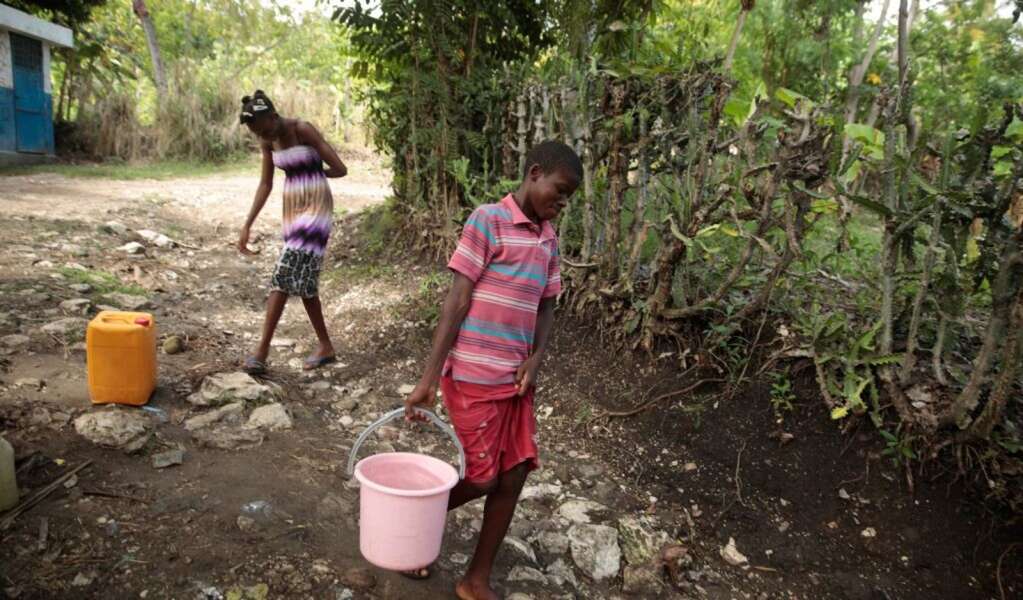
Caribbean’s poor face growing climate threat – UN report
A recent report by the United Nations Development Programme (UNDP) and the Oxford Poverty and Human Development Initiative highlights the severe challenges faced by Caribbean nations, where deep inequalities and escalating climate risks are converging. The 2025 Global Multidimensional Poverty Index, titled ‘Overlapping Hardships: Poverty and Climate Hazards’, underscores the dual burden of poverty and environmental threats in Small Island Developing States (SIDS). Approximately 23.5% of the population in SIDS, or 13.6 million people, live in multidimensional poverty, which encompasses not only income but also access to education, health, housing, sanitation, and energy. While countries like Trinidad and Tobago and Cuba have achieved significant progress, with less than 1% of their populations living in poverty, Haiti remains one of the most impoverished nations globally, with over 40% of its population experiencing severe deprivations. The report also highlights regional disparities in Guyana, where poverty rates range from 0.1% to 23%. Common issues across the Caribbean include lack of clean cooking fuel, poor sanitation, inadequate housing, and unreliable electricity. Climate change exacerbates these vulnerabilities, with rising sea levels posing existential threats to low-lying coastal communities. The UNDP calls for integrated policies that address poverty reduction, climate adaptation, and sustainable development, emphasizing the need to prioritize both people and the planet to build resilient communities.
-
The moving finger writes
The phrase ‘This too shall pass’ often serves as a resigned yet hopeful reminder during overwhelming times. For many in Trinidad and Tobago (TT), the anticipation surrounding last week’s significant events has now crystallized into either unbridled joy or profound disappointment, depending on individual perspectives and circumstances. The recent budget reading, delivered last Monday, brought mixed reactions. While some sectors celebrated, the arts community was left puzzled by vague promises. The budget briefly mentioned plans to ‘expand cultural industries through a Creative Value-Chain Fund,’ supporting film, fashion, design, and music, alongside enhanced intellectual property (IP) protection and duty concessions. However, the lack of detail has left artists and creatives anxiously awaiting further clarification from the Ministry of Community Development and the Arts. The grouping of arts practice and people development within one ministry is a positive step, acknowledging their symbiotic relationship. Yet, concerns arise as tourism and trade increasingly overlap with culture. Proposals for a year-round Carnival city, driven by the Ministry of Trade and Tourism, risk prioritizing economic gains over cultural authenticity, potentially undermining the essence of TT’s vibrant traditions. The arts fraternity is currently in despair, facing what many describe as the most critical juncture in decades. Critics highlight a significant political knowledge gap regarding the sector’s true potential, both locally and internationally. Calls for a government summit aim to bridge this divide and foster a deeper understanding of the arts’ transformative power. Globally, the creative sector is a powerhouse, employing 50 million people—half of whom are women—and ranking as the world’s second-largest industry, surpassing even the automotive sector. In the UK, the ‘orange economy’ contributes £125 billion, while in the US, it adds over $1.1 trillion to the economy. Despite these staggering figures, TT’s budget failed to address key areas like literature and publishing, leaving the VAT on books unchanged—a move seen as a penalty on reading. The literary sector has been a success story over the past 15 years, with initiatives like the Bocas Lit Fest school projects enhancing cognitive skills, critical thinking, and communication among students. Advocates emphasize that the arts not only drive economic growth but also foster cultural evolution, social change, and interdisciplinary collaboration. Meanwhile, in the Middle East, Palestinians and Israelis cautiously celebrate a fragile ceasefire. The release of hostages and detainees has brought relief, but the question of ‘what next?’ looms large. The future hinges on the unpredictable actions of global leaders, leaving many to wonder if lasting peace and stability can be achieved.
-

Ramps Logistics hosts Divali in Cunupia 2025
Ramps Logistics recently hosted a spectacular Divali celebration in Cunupia, marking a night of cultural reverence, unity, and innovation. The event, attended by prominent figures including Minister of Public Administration and Artificial Intelligence Dominic Smith and Minister of Land and Legal Affairs Saddam Hosein, showcased a harmonious blend of tradition and modernity. The evening commenced with the ceremonial lighting of the first diya by the Rampersad family, symbolizing the triumph of light over darkness and setting a reflective tone for the festivities. The stage then came alive with vibrant performances by Devashish Ramdath and Group, Kaveesh Maharaj and Band, Joshua Regrello on steelpan, and Viraj Ramsundar on tabla, culminating in an electrifying set by DJ Ari, Agent SB, and a tassa group that energized the crowd. A highlight of the evening was the illuminated display by EVolve Mobility, which underscored the coexistence of progress and heritage. Shaun Rampersad, CEO of Ramps Logistics, emphasized the significance of Divali as a reminder of the light within people, the connections they build, and the progress they create together. The event stood as a testament to unity, cultural pride, and the shared hope that comes from spreading light.
-

Box for a bed
For months, a 63-year-old man in downtown Kingston called a cardboard box his home. Shielded only by a discarded plastic mattress wrap, he endured the elements, with Kingston Harbour serving as his makeshift bathroom. Dependent on sporadic meals from charitable organizations, he lived in absolute poverty, uncertain of his next meal. His life took a dramatic turn in 2003 when he found refuge at The Lord’s Place, a sanctuary run by the Missionaries of the Poor. Today, he has a stable job in landscaping, a roof over his head, and the ability to assist others experiencing homelessness.