分类: society

  • Cooper orders probe into Exuma runway lights after patient’s death

    Cooper orders probe into Exuma runway lights after patient’s death

    A critical emergency medical evacuation flight arriving at Exuma International Airport on Wednesday evening encountered potential operational complications due to alleged runway lighting malfunctions, resulting in the subsequent death of the intended patient. Chester Cooper, Member of Parliament for Exumas and Ragged Island, confirmed the tragic outcome and announced he has formally requested a comprehensive investigation by the Civil Aviation Authority of The Bahamas.

    Initial reports indicate that while routine sundown inspections confirmed the runway lighting system was fully operational, the emergency flight may still have been impacted by illumination issues during its approach. Cooper has committed to keeping the public informed as the investigation progresses and more details become available.

    The incident has ignited political tensions and drawn attention to broader healthcare deficiencies in the region. Debra Moxey-Rolle, opposition FNM candidate for Exumas and Ragged Island, characterized the event as symptomatic of systemic healthcare failures. She revealed that concerns about airport infrastructure were raised as early as October 2025, resulting only in temporary repairs that have since deteriorated.

    Moxey-Rolle highlighted multiple healthcare crises plaguing the community: emergency medical flights costing approximately $1,800 per evacuation, non-functional morgue facilities due to excessive heat, absence of ultrasound technicians forcing pregnant women to travel to New Providence for basic prenatal care, and reduced laboratory services operating just twice monthly—or sometimes once—due to funding shortages.

    The situation has prompted urgent calls for accountability and improved healthcare infrastructure, with residents questioning why basic medical services remain inaccessible despite repeated appeals to elected officials.

  • Moore: Govt failing to tackle crisis of mothers prostituting daughters

    Moore: Govt failing to tackle crisis of mothers prostituting daughters

    A year after Bahamian Social Services Minister Myles Laroda alerted Parliament to an alarming surge in maternal-facilitated child prostitution, advocates report a complete absence of government-funded national measures to combat this deeply entrenched crisis. The Bahamas Urban Youth Development Centre (BUYDC) reveals that vulnerable minors continue to be commercially sexually exploited, primarily driven by severe economic deprivation that forces desperate mothers into unthinkable choices.

    Prodesta Moore, BUYDC’s founder and president, characterizes this not as a sudden epidemic but as a decades-old systemic failure stemming from intergenerational poverty, housing insecurity, and profound trauma. While public awareness has increased since Minister Laroda’s 2025 disclosure that girls as young as 14 were being exploited to pay household bills, Moore confirms that concrete governmental response remains conspicuously absent.

    Critical gaps persist across multiple fronts: emergency housing for at-risk youth, economic stabilization programs for struggling families, trauma-informed counseling, and rehabilitation services remain underdeveloped. Prevention education in high-risk communities and sustainable funding partnerships with frontline NGOs have similarly failed to materialize despite repeated advocacy efforts.

    BUYDC, established in 2010 by Moore, has pioneered trauma-informed care, mentorship programs, housing referrals, and life-skills training specifically targeting youth coerced into transactional sex due to economic desperation. The organization emphasizes that the crisis transcends criminal justice matters, representing instead a catastrophic failure of social protection systems when families resort to exploitation for basic subsistence.

    Minister Laroda, when contacted by The Tribune, maintained that the government continues working to mitigate the issue and eliminate instances of child exploitation, though he acknowledged the challenges of complete eradication. This stands in stark contrast to advocates’ assertions that the government has failed to implement targeted interventions despite its public acknowledgments.

    Moore stresses that meaningful change requires immediate political commitment, coordinated leadership, and substantial financial investment—elements that have yet to materialize in any comprehensive national strategy. The organization remains prepared to collaborate on immediate solutions, emphasizing that the window for effective intervention is rapidly closing for countless vulnerable youth.

  • Bill Express and Elhydro power rural student travel with islandwide top-up access

    Bill Express and Elhydro power rural student travel with islandwide top-up access

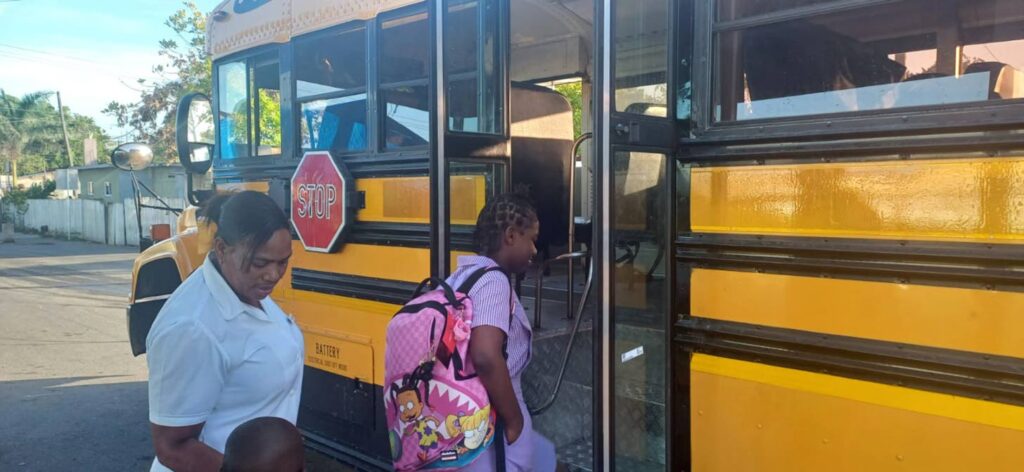
    KINGSTON, Jamaica – A significant enhancement to Jamaica’s National Rural School Bus Programme (NRSBP) now enables students and parents to reload transportation cards through an expanded network of physical locations across the island. GraceKennedy Payment Services (GKPS) has formally partnered with Elhydro Limited to introduce in-store top-up services available at all Bill Express outlets, according to a recent company announcement.

    This collaborative initiative addresses critical accessibility challenges by establishing dependable, tangible locations for managing student travel finances throughout rural parishes. The service operates exclusively on a cash basis, with deposited funds becoming active on bus cards within 30 minutes of transaction completion. Notably, the program imposes no restrictions on transaction frequency or maximum top-up amounts.

    To utilize the service, customers must present the alphanumeric identifier displayed on the student card. Initial registrants need to supply additional details including full name, contact number, residential address, and optional email information. All collected data will be utilized solely for transactional, informational, and promotional purposes according to the company’s privacy guidelines.

    Eligibility guidelines permit independent top-ups by students aged 15 and above presenting valid identification, while younger students require adult accompaniment during transactions.

    Margaret Campbell, Chief Executive Officer of GraceKennedy Money Services, emphasized the corporation’s dedication to national social development during the partnership signing ceremony at GraceKennedy’s Kingston headquarters. “This integration transcends mere financial transactions by actively supporting the educational continuum of Jamaica’s youth while delivering practical convenience and reassurance to families,” Campbell stated.

    Terence Slater, Regional Manager at GKPS, highlighted the program’s extensive reach through over 300 retail facilities. “Our strategic objective focuses on serving customers across all geographical constraints, particularly benefiting residents in remote regions experiencing connectivity limitations,” Slater explained.

    Elhydro Limited Vice President Major Paul Brown noted the partnership’s critical timing, observing how the physical top-up solution assists families still grappling with internet infrastructure damage caused by Hurricane Melissa.

    To facilitate adoption, GraceKennedy will implement a subsidized transaction fee of $25 JMD until June 30, 2026, after which the standard $65 JMD charge will apply. Launched in September 2025, the NRSBP provides affordable transportation solutions for students across thirteen rural parishes including St. Andrew, St. Catherine, Clarendon, and Portland.

  • ROOFS programme brings tangible relief to Westmoreland communities

    ROOFS programme brings tangible relief to Westmoreland communities

    WESTMORELAND, Jamaica — The Jamaican Ministry of Labour and Social Security has achieved a significant milestone in its post-hurricane reconstruction efforts, distributing Restoration of Owner-Occupant Family Shelters (ROOFS) grants to beneficiaries in Westmoreland on Thursday. This distribution represents a crucial phase in the national Shelter Recovery Programme (SRP) designed to address housing devastation caused by Hurricane Melissa’s October 28, 2025 landfall.

    Minister Pearnel Charles Jr, speaking at the handover ceremony at Sean Lavery Faith Hall, emphasized the profound human dimension of the initiative. He characterized the program as fundamentally restoring “safety, stability, and dignity” to affected families, moving beyond mere financial transactions. “Today is not just about grants,” Charles Jr stated. “It is about restoration and dignity. The families gathered here are not statistics; they are Jamaicans who deserve secure homes and the opportunity to rebuild with confidence.”

    The SRP emerged as the government’s strategic response to transition from immediate emergency aid to a meticulously organized, transparent, and long-term recovery framework. This nationally coordinated, data-driven system has now completed over 95,000 detailed household assessments across Jamaica. This extensive verification process ensures that all distributed aid is allocated fairly and is strictly prioritized according to objectively evaluated need.

    The recent grant distribution in Westmoreland constitutes merely one segment of the ongoing national rollout. Numerous additional beneficiaries throughout Westmoreland and other severely impacted parishes are scheduled to receive their financial support in the imminent days and weeks.

    Operating within the broader SRP, the ROOFS initiative provides direct financial assistance based on a clear, categorized damage assessment system. Adhering to the principle of “one household, one coordinated recovery pathway,” it aims to eliminate duplication of aid and prioritize the most vulnerable households. The grants are tiered according to three verified damage categories: Severe Damage (homes requiring complete demolition and rebuilding, with grants up to $500,000), Major Damage (homes with compromised critical structural elements, receiving $200,000), and Minor Damage (structurally sound homes requiring repairs to roofs, windows, doors, or fixtures, eligible for $75,000).

  • Eastern Caribbean Judges Complete Three-Day Orientation in St. Lucia

    Eastern Caribbean Judges Complete Three-Day Orientation in St. Lucia

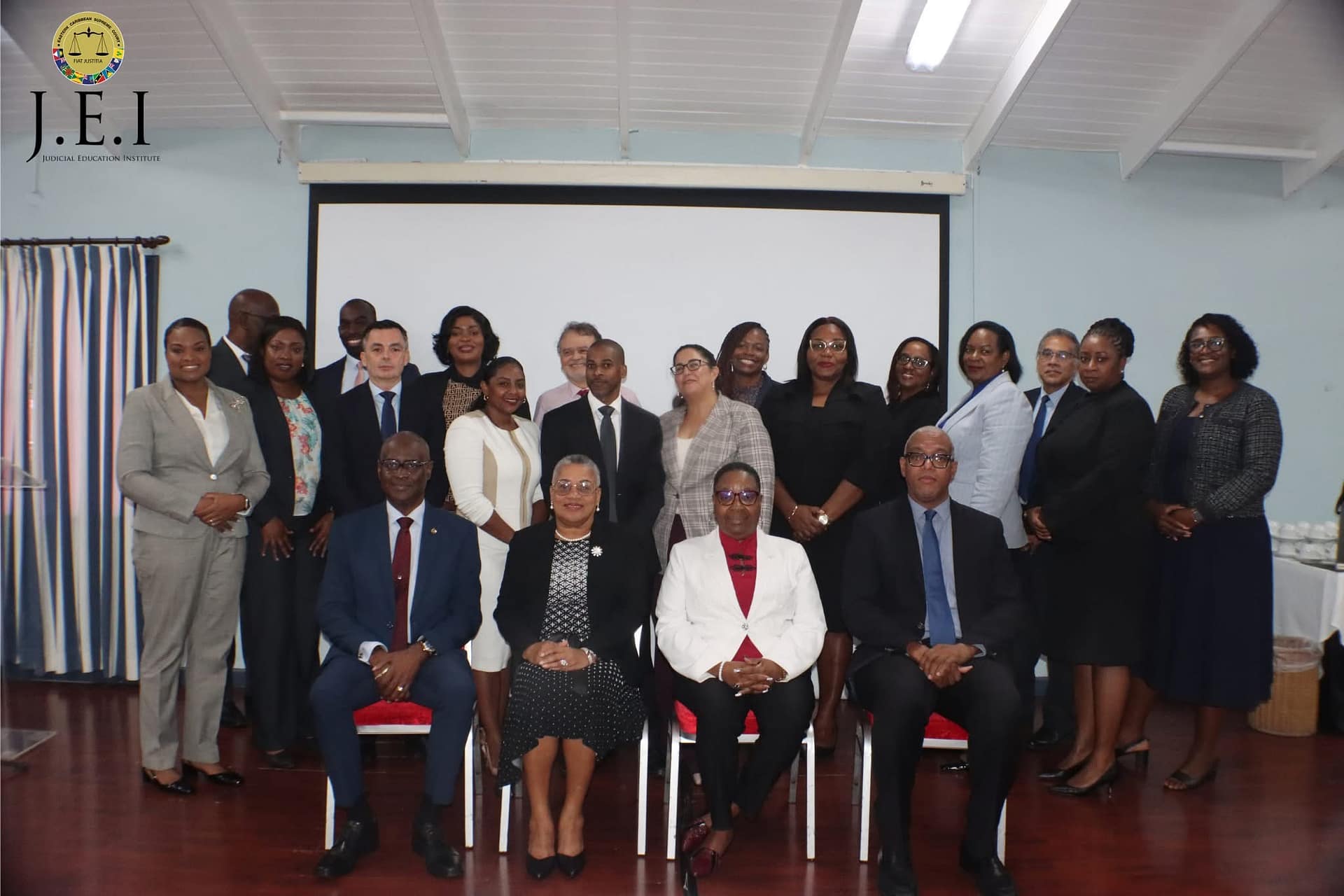
    The Eastern Caribbean Supreme Court’s Judicial Education Institute (JEI) has successfully completed its comprehensive Judicial Officers’ Orientation 2026, a transformative three-day training event held in Saint Lucia from February 2-4, 2026. This intensive program brought together recently appointed judges and masters to advance their professional capabilities and reinforce the integrity of the regional judicial system.

    The inaugural day established foundational principles, featuring Ms. Myrtene Cenac’s compelling analysis on statistical applications in judicial operations, demonstrating how data-driven methodologies can bolster transparency and accountability. Justice Agnes Actie followed with practical guidance on active case management strategies to ensure timely and cost-effective resolution of legal matters. The afternoon sessions culminated with retired Chief Justice Dame Janice Pereira’s authoritative address on building public trust through strict adherence to the ECSC Code of Conduct, while Justice Alvin Pariagsingh provided expert analysis of the updated Costs Regimes under the Civil Procedure Rules 2023.

    Day two embraced contemporary challenges through examinations of digital transformation and implicit bias. Mr. Mark Ernest delivered a comprehensive overview of technological integration in judicial processes, highlighting artificial intelligence applications, digital recording systems, electronic case management, and virtual courtroom technologies. In a particularly impactful session, Justice Peter Jamadar of the Caribbean Court of Justice addressed unconscious prejudices in judicial decision-making, presenting effective strategies to mitigate bias and promote equitable proceedings. Additional sessions covered interim remedies and the critical functions of court registrars, with Justice of Appeal Eddy Ventose concluding the day with an authoritative discussion on public law claims.

    The final day focused on practical judicial skills with Dame Janice Pereira leading an interactive workshop on precision in judgment writing, emphasizing clarity in reasoning and effective communication techniques for oral judgments. Justice of Appeal Trevor Ward conducted an in-depth exploration of sentencing principles, including proportionality and reasoned decision-making, complemented by scenario-based exercises to enhance sentencing consistency. Justice Ventose, as JEI Chair, formally closed the orientation, acknowledging participants’ active engagement and the collective success of the program.

    This landmark event reaffirms the ECSC’s commitment to judicial excellence through continuous professional development. Participants departed with enhanced capabilities in technological adaptation, ethical standards, and practical judicial skills essential for navigating the evolving legal landscape. The judiciary expressed profound gratitude to all speakers, facilitators, and participants whose dedicated engagement strengthens the rule of law throughout the Eastern Caribbean.

  • Investment scams advisory

    Investment scams advisory

    The Grenada National Cyber Security Incident Response Team (CSIRT-Gnd) has issued an urgent public alert regarding a significant escalation in sophisticated investment fraud schemes targeting citizens across Grenada and neighboring Caribbean islands. These fraudulent operations are primarily disseminated through prominent social media platforms, including Facebook and Instagram, often appearing as sponsored content or advertisements strategically embedded within legitimate posts.

    According to cybersecurity experts, these investment scams employ deceptive tactics where perpetrators deliberately conceal crucial information or present outright falsehoods to lure victims into transferring funds. The schemes typically promise exceptionally high financial returns with minimal or nonexistent risk—a classic hallmark of fraudulent investment operations.

    The scammers utilize complex financial terminology and technological jargon that appears credible superficially but lacks substantive meaning upon closer examination. CSIRT-Gnd has identified several red flags that characterize these fraudulent schemes:

    Potential investors should exercise extreme caution when encountering promises of unrealistically high returns within implausibly short timeframes, such as offers to transform $100 into $5,000 within 24-48 hours. Fraudsters frequently minimize perceived risks, falsely claiming that previous investors have universally profited without losses.

    Additional warning indicators include guarantees of returns, pressure to migrate conversations to private messaging platforms like WhatsApp or Telegram, aggressive persuasion tactics, avoidance of voice communication, and inability to provide verifiable business credentials or regulatory documentation.

    CSIRT-Gnd emphasizes that encountering any of these warning signs should immediately trigger suspicion. The agency strongly advises against transferring funds, sharing identification documents, or granting remote access to personal devices under these circumstances.

    The cybersecurity team has made multiple communication channels available for citizens seeking assistance, including WhatsApp and Telegram at (473) 423-2478, email at [email protected], and social media platforms under the handle @csirtgnd.

  • National Solid Waste Authority Presses Ahead With Five Islands Cleanup

    National Solid Waste Authority Presses Ahead With Five Islands Cleanup

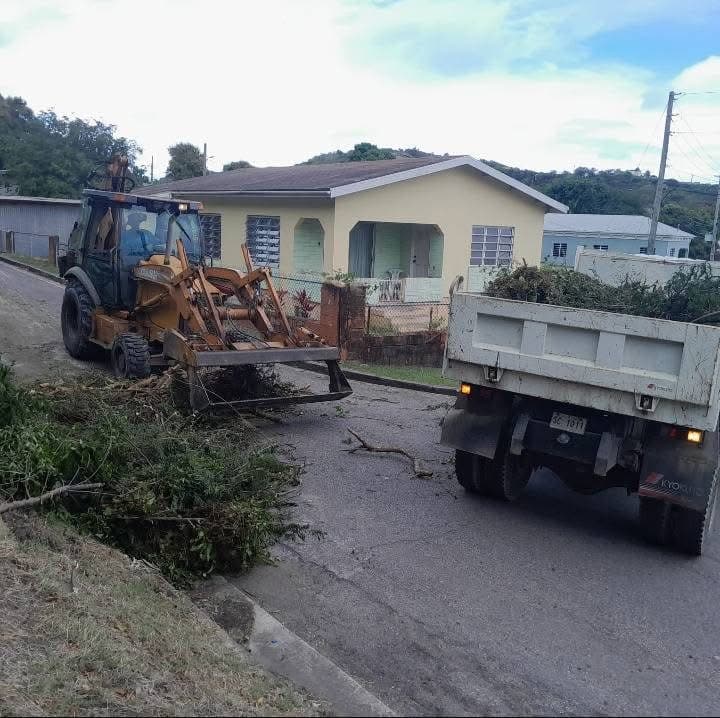
    The National Solid Waste Management Authority has issued an urgent advisory to residents of the Five Islands community, calling for immediate preparation of bulk waste materials ahead of scheduled cleanup operations. According to the authority’s latest update, municipal cleanup teams will conclude their intensive waste collection efforts in the area on February 25, marking the final opportunity for residents to dispose of accumulated bulk items.

    The waste management authority emphasized that all large, non-regular waste items must be properly placed outside residential properties well before the scheduled departure date to ensure collection. This community-wide initiative represents part of ongoing efforts to maintain environmental sanitation and proper waste disposal practices across the region.

    Municipal authorities have coordinated this specialized bulk waste removal operation to address the unique disposal needs of island communities, where waste management presents distinct logistical challenges. The February 25 deadline serves as a critical cutoff point for residents seeking to utilize these specialized collection services.

    The cleanup campaign reflects broader national efforts to enhance waste management infrastructure and promote sustainable disposal practices among island communities. Residents requiring additional information or assistance with bulk waste preparation have been encouraged to contact local waste management representatives for guidance on proper disposal procedures and acceptable materials.

  • Resilient green and affordable housing initiative launched

    Resilient green and affordable housing initiative launched

    Grenada has embarked on an ambitious initiative to transform its housing sector through climate-resilient and sustainable solutions. On February 17, the Government of Grenada and the Global Green Growth Institute (GGGI) officially launched the ‘Scaling-Up Resilient, Green, and Affordable Housing’ program, marking a significant step toward addressing both housing needs and climate challenges.

    The initiative represents a strategic component of Grenada’s flagship Project 500 housing intervention, receiving financial backing from the Government of Ireland and Agence française de développement (AFD) as part of a broader Eastern Caribbean regional program.

    Gloria Thomas, Grenada’s Minister of Social and Community Development, Housing and Gender Affairs, emphasized the critical nature of this partnership: “As a small island developing state on the frontlines of climate change, we must build homes that can withstand increasingly severe weather events while remaining accessible to vulnerable families.” She noted that the collaboration would integrate climate resilience and green building principles into the national housing strategy.

    The program will focus on developing innovative financial models, strengthening planning frameworks, and accelerating the delivery of quality housing that aligns with long-term national development goals. Rachel Fitzpatrick, SIDS Lead in Ireland’s Department of Foreign Affairs and Trade, highlighted the alignment with Ireland’s strategic partnership with Small Island Developing States, particularly in expanding climate support to vulnerable regions.

    The launch event featured expert panel discussions examining pathways, barriers, and partnerships for scaling up resilient housing solutions. Representatives from government, financial institutions, construction sectors, and civil society explored policy reforms, financing mechanisms, and technical approaches to overcome existing challenges.

    Daniel Muñoz-Smith, GGGI’s Caribbean Representative, stated: “Investing in resilient and sustainable housing can contribute to safeguarding livelihoods and supporting inclusive economic growth. GGGI partners with countries like Grenada to translate ambition into lasting development outcomes for people and local communities.”

    The regional program extends technical assistance to St. Lucia and St. Vincent and the Grenadines, creating a coordinated approach to housing resilience and sustainable green growth across the Eastern Caribbean.

  • Education Spending Across CARICOM Ranges From Under 3% to Over 6% of GDP

    Education Spending Across CARICOM Ranges From Under 3% to Over 6% of GDP

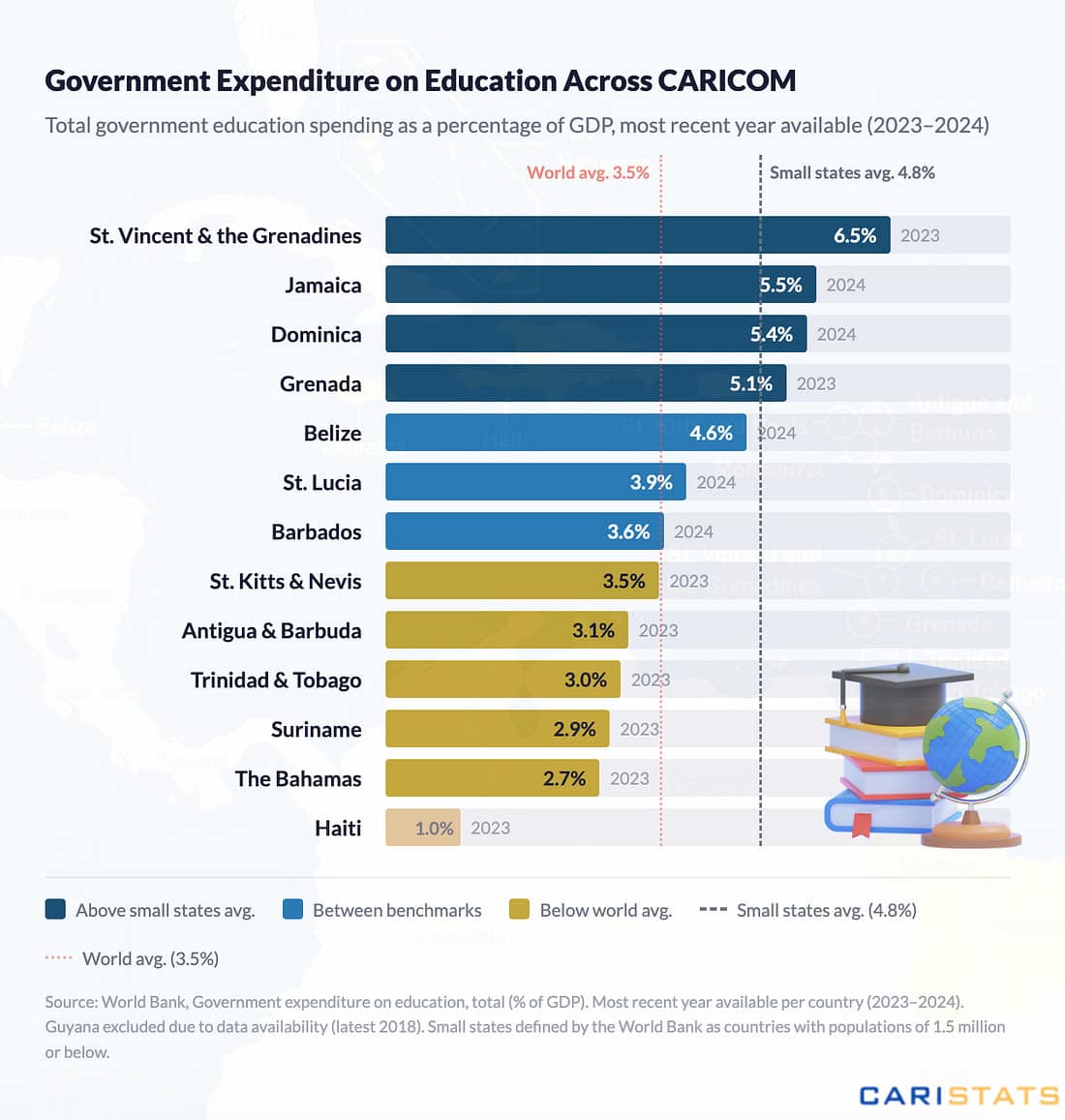
    A comprehensive analysis of education funding across CARICOM member states reveals significant disparities in governmental commitment to educational development. While seven nations exceed the global average expenditure of 3.5% of GDP, six member states plus Haiti—which allocates less than 1%—fall substantially below this international benchmark.

    Leading the regional education investment ranking is St. Vincent and the Grenadines with a notable 6.5% of GDP dedicated to education, followed closely by Jamaica (5.5%), Dominica (5.4%), and Grenada (5.1%). A middle cohort comprising Belize, St. Lucia, and Barbados maintains spending above the world average but below the 4.8% threshold recommended for small states facing structural challenges comparable to Caribbean nations.

    The lower investment tier includes St. Kitts and Nevis, Antigua and Barbuda, Trinidad and Tobago, Suriname, and The Bahamas, all falling short of the global average. Particularly concerning is Suriname’s dramatic education budget reduction, which has nearly halved from 5.5% to 2.9% since 2015 amid mounting fiscal constraints. Barbados and Trinidad and Tobago have similarly witnessed declines exceeding one percentage point during the same period.

    In contrast, Dominica and St. Vincent and the Grenadines have demonstrated increased educational investment since 2015. This financial data emerges as regional discussions have predominantly centered on educational outcomes including examination results, curriculum development, and instructional quality. The new expenditure analysis suggests that resource allocation and funding mechanisms warrant equivalent consideration in policy dialogues.

    Data sourced from World Bank records on government education expenditure (most recent 2023-2024 figures) excludes Guyana due to insufficient current statistics. The World Bank defines small states as nations with populations under 1.5 million, representing a relevant comparison group for Caribbean development strategies.

  • Bad Bunny and agriculture

    Bad Bunny and agriculture

    During one of the world’s most watched sporting events, the American football championship halftime show traditionally showcases technological marvels and consumer spectacle. However, this year’s performance by global artist Bad Bunny took a profoundly different approach, opening with powerful imagery of sugarcane fields and agricultural workers laboring under the sun.

    This visual statement on the global stage connected millions of viewers to a fundamental question that rarely receives prime-time attention: Who actually sustains the economic stability and daily functioning of our societies? The agricultural sector, despite being an economic and social pillar, typically remains invisible in dominant cultural narratives that prioritize urban perspectives.

    The symbolic choice of sugarcane imagery carries particular significance for Latin America and the Caribbean, where this crop embodies economic history, cultural identity, and social memory. Throughout the region, agriculture employs over 40 million people—approximately 14% of total regional employment—while serving as a critical source of food security, export revenue, and territorial sustainability.

    This cultural gesture arrives at a crucial moment when global supply chain vulnerabilities, price shocks, and trade tensions have elevated food production from a sectoral concern to a central component of international stability discussions. The performance highlighted the growing recognition that agri-food systems represent critical components of global economic resilience.

    The presentation also addressed a pressing generational challenge facing rural communities. Latin America experiences rapid aging of agricultural workers and persistent youth migration to urban centers, compounded by unequal access to financing, innovation, and connectivity for rural youth. Without generational renewal, productive continuity becomes compromised and social gaps widen.

    By placing agricultural workers at the center of his narrative, Bad Bunny challenged entrenched cultural hierarchies that equate modernity exclusively with urban development. The performance expanded agriculture’s symbolic space in popular culture, initiating conversations about work dignity, territorial inequality, and productive futures.

    This was not technical discourse or ideological proclamation but a powerful visual statement that resonated deeply in our stimulus-saturated society. For many viewers, it may have seemed merely an aesthetic introduction, but it fundamentally brought typically overlooked realities into the global frame, reminding audiences that contemporary wellbeing maintains rural, often invisible origins.