分类: society

  • Confrontation Operation in Los Frailes: ‘Tulile Palomería’ killed in exchange of gunfire with authorities

    Confrontation Operation in Los Frailes: ‘Tulile Palomería’ killed in exchange of gunfire with authorities

    SANTO DOMINGO EAST — A high-profile criminal suspect wanted for multiple homicides and violent crimes was fatally wounded during an armed confrontation with specialized police units in the Los Frailes sector. The incident occurred during a targeted operation conducted by the Central Directorate of Criminal Investigation (DICRIM) to apprehend the individual known by the alias “Tulile Palomería.”

    The suspect, who had been evading authorities through multiple arrest warrants, succumbed to gunshot injuries while receiving emergency medical treatment at Dr. Darío Contreras Traumatological Hospital. Preliminary reports indicate the confrontation erupted when DICRIM patrol units were conducting investigative operations to locate the wanted individual.

    Court documents reveal Palomería faced three outstanding arrest warrants: Case No. 2025-AJ00502698 (August 11, 2025) for firearm assault against a civilian; Case No. 2025-AJ0058460 (September 1, 2025) for homicide; and Case No. 2026-AJ0002783 (January 13, 2026) for an additional murder in Pedro Brand municipality.

    According to official police reports, the incident unfolded along José Francisco Peña Gómez Street near Progreso Street. The suspect allegedly initiated gunfire upon recognizing police presence, forcing officers to return fire in self-defense. The exchange resulted in critical injuries to Palomería, who was subsequently transported to medical facilities where he was pronounced dead.

    Forensic teams from the Scientific Police secured substantial evidence from the scene, including a 9mm Model 75 pistol (serial F9225), two spent cartridge casings, a National Police-issued ballistic vest, and three mobile devices. The investigation remains ongoing as authorities continue to process evidence and witness statements.


  • Guinea Grass Villagers to Protest Water Board Over Billing Disputes

    Guinea Grass Villagers to Protest Water Board Over Billing Disputes

    The residents of Guinea Grass Village are organizing a demonstration this Sunday to voice their profound discontent with the local water authority’s management practices and disputed billing procedures. This civic action stems from a recently implemented metered water system that was initially welcomed in December 2024 as a solution to the village’s historical water access limitations.

    However, the anticipated relief has rapidly transformed into widespread frustration. Numerous households have reported receiving inexplicably high water consumption statements, with some bills indicating usage of up to 22,000 gallons within a single month—a volume that residents assert is practically impossible.

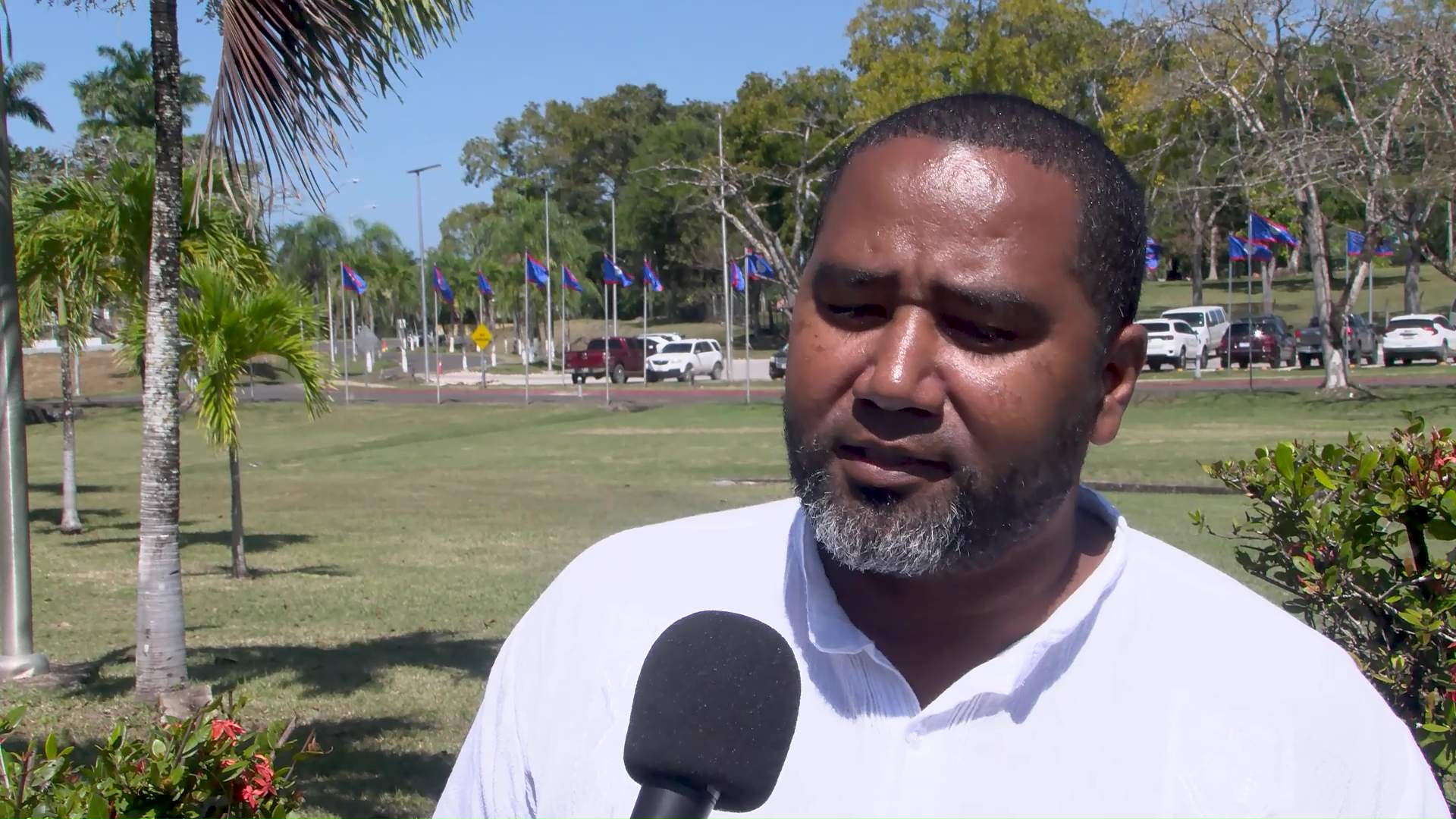
    Enio Lopez, Vice President of the Guinea Grass Development Committee, provided context to the escalating conflict. While acknowledging that meter implementation theoretically promotes accountability and conservation, Lopez emphasized that the community’s central grievance revolves around execution failures rather than the concept itself. According to his statement, approximately 90-95% of villagers express discontent with the current situation.

    The core issues identified by community representatives include the absence of promised trained personnel to oversee the new system, lack of transparency regarding water board membership, and insufficient communication from authorities. Lopez highlighted that despite the presence of qualified, educated individuals within the community capable of managing water affairs effectively, their expertise remains untapped.

    The planned peaceful protest aims to demand three specific resolutions: transparent accountability mechanisms for billing discrepancies, the establishment of fair charging structures reflective of actual consumption, and the appointment of new, properly trained leadership to administer the village’s water supply system.

  • Residents Challenge High Water Bills After Meter System Rollout

    Residents Challenge High Water Bills After Meter System Rollout

    Tensions are escalating in the village of Guinea Grass as residents mobilize to protest against what they describe as exorbitant and unjust water billing practices following the rollout of a new metered system. The community alleges severe discrepancies in their water usage readings and cites unfulfilled commitments regarding the establishment of a professionally trained water board.

    Village Council Chairman Benito Uck has acknowledged the growing discontent, confirming that numerous residents have reported implausibly high consumption figures—with some bills indicating usage between 12,000 to 14,000 gallons—which they insist do not reflect their actual water consumption. Many suspect faulty meter installations or underlying system leaks.

    In response to the mounting crisis, local leadership is collaborating with the national Ministry of Rural Transformation to formulate a multi-pronged resolution strategy. This includes conducting comprehensive technical evaluations of the installed meters, initiating village-wide leak detection investigations, and deliberating on provisional billing adjustments. One proposed measure involves temporarily reverting to the previous flat-rate payment structure for March, allowing residents to pay a standardized fee while systemic corrections are implemented.

    Chairman Uck referenced a prior communication from October 2025 that outlined the new tiered pricing model: $10 for the first 1,500 gallons, followed by one cent per gallon thereafter, and a rate of two cents per gallon after exceeding 10,000 gallons. However, the execution and perceived accuracy of this system have become the core of the dispute. Despite plans for public consultations, these meetings were postponed, exacerbating public distrust.

    As villagers prepare for organized demonstrations to voice their grievances, the Council is urgently seeking final directives and support from the Ministry to normalize the situation and restore public confidence in the water infrastructure management.

  • Legislation Boosts Traffic Wardens’ Enforcement Role

    Legislation Boosts Traffic Wardens’ Enforcement Role

    In a significant shift in traffic enforcement policy, legislative amendments introduced on February 6, 2026, will substantially increase the operational authority of traffic wardens across road networks. The proposed changes to the Motor Vehicles and Road Traffic Act will empower these officers to make direct arrests and issue citations for specific violations that previously required police intervention.

    Transport Minister Dr. Louis Zabaneh outlined the specific infractions that will fall under the expanded jurisdiction of traffic wardens. These include operating vehicles without mandatory third-party insurance coverage, failure to properly display insurance documentation, and refusal to provide identification details when requested by enforcement personnel.

    Under the current framework, traffic wardens who encounter such violations must escalate the matter to sworn police officers for resolution. This procedural requirement often creates operational delays and reduces enforcement efficiency. The legislative revision specifically targets Section Three of Chapter 230 of the Substantive Laws to eliminate this bureaucratic barrier.

    The amendment will authorize both traffic department personnel and municipal enforcement officers to execute duties under the Motor Vehicle Insurance Third Party Risk Act. This represents a strategic reallocation of enforcement resources designed to improve compliance with insurance regulations and enhance overall road safety measures.

    This policy change reflects growing concerns about uninsured motorists and aims to create a more responsive traffic management system. By decentralizing enforcement capabilities, authorities anticipate improved detection and deterrence of insurance-related violations throughout the transportation network.

  • Government Moves to Toughen Traffic Penalties

    Government Moves to Toughen Traffic Penalties

    In a significant move to enhance road safety and legal compliance, the government has unveiled stringent new measures targeting traffic violations. Transport Minister Dr. Louis Zabaneh presented legislation on February 6, 2026, designed to substantially increase penalties for motorists operating vehicles without mandatory third-party insurance.

    The proposed amendments to the Motor Vehicle Insurance Third Party Risk Act represent a dramatic escalation in consequences for offenders. The current maximum penalty of a $400 fine and six months’ imprisonment will be raised to $1,000 or eight months’ incarceration. Furthermore, the legislation addresses other common traffic infractions by elevating penalties from $200 fines or three-month sentences to $600 fines or six-month imprisonment terms.

    This legislative initiative forms part of a broader governmental strategy to empower traffic enforcement personnel with enhanced authority while creating stronger deterrents against unlawful driving practices. The reforms specifically target prevalent violations that compromise public safety and financial responsibility on roadways.

    Dr. Zabaneh’s announcement signals the administration’s commitment to reducing uninsured motorist incidents and improving overall traffic law compliance through substantially increased financial and custodial penalties for violations.

  • Unions Celebrate Landmark Workplace Safety Law

    Unions Celebrate Landmark Workplace Safety Law

    BELIZE CITY – In a landmark legislative achievement, Belize’s National Assembly has passed the long-awaited Occupational Safety and Health Bill, marking a transformative moment for workplace protections nationwide. The legislation received its decisive second reading on February 6, 2026, culminating more than a decade of persistent advocacy from labor organizations.

    Outside the parliamentary chambers, veteran labor leader Luke Martinez, former president of the National Trade Union Congress of Belize (NTUCB), characterized the development as profoundly historic for the nation’s workforce. Martinez revealed his personal connection to the legislation dates back to 2014 when he first encountered the draft bill while serving as a records and research officer at the National Assembly.

    The newly passed framework establishes comprehensive safety standards for workplaces across Belize, addressing what advocates have described as a critical gap in worker protections. Martinez emphasized that the legislation’s passage represents not the conclusion but the commencement of implementation efforts, noting that developing effective regulations will constitute the next phase of work.

    Contrary to speculation that the bill served as a diversion tactic during other labor disputes, Martinez clarified that occupational safety legislation had been in development pipelines for years, with preliminary discussions involving the Prime Minister’s office preceding recent controversies.

    The former union leader, who originated the “Rush the OSH” advocacy slogan, pledged continued collaboration with government and private sector stakeholders to develop specialized occupational safety training programs and ensure regulatory effectiveness. The legislation represents a tripartite achievement involving labor unions, employers, and government entities working collectively to enhance workplace safety standards.

  • PM Attends Jesuit Anniversary, House Sits Late

    PM Attends Jesuit Anniversary, House Sits Late

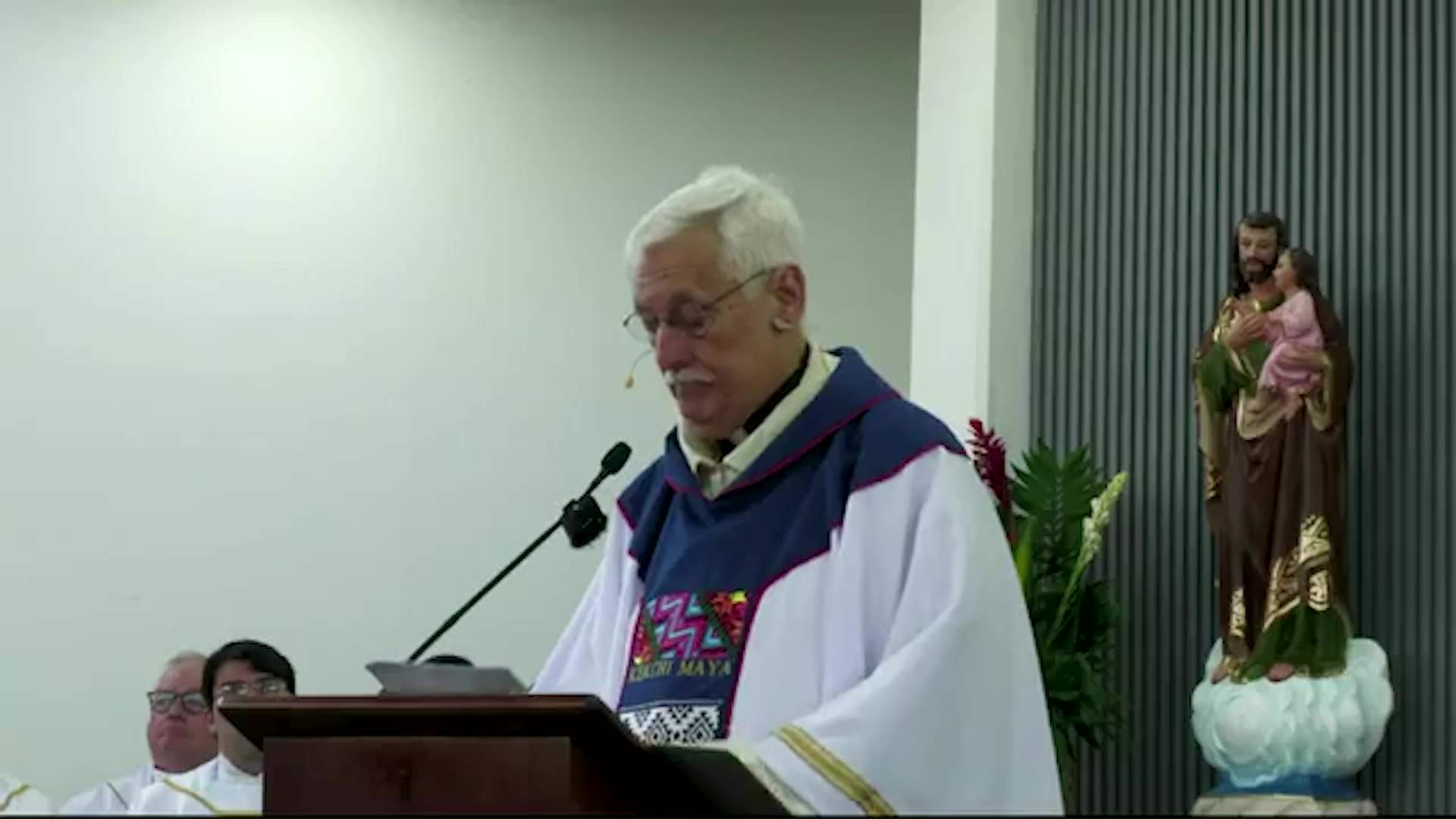
    BELIZE CITY – A significant religious commemoration took precedence over parliamentary proceedings on February 6th as Prime Minister John Briceño and several government representatives attended a special mass honoring the Jesuit Society’s 175th anniversary of service to Belize. The ceremony held at the newly constructed Fordyce Chapel on the Saint John’s College campus drew international attention with the presence of Father Arturo Sosa, the Superior General of the Jesuits, who traveled from Rome for the occasion.

    The Prime Minister, himself an alumnus of Saint John’s College, emphasized the importance of governmental participation in the historic event. “The leader of the Jesuits was here and I think it was important for us as the government to be there,” Briceño stated. “He brought significant representatives from Africa, the U.S., and Latin America. I felt it was crucial as Belizeans to demonstrate our support and reverence for their visit while acknowledging their remarkable 175 years of service to our nation.”

    The Jesuit order has maintained a profound presence in Belize since 1851, contributing substantially to education, social development, and spiritual guidance throughout the country. Today’s celebration not only recognized this enduring legacy but also highlighted the ongoing relationship between religious institutions and governmental bodies in Belize. The delayed House meeting underscored the administration’s prioritization of cultural and historical recognition alongside legislative duties.

  • Twee woningen volledig verwoest door brand aan Florris Zwakkestraat

    Twee woningen volledig verwoest door brand aan Florris Zwakkestraat

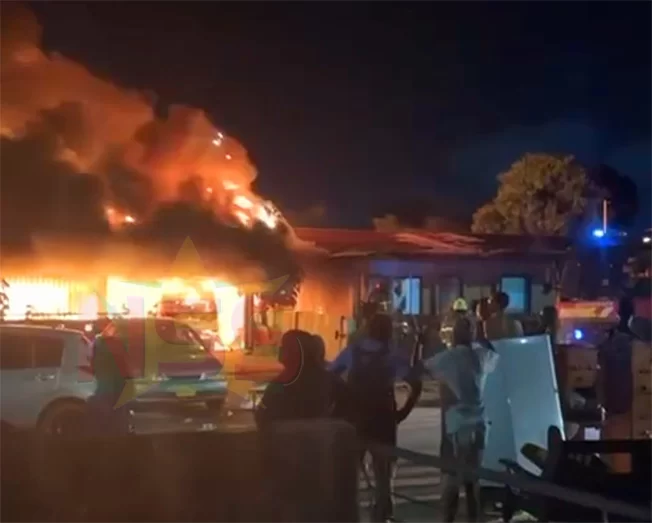
    A severe residential fire erupted at approximately 7:52 PM on Florris Zwakkestraat in Flora, resulting in the complete destruction of two adjacent homes. Emergency services responding to the incident found both properties fully engulfed in flames upon arrival.

    The fire department deployed multiple units to combat the blaze and remains on scene conducting extensive follow-up operations to prevent further fire spread to neighboring structures. The precise origin and cause of the fire remain undetermined at this early stage.

    Authorities from both police and fire services have confirmed no casualties resulted from the incident. Law enforcement has established a security perimeter around the affected area while collaborating with fire investigators to determine the circumstances that led to the devastating blaze.

    Additional details regarding the investigation and property damage assessment are expected to be released as the official inquiry progresses. The coordinated response between emergency services successfully prevented potential tragedy despite the substantial property loss.

  • PM Says BTL Has to Find “Some Way” to Pay Severances

    PM Says BTL Has to Find “Some Way” to Pay Severances

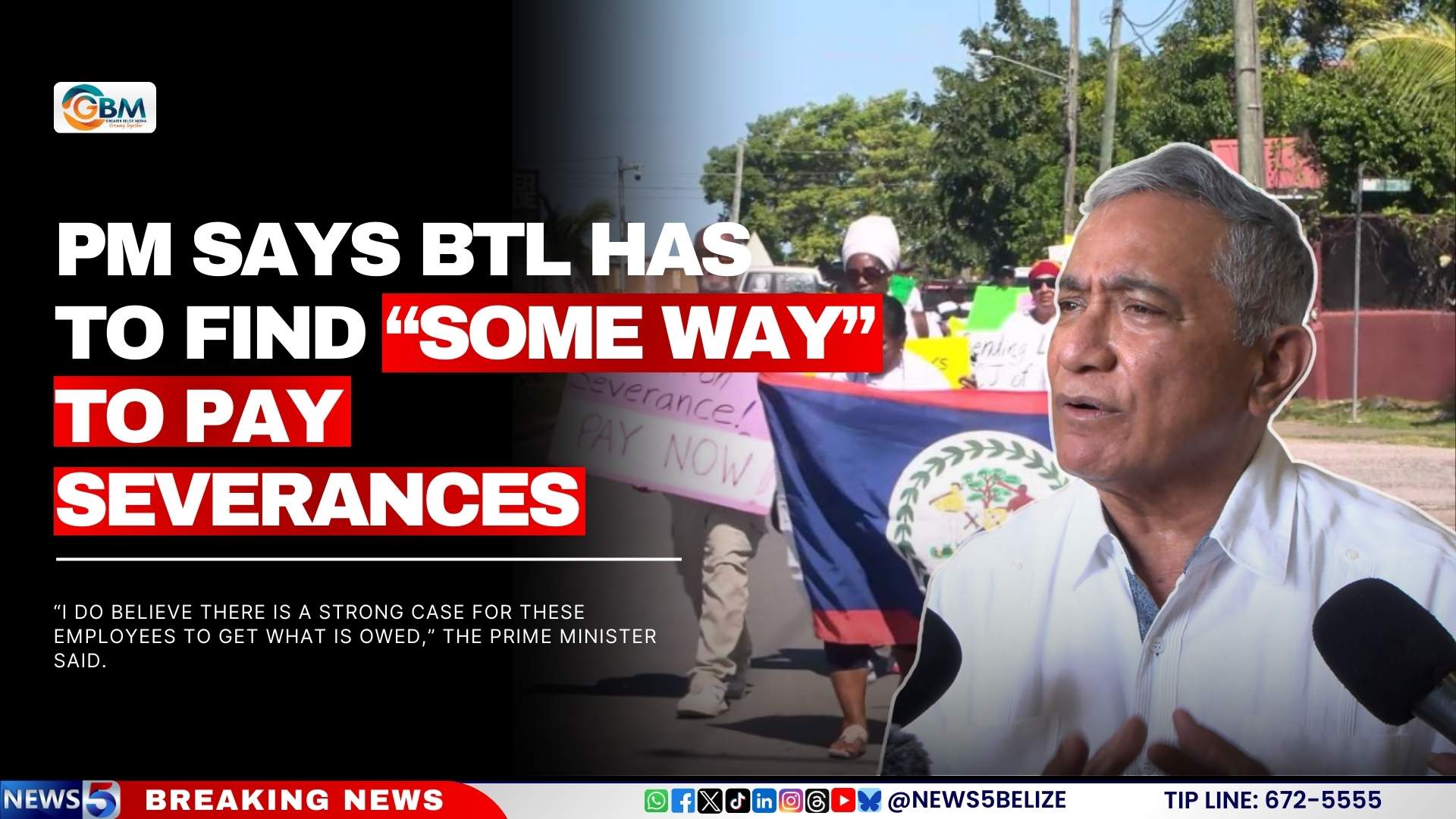
    Belize’s Prime Minister John Briceño has thrown his political weight behind former Belize Telemedia Limited (BTL) employees in their escalating dispute over unpaid severance packages. In a significant development, the Prime Minister declared that the telecommunications giant must devise a viable solution to settle outstanding claims for more than 100 former workers.

    During an interview with News Five, Briceño expressed his conviction that the former employees possess a compelling legal case for receiving their entitled compensation. He specifically noted the absence of any statutory limitations that would legally obstruct these payments from being made. “I do believe there is a strong case for these employees to get what is owed,” the Prime Minister stated unequivocally.

    The matter is currently under active consideration by BTL’s board of directors, who convened a meeting specifically to address this contentious issue. Regardless of the board’s deliberations, Briceño emphasized the non-negotiable necessity of resolving the situation, asserting that “at the end of the day, some way has to be found to pay those people.”

    This political intervention comes amid sustained protests organized by the Belize Communications Workers for Justice, who have maintained a three-day demonstration outside BTL’s corporate headquarters. The protestors have raised pointed questions about the company’s financial priorities, particularly its proposed acquisition of Speednet—reportedly valued at approximately eighty million dollars—while simultaneously claiming an inability to fulfill severance obligations to former employees.

  • Fines for Driving Without Insurance Could Increase to $1,000

    Fines for Driving Without Insurance Could Increase to $1,000

    The Belizean government has initiated a significant legislative overhaul targeting uninsured motorists. Transport Minister Louis Zabaneh presented a bill to the House of Representatives on February 6, 2026, seeking to amend the Motor Vehicle Insurance (Third Party Risk) Act with substantially increased penalties.

    Minister Zabaneh justified the proposed amendments by highlighting that the existing penalty structure, unchanged since 1999, no longer serves as an effective deterrent against driving without mandatory insurance coverage. The legislation would grant traffic officers expanded authority to immediately demand proof of insurance during traffic stops.

    Current statutes impose maximum penalties of $400 in fines or six months’ imprisonment for driving without insurance. The proposed amendments would dramatically increase these penalties to $1,000 or up to eight months imprisonment. General penalties for other insurance-related offenses would similarly rise from $200 to $600, with potential jail terms doubling from three to six months.

    The minister noted the legislation carries cabinet endorsement and has been forwarded to the Public Utilities, Transport and Communications Committee for detailed examination and reporting.

    The parliamentary session proceeded without opposition representation, as members boycotted proceedings in protest of the ongoing BTL-Smart acquisition controversy.