分类: society

  • Viva Hotel in Bayahibe engulfed in flames as firefighters battle blaze

    Viva Hotel in Bayahibe engulfed in flames as firefighters battle blaze

    A major uncontrolled fire has broken out at the Viva Hotel, located in the popular coastal tourist destination of Bayahibe in the Dominican Republic’s La Romana province, triggering an urgent large-scale response from local emergency services. Multiple fire crews from across La Romana province have been deployed rapidly to the scene, where firefighters are working around the clock to bring the destructive blaze under control.

    Early reports from the area confirm that dense plumes of dark smoke are billowing from the multi-building hotel complex, and user-generated footage and photos capturing the extent of the fire have spread quickly across various social media platforms, drawing widespread public attention to the incident.

    As of the latest update, local authorities have not released any confirmed information about what sparked the fire, and official investigations into the origin and cause of the emergency are still in their early stages. Crucially, there have been no official announcements of injuries, fatalities or missing persons connected to the blaze to date.

    Emergency response teams remain positioned on site, focusing both on fully extinguishing existing hotspots and stopping the fire from spreading to adjacent buildings and other properties within the larger resort area that hosts the hotel. This is an actively developing situation, and local officials have indicated that additional updates, including more details on the cause, impact and any potential casualties, will be released as emergency operations and investigative work progress.

  • Government says JCE registers 90% of hospital births nationwide

    Government says JCE registers 90% of hospital births nationwide

    In a remarkable policy win for inclusive governance and children’s rights, the Dominican Republic has boosted its hospital birth registration coverage from just 61% in 2018 to over 90% as of 2025, the national Cabinet for Children and Adolescents (GANA) has announced. The milestone was formally marked this week during a ceremony renewing a cross-agency cooperation framework focused on eliminating birth under-registration across the country, extending the joint initiative for an additional four years through 2030.

    The sweeping progress recorded over the past seven years stems from a series of targeted interventions rolled out by participating state institutions. National outreach and awareness campaigns have reached more than 700,000 expectant women across the country, educating them on the importance of timely birth registration for their children’s access to future services. In addition, authorities launched the specialized “Express Route” program, designed to streamline processes for people facing barriers to obtaining required supporting documentation. Most notably, permanent Civil Registry offices have now been established in every maternal and child health facility nationwide, bringing registration services directly to the point of birth.

    The renewed cooperation agreement unites 18 key national stakeholders, including GANA, the National Council for Children and Adolescents (CONANI), the Central Electoral Board (JCE), the Ministry of the Presidency, and 14 other government and civil society bodies. The overarching goal of the extended partnership remains the same: to achieve universal birth registration within the country’s legal timeframe by ensuring every newborn is documented immediately after birth.

    As part of the new phase of the initiative, authorities will upgrade cross-agency operations through new digital infrastructure. CONANI has led development of the innovative Registry System for Children and Adolescents (SIRENNA), a centralized digital platform that will enable secure real-time information sharing across all entities part of the national child protection system. The new tool is expected to drastically improve interinstitutional coordination and streamline public access to identity-related services.

    In a key governance adjustment included in the renewed agreement, overall coordination of the initiative’s interinstitutional monitoring committee will be transferred to the JCE. The shift formally recognizes the JCE’s constitutional mandate as the state authority responsible for overseeing civil registry operations and all official identity documentation.

    Speaking at the official signing ceremony, Dominican First Lady Raquel Arbaje underscored the life-altering impact of the work, stressing that no child should be discharged from a hospital without an official birth certificate. Arbaje noted that access to education, healthcare and nearly all other fundamental rights enshrined in national law depend entirely on holding formal legal identity documentation.

    National officials emphasized that the extended cross-agency partnership will strengthen and embed a long-term public policy focused on upholding the fundamental right of every Dominican child to a legal identity. Once fully implemented, the initiative will ensure all children in the country can fully access the protections, social services and life opportunities guaranteed under Dominican law.

  • Fathers make a difference through presence and sacrifice

    Fathers make a difference through presence and sacrifice

    KINGSTON, Jamaica — As the country prepares to mark Father’s Day on June 21, a quiet but profound cultural shift is reshaping understandings of what it means to be a father across Jamaican households and communities. No longer limited to the traditional role of primary breadwinner, modern fatherhood in Jamaica increasingly includes emotional engagement, daily caregiving and consistent, intentional presence even amid the pressures of work and life.

    Three Jamaican fathers from different professional backgrounds and age cohorts are illustrative of this changing landscape: 58-year-old Gerald Miller, a health promotion and education officer at the Westmoreland Health Department; 58-year-old Kavanaugh Campbell, a technical officer at the Jamaica Information Service; and 33-year-old Dr. Daren Johnson, a senior advisor and consultant for the Government of Jamaica. For all three men, fatherhood is far more than a one-day annual celebration — it is a lifelong commitment that stands as one of the most meaningful contributions a man can make to his country’s long-term growth.

    Dr. Johnson, a younger-generation father from Middle Buxton, St. Ann, has centered active presence as the core of his parenting philosophy. Though he balances multiple high-demand professional roles — including senior government advisor, immigration advocate, college professor and school board chair — he says no title holds more meaning for him than that of “father.” He welcomed his son S’Wayne when he was 22, an experience he describes as the most defining event of his entire life.

    “Before S’Wayne, ambition was all about me. Now every decision passes through one question: what does that build for him?” Dr. Johnson explained. Fatherhood, he added, has transformed his character, making him more patient, more purpose-driven and far less self-centered with his time. Even with a packed schedule, he prioritizes small, daily moments with his son: checking in on his school life, traveling together, listening to music, and turning ordinary interactions into opportunities to teach life values. On multiple occasions, he has turned down lucrative professional assignments or left key engagements early to honor his parenting responsibilities.

    “Opportunities come back around, but you only get one chance at the moments that shape a child,” he noted. Dr. Johnson hopes to instill faith, integrity, humility and pride in his son’s cultural roots — and he prioritizes modeling these values rather than just speaking about them, well aware that children learn more from parental action than words. He also has an urgent message for fathers who are disconnected from their children: “find your children, give them a little love. Try to make the communication start from there.”

    As Jamaica gathers to honor fathers this year, the stories of these three men highlight a national move away from the outdated, narrow framing of fathers as only financial providers toward a fuller, more holistic vision of fatherhood that values emotional investment and active involvement in children’s daily lives.

  • Abinader and Carolina Mejía unveils Paseo 30 de Mayo Sports Park, advancing Santo Domingo’s urban transformation

    Abinader and Carolina Mejía unveils Paseo 30 de Mayo Sports Park, advancing Santo Domingo’s urban transformation

    On Thursday, Dominican Republic President Luis Abinader and National District Mayor Carolina Mejía officially opened the long-awaited Paseo 30 de Mayo Sports Park in Santo Domingo, launching one of the most ambitious urban regeneration projects completed in the capital in recent years.

    This sprawling recreational complex, which covers over 50,000 square meters of public land, was developed as a core initiative under the city’s Integrated Plan for Santo Domingo (PISD). Its core mission is to reimagine underused public space as a dynamic hub that fosters active lifestyles, casual leisure, and cross-community connection for residents across the capital.

    Speaking at the inauguration ceremony, President Abinader emphasized how the new park directly advances the national government’s overarching urban development strategy, which centers on improving quality of life for all Dominican residents in the capital. Ranked as the second-largest public recreational space in the entire National District, the project was brought to fruition through a cross-sector collaboration between the central government, the National District municipal government, and private sector stakeholders.

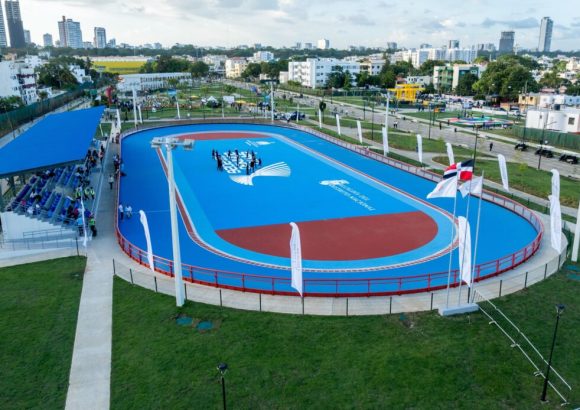
    One of the park’s standout features is a cutting-edge speed skating rink built to meet full international competition standards. This venue is already scheduled to host speed skating events during the 2026 Central American and Caribbean Games, which will be held in Santo Domingo, and is positioned to accommodate future international athletic tournaments long after the 2026 games conclude.

    Beyond the competition-ready skating facility, the park boasts a diverse array of public amenities designed to serve visitors of all ages and interests. These include a dedicated bicycle lane, accessible pedestrian ramps, multi-purpose sports courts, fenced children’s playgrounds, an open-air urban amphitheater for community events, a off-leash dog park, designated outdoor exercise zones, on-site parking, shaded rest areas, and preserved historical ruins on the property. The complex also offers direct connection to Santo Domingo’s OMSA public transit network, making it easily accessible for residents traveling from across the city.

    A notable design element of the park is the custom Malecón slab, a specialized decorative pavement that draws inspiration from Santo Domingo’s iconic coastal shoreline. This feature not only gives the space a unique visual identity rooted in local culture, but also adds distinct aesthetic value to the entire waterfront corridor.

    Paseo 30 de Mayo is the third major recreational project completed under the Integrated Plan for Santo Domingo, joining the previously opened Paseo Marítimo and Malecón Deportivo. Together, these three initiatives are creating a continuous, connected waterfront corridor dedicated exclusively to public recreation, organized sports, and community gatherings. Local government officials note that the project strengthens the capital city’s connection to its coastal heritage, while moving the city closer to its long-term vision of becoming a more modern, well-planned, and inclusive urban center for all residents.

  • Saint Lucians to pay more for water, sewerage services

    Saint Lucians to pay more for water, sewerage services

    Residents and commercial operators across the Caribbean island nation of Saint Lucia are bracing for higher water and sewerage bills after the country’s National Utilities Regulatory Commission (NURC) gave formal approval to a revised tariff schedule for the Water and Sewerage Company (WASCO). The adjusted rates will not take effect until the June 2026 billing cycle, with incremental increases rolled out gradually over a 24-month period to soften the financial impact on consumers.

    Regulators framed the price adjustment as a critical intervention to shore up WASCO’s long-term financial viability, fund overdue infrastructure upgrades across the island’s water distribution network, and ensure the utility can continue delivering reliable basic services to all Saint Lucians.

    To protect low-volume residential users, the base rate for households consuming up to 2,000 gallons per billing cycle will remain unchanged at Eastern Caribbean $24.42. Higher consumption brackets, however, will see incremental cost hikes over the two-year phase-in period. For residential users using between 2,000 and 3,000 gallons per cycle, the current rate of $12.21 per 1,000 gallons will rise to $16.77 when the new scheme launches in June 2026, before increasing again to $23.03 in January 2027. For heavy users consuming more than 3,000 gallons per cycle, the rate will climb from the current $24.92 per 1,000 gallons to $34.23 in 2026, reaching $47.00 in 2027.

    Non-residential customer groups will also face rising costs, with staggered increases varying by sector. Commercial enterprises and government agencies will see a cumulative 37.34% rate hike over the phase-in period, while hotels and maritime boat operators will face a steeper cumulative increase of 76.17%. Sewerage service rates will follow the same phased adjustment model, with hotels again shouldering a larger percentage increase than all other customer categories.

    The NURC’s approval comes after months of public consultation held earlier this year, where WASCO made the case that its existing tariff structure was no longer sufficient to let the utility meet its core service obligations. The company highlighted mounting operational pressures including spiking global energy costs, decades of underinvestment in aging water and sewer infrastructure, and growing consumer demand for improved service quality.

    During public input sessions, many stakeholders acknowledged that urgent investment in Saint Lucia’s aging water distribution network was unavoidable. However, broad public support for the tariff adjustments was tied directly to concrete promises of tangible service improvements. Consumers raised repeated concerns about the island’s longstanding issues with intermittent water supply, a lack of transparency and accountability from the utility, and the need to deliver measurable upgrades to service reliability after price increases go into effect.

    In its formal order approving the new tariffs, the NURC outlined clear performance expectations for WASCO. The regulator is requiring the utility to boost operational efficiency, cut down on costly non-revenue water losses that have plagued the island’s system, improve customer complaint resolution processes, strengthen internal governance and accountability, and deliver more consistent, reliable water access across Saint Lucia.

    To ensure the company fulfills these commitments, the NURC announced it will put in place formal monitoring and enforcement mechanisms throughout the duration of the new tariff schedule, holding WASCO accountable for meeting its performance targets.

    A portion of the additional revenue generated by the tariff hikes will be allocated to the high-priority John Compton Dam Raw Water Pipeline Project, a major initiative that will replace and upgrade critical segments of Saint Lucia’s core water transmission system. All funds earmarked for this infrastructure upgrade will be held in a dedicated, segregated account, with ongoing oversight from the NURC to guarantee the resources are used exclusively for their intended purpose.


  • Police Probe Theft of Construction and Agricultural Equipment in Bolans Area

    Police Probe Theft of Construction and Agricultural Equipment in Bolans Area

    Authorities in Antigua have launched a formal investigation into two separate theft incidents that targeted construction and agricultural work sites across the Bolans region over the recent weekend. The two cases, which occurred days apart but within the same weekend window, have left local work operations short of critical gear and prompted detectives to comb through evidence for leads.

    The first of the two thefts took place at the Chapa Housing Project construction site, where a high-powered Bosch jackhammer, valued at approximately $2,000, was stolen from an on-site storage container. Investigators have narrowed the window of the theft to between Friday afternoon and early Monday morning, when the missing tool was first discovered. A key detail that has drawn investigators’ attention is the total lack of forced entry evidence at the storage container, suggesting the perpetrator may have had access to keys or knew the site’s security layout.

    As part of ongoing inquiries, law enforcement officers have already conducted interviews with multiple witnesses and persons of interest connected to the housing project, and have collected statements and physical evidence to advance the case. As of the latest update, however, the stolen jackhammer has not been recovered, and the search continues.

    In a second, unrelated incident just days later, thieves targeted the Green Castle Agriculture Station, making off with multiple pieces of landscaping and agricultural equipment. In this case, the perpetrators used force to gain entry: investigators confirmed that the suspects forced open two separate padlocks to access the equipment storage area, and caused additional damage to a window before fleeing the property with their stolen goods. The items taken include four weed wackers and one commercial mist blower, a tool commonly used for pesticide and fertilizer application on agricultural sites. Authorities have not yet released a total estimated value for the stolen agricultural gear, as they continue to document the loss for the facility.

    The break-in at the agriculture station is believed to have occurred between Saturday evening and Monday morning, when staff arrived to start the work week and discovered the break-in. Antigua Police confirmed that active investigations into both of these theft cases are still ongoing, and have asked any members of the public who saw suspicious activity in the Bolans or Green Castle areas over the weekend to come forward with information that could help solve the cases.

  • St. Peter’s to be restored to 24/7 water supply following key upgrades

    St. Peter’s to be restored to 24/7 water supply following key upgrades

    For decades, residents of St. Peter’s, a community on the Caribbean island of Saint Kitts, have navigated daily disruptions to their water access, a persistent consequence of underfunded and outdated infrastructure. That long-standing challenge is finally poised to be resolved, as the island’s Water Services Department (WSD) nears completion of key infrastructure upgrades that will bring round-the-clock running water to the area within days.

    The breakthrough comes on the heels of the launch of the new Basseterre Desalination Plant, which entered full operation in late February 2026. The plant has produced a consistent surplus of water that currently replenishes the Basseterre aquifer, creating extra capacity that can be redirected to underserved communities across the island. To unlock that surplus for St. Peter’s, however, WSD crews had to complete months of work to lay new distribution pipelines and source specialized pumping equipment.

    In a project update delivered to stakeholders on June 16, WSD Water Engineer Cromwell Williams shared that the new pump required for the expansion only arrived on Saint Kitts on June 12, with installation finalized three days later on June 15. Technical teams have already begun final performance testing of the new pipeline and pumping system to ensure it can deliver the full expected volume of additional water.

    Once testing wraps up, the system will add 150,000 gallons of water per day to St. Peter’s existing water network, a volume large enough to meet all residential demand around the clock. According to Williams, the upgrade will mark the first time the community has had uninterrupted 24/7 water access in more than 30 years, resolving a decades-long barrier to quality of life for local residents.

    This press update was originally issued by the St. Kitts-Nevis Information Service (SKNIS) and distributed via local media outlet SKNVibes.com on June 18, 2026.

  • Department of Environment Reopens Thursday After Closure for Electrical Works

    Department of Environment Reopens Thursday After Closure for Electrical Works

    The Newfoundland and Labrador Department of Environment has announced a one-day full closure to the public at its Victoria Park headquarters in St. John’s, scheduled for June 17. The temporary shutdown was prompted by critical scheduled electrical work that will cut off power access to the entire building for a prolonged working window. Without full power access, the department cannot safely or effectively deliver in-person public services, leading leadership to make the decision to close all public-facing office operations for the entire day. In an official public notice released ahead of the closure, department officials confirmed that standard service delivery and office operations will return to their regular schedule starting June 18. The statement also included a note of appreciation to local residents and service users for their patience and understanding during the short-term disruption, which is necessary to complete critical infrastructure improvements at the facility.

  • School Uniform Grant Programme Heads to Barbuda June 22–26

    School Uniform Grant Programme Heads to Barbuda June 22–26

    As the 2026 new academic year approaches, families across Barbuda are set to receive targeted financial support for school uniform costs through a government-backed initiative. The Ministry of Education of Antigua and Barbuda has officially confirmed that the 2026 School Uniform Grant Programme will operate from June 22 to June 26 at Holy Trinity Primary School, bringing much-needed relief to households struggling with back-to-school expenses.

    According to official updates shared via the Ministry’s Education Broadcasting Unit, the distribution of grants will run on a daily schedule throughout the five-day event, opening its doors to eligible applicants from 8:30 a.m. local time to 3:00 p.m. each day. To streamline the application and verification process, education officials have outlined clear documentation requirements for all parents and guardians seeking assistance.

    For citizen applicants, a valid government-issued photo ID is mandatory for the adult applying, while the child for whom the grant is requested must provide an original or certified copy of a birth certificate or a valid passport. A critical additional requirement is official documentation confirming that the child is currently enrolled at a school formally registered with the Ministry of Education, a measure put in place to ensure the grant reaches only eligible, enrolled students.

    Special provisions have been made for non-national parents or guardians who are legal residents of Antigua and Barbuda. This group must present valid passports alongside official documentation proving that both they and their children hold legal resident status in the country. Education authorities have emphasized that incomplete documentation will delay processing, so all applicants are strongly encouraged to compile all required paperwork before arriving at the distribution site.

    For any applicants with questions about the eligibility criteria, required documents, or event logistics, additional information can be obtained by calling the dedicated hotline at 727-2427 during official working hours. This long-running program has become a key annual support measure for families across the country, helping to reduce the financial burden of back-to-school preparations and ensure all children can start the new academic year with the necessary supplies without their families facing undue financial strain.

  • Teen goes on Shopping Spree

    Teen goes on Shopping Spree

    In a recent incident that has sparked widespread public discussion across social media and local communities, a teenager has made headlines for carrying out an extravagant, unauthorized shopping spree that left many questioning modern youth spending habits and parental supervision frameworks.

    Details emerging from local retail sources indicate that the young individual spent thousands of dollars on high-end clothing, electronics, and luxury accessories over a 48-hour shopping binge across multiple major retail outlets in the downtown district. What makes this incident particularly notable is that the funds used for the purchases were not the teen’s own, reportedly accessed through an unsecured payment method linked to a family member’s financial account.

    Local retail workers first noticed unusual activity when the teenager arrived at a designer boutique on Friday afternoon, purchasing multiple high-value items in one transaction without hesitation. Over the following two days, the spending spree continued across electronics stores, beauty counters and sneaker boutiques, with the teen carrying multiple large shopping bags between stores, drawing little attention at first amid the busy weekend shopping rush.

    Once the unauthorized activity was detected by the account holder, who is a parent of the teenager, local authorities were contacted, and an investigation into the incident is now ongoing. Retail representatives have confirmed that they are cooperating fully with the investigation, noting that there were no obvious red flags during the transactions that would have prompted staff to intervene.

    This incident has reignited debates around two key issues in modern society: the ease of access to digital payment methods for minors, and the lack of financial literacy education for young people. Many child development experts have weighed in, noting that as contactless and digital payments become the norm, teenagers are often disconnected from the real value of money, making impulsive and excessive spending more likely.

    Community members have expressed mixed reactions to the news. Some have criticized the teenager’s actions as irresponsible and entitled, while others have pointed the finger at poor parental monitoring and a consumer culture that pushes young people to equate self-worth with expensive possessions. Local education officials have announced that they will review the current personal finance curriculum for secondary schools in the district in response to growing concerns about youth financial literacy.