
The Bahamas’ Minister of Youth, Sports, and Culture, Mario Bowleg, has announced a comprehensive audit of the Junkanoo Corporation of New Providence (JCNP) amid escalating tensions over the management of the nation’s iconic Boxing Day and New Year’s Day parades. The minister has also ruled out approving any private parades organized by the JCNP, citing concerns over financial mismanagement and accountability. “The public will be very surprised by the audit’s findings,” Bowleg stated, emphasizing the need for transparency in the use of public funds. The government has transferred parade management to the newly established Parade Management Committee, chaired by veteran Junkanooer Douglas Hanna, which will oversee the 2025 and 2026 events. The JCNP, which has managed the parades for decades, has protested the decision, claiming it will suffer significant financial losses, including unpaid sponsorships and recent investments in scoring systems. Despite the backlash, Bowleg defended the move, stating it was based on a vote by Junkanoo groups, with 19 in favor of the National Junkanoo Committee (NJC) taking charge. The government has also unveiled plans to expand Junkanoo into a two-week festival, aiming to boost cultural and economic impact. Opposition Leader Michael Pintard criticized the government’s approach, calling it politically motivated and urging a delay in major changes until after the holidays. Bowleg dismissed the criticism, asserting the decision was driven by the wishes of Junkanoo practitioners.
分类: society
-

Protestors face off over LGBTQI+ rights march
In a dramatic display of societal division, religious demonstrators and LGBTQI+ advocates confronted each other on Saturday outside the University of The Bahamas, highlighting the nation’s ongoing struggle over faith, sexuality, and human rights. The event unfolded as two distinct groups gathered on opposite sides of University Drive, each voicing their deeply held convictions.
-

Armoured truck driver wanted in $15m ABM theft at St Andrew supermarket
A security officer is currently being sought by authorities in connection with a high-profile $15 million robbery of an automated banking machine (ABM) at a supermarket in St Andrew. The incident occurred on Sunday morning, around 9am, when the suspect, employed as a driver for a well-known security company, and four colleagues were servicing the ABM at the shopping facility. The suspect was reportedly left alone in the armoured truck during the operation. Upon the return of his colleagues, it was discovered that he had vanished. Security footage allegedly captured the suspect exiting the back of the vehicle with a backpack and later leaving the compound with the same bag. Despite extensive efforts to locate him, the suspect has not been seen or heard from since the incident. The Half Way Tree Police are actively investigating the case, which has raised significant concerns about internal security protocols within the company.
-

Widespread flooding in Nassau after weekend of heavy rain
New Providence faced unprecedented flooding over the weekend as torrential rains transformed roads into rivers, severely disrupting daily life and submerging multiple communities. Housing Minister Keith Bell expressed concerns about the growing need for government assistance, particularly as the region is still recovering from the aftermath of Tropical Storm Imelda. Bell highlighted that areas such as Bel Air Estates, Carmichael Road, Tonique Williams-Darling Highway, and West Bay Street experienced some of the most severe flooding. Social media was flooded with videos depicting vehicles battling surging waters, overwhelmed drainage systems, and major thoroughfares rendered impassable. The Ministry of Works and Family Island Affairs has announced plans to deploy drainage pumps and pump trucks once weather conditions stabilize. While the full extent of the damage is still being assessed, Bell emphasized that the weekend’s deluge has significantly increased the number of Bahamians requiring government aid for home repairs and replacement of damaged possessions.
-

TTSPCA welcomes animal shelter tax concession
In a significant move to support animal welfare, the Trinidad and Tobago government has announced tax concessions for corporate and individual contributions to registered animal shelters. Finance Minister Davendranath Tancoo unveiled this initiative during the national budget presentation on October 13 at the Red House. The proposal includes amendments to the Corporation Tax Act and the Income Tax Act, allowing companies and individuals to claim deductions for their donations to approved shelters. Companies can deduct up to 15% of their chargeable profits or $100,000 annually, while individuals can claim up to 20% of their total income or $20,000 per year. These changes, set to take effect on January 1, 2026, aim to bolster the efforts of shelters in controlling stray populations, promoting spaying and neutering, and enhancing public health and environmental sanitation. Sita Kuruvilla, chairman of the TT Society for the Prevention of Cruelty to Animals (TTSPCA), expressed optimism about the new policy, highlighting its potential to attract more support and reduce the financial burden on shelters. The TTSPCA, which faced imminent closure in September 2024 due to funding shortages, hopes this initiative will encourage more donations and ensure the sustainability of their operations.
-

Jamaica ranks #1 for most likely to help strangers
Jamaica has emerged as the global leader in altruism, securing the top spot for its citizens’ willingness to assist strangers, as revealed in the World Happiness Gallup Report 2025. The Caribbean nation is closely trailed by Liberia and Sierra Leone, both of which also exhibit remarkable levels of generosity toward unfamiliar individuals. However, despite their commendable acts of kindness, these countries rank significantly lower in terms of charitable donations, with Jamaica, Liberia, and Sierra Leone positioned more than 80 places behind in global charity contribution rankings. The report identifies a similar trend in Nigeria and Kenya, which also feature in the top 10 for helping strangers but struggle with financial contributions to organizations. These nations, along with Jamaica, grapple with issues of institutional trust, particularly in their interactions with law enforcement, which often results in a diminished reliance on formal systems. This phenomenon underscores a broader societal pattern: in regions where institutional frameworks are perceived as unreliable or inaccessible, individuals tend to seek support from one another rather than from formal entities. In Jamaica and similar contexts, generosity transcends mere moral obligation, evolving into a tangible manifestation of trust and solidarity among neighbors and strangers alike. This preference for personal, human-centered assistance over formal charitable mechanisms highlights the unique social dynamics at play in these societies.
-

LETTER: A special place in hell for “Churches” taking tithes from poor old people
A scathing critique has emerged regarding the practice of certain churches and religious ministers accepting tithes from elderly, vulnerable individuals, many of whom suffer from dementia or live in poverty. The author, a self-proclaimed ‘God-fearing prostitute on Popeshead Street,’ expresses deep frustration and moral outrage over this exploitation. The letter highlights the case of an elderly woman in her 80s or 90s, surviving on a meager pension and occasional support from family and friends, who is still pressured to donate to the church. The author questions the ethics of religious leaders who fail to inform these elderly individuals that they are not obligated to tithe, especially when their financial situation is dire. The letter also touches on the historical context of brainwashing, where older generations were taught that withholding tithes would result in divine punishment. The author calls for legal measures to prevent religious organizations from accepting tithes from low-income seniors, labeling the practice as ‘shameful’ and ‘plain wickedness.’ The piece concludes with a broader critique of declining church attendance, attributing it to such unethical behaviors.
-
Trainingen museumwezen moeten kennis verdiepen en verbreden
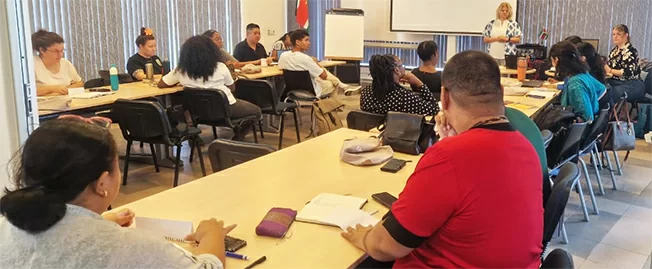
A groundbreaking collaboration between the National Museum Commission of Suriname (NMS) and the Netherlands Cultural Heritage Agency (RCE) has culminated in the launch of an extensive museum training program. The initiative, which commenced on Monday, October 13, and will run until October 31, is being held at the National Archives of Suriname. This training follows the announcement made to Surinamese stakeholders in January and the signing of a final agreement with the RCE on April 10, 2025, in the Netherlands.
Roseline Daan, Chairperson of the NMS, expressed her enthusiasm for this significant milestone, emphasizing the months of preparation that led to this point. Alongside NMS Vice-Chairperson Rita Tjien Fooh and Secretary Tanya Sitaram, Daan engaged in discussions with Dutch educators, who are now paired with Surinamese experts, referred to as ‘buddies,’ to co-facilitate the training sessions.
The program is structured into three modules, covering critical areas such as collection management and registration, conflicting value systems, organization of the museum sector, sustainability, and preventive conservation. Daan highlighted the importance of preventive conservation, noting that the training aims to enhance knowledge and skills in museum heritage, education, and presentation. This, she believes, will lay a stronger foundation for the development of Suriname’s museum sector, particularly in light of the NMS’s plans to establish a National Museum. The initiative includes the rehabilitation of Building 1790 under the PURP program and the restoration of the Zeelandiaweg building, known as ‘Devil,’ which will serve as a depot for the new museum.
‘We are building capacity now so that when the museum is ready, the expertise will already be in place to get started,’ Daan explained. She also stressed the importance of deepening the careers of museum professionals and fostering a broader understanding of operational and strategic tasks within Suriname’s cultural institutions.
The training aims to achieve several key outcomes, including broadening knowledge and skills in collection management and conservation, developing interactive and educational visitor programs, improving practical skills in exhibition design and execution, and strengthening leadership and teamwork abilities for successful collaboration within museum institutions.
The Dutch trainers include Emmy Steenhoek, Vivian van Saaze, Bente Bergmans, Marc Stappers, and Nadia Wilting, while the Surinamese trainers are Audrey Hofwijks, Irene Meulenberg, and Rinaldo Klas. Participants in the training represent a wide range of institutions, including the National Herbarium of Suriname, the National Zoological Collection of Suriname, the Koto Museum, the Commewijne Story Museum, Villa Zapakara, the Bakkie Museum, the Diitabiki Museum Fositen Gudu, the National Army Museum, VHJI, the Suriname Museum Foundation, VIDS, the Suriname Nature Conservation Foundation, and staff from the Directorate of Culture.
-

OECS conducts 5th Regional Data Governance Council Meeting to promote evidence-based growth
The Organisation of Eastern Caribbean States (OECS) Commission successfully concluded the fifth session of the Regional Data Governance Council (RDGC), held from October 7 to 10, 2025. The four-day event brought together statistical leaders from OECS member states, regional agencies, and international development organizations to enhance collaboration, improve statistical capabilities, and promote data-informed decision-making across the Caribbean region.
Corneil Williams, Chairperson of the RDGC, opened the session by stressing the importance of unified strategies in data collection and governance. Key figures and partners underscored the critical role of data governance in driving sustainable development within the OECS.
Dr. Didacus Jules, Director General of the OECS Commission, emphasized the organization’s commitment to strengthening statistical systems as vital tools for evidence-based policymaking. He highlighted the need to cultivate a culture of data use and trust, urging stakeholders to move beyond data collection to actionable insights. Jules also called for integration beyond formal treaties, fostering a shared understanding through data.
Elbert Ellis of the Caribbean Development Bank (CDB) reiterated the bank’s support for regional development efforts, including the Enhanced Country Poverty Assessment (eCPA). He emphasized the importance of robust data systems for sustainable development and outlined the CDB’s technical and financial contributions to improving data governance and institutional frameworks.
Ms. Anna Luisa Paffhausen from the World Bank highlighted the Bank’s collaboration with the OECS through the Data for Decision Making (DDM) Project. She noted the meeting’s focus on anonymizing core datasets to support data dissemination and analysis, aiming to address key policy and development priorities in the region.
Ms. Sherma Beroo, OECS DDM Project Manager, emphasized the importance of fostering stronger partnerships to ensure robust, harmonized data systems capable of supporting sustainable development.
The sessions covered critical topics, including progress on regional and national statistical initiatives, updates on flagship projects like DDM and CARDTP, strategies for data anonymization, and the development of a Communication and Advocacy Strategy to promote statistical data use. The meeting concluded with a coordinated work plan, renewed commitments to data harmonization and privacy protections, and strengthened collaborations among OECS member states and development partners.
-

Animal welfare group calls for urgent action
Barbados is grappling with a mounting dog crisis, prompting urgent calls for action from local animal welfare organizations. The issue gained heightened attention following a recent dog attack in Bayville, St Michael, which left a woman and two children injured. Ocean Acres Animal Sanctuary, a prominent animal welfare group, has issued a statement demanding stronger legislation, consistent enforcement, and greater accountability among dog owners. Karen Whittaker, Founder and CEO of Ocean Acres, emphasized the severity of the situation, stating, ‘No one should feel unsafe walking in their own neighbourhood. Animal abandonment and stray dogs have become national health and safety concerns. It is time for stronger legislation, better enforcement, and responsible ownership.’
Ocean Acres has proposed a series of measures to address the crisis. These include regular inspections of properties housing dogs, penalties or removal of animals from non-compliant owners, and annual checks of registered kennels to ensure compliance with tax and sanitary requirements. The sanctuary also advocates for stricter controls on dog imports, including a ban on certain large, thick-coated breeds like Huskies and Akitas, which are deemed unsuitable for Barbados’ tropical climate.
Additionally, the group recommends that only registered breeders or owners importing neutered pets be permitted to bring dogs into the island, with animal welfare representatives involved in all inspection and approval processes. To reduce the stray dog population, Ocean Acres has suggested a five-year moratorium on dog imports, with limited exemptions for licensed breeders.
The organization has also urged the government to bolster the Animal Control Unit and Veterinary Services Division to enhance enforcement and oversight. Whittaker stressed that the root of the problem lies not with the animals but with neglectful ownership. ‘To be clear, there are no bad dogs. These are dogs in the wrong place without adequate care and supervision,’ she said. She further cautioned potential dog owners to carefully consider their ability to care for a pet, noting that shelters are already overwhelmed, particularly with abandoned large breeds that become unmanageable as they grow.
Whittaker highlighted the need for responsible ownership, stating, ‘Many owners lack the means to manage them properly, and when that happens, tying them up or letting them roam is not a solution. There are only two viable choices: invest the time and resources to manage them responsibly, or have them humanely euthanised.’ Ocean Acres maintains that resolving the crisis will require stronger legislation, enforcement, public education, and collaboration between government, veterinarians, and animal welfare groups.