分类: politics

  • Regime change by force in Venezuela

    Regime change by force in Venezuela

    In a dramatic escalation of tensions, United States military forces initiated a covert operation in Venezuela during the early hours of Saturday, resulting in the capture of President Nicolás Maduro. The intervention began with precision airstrikes targeting key Venezuelan military installations including La Guaira port, Higuerote airport, La Cariota airport, and the Fuerte Tiuna military complex. Notably, the country’s critical oil infrastructure remained untouched throughout the operation.

    Eyewitnesses reported explosions illuminating the night sky over Caracas as military helicopters patrolled the capital. The strategic strikes appear to have served as a diversion for the primary objective: the extraction and detention of President Maduro, who was transported with his wife, Cilia Flores, to the USS Iwo Jima naval vessel.

    The operation culminates years of mounting pressure on Maduro’s administration, which faced indictment by U.S. authorities in 2020 on multiple charges including corruption and drug trafficking. The State Department had previously offered a $50 million reward for information leading to his arrest or conviction.

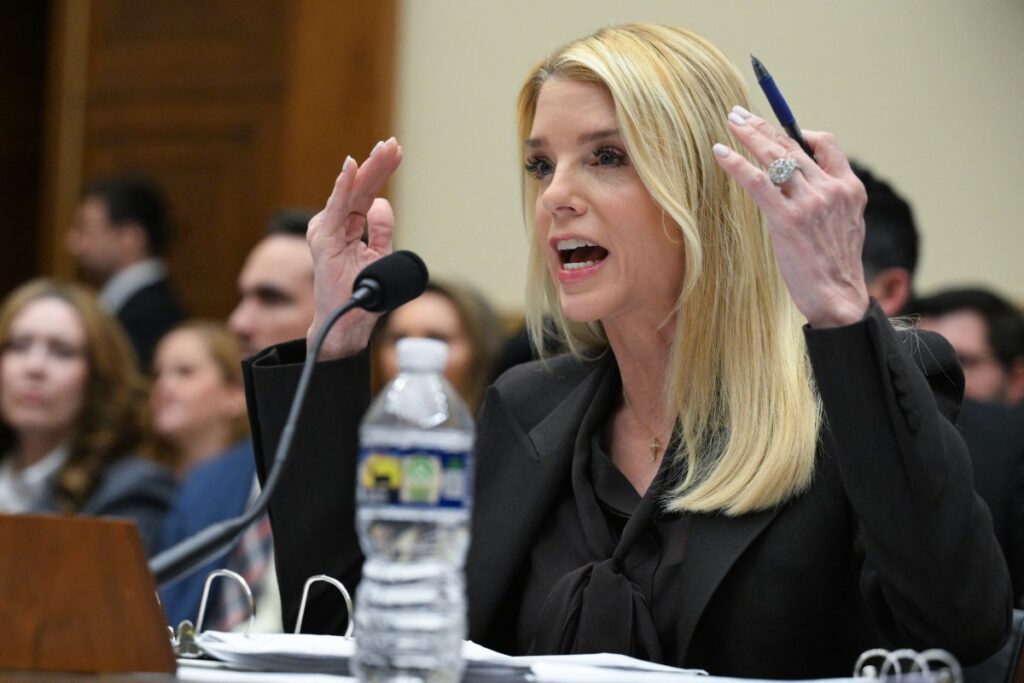
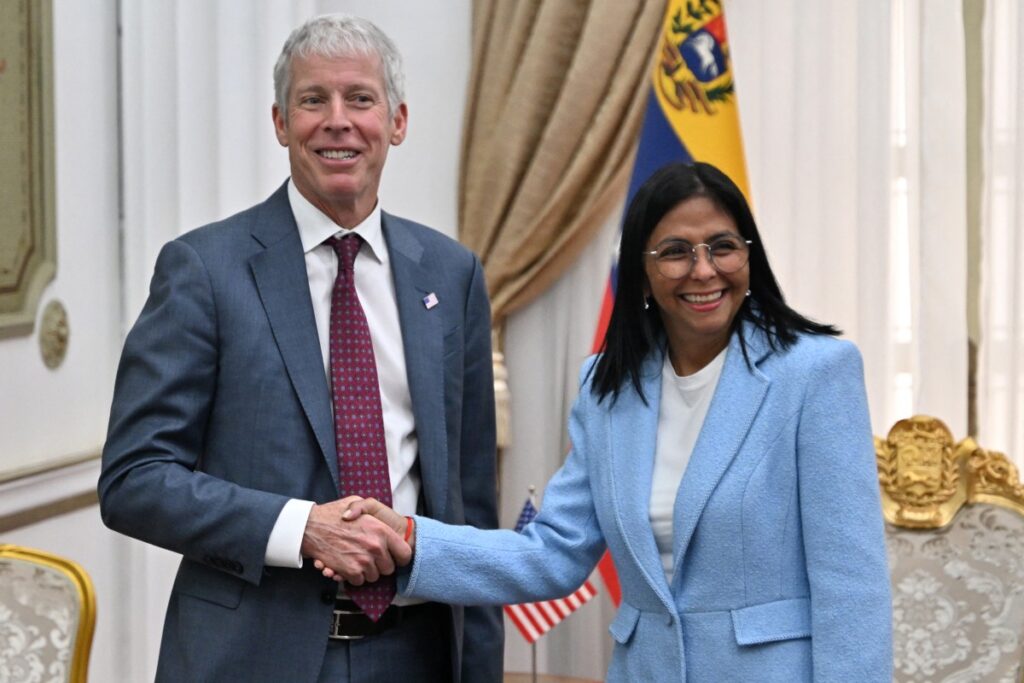
    Following the military incursion, Attorney General Pam Bondi declared that Maduro would face ‘American justice on American soil in American courts.’ With Maduro’s capture, constitutional power has transferred to Vice President Delcy Rodríguez, who was swiftly sworn in as interim leader.

    The action represents a significant evolution from previous U.S. military interventions in the region, notably the 1989 Operation Just Cause in Panama which required several days to capture General Manuel Noriega. That operation drew widespread international condemnation and resulted in substantial civilian casualties.

    This intervention occurs against the backdrop of a newly articulated ‘Trump Corollary’ to the Monroe Doctrine, which advances a doctrine of American preeminence and flexible realism as pillars of foreign policy. During a recent press conference, President Trump explicitly connected the operation to Venezuela’s substantial oil reserves, suggesting the newly installed leadership would cooperate with U.S. economic interests.

  • Gaston Browne aims to meet Kamla to discuss Clico

    Gaston Browne aims to meet Kamla to discuss Clico

    Antigua and Barbuda’s Prime Minister Gaston Browne has announced his intention to seek bilateral discussions with Trinidad and Tobago’s Prime Minister Kamla Persad-Bissessar regarding outstanding compensation commitments for victims of the CLICO and BAICO insurance collapses. The meeting is anticipated to occur during the upcoming CARICOM Heads of Government Meeting scheduled for February in St. Kitts and Nevis.

    The insurance crisis originated in 2009 when Colonial Life Insurance Company (CLICO), a Trinidad-based financial conglomerate with diversified interests across energy, beverages, and construction, experienced severe liquidity problems following the global financial crisis. The subsequent collapse affected thousands of policyholders throughout the Eastern Caribbean region, with many investors losing substantial portions of their life savings and investments.

    According to Prime Minister Browne, the Trinidad and Tobago government had previously pledged US$100 million toward a regional relief initiative but has only disbursed approximately 40% of this commitment to date. “With the commitment that was made, we still have a significant amount outstanding,” Browne stated, emphasizing the ongoing financial hardship faced by hundreds of affected residents in his nation and thousands more throughout the Eastern Caribbean.

    Browne expressed optimism about the prospects for resolution, noting that Persad-Bissessar’s previous administration had demonstrated serious intent to address the matter. “I am very thankful that her administration had shown seriousness about the issue in the past,” he remarked. “From this standpoint, I hope she remains consistent and we can bring further relief to the CLICO-BAICO situation.”

    While some regional governments have negotiated partial settlements and implemented restructuring measures over the past decade, many policyholders continue to await full recovery of their funds. Browne has vowed to continue advocating for affected citizens and expects Trinidad and Tobago, as the home jurisdiction of the failed insurance conglomerate, to honor its financial commitments in full.

  • China ‘strongly condemns’ US strikes on Venezuela

    China ‘strongly condemns’ US strikes on Venezuela

    BEIJING — The Chinese government issued a forceful condemnation on Saturday against United States military operations in Venezuela that resulted in the capture of Venezuelan leader Nicolás Maduro. In an official statement from the Ministry of Foreign Affairs, China characterized the American actions as a flagrant violation of international legal standards and an infringement upon Venezuela’s national sovereignty.

    The statement expressed profound shock at what it termed ‘hegemonic behavior’ by the United States, warning that such military aggression threatens regional stability throughout Latin America and the Caribbean. Chinese officials emphasized their firm opposition to unilateral military interventions against sovereign states, regardless of the circumstances.

    The development comes amid dramatic scenes in both Venezuela and abroad. In Caracas, supporters of President Maduro gathered in the streets following news of his capture by US forces. Simultaneously, Venezuelan expatriates in Madrid celebrated the military operation that targeted Maduro’s government.

    President Donald Trump confirmed on January 3, 2026, that American forces had successfully captured Maduro following extensive airstrikes on Caracas and other Venezuelan cities. This military action represents the culmination of a prolonged geopolitical confrontation between the Trump administration and the Venezuelan leadership.

    China’s statement reflects growing international concern over the precedent set by military intervention in sovereign nations and highlights the deepening diplomatic divisions between global powers regarding appropriate responses to political crises.

  • Venezuelans in Trinidad and Tobago hopeful for change

    Venezuelans in Trinidad and Tobago hopeful for change

    The Venezuelan diaspora in Trinidad and Tobago has responded with both celebration and concern following the unprecedented US military operation that resulted in the capture and removal of President Nicolás Maduro on January 3rd. US President Donald Trump confirmed at a Mar-a-Lago press conference that a “large-scale strike” had been executed, resulting in Maduro and his wife being transported to the United States to face criminal charges.

    Trump announced that the United States would temporarily administer Venezuela through an unspecified group while explicitly stating his intention to access the country’s substantial oil reserves. He outlined plans for US oil companies to invest billions in rebuilding Venezuela’s energy infrastructure with the goal of exporting “large amounts of oil to other countries.”

    Former photojournalist Grevic Alvarado expressed cautious optimism, describing Maduro’s removal as “the first step towards freedom” while acknowledging concerns about family members remaining in Venezuela. “We are hopeful, but at this moment we need to understand what is happening,” Alvarado stated, emphasizing the need for calm until more information becomes available from US authorities and Venezuelan opposition leaders María Corina Machado and Edmundo González.

    Human rights activist Yesenia González characterized the development as “a very happy and emotional day” for Venezuelans who have endured years of economic collapse, shortages of basic necessities, and political repression. While not celebrating violence, she expressed hope for national renewal, institution rebuilding, and the eventual return of millions of displaced Venezuelans.

    González specifically thanked Trinidadian Prime Minister Kamla Persad-Bissessar for supporting US actions and praised Trump’s leadership, asserting that a “free, stable and democratic Venezuela” would benefit both Venezuelans and the broader region by reducing forced migration and fostering cooperation.

    However, dissenting voices emerged from within Venezuela. Political analyst Jesús Enrique Rojas described the atmosphere as “tense” following what he called a “big surprise” that sparked widespread indignation. Rojas reported civilian and military casualties from the strikes and emphasized that neither the public nor Vice President Delcy Rodríguez knew Maduro’s precise whereabouts or condition.

    Rojas condemned the operation as a violation of international law and Venezuelan sovereignty, warning that installing an opposition figure like Machado could trigger civil war. He insisted that constitutional protocols must be followed, with Vice President Rodríguez assuming leadership pending Maduro’s return or a Supreme Court decision regarding new elections.

    The professor called for unified action among Venezuelans to restore their democratically elected leader and normalcy to the nation, asserting that “We decide who is going to be our President because we have our own laws.”

  • Spain rejects Israel’s intention to expel NGOs

    Spain rejects Israel’s intention to expel NGOs

    The Spanish government has issued a formal diplomatic condemnation against Israel’s systematic targeting of humanitarian organizations operating in Palestinian territories. Through an official statement released by its Foreign Ministry, Madrid denounced Israel’s controversial practice of requiring NGOs to register, only to subsequently revoke their operational licenses and expel them from the region.

    This regulatory crackdown has significantly impacted both Spanish and international aid groups, effectively crippling their capacity to address what Spain describes as a ‘humanitarian catastrophe’ in Gaza. The measures directly hinder the delivery of essential supplies and services to Palestinian civilians facing extreme deprivation.

    The Spanish statement further contextualized these actions within Israel’s broader legislative offensive against humanitarian operations. Reference was made to the recent Knesset-approved law authorizing the termination of electricity and water supplies to UNRWA facilities while simultaneously stripping the agency of its diplomatic immunities and operational privileges.

    Madrid expressed profound alarm regarding the compounded severity these decisions impose on Gaza’s already dire humanitarian landscape. The government emphasized that these policies will have devastating consequences for civilian populations throughout the Occupied Palestinian Territories.

    Concluding with a firm diplomatic demand, Spain urged Israeli authorities to immediately reverse these ‘unacceptable decisions’ that obstruct life-saving humanitarian operations. The appeal specifically highlighted the need to protect vulnerable refugee populations across Gaza, the West Bank, and the broader Middle East region who rely on international aid for survival.

  • DRC begins two-year term on UN Security Council

    DRC begins two-year term on UN Security Council

    The Democratic Republic of Congo has officially commenced its term as a non-permanent member of the United Nations Security Council, marking its first return to the powerful diplomatic body in over three decades. Foreign Minister Therese Kayikwamba Wagner characterized this development as a profound responsibility rather than an accolade, emphasizing the nation’s dedication to international peace and security during a video address.

    This ascension to the Security Council occurs amid significant domestic security challenges within the DRC, including ongoing instability and external aggression. Minister Wagner expressed gratitude to all UN member states for their confidence in the Central African nation’s capabilities, acknowledging the timing as particularly symbolic given the country’s current circumstances.

    The diplomatic mission will prioritize conflict prevention and resolution, with particular focus on African continent security issues. The minister articulated the nation’s approach would be grounded in principles of multilateral cooperation, respectful dialogue, and strict adherence to international legal obligations.

    Minister Wagner explicitly framed the Security Council position as “a mission, not a reward,” underscoring the DRC’s commitment to defending fundamental international principles including state sovereignty, territorial integrity, and the established framework of international law. The country previously held Security Council membership during the 1982-1983 and 1990-1991 periods, bringing historical perspective to its current term.

  • Maldives expresses interest in strengthening ties with Cuba

    Maldives expresses interest in strengthening ties with Cuba

    Marking the 67th anniversary of the triumph of the Cuban Revolution, Maldivian Foreign Minister Moosa Zameer has articulated a clear vision for enhanced cooperation between the Maldives and Cuba. In a formal diplomatic communiqué addressed to his Cuban counterpart, Bruno Rodríguez Parrilla, Minister Zameer extended warm congratulations on behalf of both the Maldivian government and its citizens, recognizing the occasion as Cuba’s ‘Liberation Day.’

    The correspondence served as a platform to reaffirm the enduring diplomatic partnership between the two nations. Minister Zameer explicitly expressed his intent to fortify the existing bilateral and multilateral collaboration in the years ahead, underscoring a mutual commitment to international solidarity. The message concluded with formal assurances of the Minister’s highest regard and esteem for his Cuban colleague.

    The foundation for this modern partnership was established on January 29, 1977, when diplomatic relations were first formalized. For nearly five decades, the relationship has been defined by a consistent pattern of strong diplomatic alignment and reciprocal support across numerous international forums and development initiatives, fostering a relationship built on shared principles and mutual respect.

  • Venezuela: Maduro houdt VS olijftak voor

    Venezuela: Maduro houdt VS olijftak voor

    In a striking diplomatic overture, Venezuelan President Nicolás Maduro has proposed comprehensive dialogue with the United States regarding narcotics enforcement while offering American energy corporations expanded access to Venezuela’s substantial petroleum reserves. The unexpected conciliatory message was delivered during a New Year’s Day broadcast on state television, filmed within a militarized zone of Caracas.

    Maduro characterized Venezuela as a “brother nation” to the United States and referenced his November exchange with President Donald Trump, noting the American leader had formally acknowledged his presidency during their communication. This represents a notable tonal shift from Venezuela’s previous stance toward Washington amid escalating bilateral tensions.

    The televised interview featured Maduro demonstratively driving a vehicle with his wife Cilia Flores seated in the rear—a gesture analysts interpreted as projecting confidence despite recent reductions in his public appearances following U.S. threats of military intervention.

    Washington has recently intensified its Caribbean military presence while accusing Maduro’s administration of presiding over a “narco-state” and threatening regime change. The Venezuelan leader has consistently denied these allegations, maintaining that U.S. hostility stems from desires to control Venezuela’s extensive oil reserves and rare earth mineral deposits.

    Maduro’s proposal specifically mentioned readiness to accommodate investments from American energy giants like Chevron, stating: “Venezuela is prepared to accept U.S. investments wherever and whenever they choose to proceed.” Regarding narcotics cooperation, he emphasized: “If they seriously wish to discuss agreements to combat drug trafficking, we are prepared for that conversation.”

    This development occurs against the backdrop of increased U.S. naval deployments in the Caribbean and follows Maduro’s Christmas-season admonition that Trump should focus primarily on domestic challenges rather than Venezuelan affairs.

  • Cuba expresses gratitude for messages on the anniversary of the Revolution

    Cuba expresses gratitude for messages on the anniversary of the Revolution

    Cuban Foreign Minister Bruno Rodríguez has publicly reciprocated the diplomatic messages received from international leaders and counterparts through his official social media account. The communications, which conveyed congratulations, solidarity, and goodwill, originated from heads of state, government officials, and global associates across multiple nations.

    In his digital correspondence, Minister Rodríguez underscored the Caribbean nation’s international recognition for its humanitarian initiatives and solidarity-driven foreign policy. The minister’s post emphasized Cuba’s revolutionary ethos, encapsulated by the hashtag #APuebloEnRevolución (A People in Revolution), which champions peace advocacy and the establishment of a reformed international framework characterized by democratic values, equity, and inclusiveness.

    Furthermore, Rodríguez articulated Cuba’s diplomatic vision for a global order free from armed conflicts, coercive force, and unilateral sanctions. His statements coincided with commemorations marking the 67th anniversary of the Cuban Revolution, during which he reaffirmed the government’s commitment to enhancing bilateral friendship and cooperative agreements with partner nations. The minister’s message serves as both an acknowledgment of international solidarity and a reaffirmation of Cuba’s revolutionary principles in global diplomacy.

  • Rebels accuse DRC government of preparing genocide against Tutsis

    Rebels accuse DRC government of preparing genocide against Tutsis

    In a sharp escalation of rhetorical hostilities, rebel forces in the Democratic Republic of Congo have publicly denounced recent allegations from the Congolese government. The statement specifically targeted remarks made by government spokesperson Patrick Muyaya concerning Rwandan military presence and territorial expansion in eastern DRC.

    The armed group, identified as AFC/M23, characterized the government’s assertions as a calculated disinformation campaign designed to obscure accountability for ongoing military operations and breaches of the Qatar-mediated truce. The rebels presented a counter-narrative alleging that Congolese forces have been conducting attacks in densely populated regions while systematically violating the Doha Framework Agreement.

    Most alarmingly, the rebel communication issued a grave warning to the international community regarding what they termed an ‘imminent genocide risk’ targeting Congolese Tutsis. The statement detailed accusations of state-sponsored hate speech dissemination and institutionalized stigmatization against this ethnic minority. The rebels further contended that Kinshasa maintains policies of systematic exclusion and discrimination, exacerbating ethnic tensions while simultaneously undermining diplomatic peace efforts through persistent ceasefire violations.