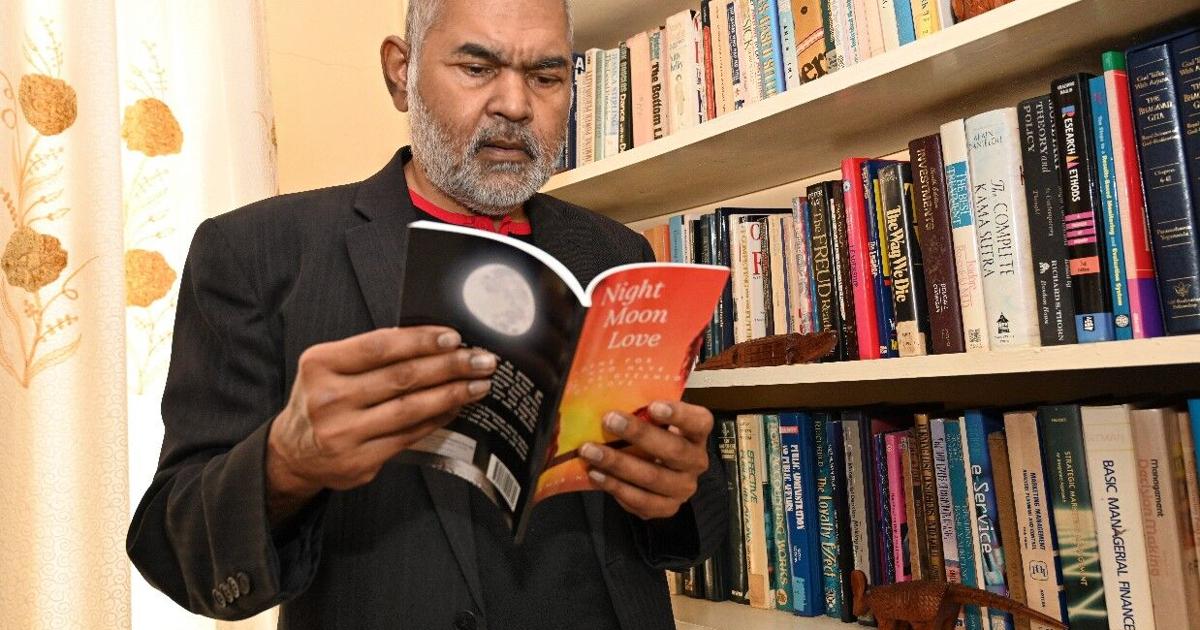
In May 2026, 62-year-old Jamir Nazir, a little-known writer from Cunupia, Trinidad and Tobago, was named the Caribbean regional winner of the 2026 Commonwealth Short Story Prize. Almost immediately, the announcement sparked global online controversy when unsubstantiated claims emerged that his winning submission, *The Serpent in the Grove*, had been generated by artificial intelligence. Last Tuesday, the Commonwealth Foundation, which administers the prestigious annual competition, ended the speculation with an official ruling: after a thorough investigation, the organization confirmed that Nazir had not used AI to create his story, and formally named him the overall winner of the 2026 prize, selected from more than 7,800 entries across 56 Commonwealth nations.
For the first time since the controversy erupted, Nazir opened up about the ordeal, his lifelong passion for writing, and the personal roots of his award-winning story in an exclusive interview with Trinidad’s *Sunday Express*, held at his family home in Cunupia last Friday.
Nazir’s journey as a writer began far from the international literary spotlight. Born the eldest of three children to a working-class Indo-Trinidadian family, he grew up in a small rural sugarcane village along Reform Road in South Trinidad. His father, a field worker on the Reform Sugar Estate who has since passed away, and his 81-year-old mother never had the chance to attend secondary school, and they impressed on their son from a young age that education was the only path to upward mobility. Following his primary education at Reform Presbyterian Primary School and secondary schooling at San Fernando Government Secondary School, Nazir enrolled in agricultural studies at the University of the West Indies St. Augustine campus. He met his wife there at age 21, and the couple, who just celebrated their 42nd wedding anniversary, migrated to the United States a year later. There, Nazir completed a Bachelor of Science degree and an MBA in financial services before returning to Trinidad three years later. He launched a long career in the insurance industry, holding senior leadership roles at regional and local firms, before transitioning to public service, where he spent six and a half years as Head of Policy and Strategy, and later Director of Strategic Services, in Trinidad and Tobago’s Office of the Prime Minister. He retired from public service in 2017 due to declining health, though he continued to work as an independent consultant for private firms.
Writing has been a constant, private passion for Nazir since he wrote his first poem at age 10. Over the decades, he published two volumes of poetry independently: *Night Moon Love* in 2017 and *One a Day* in 2019. He never sought the limelight of the literary world until he decided to enter the 2026 Commonwealth Short Story Prize, a competition he was confident he could win. “I said I could go and win this thing. I could write, I know I could write, so I said let me, and I started to think about what would be an appropriate story,” he explained.
The allegations that he relied on AI to create *The Serpent in the Grove* have taken a significant toll on Nazir and his family, especially his elderly mother and wife. For months, the writer chose to stay silent amid the online vitriol, a decision he says was rooted in an agreement with the Commonwealth Foundation that regional winners would not comment publicly during the investigation to avoid inflaming tensions. “I saw people being very nasty to me, and I was really tempted, and then I stopped looking at any comments on Facebook and thing,” he recalled. “This demoralised me for a bit. So, this is the challenge now that all this that they’ve caused now has sort of shadowed the success.”
In his first public response to the claims, Nazir flatly denied using generative AI to write his story, noting that the tools are far from capable of producing original, resonant work that meets competition standards. “I didn’t need to use it because I had no need… This story, I didn’t need to get it from nobody. This story can, as I say, write itself because it is my experiences,” he told the *Sunday Express*. He did acknowledge that he used his smartphone’s speech-to-text functionality to draft the story, a necessary accommodation for the chronic neuropathy he lives with, which makes typing impossible. “If I didn’t have that, I couldn’t do this,” he said. Because his phone only displays three lines of text at a time, Nazir explained he was able to polish each section of the story slowly and deliberately, line by line, resulting in a tightly crafted final text that some mistook for AI output. “When you put them together, everything polished now,” he said.
A self-described commentator on artificial intelligence who often posts about the technology on LinkedIn, Nazir pushed back against claims that AI detectors, which flagged his work as AI-generated, are reliable tools. “I suspect they know nothing about AI because if they knew about AI, they wouldn’t be just taking things from other people and copying it, and they should know that AI detectors are notoriously unreliable. People make all kinds of claims that this AI detector is 100% reliable. Total crazy,” he said. Unlike the large language models at the center of today’s AI boom, Nazir said his interest in AI focuses on medical diagnostic applications, not creative writing: “What is really the AI I was interested in (is) not large language models; that is a piece of crap. I was thinking AI that will diagnose diseases and conditions.”
Nazir’s health struggles have been a long-running part of his life: he was born with diabetes, which progressed to kidney failure in 2019 and required a kidney transplant in 2021. Just recently, he was diagnosed with cancer and continues to undergo chemotherapy. Even amid these challenges, he spent more than five months refining *The Serpent in the Grove*, drawing directly from his childhood memories growing up in a rural Trinidadian sugarcane village to craft the story. Though the narrative is fictional, all of its core characters and settings are drawn from real life, lightly modified to fit the plot. The story’s main character, Vishnu Mohammed, is shaped by Nazir’s childhood memories of walking home from school past three village rum shops, where sugarcane workers would spend their entire paychecks on alcohol, leaving their families to suffer. “We knew how bad alcohol and the scourge of it was and how it affected people’s lives and family. So, that stuck with me,” he said. One of the story’s supporting characters, Zoongie, who works at a local rum shop, was first conceived 25 years before Nazir completed the story. Every location in the narrative, except for a central well, is based on an actual place he knew growing up. He submitted multiple draft versions of the story to the Commonwealth Foundation during the investigation to prove his iterative writing process.
The judging panel for the 2026 prize described *The Serpent in the Grove* as “an original, poetic and deeply moving story”, a rhythm that Nazir credits to his decades of experience writing poetry. “I had a good story there. You know why? It was from real life, and I thought it would resonate with people,” he said. “I felt it was real, that it would have been able to appeal to people. As one of the judges said, the rhythmic flow was almost musical, and that came because I used to write in poetry. So, it’s the same style, without even thinking.”
Now officially exonerated and named the overall winner of one of the world’s most prestigious short fiction competitions, Nazir says the simple truth of his authorship speaks for itself: he never needed AI to create a story rooted in a lifetime of personal experience.