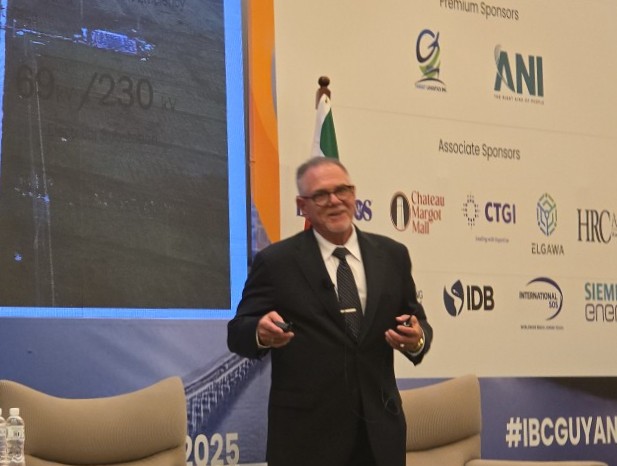
The ambitious 300-megawatt natural gas-fired power plant in Wales, West Bank Demerara, has reached 68.3% completion despite a 14-month delay caused by extensive soil stabilization efforts. LINDSAYCA Guyana Inc. Chairman Nelson Drake revealed the update during the 2025 International Business Conference, highlighting the US$100 million investment required to prepare the site for construction. The project, initially delayed due to disputes with Puerto Rico-based CH4, is now on track to commence electricity generation between January and March 2026. The soil stabilization process, deemed critical for the project’s success, utilized advanced technology to ensure the site could support the heavy infrastructure, including four main turbine foundations made of 44,000 cubic meters of cement. Drake emphasized the complexity of the project, noting that 89% of engineering, 90.46% of procurement, and 23% of construction have been completed. Over 75% of the equipment, including gas turbines, steam turbines, transformers, and cooling towers, has already arrived in Guyana. The natural gas liquids facility, currently in Houston, is expected to be on-site by year-end. Once operational, the plant will utilize 50 million cubic feet of gas produced by ExxonMobil, generating significant energy savings and reducing electricity costs by 50% for Guyanese households. The project is also projected to contribute US$200 million annually to the Guyana government’s treasury through energy savings and condensate sales.
分类: business
-

GARFIN monitoring CLICO payout after court ruling
In a significant development for thousands of policyholders, the Grenada Supreme Court has approved an initial distribution of approximately EC$9.5 million to CLICO International Life (CIL) policyholders, marking a long-awaited step toward financial recovery. The decision, announced on 12 May 2025, comes 14 years after the company’s collapse in 2011, which left many Grenadian families without life insurance benefits and retirement savings. Despite this progress, the payout represents only 6.59% of the total admitted claims, which amount to EC$144.9 million. The distribution follows a small claims scheme, with claims under EC$50 receiving no payment due to high processing costs, while claims between EC$50 and EC$1,000 will be paid in full. Policyholders with claims between EC$1,000 and EC$15,576 can choose between a lump sum payment of EC$1,000 or 5.5% of their total claim amount, while claims over EC$15,576 will receive 5.5% of their claim value. The Grenada Authority for the Regulations of Financial Institutions (GARFIN) has urged policyholders to review correspondence and respond promptly if they have not received personalized letters by 31 October 2025. The Judicial Manager has also launched a dedicated website to provide updates on the ongoing judicial process, ensuring transparency and communication with affected parties.
-
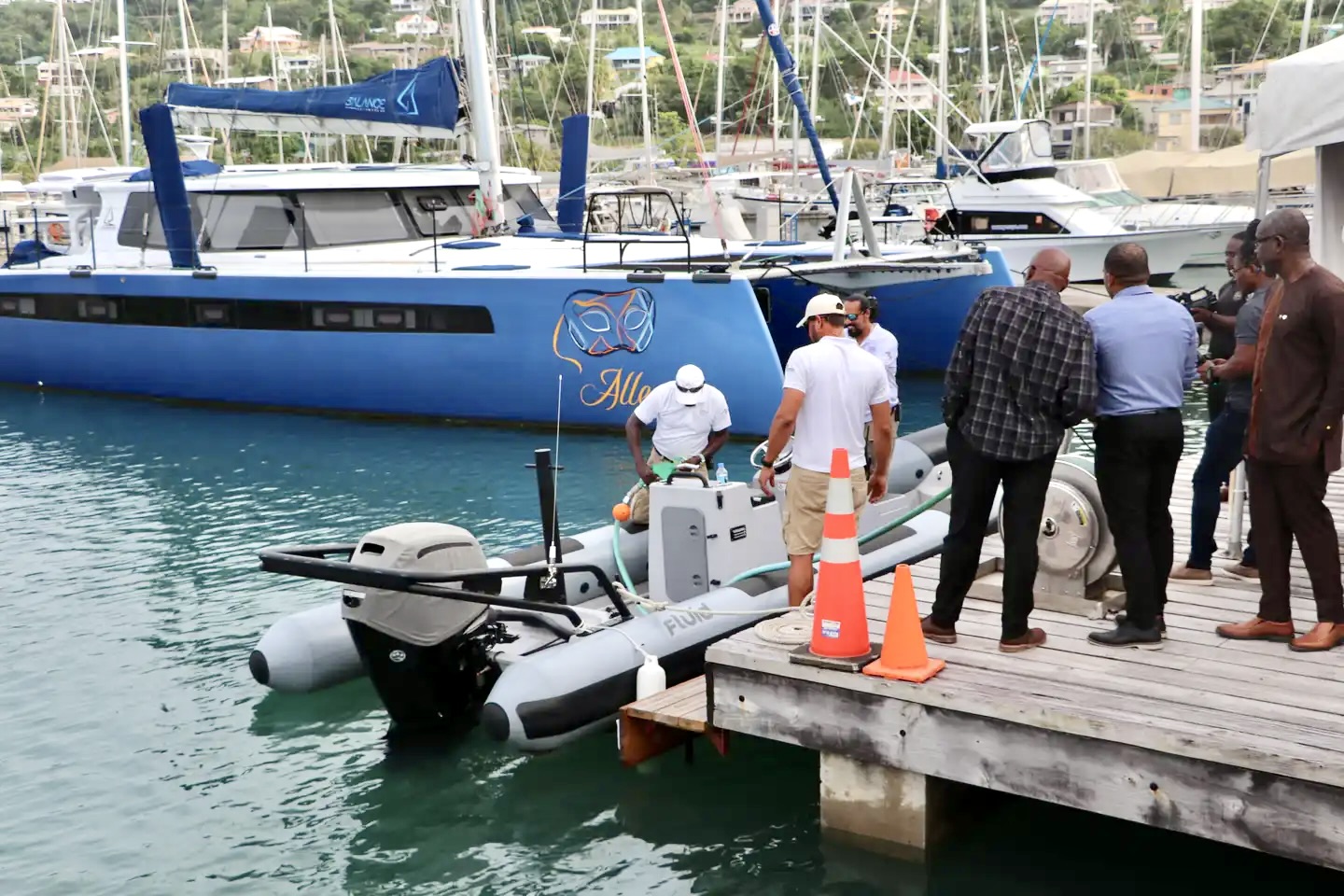
New fuelling facility enhances services for yachting community
Camper & Nicholsons Port Louis Marina, in collaboration with Sol Grenada Ltd, has officially launched a state-of-the-art marine fuelling system at Port Louis Marina. The inauguration ceremony, held on 10 October 2025, marked a significant milestone in enhancing marine services in Grenada. The new system is designed to cater to the needs of modern superyachts and sailing vessels, solidifying Grenada’s reputation as a top-tier destination in the southern Caribbean. The event was attended by key stakeholders and dignitaries, including Zara Tremlett, General Manager of Camper & Nicholsons Port Louis Marina; Stacey Liburd, CEO of the Grenada Tourism Authority; Frank Redhead, CEO of the Grenada Ports Authority; Collin Francis, General Manager of Sol EC Ltd; and Hon. Lennox Andrews, Acting Prime Minister. The ceremony featured a ribbon-cutting and a symbolic “mock fill” demonstration, showcasing the system’s efficiency. Tremlett emphasized the facility’s role in providing world-class amenities, while Francis highlighted Sol’s commitment to safety and quality. The Grenada Tourism Authority sees the development as a boost to the island’s tourism economy, encouraging longer stays and increased spending.
-

PM Dickon Mitchell praises progress at Grenada National Resort
Grenada’s Prime Minister, the Honourable Dickon Mitchell, led an official inspection of the Grenada National Resort (GNR) construction site on October 2, marking a significant milestone for the nation’s tourism and investment landscape. Developed by Heng Sheng International, GNR stands as the largest Citizenship by Investment (CBI)-approved project in Grenada, strategically located in the island’s picturesque northern region near Levera Beach. The resort is poised to set a new standard for luxury tourism and residential investment in the Caribbean, featuring world-class amenities such as a 500-suite ocean-view hotel, an 18-hole championship golf course designed by Robert Trent Jones II, a casino complex, and premium apartments and villas available for purchase. Accompanied by senior government officials, including Finance Minister Dennis Cornwall and Investment Migration Agency Chairman Richard Duncan OBE, Prime Minister Mitchell expressed his admiration for the project’s rapid progress. “I visited in March, but I didn’t expect such significant advancements in just six months. This project will have a transformative impact on local employment and tourism,” Mitchell stated. Heng Sheng Chairman Yuanfa Li guided the delegation through the site, highlighting key developments, including the completion of the golf club structure, the foundation of the casino, and the ongoing construction of the golf course. The first 10 floors of Hotel Tower 1 have been completed, with the 11th floor underway. Li emphasized the team’s commitment to efficiency and quality, projecting the topping out of Hotel Tower 1 by year-end. The visit underscored the strong partnership between the Grenadian government and Heng Sheng, aimed at delivering a landmark project that will redefine luxury tourism and create a lasting economic legacy for Grenada.
-

Government and GDB partner to empower young entrepreneurs
The Government of Grenada, in collaboration with the Grenada Development Bank (GDB), has unveiled a transformative initiative aimed at empowering young entrepreneurs. The Ministry of Youth and Sports (MOYS) and GDB recently formalized their partnership through a Memorandum of Understanding (MoU) for the Youth in Business Fund. This program is designed to provide concessional loans, grants, and technical support to young individuals, with a particular focus on agribusiness ventures. The initiative aligns with the government’s broader strategy to foster youth entrepreneurship, create jobs, and stimulate economic growth. Permanent Secretary Kim Frederick represented MOYS, while General Manager Royston Cumberbatch signed on behalf of GDB during the ceremony held at the bank’s headquarters in St. George’s. The fund targets individuals aged 18 to 35, including unemployed and underemployed youth, fishers, agricultural workers, and agroprocessors. It will support businesses in areas such as apiculture, hydroponics, vertical farming, crop and livestock production, agro-processing, and climate-smart agriculture. Beneficiaries can access loans with a fixed interest rate of 1%, repayment terms of 5–7 years, and a maximum amount of EC$30,000, alongside grants of up to EC$3,000. Permanent Secretary Frederick emphasized the program’s potential to empower youth, create jobs, and enhance Grenada’s agricultural output. General Manager Cumberbatch echoed this sentiment, highlighting the role of youth as the backbone of the economy and the importance of providing them with practical financial and business support. To qualify, participants must register with the Youth in Business Project and complete mandatory training. This initiative marks a significant step toward sustainable economic development and youth empowerment in Grenada.
-

Mystic India Opens in Panama
What started as a celebrated wedding catering service has now evolved into Panama’s first fine dining Indian restaurant. Mystic India, after nearly a decade of creating unforgettable culinary experiences at grand Indian weddings across Panama, has officially launched its permanent establishment. This new venture offers residents and visitors a unique blend of authentic Indian flavors, artistic presentation, and exceptional hospitality. Since 2014, the Mystic India team has been traveling annually to Panama to cater lavish Indian weddings, earning a reputation for consistency, quality, and unmatched flavor. Their dedication has secured the trust of numerous Indian families who repeatedly invite them to celebrate their most cherished occasions. ‘We’ve had the honour of being invited to cater weddings in Panama for over a decade,’ a spokesperson for Mystic India shared. ‘Each year, our team travels to Panama to create unforgettable culinary experiences. Guests would often ask, ‘Why don’t you open a restaurant in Panama?’’ That opportunity recently arose, and the team seized it, transforming their years of passion and expertise into a permanent culinary landmark. The result is Mystic India, a stunning new restaurant that redefines the perception of Indian cuisine in Panama. With elegant décor, warm service, and an inventive menu, Mystic India has quickly captivated food lovers across the city. The restaurant’s soft opening was met with overwhelming enthusiasm, with a fully booked first night and steady reservations ever since. The buzz continues to grow as the team prepares for its grand opening on October 18, marking a new era for fine dining in Panama City. ‘Mystic India isn’t just about food — it’s about sharing culture, celebration, and connection,’ shared founder Karina Mahbubani. ‘Panama has always welcomed us with open arms during weddings and special events, and now, we’re honoured to make it our home.’ With its blend of traditional recipes, modern presentation, and impeccable consistency, Mystic India promises to be a destination where every meal feels like a celebration.
-

Jamaica Observer, Gleaner move to sign joint venture agreement
In a landmark move for Jamaica’s media industry, Jamaica Observer Limited (JOL) and Gleaner Company Media Limited (GCML) have announced their decision to form a formal joint venture (JV) by the end of the calendar year. This strategic collaboration, initiated through a memorandum of understanding (MOU) signed in early August, aims to explore operational efficiencies by outsourcing shared printing and distribution logistics services, print production, and distribution networks. Following a comprehensive fact-finding period, the two independent entities have agreed to establish a JV focused on creating a unified logistics model for print production and distribution. The partnership is expected to yield significant cost savings, improved delivery timelines, and enhanced consumer service. Anthony Smith, CEO of the RJRGleaner Communications Group, emphasized that the JV discussions have meticulously outlined the coordination and efficient logistics required to ensure the stability and integrity of both operations. Dominic Beaubrun, Managing Director of JOL, highlighted the transformative potential of this collaboration, noting its practical and forward-thinking approach to preserving the industry. Despite the joint venture, both companies will retain their independence, with separate ownership, operations, and editorial control, ensuring continued high-quality journalism and service to their respective audiences. The Gleaner, established in 1834, and the Observer, founded in 1993, bring decades of experience to this innovative partnership.
-

Replacing VAT with sales tax requires care
In a groundbreaking move, Trinidad and Tobago’s Finance Minister Davendranath Tancoo has announced a review of the Value Added Tax (VAT) regime, with plans to potentially replace it with a sales tax. This marks a significant departure from the fiscal landscape, where VAT has been a cornerstone since its introduction in 1989. The proposed shift aims to simplify the tax system, ensure revenue preservation, and promote equity, particularly for low-income households. However, the transition requires meticulous planning, including legal amendments, administrative restructuring, and IT reconfiguration, which will take considerable time. The budget also includes measures to make certain food items zero-rated, acknowledging that VAT will remain in place for the foreseeable future. The current VAT system has been a major revenue generator, contributing $6.6 billion in 2023, $9.5 billion in 2024, and an estimated $8.3 billion in 2025. These figures highlight the importance of careful implementation to avoid replacing one set of challenges with another. The idea of a sales tax is not new; it was first considered in the 1980s but was shelved due to administrative complexities. While businesses historically favored VAT, the proposed review signals a recognition of the need to address systemic inefficiencies, such as delayed VAT refunds and audit inefficiencies. A sales tax, applicable only at the point of transaction, could simplify the process and shift focus from what is being purchased to who is purchasing it.
-

Another CL Financial probe
In a renewed twist to the long-standing saga of CL Financial (CLF), a High Court judge has halted the sale of a key asset of the defunct conglomerate, prompting Commissioner of Police Allister Guevarro to direct the Anti-Corruption Investigation Bureau (ACIB) to probe the transaction. This development, reported on October 13, marks another chapter in the tumultuous history of CLF, which collapsed in 2009, leading to a $28 billion state bailout. The ACIB’s investigation comes over a decade after it first launched a criminal probe into former CLF executives for their role in the company’s downfall. This time, the bureau is examining allegations of irregularities in the sale of group assets, including the Trincity Mall, which was sold for $505 million in 2024. Shareholders and creditors have raised “grave concerns” about these transactions, which occurred even after the Central Bank relinquished control of Clico, CLF’s former insurance arm, in 2022. The public’s demand for transparency grows as questions linger about the ACIB’s recent transfer from the police to the Office of the Attorney General. Past investigations, such as the Colman Enquiry initiated by former Prime Minister Kamla Persad-Bissessar, have yielded little accountability, with key figures like CLF’s Lawrence Duprey passing away before justice could be served. As Ms. Persad-Bissessar returns to power, there is hope that the findings of the Colman Enquiry will finally be published, though concerns remain that this latest probe may follow the same inconclusive path as its predecessors.
-
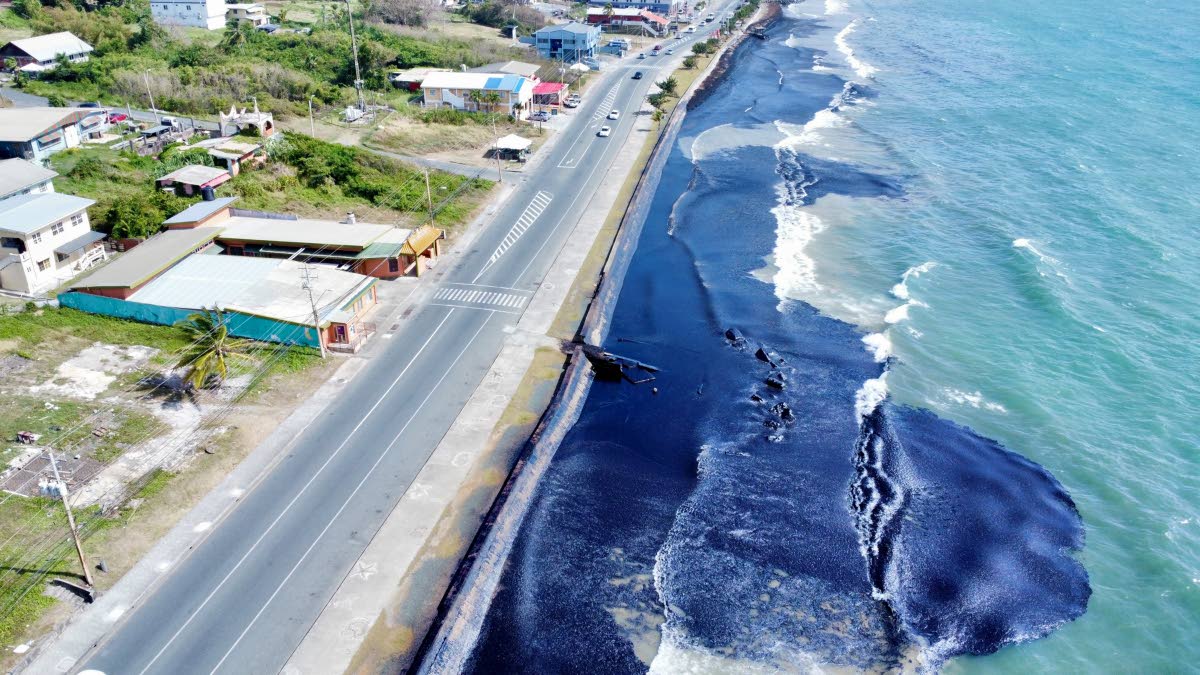
Strengthening industrial resilience
As Trinidad and Tobago (TT) marks the International Day for Disaster Risk Reduction on October 13, the nation confronts a pivotal juncture in safeguarding its industrial and energy sectors. These sectors, the backbone of TT’s economy, are grappling with aging infrastructure, climate vulnerabilities, and inadequate emergency response capabilities. While natural disasters like hurricanes and floods often dominate risk discussions, the threat of industrial disasters looms equally large. TT’s reliance on oil and gas—spanning upstream, midstream, and downstream operations—has left it exposed to systemic risks as critical assets, including pipelines, tanks, and flare systems, operate beyond their intended lifespans. Without sustained reinvestment, these once-cutting-edge systems have become national liabilities. Industrial emergencies, such as the 2013 oil spill and the 2024 barge disaster off Tobago’s coast, underscore the cascading impacts of such incidents, which disrupt livelihoods, ecosystems, and economic stability. The region’s history of pipeline failures, chemical spills, and oil leaks highlights the urgent need for robust emergency preparedness. However, TT faces significant gaps in both equipment and responder competency. Outdated fire suppression systems, gas detectors, and spill containment gear, coupled with insufficient training, hinder effective crisis management. To address these challenges, TT must elevate its standards, ensuring that emergency responders meet internationally recognized benchmarks. Certifications aligned with global best practices, modern technologies, and methodologies are essential to fostering credibility, confidence, and international collaboration. Industrial resilience is not merely a technical necessity but a strategic imperative for sustaining foreign investment, infrastructure development, and economic diversification. As climate change amplifies the risk of natural disasters triggering industrial failures, TT must prioritize a culture of competence, transparency, and accountability. The nation’s ability to thrive in a new energy era hinges on its capacity to manage industrial risks effectively. Investments in training, certification, and equipment are investments in resilience, safeguarding people, communities, and economic continuity. TT stands at a crossroads: it can either react to disasters or build a system capable of preventing them. The choice will shape the nation’s safety, reputation, and prosperity for generations to come.