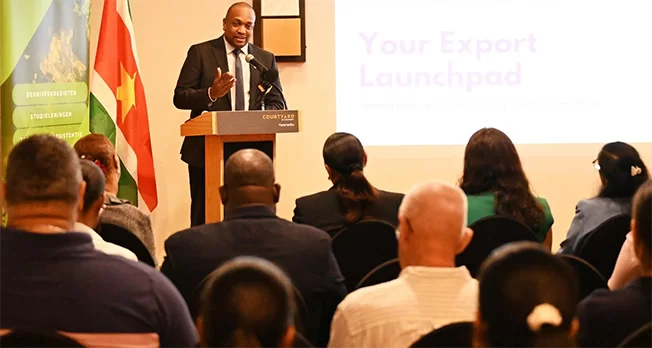
Suriname has taken a significant step forward in enhancing its export capabilities with the launch of the Cost Sharing Grant and the certification of fifteen export coaches. The initiative, officially inaugurated by Minister Melvin Bouva of Foreign Affairs, International Trade, and Cooperation (BIS), marks a pivotal moment in the nation’s efforts to strengthen its global competitiveness. The ceremony, held at the Courtyard Marriott in Paramaribo, highlighted Suriname’s commitment to transforming its economic potential into tangible achievements. Minister Bouva emphasized that while the country boasts innovative entrepreneurs, abundant natural resources, and strategic access to regional and international markets, many of its products and services remain underrecognized abroad. He attributed this gap to limited access to knowledge, markets, and the necessary tools for success. The minister praised the first cohort of certified export coaches and the twenty-six companies that have already begun implementing their export strategies, calling them ‘pioneers of a new export culture.’ The Cost Sharing Grant, a co-financing model, aims to support businesses in realizing their export plans by funding activities such as marketing materials, digital platforms, trade mission participation, product certification, and sample distribution. This initiative is part of the Foreign Investment and Export Promotion Program, funded by the Inter-American Development Bank and implemented in collaboration with BIS, the Suriname Investment and Trade Agency (SITA), and the National Development Bank. The program focuses on non-extractive sectors like agribusiness, manufacturing, services, and the creative industry, with transparency, inclusivity, and impact as core principles. For businesses without an export strategy, the Export Coaching Facility offers subsidized guidance to develop an SITA-approved Export Marketing Plan. The application process is open and merit-based, with subsidies tailored to the activity’s importance, such as 90% support for product certification and 50% for marketing materials. Minister Bouva underscored that export is more than selling products—it is a national project that creates jobs, strengthens value chains, and shares Suriname’s story of quality, resilience, and pride with the world.
分类: business
-
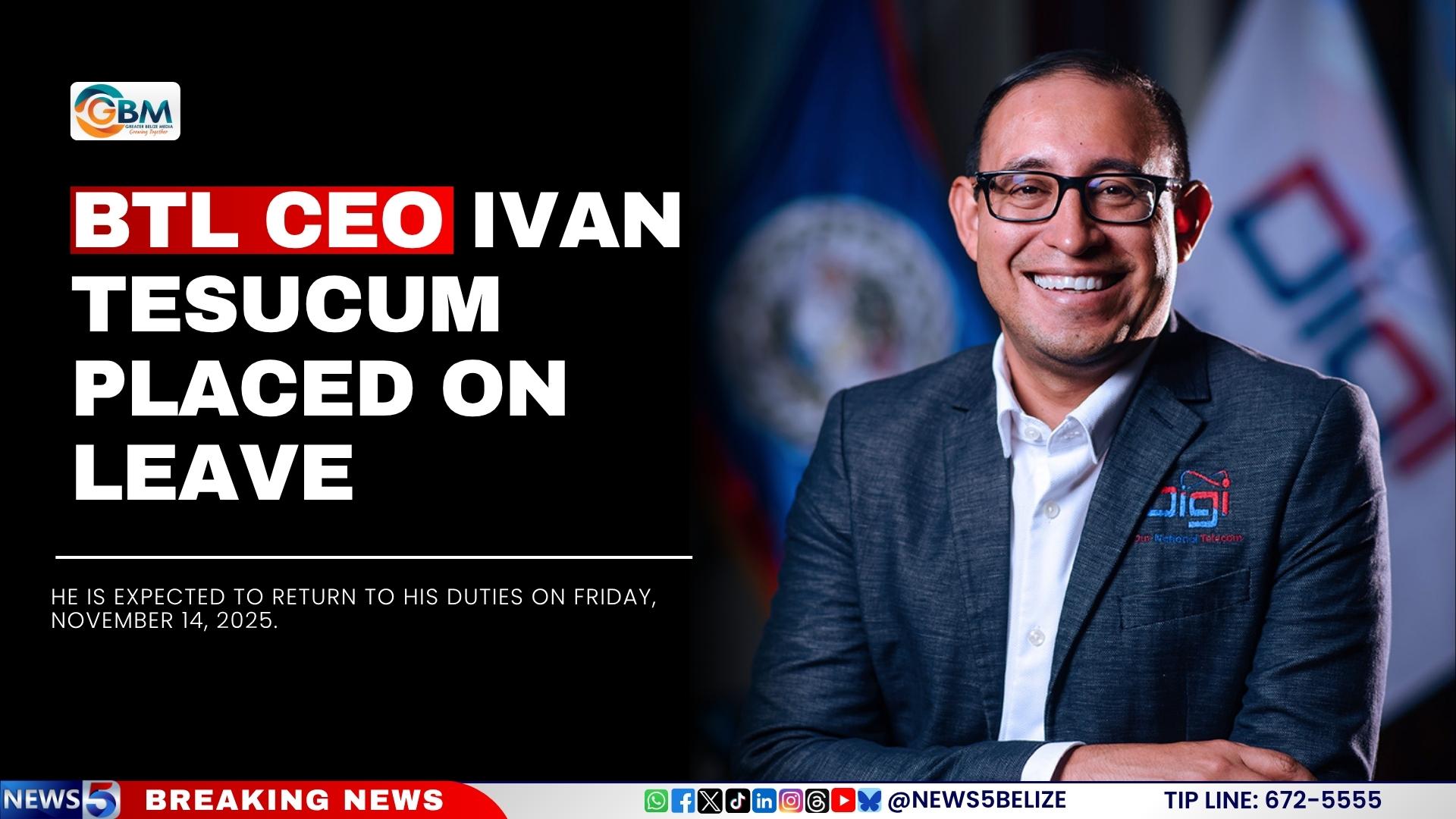
BTL CEO Ivan Tesucum Placed on Leave
Belize Telemedia Limited (BTL) has announced that its Chief Executive Officer, Ivan Tesucum, has been placed on a 10-day leave effective immediately. This decision comes after the conclusion of an internal disciplinary process initiated by the company’s Board of Directors. The Board reviewed a complaint filed against Tesucum, which was examined by a disciplinary committee. The committee gathered evidence from both Tesucum and the complainant before making its recommendations. The Board ultimately determined that the specific complaint was not substantiated under the law, and both parties were informed of this outcome. However, the Board identified a related issue that required disciplinary action. After considering Tesucum’s response and ensuring due process, the Board decided on the 10-day leave as an appropriate measure. Tesucum is expected to resume his duties on November 14, 2025. This development has sparked discussions within the company and among stakeholders, raising questions about corporate governance and leadership accountability.
-
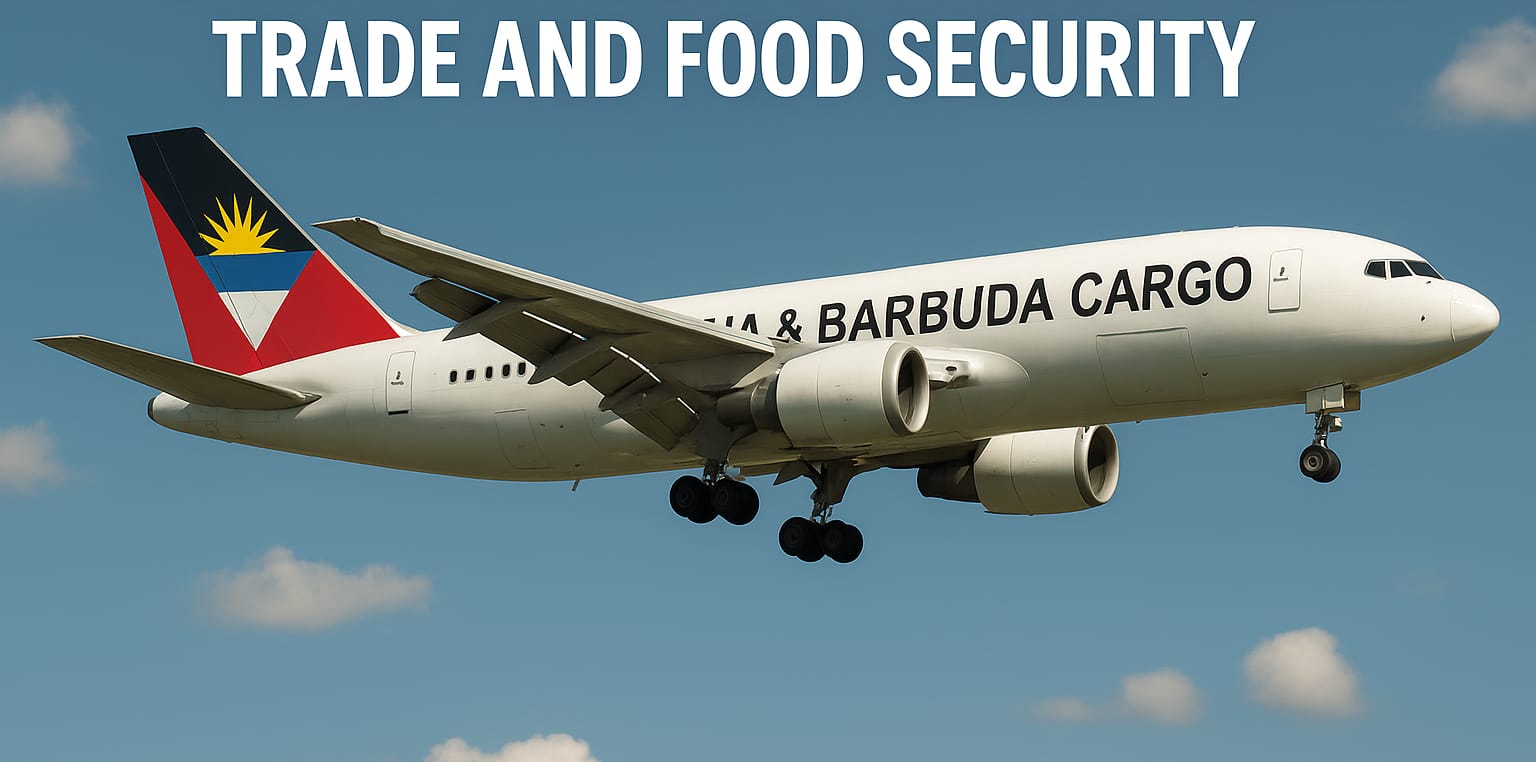
Antigua Government in Active Talks on Cargo Plane Partnership
The government of Antigua and Barbuda is actively engaging in discussions with regional transport companies to forge a cargo aircraft partnership, aimed at enhancing trade and logistics across the Eastern Caribbean. Maurice Merchant, the Director-General of Communications, confirmed that while negotiations are ongoing, the procurement of a government-owned cargo plane has been temporarily suspended pending the outcome of these talks. Merchant emphasized that a successful agreement with these companies would streamline the acquisition process. This initiative is part of a broader strategy to fortify regional trade links and supply chains, particularly within the Organisation of Eastern Caribbean States (OECS). Additionally, the partnership could improve access to cost-effective goods from neighboring markets, such as the Dominican Republic. Merchant highlighted that this effort is seen as a pivotal step to make regional commerce more efficient and resilient, while also bolstering Antigua and Barbuda’s role in regional trade and transport logistics.
-

Energy Minister: Manatee gas ‘safe’ despite Venezuela ‘echoes’
Energy Minister Dr. Roodal Moonilal has assured that the Manatee gas project remains on track and secure, despite recent statements from Venezuelan officials. Speaking on the matter, Moonilal emphasized that infrastructure developments related to the project are ongoing, with continued collaboration with Shell and other stakeholders to expand gas production from Manatee. When questioned about his interactions with Venezuelan officials, Moonilal clarified that all discussions are conducted through diplomatic channels and state-to-state relations, facilitated by the Ministry of Foreign and Caricom Affairs. He reiterated Prime Minister Kamla Persad-Bissessar’s stance, highlighting that Trinidad and Tobago is not reliant on Venezuelan gas. The country has a robust strategy for oil and gas exploration, particularly with Heritage Petroleum onshore and several multinationals offshore. Moonilal also noted that there are currently no commercial ties with Venezuela regarding gas, and no financial losses are being incurred. The Manatee project, part of the Loran-Manatee field agreement reached in 2019, is expected to commence production in 2027, with a peak output of 104,000 barrels of oil equivalent per day. Additionally, Moonilal addressed Nutrien’s recent shutdown in Trinidad and Tobago, stating that the company remains interested in future investments, particularly in the agricultural sector, with further discussions anticipated in the coming days.
-

The economic cost of war
The escalating tensions between the United States and Venezuela, coupled with the presence of warships in the region, have sparked widespread concern in Trinidad and Tobago (TT). The economic implications of such conflicts are profound, as highlighted by a recent study from Germany’s Kiel Institute. Analyzing data from over 150 wars since 1870, the study reveals that war zones experience a 30% decline in GDP and a 15% rise in inflation over five years. Neighboring countries, even if not directly involved, face a 10% GDP drop and a 5% inflation increase. For TT, these figures are particularly alarming due to its close economic ties with Venezuela, which has already suspended energy deals with TT. The energy sector is a cornerstone of TT’s economy, and the suspension has already impacted local fishermen and businesses. The country, still recovering from an 8.8% economic contraction in 2020 due to the COVID-19 pandemic, cannot afford another significant downturn. A 10% decline in output would devastate households, businesses, and the broader social fabric. Moreover, TT’s relationship with Venezuela is strained, with the latter declaring TT’s Prime Minister persona non grata. This tension could lead to a loss of confidence among Caricom members and investors, further destabilizing TT’s economy. While some large economies, like the US, Russia, and Israel, have historically grown during wars, smaller neighboring countries bear the brunt of the economic fallout. The presence of the USS Gravely in TT underscores the region’s volatility. As Dr. Jamelia Harris, an economist, aptly notes, ‘Nobody wins a war,’ yet the economic and social costs for smaller nations like TT are disproportionately high.
-

#MelissaAftermath: JN Bank, JN Money roll out waivers, discounts to customers
In response to the widespread devastation caused by Hurricane Melissa, the JN Group has unveiled a series of robust support measures aimed at aiding its members and the broader community in Jamaica. Through its subsidiaries, JN Bank and JN Money Services, the group is offering a range of financial relief options, including loan discounts, moratoria, and fee waivers, to assist those most severely impacted by the disaster.
-

Appeal Court reserves ruling on ex-Cepep contractor’s challenge
The Court of Appeal has deferred its decision on an appeal lodged by Eastman Enterprises Ltd, a former contractor of the Cepep Company, challenging a High Court order to halt its lawsuit. The lawsuit pertains to the termination of over 300 contracts by Cepep shortly after the April 28 general election. Justices Peter Rajkumar, James Aboud, and Ricky Rahim heard arguments on October 31 before reserving their ruling. The central issue revolves around whether the High Court was correct in staying Eastman’s lawsuit due to an alternative dispute resolution (ADR) clause in the contract. Eastman’s legal team, led by Larry Lalla, SC, argued that the trial judge erred by treating the ADR clause as mandatory and failing to consider the contractor’s right to seek urgent injunctive relief. Lalla emphasized that a mediator could not grant such emergency relief and contended that the referral to the Director of Public Prosecutions (DPP) was premature. Representing Cepep, Anand Ramlogan, SC, defended the trial judge’s decision, asserting that the ADR process should precede court intervention and highlighting the alleged $1.4 billion in unauthorized contract extensions. The appeal stems from a High Court ruling by Justice Margaret Mohammed, who stayed Eastman’s lawsuit in August, directed case documents to the DPP, and ordered Eastman to pay Cepep’s legal costs. Eastman seeks to have its lawsuit and injunction application returned to the High Court, a declaration that the DPP referral was improper, and, if successful, for the Appeal Court’s decision to be forwarded to the DPP. The case underscores broader concerns over contract management and dispute resolution in public procurement.
-

Uber Barbados launches operations with licensed taxi service
Uber, the global ride-hailing giant, has officially launched its services in Barbados, marking the company’s first foray into the Eastern Caribbean. The app became operational last week, offering residents and visitors the ability to book rides through the Uber Taxi option, which connects users with licensed local taxi drivers. Belén Romero, Regional General Manager for the Andean Region, Central America, and the Caribbean, expressed enthusiasm about the expansion. “We are proud to begin this new chapter in Barbados, a strategic location for Uber in the region. Our mission is to enhance mobility by integrating technology that ensures safety and convenience while creating economic opportunities for local drivers,” she stated. Romero emphasized Uber’s commitment to aligning with Barbados’ transportation framework, noting that the Uber Taxi service will not operate at the Bridgetown Port during the 2025/26 winter season to respect local priorities. The Uber Taxi feature allows licensed drivers to accept ride requests via the app while maintaining their independence. Users can access real-time driver details, fare estimates, and routes, with fares displayed in US dollars and fully compliant with Transport Authority regulations. The app also includes a tipping feature for passengers to express appreciation. Uber highlighted that its entry into Barbados aims to strengthen the local taxi industry by leveraging technology, safety, and convenience. Drivers stand to benefit from increased earning potential, particularly from the tourism sector, and gain access to a global platform used by millions worldwide. Additionally, drivers will have access to over 30 in-app safety features and 24-hour support. “Safety is our top priority,” Romero said, explaining that the app enables riders to share trip details with trusted contacts, verify drivers via a PIN system, and rely on continuous monitoring throughout each journey. Uber’s taxi option has already proven successful in other markets. In the Dominican Republic, the service has facilitated over 115,000 trips since 2022, while in France, more than 3,000 taxis now operate through the platform. Similar services are available in major cities like New York, Los Angeles, and London, where traditional black cabs use the app. To cater to Barbados’ tourism market, Uber has introduced features such as Uber Reserve, allowing users to schedule trips up to 90 days in advance, and Uber Hourly, enabling passengers to book a driver by the hour with multiple stops. Barbados is the first Caribbean country to offer Uber Hourly. “Tourism and mobility go hand in hand,” Romero remarked. “We want visitors to explore Barbados with confidence, knowing they have access to the same trusted safety standards Uber provides globally. Our goal is to support the island’s tourism by connecting people safely and reliably while creating new opportunities for local taxi drivers, who are integral to the authentic Barbadian experience.” The onboarding process for local drivers is managed by an on-island partner responsible for verifying permits, licenses, and insurance documents. Earnings from completed trips will be deposited directly into drivers’ registered bank accounts.
-

GDB: Public Invitation to Tender
The Grenada Development Bank (GDB) has announced a Public Invitation to Tender (PIT) for the procurement of water tanks as part of the Climate-Resilient Water Sector in Grenada (G-CREWS) project. This initiative is funded by the Green Climate Fund (GCF) and the German Federal Ministry for the Environment, Nature Conservation, Nuclear Safety, and Consumer Protection (BMUV), in collaboration with the Deutsche Gesellschaft für Internationale Zusammenarbeit (GIZ) GmbH. The G-CREWS project aims to enhance water resilience in Grenada, with a specific focus on the agricultural sector through the Challenge Fund for Agriculture (CFA). The CFA supports farmers by providing Rain Water Harvesting (RWH) equipment, irrigation systems, and shade houses to promote efficient water use. The GDB is seeking bids from eligible suppliers to provide water tanks for distribution to beneficiary farmers under the CFA project. The successful supplier will be responsible for delivering the tanks island-wide as part of their standard service. Bidding documents can be requested via email at [email protected], and bids must be submitted electronically by 3 pm on Friday, 28 November 2025. The contract will be awarded to the supplier who meets eligibility criteria, offers the lowest evaluated price, submits a technically compliant bid, and guarantees timely delivery. This procurement is open to all qualified bidders, reinforcing Grenada’s commitment to sustainable agricultural practices and climate resilience.
-

WIOC Reschedules Annual Meeting to November 27
The West Indies Oil Company Ltd. has announced a new date for its Annual General Meeting (AGM), now set for November 27, 2025, following a postponement caused by Tropical Storm Jerry. The meeting will be held at 5:30 p.m. at the John E. St. Luce Finance and Conference Centre on Factory Road. Initially delayed due to the storm’s impact, the company has since updated its draft bylaws and amendments based on shareholder feedback. These revised documents have been circulated to shareholders, who are encouraged to review them thoroughly. The company emphasized the importance of participation, whether in person, by proxy, or online, stating, ‘Attendance and contribution to what we hope will be a very productive AGM is anticipated.’ This rescheduling ensures that all stakeholders have adequate time to prepare and engage in the decision-making process.