分类: business

  • Energy Minister, Perenco executives discuss Greater Angostura assets

    Energy Minister, Perenco executives discuss Greater Angostura assets

    In a significant development for Trinidad and Tobago’s energy sector, multinational oil and gas company Perenco convened high-level talks with Ministry of Energy and Energy Industries (MEEI) officials on January 14. The meeting centered on Perenco’s recent acquisition of Greater Angostura oil and gas assets and associated production facilities, marking a substantial investment in the country’s energy infrastructure.

    During the strategic discussions at the ministry headquarters, Perenco executives delivered comprehensive updates on operational advancements and outlined plans to enhance efficiency across their Trinidadian operations. The dialogue emphasized collaborative initiatives designed to sustain and strengthen investment in the nation’s critical energy sector.

    Energy Minister Dr. Roodal Moonilal expressed the government’s endorsement of Perenco’s initiatives to extend the productive lifespan of mature oil fields while fostering a favorable investment climate. The minister emphasized the administration’s commitment to supporting energy companies in maximizing Trinidad and Tobago’s hydrocarbon resources.

    Perenco detailed performance metrics from their existing operations, including the CAFI gas fields (Cashima, Amherstia, Flamboyant, and Immortelle) and revealed development strategies for the Onyx field situated within the Teak, Samaan, and Poui (TSP) area.

    The energy company’s delegation, led by CEO Armel Simondin, reaffirmed their commitment to maintaining close collaboration with MEEI as current projects progress and new opportunities materialize in the local energy landscape. The meeting participants included key figures from both organizations, underscoring the importance both parties place on this strategic partnership.

  • Jamaica Broilers secures $15-b bailout following US operations crisis

    Jamaica Broilers secures $15-b bailout following US operations crisis

    In a landmark financial intervention, NCB Financial Group has orchestrated a comprehensive $15.1-billion (JMD) stabilization package for the Jamaica Broilers Group (JBG), pulling the iconic agribusiness from the verge of collapse following devastating losses in its American division. The rescue financing, formally announced on Wednesday, combines substantial new credit facilities with a sophisticated multi-tranche bond restructuring designed to grant JBG the necessary liquidity and strategic time to implement a rigorous corporate turnaround.

    The financial architecture of the deal involves two primary components. National Commercial Bank Jamaica Limited (NCBJ) is providing $6.4 billion in direct loans. Concurrently, NCB Capital Markets (NCBCM) has arranged a complex $8.7 billion bond issuance, with tranches extending maturities up to 14 years. Beyond capital injection, the NCB team spearheaded critical negotiations with JBG’s domestic creditors to reset financial covenants and modify existing collateral agreements, creating a more sustainable capital structure.

    This crisis originated from severe accounting irregularities and operational failures within JBG’s US segment, which triggered massive financial hemorrhaging. Paradoxically, the company’s core Jamaican operations consistently remained profitable and viable, a fundamental factor that convinced NCB to back the rescue. The strength of these domestic assets, vital to national food security and employment, formed the cornerstone of the bailout decision.

    Angus P Young, CEO of NCBCM, emphasized the strategic importance of the intervention, stating, ‘Our support is grounded in the strength of the company’s core Jamaican operations and the decisive corrective actions now underway.’ He noted the financing was specifically tailored to align with JBG’s unique recovery needs and capital requirements.

    The entire financial package is contingent upon the execution of a strict corporate overhaul already in motion. Under the conditions of the bailout, Group President and CEO Christopher Levy is implementing a disciplined recovery strategy focused on radical governance enhancement, fortified financial controls, and direct Jamaican oversight of the troubled US operations. The company has also engaged auditors with specialized sector experience to ensure transparency.

    For decades, JBG has been an indispensable pillar of Jamaica’s agricultural economy, supplying poultry, eggs, and animal feed, thereby supporting countless rural livelihoods. This rescue deal not only secures the company’s future but also serves as a powerful demonstration of NCB Financial Group’s capacity to structure and lead large-scale domestic financial stabilizations.

  • Jamaica’s unemployment rate now 3.3 per cent, says STATIN

    Jamaica’s unemployment rate now 3.3 per cent, says STATIN

    Jamaica’s labor market demonstrated resilience with unemployment declining to 3.3% in October 2025, showing improvement from the 3.5% rate recorded during the same period in 2024. The Statistical Institute of Jamaica (STATIN) disclosed these findings in its latest Labour Force Survey released Thursday, providing crucial insights into the nation’s employment landscape.

    The report indicates relative stability in employment levels with 1,413,200 persons employed in October 2025, representing a marginal decrease of 3,800 individuals compared to the previous year. Concurrently, the number of unemployed persons decreased from 51,300 to 48,800, contributing to the improved unemployment rate.

    Notably, Jamaica’s labor force experienced a contraction, falling by 6,300 individuals to reach 1,462,000. This decline manifested differently across genders, with the male labor force decreasing by 11,900 to 777,200, while the female labor force expanded by 5,600 to 684,800. The overall labor force participation rate consequently edged down to 67.8% from 68.1% in October 2024.

    The survey also recorded 693,800 individuals outside the labor force, marking an increase of 6,300 persons year-over-year.

    STATIN emphasized that these statistics capture Jamaica’s labor market conditions immediately preceding Hurricane Melissa’s landfall on October 28, 2025. The catastrophic weather event significantly disrupted data collection operations, particularly in western parishes including St Elizabeth, Westmoreland, St James, Hanover, and Trelawny.

    In response to these challenges, STATIN implemented modified methodologies, deploying an abbreviated version of its standard questionnaire to maintain data continuity while capturing essential labor market indicators. The institution extended both data collection and processing timelines by two weeks beyond the typical six-week period due to the hurricane’s extensive impact on field operations.

  • Economist warns businesses of ‘black swan events’

    Economist warns businesses of ‘black swan events’

    Economist and Independent Senator Marlene Attzs has issued a stark warning to Trinidad and Tobago’s business community about the looming threat of catastrophic “black swan” events that could devastate even well-established enterprises. Speaking at a conference hosted by the TT Extractive Industries Transparency Initiative and the TT Chamber of Industry and Commerce on January 13, Attzs described these events as a dangerous convergence of unpredictable shocks that could derail the most carefully laid business plans.

    The urgency of this warning is underscored by recent developments in the local business landscape, including Newsday’s announcement of its winding-up process after more than three decades of operation. Managing director Grant Taylor attributed this decision to a “perfect storm” of challenges, mirroring similar struggles across multiple industries from energy to retail and entertainment.

    Attzs emphasized that these black swan events may already be unfolding, citing recent airspace compromises that forced flight cancellations as a potential precursor to more significant disruptions. She pointed to escalating geopolitical tensions, including the US-China rivalry and renewed Russian activity, as factors that could create concentric circles of impact affecting even peripheral economies like Trinidad and Tobago.

    The conference panel, which included TTEITI co-ordinator Sherwin Long, senior fellow Preeya Mohan, and chairman Gregory McGuire, identified multiple systemic risks to the national economy. Chief among these is the country’s persistent dependence on the volatile oil and gas sector, which continues to drive GDP fluctuations and government revenue instability.

    Long revealed that between 2011 and 2024, the upstream energy sector contributed US$17.3 billion in foreign exchange, with companies like bpTT and NGC providing over US$7 billion. However, he noted that this volatility is largely driven by external factors beyond local control, including global energy prices, demand-supply imbalances, and geopolitical tensions.

    Attzs highlighted additional concerns regarding the nation’s economic dependence on government support and rising debt challenges. Latest data indicates Trinidad and Tobago’s debt-to-GDP ratio has reached 85 percent and continues to climb, creating fiscal constraints that could limit the government’s ability to respond to economic crises.

    Mohan addressed emerging trade-related risks, particularly the Carbon Border Adjustment Mechanism (CBAM) and adjustments to tariff regimes. She warned that 90 percent of TT’s exports to the EU—accounting for 14 percent of total exports—could be affected by CBAM, while half of exports to the US (30 percent of total) face similar exposure. These mechanisms could increase taxes on the ammonia sector by 22 percent, though implementation of emission reduction technologies like carbon capture could mitigate these impacts.

    The consensus among experts is that data-driven preparedness represents the most effective defense against these converging challenges. Attzs urged businesses to professionalize, modernize, and leverage available data to build resilience, conduct thorough risk analyses, and develop strategic plans for survival in an increasingly uncertain global economic landscape.

  • Cruise line suspends visits to Haiti

    Cruise line suspends visits to Haiti

    MIAMI – Royal Caribbean International, the sole cruise operator with scheduled service to Haiti, has announced a significant extension of its suspension of voyages to its private destination in the Caribbean nation. The company confirmed it will halt all port calls to Labadee through the end of 2026, citing ongoing security concerns and escalating gang violence that has destabilized the country.

    The decision represents a substantial extension of previous operational pauses, which had been set through April 2026. A corporate spokesperson characterized the move as “an abundance of caution” given the deteriorating security environment in Haiti, where criminal organizations continue to challenge the provisional government’s authority.

    This security assessment aligns with the United States State Department’s Level 4 travel advisory – its most severe classification – which explicitly warns against all travel to Haiti. The advisory highlights prevalent armed criminal activities including kidnapping for ransom, carjackings, sexual assault, and robbery.

    Labadee, Royal Caribbean’s privately leased peninsula on Haiti’s northern coast, typically offers passengers exclusive access to five secluded beaches, an 800-meter zipline course, aquatic attractions, and premium amenities. The resort maintains its own dedicated security force, though this has proven insufficient to mitigate broader regional risks that affect cruise operations.

    The extended suspension through December 2026 reflects the cruise industry’s mounting concerns about passenger safety in destinations experiencing political instability and widespread violence. This operational decision will necessitate itinerary redesigns affecting numerous scheduled voyages and represents a significant economic impact to both the cruise line and local vendors who depend on tourism revenue.

  • How to migrate to Thailand from Trinidad and Tobago

    How to migrate to Thailand from Trinidad and Tobago

    In a significant shift from traditional migration patterns, professionals and families from Trinidad and Tobago are increasingly looking toward Southeast Asia as viable relocation destinations. While the United States, Canada, and the United Kingdom have historically dominated migration conversations, these routes have become progressively challenging due to visa backlogs, stringent immigration policies, and escalating living costs.

    Thailand has strategically positioned itself as an attractive alternative through comprehensive immigration reforms implemented over the past two years. The country now offers structured visa programs specifically designed to accommodate Caribbean nationals seeking short, medium, or long-term residence solutions. This development comes at a critical time when economic pressures are compelling individuals to reconsider conventional migration paradigms.

    The financial advantages present a compelling case for consideration. Thailand’s comparatively lower cost of living enables foreign currency earners and digital professionals to achieve greater financial flexibility. Metropolitan centers like Bangkok and Chiang Mai offer substantially reduced housing expenses compared to Trinidad and Tobago, complemented by reliable utilities, affordable internet services, and diverse culinary options ranging from local cuisine to international fare.

    Thailand’s immigration framework demonstrates remarkable flexibility through its visa-free entry policy for TT passport holders, permitting initial 60-day stays with optional 30-day extensions. This approach facilitates practical ‘trial periods’ where prospective migrants can evaluate living conditions before making long-term commitments. The geographical proximity to neighboring countries like Vietnam, Cambodia, and Laos further enables cost-effective regional exploration.

    A distinctive advantage lies in Thailand’s family-inclusive visa policies, which contrast sharply with the complex family reunification processes typical of Western nations. Several long-stay visa categories permit spouses and children to accompany primary applicants, supported by expanding international education infrastructure offering British, American, and IB curricula across major cities.

    Key visa options include:
    – Destination Thailand Visa (DTV): Five-year validity for digital professionals and remote workers, allowing 180-day stays per entry
    – SMART Visa: Four-year duration for specialists in technology, engineering, biotechnology, and digital innovation
    – Long-Term Resident (LTR) Visas: Decade-long options for high-net-worth individuals, investors, and executives
    – Education Visas: For language studies, university programs, and specialized training courses
    – Retirement Visas: For applicants over 50 with sufficient pension income and health insurance

    Critical compliance considerations include mandatory yellow fever vaccination documentation for TT nationals and strict adherence to local immigration reporting requirements. These regulatory measures ensure smooth entry and sustained legal residency for all migrants.

    This paradigm shift represents more than mere destination diversification—it signifies a fundamental reimagining of migration as a strategic lifestyle choice rather than necessity. Thailand offers modern infrastructure, robust healthcare systems, digital public services, and regional connectivity that align with contemporary professional and personal aspirations. For Trinidad and Tobago citizens seeking alternatives to traditional migration challenges, Thailand presents a practical, accessible, and financially sustainable solution.


  • Internal reset

    Internal reset

    KINGSTON, Jamaica—A profound transformation in leadership and corporate governance is underway at the Jamaica National Group (JN Group), forming the crucial human element behind its comprehensive strategic restructuring. This internal revolution serves as the driving force for the financial conglomerate’s pursuit of stability following three consecutive years of operational losses and a damaging negative credit outlook assessment.

    The most significant leadership transition occurred in July 2025 with the retirement of Curtis Martin as Managing Director of JN Financial Group (JNFG), the organization’s pivotal subsidiary. Succeeding him in an acting capacity is Hugh Miller, whose extensive background as former Chief Treasury & Investment Officer and Head of Asset Management signals a strategic emphasis on placing financial expertise at the forefront of recovery operations.

    In an official statement, JN Group openly acknowledged that previous ‘managerial shortcomings’ contributed to recent challenges, confirming that subsequent organizational changes represent core components of their remedial strategy. Beyond individual appointments, the group has implemented substantial structural reforms, including comprehensive reorganization of group boards and management architecture.

    According to the CariCRIS rating report, these changes have formally redefined power dynamics and oversight mechanisms. The restructured governance framework establishes a clarified chain of command where the board of directors and its sub-committees retain ultimate responsibility. Within this new structure, the finance committee assumes primary authority for group-wide risk management, supported by specialized risk and audit units—creating a robust system of checks and balances during this precarious financial period.

    The revitalized leadership team now faces a definitive twofold mandate: ensuring that billions generated from recent asset sales effectively stabilize the weakened balance sheet, while simultaneously guaranteeing that the group’s substantial $1-billion digital transformation investment dramatically reduces its unsustainable 105.6% cost-to-income ratio. Ultimately, success will be measured not by organizational charts but by achieving specific financial targets: sustained profitability, reducing the cost-to-income ratio below 65%, and more than doubling critical capital reserves to regain a stable credit outlook.

  • Tricks and traps of aircraft leasing

    Tricks and traps of aircraft leasing

    The complex world of aircraft leasing presents formidable financial risks for airlines, as demonstrated by multiple case studies of carriers facing severe contractual consequences. One particularly cautionary tale involves a local entrepreneur who embarked on establishing an airline, initiating the rigorous five-phase certification process mandated by the International Civil Aviation Organization (ICAO). The businessperson dry-leased an Airbus A321-131 jet from a United States leasing company, anticipating commercial operations.

    Dry leasing arrangements—where airlines procure aircraft without crew, maintenance, or insurance—typically serve as long-term solutions spanning three to twelve years, ideal for market expansion or new route development. However, when the entrepreneur abruptly withdrew the air operator certificate application mid-process, contractual obligations triggered severe financial repercussions.

    The lease agreement stipulated return conditions requiring the aircraft to qualify for a US 14 CFR Part 121 Certificate, mandating compliance with all Federal Aviation Administration (FAA) modifications and inspections through a Continuous Airworthiness Maintenance Programme (CAMP). The aircraft had reached threshold requirements under the Supplemental Structural Inspection Programme (SSIP), compelling the lessee to expend millions addressing mandatory airworthiness standards—ultimately forcing the sale of both lucrative business assets and personal real estate.

    This scenario exemplifies a broader pattern in aviation leasing. Historical precedents include BWIA’s experience when acquiring an MD83 twinjet, where personnel discovered an ‘as is, where is’ clause only upon delivery refusal attempts. Similarly, BWIA’s seven-year dry lease of two Airbus A321-131 aircraft resulted in substantial financial losses when leadership deemed the aircraft type inappropriate. With no termination grounds available, the carrier subleased to Turkish operator Air Alpha at reduced rates, incurring monthly deficits of $20,000 per aircraft.

    More recently, Caribbean Airlines faced significant penalties when discontinuing its London Gatwick route, agreeing to early redelivery of two Boeing 767-300ER aircraft with termination penalties totaling $135,000 monthly per aircraft. The carrier’s current commitment to four Boeing 737 MAX 8 aircraft through twelve-year leases with Air Lease Corporation further underscores the long-term financial commitments inherent in aircraft leasing.

    Industry experts emphasize that lessors make substantial capital investments expecting fair returns, leaving airlines with subleasing as the most practical alternative when aircraft become unnecessary. Fleet planning represents a critical strategic function balancing capacity, range, fuel efficiency, and maintenance considerations—a data-driven process profoundly impacting operational viability and financial sustainability.

  • Inflation picks up in December — Statin

    Inflation picks up in December — Statin

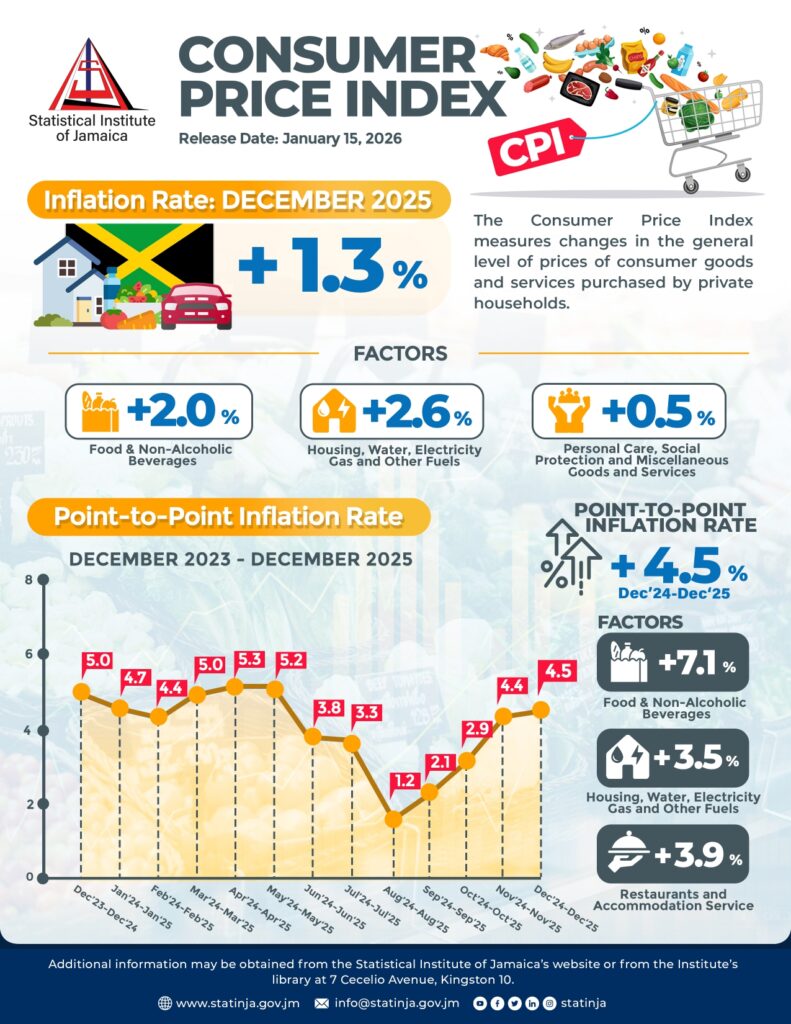
    KINGSTON, Jamaica – Inflationary pressures in Jamaica experienced a significant resurgence at the close of 2025, reversing previous months of moderation as Hurricane Melissa’s enduring impact triggered sharp increases in food prices and electricity costs. The nation’s consumer inflation accelerated markedly in December, underscoring the vulnerability of small island economies to climate-related disruptions.

    According to the Statistical Institute of Jamaica (Statin), the All-Jamaica Consumer Price Index (CPI) climbed by 1.3% during December, building upon November’s 2.4% advance. This consecutive monthly acceleration represents one of the most substantial back-to-back inflation movements recorded throughout the year. Director General Leesha Delatie-Budair emphasized that the December data provides the first comprehensive reflection of post-hurricane economic conditions, unlike earlier economic indicators that captured pre-storm activity.

    The primary driver behind this inflationary spike was a 2.0% monthly increase in food prices, with particularly severe impacts on agricultural commodities. Vegetable, tuber, plantain, and pulse categories surged by 4.5%, while fruits and nuts jumped by 5.6%. These increases directly resulted from Hurricane Melissa’s disruption to agricultural production and supply chains, with the full effect taking several weeks to manifest in consumer markets.

    Concurrently, housing and utility expenses exerted additional upward pressure, with the corresponding index rising 2.6% for the month. Electricity costs alone escalated by 5.4%, compounded by rising rental charges. The combination of food and housing expenditures accounted for the majority of December’s inflation outcome, intensifying concerns about household affordability and living standards.

    Year-end analysis revealed that point-to-point inflation between December 2024 and December 2025 reached 4.5%, substantially higher than earlier annual lows. Food inflation emerged as the dominant contributor at 7.1% year-on-year, while housing and utilities increased by 3.5%. The restaurant and accommodation sector also experienced notable inflation at 3.9%, reflecting higher costs for meals consumed away from home.

    Statin officials detailed the methodological adaptations employed to maintain data accuracy despite widespread operational challenges including damaged infrastructure, power outages, and business closures. The institution extended fieldwork periods and implemented international statistical techniques such as class-mean imputation for temporarily unavailable items, ensuring the CPI’s reliability amid difficult post-disaster conditions.

    Geographic analysis indicated broadly consistent inflation patterns across regions, with the Greater Kingston Metropolitan Area recording 1.4% inflation, compared to 1.1% in other urban centers and 1.3% in rural areas. While headline inflation remains within the Bank of Jamaica’s target range, the December figures suggest mounting persistence in price pressures, particularly for essential commodities, potentially necessitating policy responses in coming months.

  • Profit powers purpose

    Profit powers purpose

    TOBAGO – In a groundbreaking workshop hosted by EuroChamTT (European Business Chamber in Trinidad and Tobago), United Nations development finance officer Mark Thomas presented a transformative perspective on corporate sustainability, challenging the perceived dichotomy between profitability and environmental responsibility.

    The event, held at Kariwak in Tobago and attended by business leaders and EU diplomats including Ambassador Cécile Tassin, addressed the critical misconception that sustainability initiatives inherently conflict with financial success. Thomas, who coordinates UN partnerships across Trinidad and Tobago, Aruba, Curacao, and Sint Maarten, argued that profit serves as the essential catalyst for scalable sustainable solutions.

    “Sustainable means profitable,” Thomas asserted, emphasizing that profitability enables reinvestment, growth, and systemic change. He reframed profit not as an expression of greed but as the essential fuel that transforms innovative ideas into world-changing solutions.

    The workshop highlighted how global commitments like the Paris Agreement and Sustainable Development Goals are reshaping economic landscapes. Companies embracing sustainable practices now benefit from preferential financing, insurance terms, and market access, while those neglecting environmental and social responsibilities face increasing costs and regulatory pressures.

    Tobago’s tourism industry exemplifies this interconnection, where degraded reefs and eroded beaches directly threaten economic viability. Similarly, Trinidad confronts business risks through infrastructure vulnerabilities, energy reliability issues, and social instability.

    Rather than starting from scratch, Trinidad and Tobago possesses unique advantages: Trinidad’s sophisticated energy infrastructure and industrial expertise, combined with Tobago’s premier tourism offerings, create exceptional opportunities for sustainable transformation. The islands can leverage these assets to develop waste-to-energy systems, water-smart agriculture, and technical training programs that address both environmental and economic needs.

    The event emphasized that government leadership remains essential in creating enabling environments through clear regulations, infrastructure investment, and policy alignment with global standards. This collaborative approach between business, government, and civil society creates a reinforcing cycle where strong businesses build stable communities, which in turn attract investment and fuel further growth.

    As the global economy increasingly rewards sustainable practices, Trinidad and Tobago stands positioned to transform challenges into competitive advantages, proving that profitability and planetary responsibility are not opposing forces but complementary components of long-term success.