分类: business

  • CDB’s Cultural and Creative Industries Innovation Fund announces USD 190,000 in grants to promote regional events and conferences

    CDB’s Cultural and Creative Industries Innovation Fund announces USD 190,000 in grants to promote regional events and conferences

    The Caribbean Development Bank has announced a significant funding initiative through its Cultural and Creative Industries Innovation Fund (CIIF), making $190,000 available to support the region’s creative sector. This strategic investment targets organizations that can drive development and enhance competitiveness within Caribbean cultural industries.

    Applications for the grant program will remain open until January 31, 2026, with selected projects scheduled for implementation between March 1, 2026, and February 28, 2027. The funding specifically seeks proposals that address critical growth areas including policy development, MSME capacity building, market intelligence enhancement, trade facilitation, and cultural heritage preservation.

    Malene Joseph, Fund Coordinator, emphasized the program’s objectives: “Through this grant call, CDB aims to support home-grown activities that help unlock pathways for our creative Caribbean talent and businesses to become even more empowered. Beyond facilitating necessary policy dialogue and building data-driven insights, CIIF is further enabling creative MSMEs by offering financial support to these targeted events.”

    The funding will be distributed across six grants in three distinct categories. Two $25,000 grants will focus on improving the enabling environment for cultural industries, while another two $20,000 grants will support data intelligence and sector insights initiatives. The remaining two grants, totaling $50,000, will be allocated to activities that prepare MSMEs for market entry and facilitate market access.

    Eligibility is restricted to formally registered organizations operating within the Creative Industries sector, including Business Support Organizations, Non-Governmental Organizations, universities, Community-Based Organizations, and government agencies. Applicants must demonstrate at least three years of experience in hosting industry-related events and provide a co-financing contribution equivalent to at least 10% of the total project budget.

    Prospective applicants can submit proposals through the Bank’s online portal at https://cdb.submittable.com/submit. Additionally, CIIF will host a virtual consultation on January 14, 2026, to provide guidance to potential applicants.

    Established in 2017, CIIF has consistently worked to enhance the global competitiveness of Caribbean cultural and creative sectors by promoting innovation, collaboration, and sustainability through technical assistance and grants across the Bank’s 19 Borrowing Member Countries.


  • Lee-Chin misses US$94-m bond deadline, risks Supreme Court lawsuit

    Lee-Chin misses US$94-m bond deadline, risks Supreme Court lawsuit

    Jamaican-Canadian billionaire Michael Lee-Chin faces imminent asset liquidation after companies under his control defaulted on a critical US$94.1 million bond payment, violating a forbearance agreement with creditors. The formal breach, confirmed Wednesday by trustee JCSD Trustee Services Limited, activates contractual provisions mandating the sale of portions of Lee-Chin’s collateralized stake in NCB Financial Group (NCBFG).

    The payment default occurred despite Lee-Chin’s expressed confidence through representative Christopher Zacca, chairman of the bondholders’ negotiating committee, who had previously characterized the situation as manageable. The missed deadline follows the expiration of a 30-day grace period that concluded on November 29, making the December 31 payment a final opportunity to avoid legal escalation.

    According to the trustee’s advisory, while the issuer communicated intentions to fulfill the obligation by January 26, 2026, the technical default automatically triggers enforcement mechanisms established during November’s bondholder meetings. These provisions authorize the immediate filing of an originating summons and fixed-date claim form before Jamaica’s Supreme Court.

    The collapse of this initial payment tranche jeopardizes a comprehensive three-phase repayment strategy that envisioned complete debt extinguishment by 2027. That plan, negotiated between Lee-Chin and creditors, stipulated interest payments through 2026-2027 alongside a detailed repayment blueprint for the remaining US$203 million debt, due for presentation by March 31, 2026.

    Lee-Chin’s 52.15% stake in NCBFG, valued at approximately US$333 million based on current market prices, represents the most likely source for debt settlement. The stake’s valuation comfortably exceeds the total outstanding debt of US$297 million, suggesting creditors could recover funds through forced asset sales. This development contradicts Lee-Chin’s recent characterization of an ‘orderly process’ and transfers timeline control from the billionaire to the trustee, which committed to providing further updates during the week of January 5, 2026.

  • Central Bank: Protect foreign reserves, set proper conditions for growth

    Central Bank: Protect foreign reserves, set proper conditions for growth

    In its concluding monetary policy assessment for 2025, released on December 31, the Central Bank of Trinidad and Tobago has issued a cautious economic outlook for 2026. The institution emphasized the critical challenge of maintaining equilibrium between protecting the nation’s foreign reserves and cultivating conditions for sustainable economic expansion.

    The bank identified significant factors that could disrupt this delicate balance, particularly wage adjustments and aggregate demand pressures. Notably referenced was the ten percent salary increase for public servants implemented by the United National Congress following their April 28 general election victory, with partial disbursements commencing in December. These fiscal measures are projected to boost household incomes in coming months, potentially stimulating consumer activity.

    Against this backdrop, the Central Bank highlighted Trinidad and Tobago’s substantial import dependency, making the preservation of international reserves critically important. This warning comes alongside recent downward revisions of TT’s economic outlook by major rating agencies Moody’s and S&P, primarily citing declining foreign reserves.

    While acknowledging a modest stabilization in reserves—climbing from US$4.6 billion in October to US$5.3 billion by mid-December—the bank cautioned that significant challenges persist. International reserve adequacy indicators continue to warrant close monitoring.

    The report noted encouraging developments in the energy sector, with natural gas production witnessing an 11.7 percent year-on-year increase during Q2 2025. This resurgence was fueled by inaugural production from bpTT’s Cypre field and the bpTT/EOG Mento fields. Correspondingly, petrochemical outputs showed mixed results with ammonia and urea production expanding by 23.6 percent and 51.3 percent respectively, while methanol output declined by 12.7 percent.

    However, these energy sector gains were partially offset by continued softening in non-energy sector performance. The distribution, construction, and manufacturing industries demonstrated weaker results, though improvements were observed in finance and utilities.

    Financial conditions remain precisely balanced, with system liquidity constraints easing despite ongoing government borrowing and increased interbank activity. Commercial banks’ excess reserves at the Central Bank averaged $4.4 billion in November, rising to $5.3 billion by mid-December.

    Conversely, private sector credit expansion has moderated, growing at 6.3 percent year-on-year in October compared to 8.6 percent in June. This deceleration was attributed to more restrained business credit growth and slowed consumer lending, particularly in credit cards, automotive, and bridging finance.

    In response to these complex economic crosscurrents, the Monetary Policy Committee has maintained the repo rate at 3.5 percent. The Central Bank affirmed its readiness to implement necessary monetary policy measures to preserve the crucial balance between foreign reserve protection and fostering favorable funding conditions for domestic economic activity.

  • From transition to delivery in 2026

    From transition to delivery in 2026

    The year 2025 marked a period of significant economic transition, setting the stage for 2026 to become a decisive year for policy implementation and fiscal management. With a new administration taking office, the country witnessed comprehensive changes across its financial institutions, including the appointment of a new Central Bank governor and restructuring of banking boards amid persistent state ownership.

    Economic indicators throughout 2025 revealed concerning trends. Central Bank Governor Larry Howai reported in September that the economy showed signs of softening, evidenced by declining retail sales, reduced cement sales, and dropping LPG production. These challenges emerged within a context of constrained fiscal space and diminished external buffers.

    The first quarter recorded a 2.1% GDP contraction, while market liquidity constraints continued to hamper credit expansion. Particularly affected were automotive loans and bridging finance, with non-energy sector performance remaining consistently lackluster.

    By November, the Central Bank’s monetary policy report projected a deteriorating outlook. Inflation, previously contained, was expected to rise due to disruptive US tariff policies and adverse weather conditions. The closure of state employment programs like Cepep further threatened to exacerbate labor market pressures.

    While energy sector stabilization appeared promising through new gas field developments and agreements, setbacks such as the controlled shutdown of the Nutrien facility posed additional challenges. The bank characterized the overall economic situation as ‘delicate.’

    The situation intensified when Moody’s Ratings revised the country’s outlook from stable to negative, citing a substantial 24% decline in liquid foreign exchange reserves (excluding gold, drawing rights, and sovereign funds including the HSF).

    In response, the new UNC government presented a $59.2 billion budget strategy centered on growth through sustained public spending—including public sector compensation—and institutional strengthening, while implementing various duty increases to supplement revenues.

    Finance Minister Davendranath Tancoo defended the government’s approach following Moody’s assessment, arguing the ratings agency acted prematurely and employed an overly narrow definition of foreign reserves. However, Moody’s had cited similar concerns about liquid foreign exchange reserve drawdowns in its previous downgrade under the PNM administration in June 2024.

    As the government approaches its mid-year review in early 2026, the administration’s honeymoon period will conclude, mounting pressure for more assertive economic interventions and tangible results.

  • The history of LIAT

    The history of LIAT

    The story of Caribbean aviation connectivity began in 1956 when entrepreneurs L.W. Magruder and Frank Delisle established Leeward Islands Air Transport Services (LIAT) with a temporary permit from the Colonial government. What started as a single-engine aircraft operating from Delisle’s backyard airstrip in Montserrat would evolve into a vital regional carrier serving numerous Eastern Caribbean islands.

    During its formative years, LIAT operated under the stewardship of British West Indian Airways (BWIA), which provided substantial financial and operational support. Between 1962 and 1970, BWIA absorbed management costs and guaranteed loans while LIAT accumulated debts exceeding $5.6 million. Despite this support, BWIA recognized by 1971 that LIAT’s expansion requirements exceeded its financial capabilities.

    This realization prompted BWIA to sell its 75% stake to British company Court Line Limited, marking a significant departure from its policy of maintaining West Indian ownership. The transition included safeguards allowing Caribbean governments future participation. However, Court Line’s bankruptcy in 1974 forced eleven Caribbean nations to intervene, forming LIAT (1974) Ltd with regional government ownership.

    The airline persisted for decades with various aircraft configurations until the COVID-19 pandemic precipitated its collapse. Following months of operational struggles and unsuccessful bailout negotiations, LIAT (1974) Ltd ceased operations in January 2024 and entered liquidation.

    In a remarkable revival effort, Antigua and Barbuda partnered with Nigerian carrier Air Peace to establish LIAT 2020 in July 2020. The new entity features a 70-30 ownership structure, with Air Peace securing citizenship through Antigua’s Investment Programme to satisfy CARICOM ownership requirements. The partnership involved $85 million in combined investments and leased E145 aircraft from Air Peace.

    Despite this rebirth, significant challenges persist. The FAA’s Category II rating for the Organization of Eastern Caribbean States prevents LIAT 2020 from operating routes to US territories. Additionally, high airport charges and taxes continue to hamper regional air connectivity, presenting ongoing obstacles for the revitalized carrier’s sustainable operation.

  • Chambers: Break business barriers in 2026

    Chambers: Break business barriers in 2026

    PORT OF SPAIN – Trinidad and Tobago’s business community concludes a tumultuous 2025 marked by three prime ministers, multiple states of emergency, and global economic shifts, now facing a new suite of fiscal measures effective January 1, 2026. The government has implemented a series of revenue-generating initiatives including bank asset levies, rental income surcharges, and increased energy costs for commercial users, alongside heightened traffic fines for public compliance.

    Confederation of Regional Business Chambers President Vivek Charran characterized these measures as a ‘necessary evil’ given the government’s precarious fiscal position. In an exclusive interview, Charran revealed that upon taking office in May, the administration discovered a $4.42 billion budgetary shortfall, forcing month-to-month operational funding.

    The new tax structure targets specifically thriving sectors including property development and food and beverage industries. Commercial banks and insurance companies now face a 0.25% asset levy expected to generate $575 million annually. Landlords must register with revenue authorities, facing 2.5-3.5% surcharges on rental income that should yield at least $70 million. Industrial electricity consumers will pay an additional $0.05 per kWh, contributing approximately $269 million to state coffers.

    Despite these burdens, business leaders express willingness to support taxation if accompanied by improved government services and reduced bureaucratic obstacles. Charran emphasized that diversification efforts remain hampered by inefficient licensing processes that can take years for basic permits like farming certifications.

    The private sector maintains cautious optimism according to recent chamber surveys. Over half of executives reported worsened financial performance in recent months yet remain confident about medium-term investment prospects. Employment expectations show cautious expansion intentions despite persistent structural challenges.

    Opposition figures warn the government’s revenue projections may be overly optimistic, with former Finance Minister Colm Imbert predicting a potential $7-10 billion deficit rather than the official $3.8 billion estimate, citing inaccurate oil price assumptions and unbudgeted expenditures including public sector wage increases.

    Business leaders now await tangible improvements in public service efficiency following recent public sector compensation increases, hoping 2026 will bring both fiscal stability and operational reforms to support economic diversification.

  • Stakeholders weigh-in on new price regime — Dreading new hikes

    Stakeholders weigh-in on new price regime — Dreading new hikes

    Trinidad and Tobago’s business sector entered 2026 with significant apprehension as multiple government-mandated cost increases took effect on January 1st. The sweeping changes include doubled customs declaration fees from $40 to $80 and substantial increases in container examination fees, with 20-foot containers now costing $750 (up from $375) and 40-foot containers rising to $1,050 (from $525).

    The pharmaceutical industry expressed particular concern, with Pharmacy Board president Dr. Andrew Rahaman warning that these increases would exacerbate already rising medication costs. “The population could do with some relief,” Rahaman stated, emphasizing that essential medications should be exempt from such increases. He explained that additional landing costs would inevitably be transferred through wholesale suppliers to pharmacies and ultimately to consumers.

    Glenwayne Suchit, President of the Private Pharmacy Retail Association, noted that while large conglomerates could absorb the increased fees, many importers would likely use them as justification for further price hikes. Suchit revealed that stakeholders would meet with customs officials and health authorities on January 26th to address monopolistic practices and price transparency issues.

    Manufacturing representatives joined the chorus of concern. TT Manufacturers Association CEO Dr. Mahindra Ramdeen acknowledged the importance of border security but warned that the increased costs would “disproportionately impact the manufacturing sector.” Various business chambers amplified these concerns, noting the cumulative effect on small and medium enterprises already struggling with multiple cost increases.

    The automotive sector faced separate challenges with adjustments to the Motor Vehicles Act that raised import age limits for CNG vehicles to eight years. TT Automotive Dealers Association president Visham Babwah warned consumers about the pitfalls of older vehicles, citing potential quality issues and emission concerns. While supporting a fairly implemented 30% quota increase for stakeholders, Babwah called for revisions to minor traffic fines, suggesting grace periods for minor repairs.

    Despite the widespread concerns, some business leaders acknowledged the government’s need to balance operational costs. TTCSI president Dianne Joseph emphasized that “revenue increases must be matched by service improvements,” urging enhanced efficiency at ports. Couva Point Lisas Chamber of Commerce president Deoraj Mahase reported early improvements in customs processing times, suggesting that faster clearance could offset some increased costs.

    The business community now awaits the practical implementation of these changes, with many stakeholders conducting impact assessments and advocating for balanced enforcement that considers both economic realities and necessary regulatory improvements.

  • Leadership imperative: Engineering service excellence for 2026

    Leadership imperative: Engineering service excellence for 2026

    TRINIDAD AND TOBAGO – As the nation enters 2026, the Trinidad and Tobago Coalition of Services Industries (TTCSI) has issued a compelling mandate for transformative leadership and governance reform within the country’s crucial services sector. TTCSI President Dianne Joseph declared that the era of informal operations has conclusively ended, emphasizing that compliance must now be recognized as a competitive advantage rather than a regulatory burden.

    The services industry, described as the ‘heartbeat’ of Trinidad and Tobago’s economy, faces a pivotal moment requiring rigorous recalibration rather than mere reflection. Joseph’s vision centers on establishing corporate governance excellence as the sector’s defining characteristic, moving beyond transactional relationships to build trust-based ecosystems.

    Critical to this transformation is what Joseph terms ‘the new breed of leader’—executives who demonstrate visible commitment to excellence beyond titles or boardroom positions. This leadership paradigm requires courage to innovate while maintaining disciplined adherence to evolving regulatory frameworks, including recent legislative changes such as the Finance Bill 2025.

    The TTCSI advocates for a fundamental rethinking of organizational structures, emphasizing clear separation of powers between boards, management, and staff. The board’s role must remain strictly strategic and fiduciary, while management focuses on tactical execution, and staff deliver technical and administrative functions. This clarity, Joseph argues, is essential to prevent organizational chaos and ensure accountability.

    Continuous director development emerges as another cornerstone of the reform agenda. The coalition challenges the dangerous fallacy that board appointment marks the end of learning, insisting that directors must pursue ongoing education in emerging areas including ESG standards, financial oversight, and AI ethics. Static knowledge, in today’s rapidly evolving business landscape, renders directors liabilities rather than assets.

    The TTCSI plans to spearhead this educational thrust through strategic partnerships with key institutions, providing members with tools to professionalize governance structures. The organization will encourage member firms to conduct internal audits ensuring their leadership teams actively add value rather than merely occupying positions.

    Joseph’s vision positions Trinidad and Tobago’s services sector as an international benchmark for corporate governance, where members are sought not only for technical skills but for their reputation as ethical, well-governed partners. This transformation, she concludes, requires moving from ‘business as usual’ to ‘business at its best,’ honoring the trust of stakeholders through distinction, clarity, and unwavering commitment to excellence.

  • A ‘topsy-turvy’ year in Trinidad and Tobago’s energy sector

    A ‘topsy-turvy’ year in Trinidad and Tobago’s energy sector

    The year 2025 proved to be a period of significant volatility and unexpected developments within Trinidad and Tobago’s energy landscape, characterized by both promising advancements and substantial setbacks across upstream and downstream operations.

    Upstream production metrics revealed crude oil and condensate averaging approximately 52,000 barrels per day during the first half of 2025, while natural gas production maintained 2.5 billion cubic feet per day. These figures represented a marginal oil production increase from 2024 levels alongside a slight gas production decline, according to Ministry of Energy consolidated bulletins.

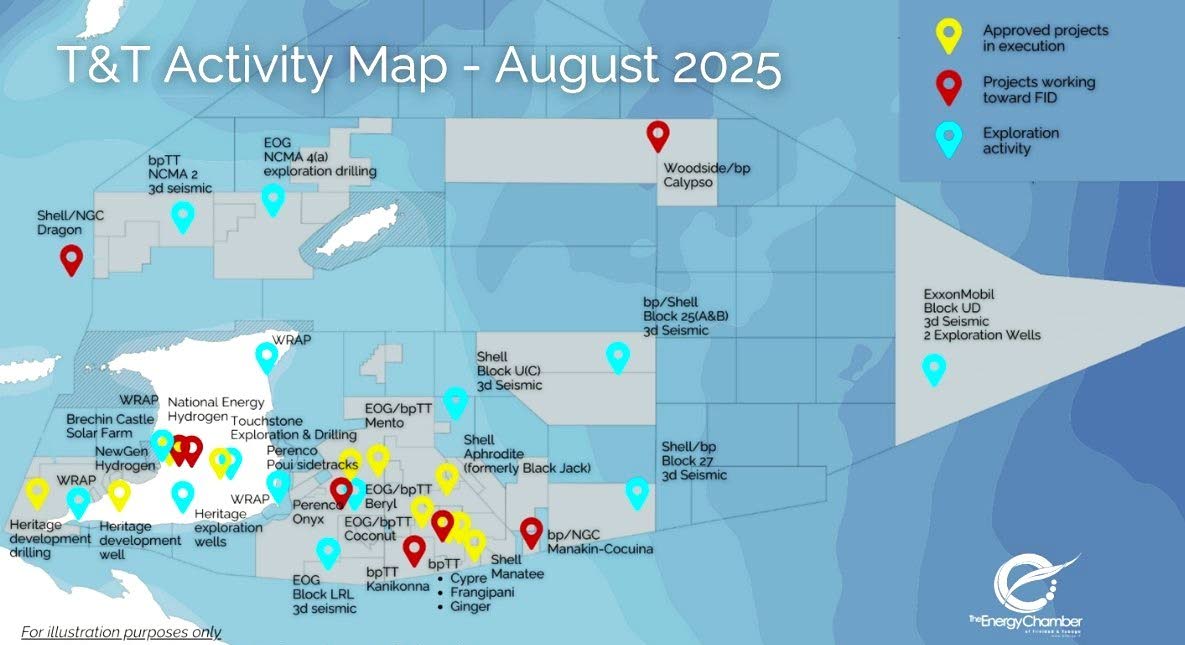
    Several medium-scale gas development projects achieved critical milestones, with BP, Shell, Perenco and EOG advancing initiatives including Cypre, Mento, Coconut, Ginger, Frangipani, Onyx, Kanikonna and Aphrodite. These developments are expected to mitigate production declines from mature fields. The landmark Manatee project is scheduled to commence drilling in 2026 with production anticipated by late 2027 or early 2028.

    Conversely, all Venezuelan cross-border gas initiatives experienced complete stagnation. Both the Dragon and Manakin-Cocuina projects faced suspension due to geopolitical tensions between the United States and Venezuela, with concerns emerging that Manatee might similarly be affected. The critical Calypso project continued to languish without reaching Final Investment Decision, despite rumors of BP potentially assuming operatorship.

    A surprising development emerged as ExxonMobil secured seven ultra-deepwater blocks through fast-tracked negotiations, theorizing that Guyana’s prolific petroleum system might extend into Trinidadian waters. Exploration activities are scheduled to commence during first-quarter 2026.

    Downstream operations suffered a major blow with Nutrien’s complete shutdown of its ammonia and urea facilities, idling 600 employees amid contract disputes with National Energy, gas availability challenges, and global competitiveness pressures. Meanwhile, the new administration progressed with plans to reactivate the Petrotrin refinery through phased restart initiatives, though technical and economic feasibility questions persist.

    The energy sector’s trajectory remains heavily influenced by geopolitical dynamics between the United States and Venezuela. Optimal outcomes would involve bilateral support for cross-border gas field development through Trinidadian infrastructure, potentially including utilization of flared gas from Venezuelan onshore operations. Such cooperation could unlock substantial opportunities for Trinidad’s energy services sector.

    Renewable energy initiatives gained momentum with BP’s Brechin Castle solar farm achieving initial electricity generation capacity. The Ministry of Energy and National Energy received recognition for pioneering green hydrogen development, while wind resource assessment programs expanded to additional monitoring locations.

    Leadership transitions across state energy enterprises including NGC, Heritage Petroleum, and National Energy introduced organizational uncertainty following the April general election. Board restructuring and executive departures raised concerns about institutional stability within these critically important energy institutions.

  • The capabilities SMEs must build to compete globally

    The capabilities SMEs must build to compete globally

    Trinidad and Tobago’s persistent efforts to boost exports through trade missions and forums have yielded limited sustainable results, not due to lack of ambition among local firms but because of fundamental capability gaps in international market penetration. The Trinidad and Tobago Chamber of Industry and Commerce, through its Export Action Programme (EAP), is addressing these challenges by providing structured support to small and medium-sized enterprises (SMEs) seeking global expansion.

    Funded by the EximBank of Trinidad and Tobago, the EAP currently supports 24 firms across diverse sectors including maritime services, fashion, film, IT, and accounting. The program emphasizes that exporting represents a fundamental capability rather than a one-time activity, requiring deliberate preparation, disciplined execution, and sustained commitment to competitiveness.

    The program identifies five critical capabilities essential for export success: customer understanding, compliance readiness, strategic branding, structured planning, and relationship management. Rather than focusing solely on promotion, the EAP provides customized support including export diagnostics, tailored action plans, and technical assistance across market intelligence, compliance, branding, strategy, and aftercare services.

    A key insight from the program reveals that export development must begin with comprehensive customer understanding. Firms must develop detailed customer profiles supported by focused market research that examines buying patterns, decision-making processes, and price sensitivity in target markets. The EAP assists SMEs in identifying ideal customers, accessing relevant market research through its Trade Desk, and developing export marketing plans grounded in actual market conditions.

    Compliance requirements represent another significant barrier, with many SMEs discovering too late that they lack necessary certifications for target markets. The program helps firms identify market-specific compliance needs and sequence required documentation before market entry, transforming compliance from an administrative burden to a strategic enabler.

    Digital presence and professional branding have emerged as critical factors in global competitiveness, as first impressions are increasingly made online through websites and digital catalogs. The EAP supports firms in strengthening their export-facing brand identity and digital platforms to signal reliability and readiness to international buyers.

    The program also addresses the common absence of structured export plans, helping firms develop clear strategies for priority markets, entry approaches, and practical implementation steps. Finally, the EAP emphasizes that export development doesn’t end with initial shipments but requires ongoing relationship management, buyer feedback responsiveness, and adaptation to market evolution for sustainable growth.