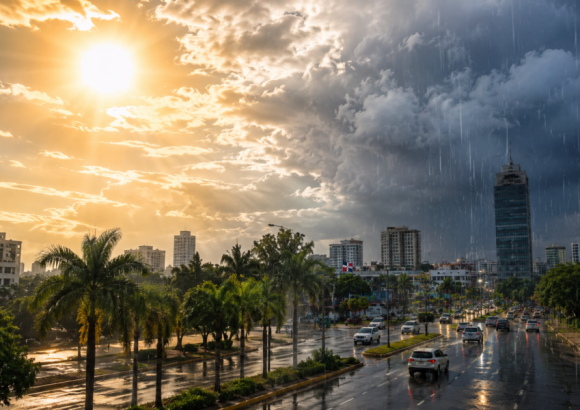
This official weather forecast, issued early on April 27, outlines a full day of variable conditions across the Netherlands, starting with a mixed morning pattern. Early risers can expect an alternating mix of sunshine and cloud cover to open the day, with patchy light fog predicted for inland areas. This fog is expected to lift and dissipate completely as the morning progresses, clearing conditions for the rest of the day. As the clock moves into midday and afternoon, cloud cover will build steadily across the country. This increase in cloud cover brings with it the chance of scattered rain showers and thunderstorms, which can grow locally intense and bring sudden gusty winds to affected areas. The highest risk of precipitation remains concentrated in inland regions, though isolated storm cells can still pop up in coastal zones as well. The risk of isolated showers will continue through the evening hours and into the overnight period, before conditions gradually calm down across the entire nation. Humidity levels will stay elevated throughout the day and night, creating a sticky, oppressive feel for residents across the country. Daytime temperatures will range between 30 and 33 degrees Celsius, with the hottest readings recorded in inland locations. Overnight temperatures will only drop to around 24 degrees Celsius, keeping conditions warm even after sunset. Winds will remain light to moderate, blowing consistently from an east-northeasterly direction.
作者: admin
-

Olieprijzen stijgen door vastgelopen VS-Iran vredesgesprekken
Global energy markets faced fresh upward pressure on oil prices Monday, as stalled peace negotiations between the United States and Iran pushed benchmark crude to a near three-week high, just as a new independent report revealed global military expenditure climbed to its highest level in 16 years last year.
Brent crude, the global benchmark for oil prices, jumped more than 2% to settle at $107.97 per barrel on Monday, its highest point recorded since mid-March. Market analysts attribute the sharp rally primarily to the breakdown of diplomatic talks between Washington and Tehran, which has extended existing uncertainty over energy export supplies from the Middle East. Persistent tensions around the Strait of Hormuz — a strategic chokepoint through which roughly 20% of global oil supplies pass daily — remain a core driver of elevated price risk, with ongoing regional conflict pushing Asian liquefied natural gas (LNG) prices far above pre-war levels already.
The sudden price surge has compounded existing inflation concerns among investors and policymakers, coming just ahead of a week packed with high-stakes monetary policy meetings from major central banks around the world. Traders have now largely priced out any expectations of interest rate cuts this year, as higher energy costs are expected to keep core inflation stickier than previously projected, prolonging tight monetary conditions.
In a separate report released Monday, the Stockholm International Peace Research Institute (SIPRI) announced that global military spending rose 2.9% in 2025 to reach $2.89 trillion, marking the 11th consecutive annual increase. Total global military expenditure now accounts for 2.5% of global gross domestic product, the highest share recorded since 2009.
Despite a 7.5% drop in U.S. military outlays in 2025 — driven primarily by the pause in new military aid funding for Ukraine — the United States remains the world’s largest military spender by a wide margin, with total expenditure hitting $954 billion last year. SIPRI analysts emphasize that the 2025 drop is almost certainly temporary: U.S. Congress has already approved a $1 trillion+ military budget for 2026, with projections indicating spending could rise to as much as $1.5 trillion by 2027.
European military spending recorded the most dramatic regional growth last year, jumping 14% to $864 billion. The increase is largely fueled by the ongoing war in Ukraine, as NATO member states across the continent have ramped up defense budgets to boost collective security. Both Russia and Ukraine also substantially increased their own defense outlays in 2025, marking the fourth full year of open conflict between the two nations.
By contrast, both Israel and Iran recorded slight drops in military spending last year. Israel’s expenditure fell 4.9% following a partial de-escalation of conflict in Gaza, while Iran recorded a 5.6% drop — its second consecutive annual decline in military outlays.
-

Mining sector leads Dominican economic growth with 7.7% expansion
SANTO DOMINGO — The Dominican Republic’s mining industry emerged as the fastest-growing segment of the national economy in the first quarter of 2026, posting a 7.7% year-over-year expansion that outpaced broader economic gains, according to Energy and Mines Minister Joel Santos. Preliminary figures released by the Central Bank of the Dominican Republic put the country’s overall first-quarter economic growth at 4.1%, marking the mining sector’s outperformance by more than 3.5 percentage points. Minister Santos attributed the sector’s robust growth to elevated extraction volumes of key commodities including gold, silver, and construction-grade materials, a trend that has cemented mining’s standing as one of the nation’s leading export-driven industries. The sector closed 2025 on a strong note, with total export values exceeding $2.5 billion, and total tax contributions to the national government hitting roughly 45 billion Dominican pesos, providing substantial support to public coffers. Alongside the strong performance of mining, the minister also reported solid 3.4% growth for the broader energy sector across the first three months of 2026. This expansion has been fueled by rising domestic and commercial demand for electricity, paired with ongoing large-scale upgrades to the Dominican Republic’s national power infrastructure. Since 2020, the country’s total installed power generation capacity has jumped significantly, climbing from just 4,921 megawatts to more than 7,100 megawatts by the end of 2025. Renewable energy projects account for a large portion of this new capacity buildout, advancing the country’s goal of energy market diversification. Minister Santos highlighted ongoing strategic projects that are shaping the future of the nation’s energy sector, including the Manzanillo Power Land initiative and the rollout of expanded battery energy storage systems. These investments are designed to boost grid reliability, reduce dependence on single energy sources, and create a more resilient national power network. Looking ahead, Santos emphasized that both the mining and energy sectors will remain core pillars of the Dominican Republic’s economic strategy, continuing to draw foreign and domestic investment, shore up public finances, and support long-term, sustained economic growth across the country.
-

Column: Wanneer loyaliteit boven bekwaamheid gaat…
Across nations, a deeply entrenched, destructive pattern continues to plague public governance: key leadership and senior positions are consistently awarded not to the most qualified, experienced candidates, but to partisan loyalists rewarded first and foremost for their unwavering allegiance to ruling political power. This long-standing, stubborn practice inflicts lasting damage on public institutions and imposes steep, widespread costs on society as a whole.
What often begins as a seemingly harmless gesture of gratitude—a senior role or lucrative position handed out to a faithful party supporter—quickly snowballs into systemic dysfunction when the appointee lacks the necessary professional expertise and hands-on experience for the role. The ripple effects of these unqualified appointments stretch far beyond individual government departments: widespread administrative inefficiency, stalled public projects, and all too often, overt corruption and widespread mismanagement become the new norm.
The recent scandal at Canawaima Management Company, where the entire board of commissioners was replaced after just a few months of chaotic leadership, followed by revelations of excessive negotiation payments to the union chair, is far from an isolated incident. In fact, conflicts of interest have become the rule rather than the exception in political patronage appointments, when loyalty is prioritized over proven competence.
When unqualified individuals hold critical decision-making positions, policy choices are shaped not by evidence and public need, but by narrow political interests. Public projects fall behind schedule, public funds are misallocated or wasted, and the quality of services delivered to ordinary citizens declines sharply. This pattern breeds widespread public frustration and erodes trust in government: how can citizens be expected to trust a system that hands power to politically compliant individuals instead of the most capable candidates?
Real-world outcomes repeatedly confirm this damaging trend. Whether the roles in question are senior leadership in government agencies, regulatory oversight positions, or board seats at state-owned public organizations, proven expertise is too often traded away for partisan loyalty. Even at the national civil aviation authority, a core agency responsible for the safety of air travel, unqualified leadership has undermined both service quality and public safety. This is not merely an internal administrative issue—it carries severe, tangible consequences for all of society. Unqualified leaders are far more vulnerable to external manipulation and far more likely to make costly, harmful decisions that put the public at risk.
It is long past time to break this toxic political culture. All public sector appointments must be rooted in the principles of meritocracy: professional knowledge, proven experience, and unwavering integrity should be the only criteria for selection. Only through this shift can nations build strong, accountable public institutions that prioritize the public good and earn back the trust of citizens. Unfortunately, the same damaging pattern of patronage reappears with every change of government, perpetuating the cycle of dysfunction.
Society deserves public leaders who are selected not just for their partisan alignment, but for their proven professional competence. At the end of the day, every member of society pays the price for unqualified governance: through higher costs, compromised public safety, and the permanent erosion of trust in democratic institutions.
Reversing this decades-long trend requires bold political courage and a deep commitment to public accountability, to build a fairer, more effective system where competence is the deciding factor in all public appointments. Only then can nations build a future where the public good is truly placed at the center of governance.
-

CUSEP reports traffic accident involving presidential advance team in Puerto Plata
A Monday morning traffic collision on the Maimón-Puerto Plata highway in the Dominican Republic has left three people injured, including two members of the presidential advance security detail and one civilian, according to an official statement from the Presidential Security Corps (CUSEP). The incident was logged at 8:56 a.m. local time, involving a government-issued vehicle assigned to the presidential security unit and a privately owned civilian car that were both traveling along the same corridor at the time of the crash.
At the time of the accident, the advance team was en route to the coastal city of Puerto Plata to finalize on-the-ground logistics preparations for an upcoming official tourism-focused event in nearby Sosúa. Dominican President Luis Abinader was scheduled to attend that event, but CUSEP officials have explicitly confirmed that the head of state was not part of the traveling convoy and was not present on the highway when the collision occurred.
First responder and emergency medical teams mobilized rapidly to the crash site immediately after receiving the distress call. They administered on-site first aid to all injured parties before transporting them to local medical facilities for further care. As of the latest update, all three affected individuals remain under medical observation at these health centers.
Preliminary reviews of nearby surveillance camera footage indicate that the official sport utility vehicle lost steering control, exited the paved roadway, and then struck the civilian passenger vehicle. Local law enforcement and transport authorities have opened a formal investigation to pinpoint the root cause of the crash, and have announced that additional updates on both the investigation progress and the health status of the injured will be released once more information is confirmed.
-

“There are more of us who love and defend Cuba”
Kicking off its multi-stop tour of Cuba’s southeastern region on April 27, 2026, the second annual May Day International Solidarity Convoy has brought tangible aid and heartfelt global support to local communities across Granma, Santiago de Cuba and Guantánamo provinces. Made up of pro-Cuba activists and supporters from Italy, France, the United States, Mexico, and Cuban expatriate communities living abroad, the convoy’s 10-day itinerary combines aid deliveries, cultural visits, and direct engagement with local residents to highlight global opposition to the decades-long U.S. blockade against the island nation.
The delegation’s first stop was Santiago de Cuba’s University of Medical Sciences, where members met with institutional leadership, faculty, and students. In remarks to the gathering, Michele Curto, president of the Italian Agency for Cultural and Economic Exchange with Cuba and director of the joint venture BioCubaCafé, reaffirmed the international community’s unwavering commitment to the Cuban people amid ongoing external pressures. “We have come to reaffirm our commitment to the noble Cuban people, who are now under constant threat,” Curto stated, adding later that a growing global movement of Cuba supporters stands with the island: “There are many more of us who love and defend Cuba; you are not alone, and we will prevail.”
The meeting became an emotional reunion for many in attendance. Dr. Abel Tobías Suárez Olivares, rector of the University of Medical Sciences, recalled his own deployment to Turin, Italy, as part of Cuba’s international medical brigade that responded to the crisis at the height of Europe’s COVID-19 pandemic. Ileana Núñez, a Cuban soprano who has resided in Italy for decades, was also on hand for the gathering – she had served as a translator and liaison between Dr. Suárez and local patients when the brigade worked in Italy’s COVID-19 red zones. The reunion unfolded as a warm exchange of hugs and shared memories, with Dr. Suárez emphasizing the transformative impact of the convoy’s visit: “Your visit shows that we are not alone in this battle and that solidarity is always capable of breaking the blockade.”
Beyond the exchange of experiences, the convoy has organized a large shipment of targeted solidarity aid for Cuban health and education institutions, including life-saving medications, critical medical equipment, school supplies, and photovoltaic solar panels. The first donations were officially handed over Thursday to the University of Medical Sciences and Santiago de Cuba’s Antonio Vegues César South Children’s Hospital. Juan Carlos Vaillant Despaigne, delegate of the Cuban Institute of Friendship with the Peoples in Santiago, called the gesture far more than a material contribution: “We deeply appreciate this gesture, which goes beyond the material and touches our souls.”
Following the Santiago opening events, delegation members traveled by bus to key stops across the region, with the explicit goal of connecting directly with Cuban communities most impacted by the U.S. blockade. One of the early stops was the historic Santa Ifigenia Cemetery, where the international delegates paid tribute to Cuba’s most iconic national figures: they honored founding father Carlos Manuel de Céspedes, national mother Mariana Grajales Cuello, national hero José Martí, and former Commander-in-Chief Fidel Castro Ruz, who is credited with building lasting bridges of friendship between Cuba and the global community.
In Matahambre, a town that suffered severe damage from Hurricane Melissa in October 2025, the convoy delivered solar panels to the local Family Doctor and Nurse Clinic to ensure the facility can maintain consistent operations amid ongoing energy challenges. The delegation also dropped off new teaching materials for the town’s elementary school and sports equipment for the local basic secondary school, taking time to interact with students and educators during the visit.
Curto, who leads the cross-border coffee initiative BioCubaCafé, met with local coffee growers in the region to discuss their work. Many of these smallholder producers cultivate coffee using sustainable agroecological practices, and they have recently benefited from new government policies designed to boost the traditional export sector. Curto’s meeting offered an opportunity to hear first-hand about the ongoing challenges producers face due to the tightened U.S. blockade, which restricts access to imported farm machinery and critical fertilizers.
Further stops along the tour included the Porfirio Valiente Polyclinic in Alto Songo, where delegates observed how the facility delivers consistent patient care even amid widespread shortages caused by the blockade. One local general practitioner noted that while the facility faces supply constraints, it retains its most valuable asset: “the powerful human capital, so professional and shaped by the Revolution.” The convoy also delivered medications and medical consumables to the Emilio Bárcenas Rural Hospital in Segundo Frente, a mountainous municipality. Opened in 1961, the hospital provides urgent care, emergency services, and inpatient care to the local rural population. The tour wrapped up its first week with a meeting with local agricultural producers, who detailed the widespread economic harm caused by the intensification of the U.S. blockade.
As the convoy continues its journey through southeastern Cuba through the end of the week, organizers say the initiative remains focused on two core goals: delivering critical support to communities in need, and demonstrating that global solidarity continues to transcend political divisions to stand with the Cuban people.
-

The Santiago de Cuba refinery also produced naphtha, fuel oil, and diesel from domestic crude oil
Amid decades of escalating economic and energy blockades that have squeezed the Caribbean nation’s energy sector, Cuban oil industry specialists have achieved a landmark technological breakthrough, unlocking the value of the country’s untapped domestic heavy crude reserves that were long written off as unrefinable.
-

Na ziekteverzuim werken luchtverkeersleiders volgens normaal schema
A sudden, widespread shutdown of air operations at Suriname’s busiest international gateway last weekend has pulled back the curtain on decades of unresolved systemic issues plaguing the country’s air traffic control sector, just as the nation prepares for an expected oil-driven economic boom next year.
On Saturday, the control tower at Johan Adolf Pengel International Airport was left completely unstaffed after multiple air traffic controllers called in sick, bringing nearly all flight activity to a standstill. Normal operations only resumed Sunday as controllers returned to their scheduled shifts, according to the Suriname Air Traffic Controllers Association (SATCA).
SATCA has repeatedly emphasized that the incident was not a deliberate strike or organized work stoppage, but rather the inevitable outcome of a chronic understaffing crisis that left no available backup personnel to cover unexpected absences. In a statement released Sunday morning, the Presidential Cabinet confirmed that the situation had been normalized following direct intervention by Suriname President Jennifer Simons, and a formal meeting between the president and SATCA leadership has been scheduled for Monday to address the root causes of the crisis.
Tensions have been building for months between air traffic controllers and Transport, Communication and Tourism Minister Raymond Landveld, whom SATCA no longer trusts to negotiate meaningful reforms. Landveld delegated all discussions on controller concerns to a special negotiation commission, but SATCA reports the commission has not held any substantive contact with the association since February 26, and failed to deliver any actionable solutions to address long-standing grievances. This stalemate led SATCA to demand direct talks only with the president, a request Simons has agreed to grant.
A key flashpoint in the dispute is a recent policy change that cut the maximum monthly overtime hours for controllers from 60 to 30, which eliminated all available backup shift coverage that relied on overtime work. Beyond staffing, SATCA is also demanding the president address severe wage inequality within the Aviation Authority’s operational divisions, a long-running imbalance that has driven a steady brain drain from the sector.
Years of excessive workloads and perceived undercompensation have pushed dozens of experienced controllers to leave the profession entirely for other opportunities. Two controllers have retrained to become commercial pilots for foreign carriers, while many others have left Suriname altogether to take up aviation roles abroad with better pay and working conditions.
Industry observers note that these challenges are not new: the Suriname air traffic control sector has struggled with persistent underperformance and understaffing for decades. Even basic safety protocols are regularly breached, the association confirms: a prohibited operating model called Single Person Operation, where only one controller plus a single assistant handle all air traffic duties during a shift, is now common practice rather than a rare exception.
As Suriname prepares for a major oil boom projected to start next year, experts warn the brain drain crisis is only set to worsen, repeating a pattern already seen in neighboring Guyana, which faced similar staffing shortfalls after its own oil sector expansion. Already, the trend of skilled controllers leaving is accelerating, and without urgent reforms, the country will be unable to meet growing air traffic demand tied to the incoming energy boom.
President Simons has acknowledged the scope of the crisis, stating that a structural, long-term solution is needed. She has confirmed that the problem extends far beyond just filling empty staffing slots, and that addressing wage inequality and upgrading outdated, aging air traffic control equipment will also be key priorities in the upcoming talks.