作者: admin

  • GOw2 trekt pompprijzen op tot price cap; druk op regeling neemt toe

    GOw2 trekt pompprijzen op tot price cap; druk op regeling neemt toe

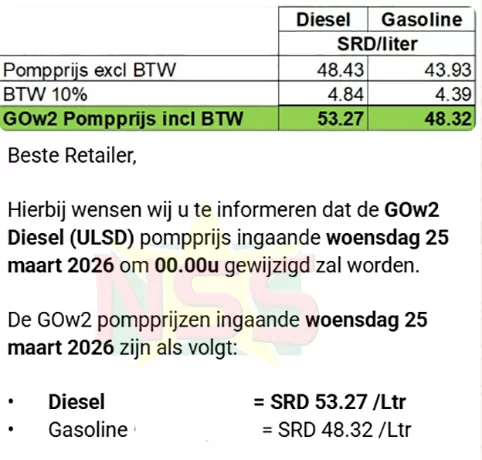
    Suriname’s state-mandated fuel price ceiling is facing mounting pressure as persistently rising global oil markets test the sustainability of the government’s consumer protection mechanism. Effective March 25th, GOw2 – historically Suriname’s most affordable fuel retailer – aligned its pricing with the official cap, setting diesel at SRD 53.27 and unleaded gasoline at SRD 48.32 per liter.

    The price control mechanism, instituted by President Jennifer Simons on March 17th, was designed to shield consumers from international market volatility by capping retail fuel prices. This intervention requires the government to absorb approximately SRD 10 per liter in foregone revenue through reduced taxation, effectively subsidizing the difference between global market rates and local pump prices.

    However, sustained upward pressure on international oil markets, exacerbated by ongoing geopolitical tensions in the Middle East, has created significant fiscal challenges. Analysts warn that the current price cap may become economically unsustainable if global trends continue, potentially forcing the government to choose between increasing its financial compensation or permitting controlled price adjustments at the pump.

    The situation highlights the delicate balance between consumer protection and fiscal responsibility in resource-dependent economies. While the measure provides short-term stability for Surinamese citizens, its long-term viability remains contingent upon unpredictable international market conditions and the government’s capacity to maintain substantial revenue sacrifices.


  • Flour sector signals upcoming price hikes across all products

    Flour sector signals upcoming price hikes across all products

    The Dominican Republic’s bakery sector is confronting an unprecedented economic challenge as skyrocketing operational expenses threaten the stability of flour-based product manufacturing. The Union of Medium and Small Flour Industries (UMPIH) has issued an urgent alert regarding unsustainable cost pressures that jeopardize the entire production chain.

    According to UMPIH President José Radhames Bruno, production and distribution expenses have escalated by a staggering 40% across the sector. This alarming increase poses particular threat to the industry’s composition, where 99% of operations are classified as micro or small enterprises with limited financial resilience.

    During a recent press briefing, Bruno emphasized that while the union maintains a policy of non-interference in pricing decisions, it bears responsibility for educating both producers and consumers about market realities. He clarified that any potential price modifications for bread and related products would constitute direct responses to these uncontrollable cost surges rather than opportunistic increases.

    In response to the crisis, UMPIH has announced plans to convene an extraordinary national assembly. This emergency gathering will focus on developing strategic measures to safeguard sector profitability while implementing mitigation strategies to cushion consumer impact. The assembly aims to establish cooperative solutions that balance commercial viability with public affordability in one of the nation’s essential food industries.

  • Zikonnect 3.0 : Women and Music in the Digital Age

    Zikonnect 3.0 : Women and Music in the Digital Age

    In a groundbreaking initiative to address gender disparity in Haiti’s music sector, the Haiti Jazz Foundation has successfully concluded Zikonnect 3.0, a specialized program exclusively dedicated to female professionals. Titled “Women and Music in the Digital Age,” this third edition represents a strategic intervention to strengthen the artistic and entrepreneurial capabilities of women in an industry where they remain significantly underrepresented.

    Supported by the International Organisation of the Francophonie under its Women, Arts, Music and Entrepreneurship (FAME) program, this capacity-building initiative marks a pivotal advancement since its initial launch in 2022. For the first time, the program assembled a cohort consisting entirely of 15 women from diverse regions and professional backgrounds within Haiti’s music ecosystem.

    The program delivered concrete, practical resources tailored to the specific challenges of the Haitian context:

    – Fifteen professionally completed Electronic Press Kits (EPKs) provided to participants
    – A comprehensive practical toolkit featuring four essential checklists covering music releases, social media strategy, concert promotions, and related activities
    – A collaboratively developed document mapping music industry professions, created in partnership with Ayiti Mizik (Haitian association of music professionals), which outlines career pathways and digital opportunities
    – A collection of standardized contract templates ready for immediate implementation

    Beyond technical resources, Zikonnect 3.0 featured inspirational sessions with prominent figures including rapper Kanis and journalist Carel Pedre, who shared firsthand experiences about navigating the complexities of the digital music landscape. Their testimonies sparked significant professional awakening among participants, with one beneficiary noting: “Her sharing opened our eyes and prepared us to face the industry’s challenges with greater clarity.

    All educational materials and tools developed during the program are now publicly accessible on the Haiti Jazz Foundation’s YouTube channel, creating an enduring digital resource for continued learning and industry development.

  • Cartel Trade Shutdown Addressed; Imports Start Moving

    Cartel Trade Shutdown Addressed; Imports Start Moving

    A critical supply route between Belize and Mexico has resumed operations following days of complete paralysis caused by Mexican cartel activity. The northern trade corridor, vital for Belize’s import economy, was effectively held hostage by criminal organizations demanding payments and threatening transporters attempting to move goods across the border.

    The blockade created immediate shortages, stranding essential food products, construction materials, and commercial supplies. The crisis highlighted Belize’s profound supply chain vulnerability amid escalating cartel violence in Mexico’s Quintana Roo region.

    Prime Minister John Briceño revealed his government initiated direct high-level communications with Mexican authorities, including the Office of the President. This diplomatic intervention prompted Mexico to deploy approximately 10,000 federal and state security personnel to secure the trade route and restore cross-border movement.

    Opposition Leader Tracy Panton characterized the situation as a national security emergency, describing firsthand accounts of cartels dictating trade operations and issuing death threats to importers. Both government and opposition figures acknowledge the cartel threat now represents Belize’s most pressing security concern.

    Prime Minister Briceño emphasized Belize cannot combat this threat alone, calling for enhanced United States support through equipment, intelligence sharing, and mobility resources. He specifically requested American pressure on Mexico to maintain security in southern border regions.

    With Easter approaching, both leaders expressed concerns about citizen travel to Mexican resort destinations. While Briceño advised extreme caution for essential travel, Panton explicitly recommended avoiding travel to Quintana Roo entirely due to targeted threats against Belizean visitors.

  • Enriquez Scores Big as CCJ Revives Case on Unequal Electoral Boundaries

    Enriquez Scores Big as CCJ Revives Case on Unequal Electoral Boundaries

    In a landmark judicial decision with profound implications for democratic integrity, the Caribbean Court of Justice (CCJ) has reinstated constitutional challenges against Belize’s electoral boundary system. The court’s March 23rd ruling represents a significant victory for social activist Jeremy Enriquez and lead attorney Anand Ramlogan, SC, whose previous appeals had been dismissed on procedural grounds by Belize’s Court of Appeal.

    The case originated in February 2025 when Enriquez filed constitutional motions arguing that Belize’s current electoral boundaries violate constitutional guarantees of equal representation. His attempt to secure an injunction delaying general elections was denied by Justice Tawanda Hondora, who issued an unprecedented personal costs order against Ramlogan—a move widely criticized as judicial overreach.

    The CCJ’s sweeping reversal condemned the lower courts’ emphasis on technicalities, asserting that procedural requirements should not obstruct access to justice. The regional court nullified the costs order against Ramlogan and reinstated appeals regarding both the injunction denial and allegations of judicial bias, remanding the latter issue back to the trial judge for reconsideration.

    Prime Minister John Briceño responded to the ruling by characterizing it as largely academic, noting his administration already committed to completing redistricting by year’s end. He confirmed an upcoming meeting with Minister Musa to review progress toward this deadline.

    Ramlogan hailed the decision as critical for advancing substantive justice, though he expressed concerns about systemic delays in Belize’s judicial process. Enriquez emphasized his long-term commitment to constitutional electoral alignment despite financial and procedural hurdles.

    The CCJ’s intervention has transformed the redistricting debate from purely technical litigation to a broader examination of judicial accessibility and political accountability. All stakeholders now await whether governmental promises will materialize into concrete electoral reforms.

  • Elderly man to serve two more years for dumping granddaughter’s body in cover-up

    Elderly man to serve two more years for dumping granddaughter’s body in cover-up

    In a landmark ruling that concludes a 24-year mystery, Barbados High Court Justice Donna Babb-Agard delivered a scathing condemnation of 81-year-old Winfield Nurse for concealing the death of his 12-year-old granddaughter Rasheeda Bascombe and deceiving both authorities and his own family for over a decade. The court sentenced Nurse to 13 years imprisonment for unlawfully disposing of the child’s body, though he will serve only two years and 24 days after credit for time already spent in remand.\n\nThe case unraveled through Nurse’s own 2013 confession, revealing that Bascombe sustained a fatal stab wound during an altercation in January 2002. Rather than seeking medical assistance, Nurse abandoned the injured child with the knife still protruding from her abdomen. He returned two days later to discover her deceased and callously disposed of her body over a cliff in Jackson, St Michael.\n\nJustice Babb-Agard characterized Nurse’s conduct as \”absolutely reprehensible,\\” noting his elaborate efforts to maintain the deception. He falsely reported Bascombe’s disappearance, claimed she frequented \”unsavoury places,\” pretended to search for her, and even displayed her photograph in the family home—all while knowing her tragic fate.\n\nThe judge emphasized the profound psychological trauma inflicted upon the family, particularly Bascombe’s mother Hermena Straker, who died without learning her daughter’s fate or achieving closure. Nurse’s actions transformed what might have been a tragic accident into a prolonged injustice, manipulating both investigators and grieving relatives through calculated falsehoods.\n\nAlthough initial murder charges were dropped due to insufficient evidence, prosecutors successfully pursued conviction for unlawful disposal of a corpse. The court determined this case warranted exceptional severity due to Nurse’s systematic obstruction of justice and the extraordinary duration of his deception.

  • Government Gives up $60 Million: Another Fuel Hike Pending

    Government Gives up $60 Million: Another Fuel Hike Pending

    The Belizean government has announced significant economic measures amid rising fuel costs, with Prime Minister John Briceño revealing a substantial reduction in tax revenue to cushion the impact on citizens. Effective midnight Tuesday, diesel prices will increase by $2.50 per gallon, compounding last week’s ten percent hike in regular and premium fuels.

    Prime Minister Briceño disclosed that his administration is forfeiting approximately $60 million in revenue by reducing fuel taxes by $1.25 per gallon on the current shipment. Without this intervention, he stated, the price increase would have exceeded $3.00 per gallon. The Prime Minister emphasized the difficult balance between providing relief and maintaining essential public services, noting that complete tax elimination would create a $200 million budget shortfall affecting teacher salaries, military funding, healthcare, and other critical expenditures.

    Simultaneously, Briceño has criticized the Department of Environment for its handling of the Humilde Viajero fuel-tanker incident, accusing the agency of overstepping its authority by offering an administrative settlement before proper review. The Prime Minister has directed the Attorney General to pursue full legal action against all parties involved in the environmental violation.

    Opposition Leader Tracy Panton issued a statement condemning the fuel price increase, warning that transportation operators, agricultural producers, tourism companies, and utility providers will face severe operational challenges. She predicted these increased costs would inevitably transfer to Belizean families already struggling with inflation.

  • In Haiti inflation continues to decline (BRH)

    In Haiti inflation continues to decline (BRH)

    Haiti’s economy continues to demonstrate positive momentum in its battle against inflation, with official data from the Bank of the Republic of Haiti (BRH) revealing a consistent downward trajectory in price growth. The latest figures indicate a significant moderation in annual inflation, dropping from 27.3% in December 2025 to 25.5% in January 2026.

    The disinflationary trend is particularly evident across both domestic and imported goods. The Consumer Price Index (CPI) for locally produced goods recorded a substantial decline, while imported product inflation decreased by one percentage point month-on-month to settle at 20.5%.

    Geographic analysis reveals broadly stable inflation patterns across most regions. The ‘West Rest’ area maintained a 1% monthly rate, followed closely by the ‘South’ at 0.9% and ‘Cross-Section’ regions at 0.7%. The Metropolitan Area experienced a slight uptick of 0.1 percentage points to reach 1.1%, while the ‘North’ region saw a modest reduction to 0.7%.

    Year-over-year comparisons show encouraging progress nationwide, with all major regions experiencing reduced inflationary pressures. The ‘South’ region demonstrated the most pronounced improvement, falling from 24.5% to 22.8%. Similar declines were observed in ‘West Rest’ (26.0% to 24.4%), ‘Cross-Section’ (25.0% to 23.6%), Metropolitan Area (25.7% to 24.4%), and ‘North’ (22.4% to 21.1%).

    Economic projections from the Directorate of Currency and Economic Analysis indicate the disinflationary process will continue through April 2026. Forecasts suggest a gradual decline to 23% in February, followed by 22.9% in March, and 22.3% in April. However, analysts note that monthly inflation rates may experience temporary fluctuations, with expected increases averaging 1.6% over the coming quarter.

    The comprehensive BRH monthly inflation report, available in PDF format, provides detailed analysis and methodology behind these economic indicators.

  • PM Briceño: “We Can’t Continue Bailing Out BSCFA”

    PM Briceño: “We Can’t Continue Bailing Out BSCFA”

    Belize’s Prime Minister John Briceño has declared that his administration will no longer provide financial bailouts to the Belize Sugar Cane Farmers Association (BSCFA), signaling a dramatic shift in the government’s approach to the ongoing crisis within the nation’s vital sugar sector. The announcement comes after months of unsuccessful negotiations between cane farmers and Belize Sugar Industries, with the government’s proposed support package being outright rejected by agricultural stakeholders.

    Speaking at a recent briefing, PM Briceño expressed growing frustration with the protracted stalemate that threatens the stability of one of Belize’s cornerstone economic industries. Despite recognizing the sector’s critical importance to the national economy, the Prime Minister emphasized that the cabinet has reached its limit regarding financial interventions.

    “We can’t continue bailing out the BSCFA,” Briceño stated unequivocally. “They have come to us several times requesting assistance, and we have complied because we recognize their significant role in our agricultural sector. However, each time we provide support to sugar cane farmers, we face mounting pressure from other industries equally deserving of government assistance.”

    The Prime Minister highlighted the dilemma his administration faces when allocating limited resources, noting that tourism operators, fisheries, cocoa producers, and other agricultural sectors all legitimately demand support. He revealed that during recent natural disasters, many small farmers lost their produce without receiving adequate government assistance, creating what he described as “frustration and jealousy within the covenant.”

    In a significant policy shift, Briceño indicated that any future support would need to be distributed equally among all four sugar associations rather than directed exclusively to BSCFA. This approach responds to complaints from other associations that they deserve equal treatment as taxpayers.

    The ongoing impasse has raised concerns about the potential disruption to fertilizer distribution and other support mechanisms traditionally provided to cane farmers. With neither side showing willingness to compromise, the Belizean sugar industry faces an uncertain future that could have ripple effects throughout the nation’s economy.

  • SVB  lanceert nieuwe identiteit ‘Natio – The Green Guardians’ en vernieuwde teamtenues

    SVB lanceert nieuwe identiteit ‘Natio – The Green Guardians’ en vernieuwde teamtenues

    The Surinamese Football Association (SVB) has unveiled a transformative new international identity for its national football team, now officially designated as ‘Natio – The Green Guardians.’ This strategic rebranding initiative was formally announced on Tuesday alongside the simultaneous launch of newly designed home and away kits developed in partnership with sportswear manufacturer Kelme.

    This comprehensive repositioning effort aims to strengthen Suriname’s presence within global football by leveraging the nation’s distinctive environmental characteristics. The innovative identity draws direct inspiration from Suriname’s status as one of the world’s most forest-rich nations, with over 90% of its territory covered by pristine rainforests.

    SVB President Dayasankar Mathoera emphasized that the national team now carries significance beyond athletic performance. “We don’t just play for Suriname; we carry something larger onto the field,” Mathoera stated. “With The Green Guardians, we add meaningful responsibility to the pride that Natio has projected for years.”

    The symbolic designation ‘The Green Guardians’ represents both the nation’s extraordinary natural heritage and the team’s philosophical approach—competing with clear purpose, strong identity, and awareness that they represent values extending beyond the sport itself.

    The newly unveiled kits embody this dual message through sophisticated design elements. The white away uniform incorporates the fayalobi flower, representing love, connection, and the diversity of the Surinamese people. The green home kit draws inspiration from palm symbolism, reflecting nature, strength, and growth. Both designs integrate subtle elements from the Surinamese national anthem within their patterns.

    According to Natio General Manager Brian Tevreden, the introduction of The Green Guardians identity opens a new chapter for Surinamese football. “This is about visibility, identity, and belief,” Tevreden explained. “Every time we enter the field, we represent who we are and what we stand for.”

    The launch receives support from the ‘Green Guard’ initiative—a consortium of founding partners committed to supporting the national team’s development and international profile enhancement. This rebranding marks another significant step in SVB’s ongoing professionalization of Surinamese football, intentionally connecting sport, culture, and national pride into a cohesive international identity.