作者: admin

  • Rural folk fed-up with ‘ridiculous cycle’ of brush fire, smoke

    Rural folk fed-up with ‘ridiculous cycle’ of brush fire, smoke

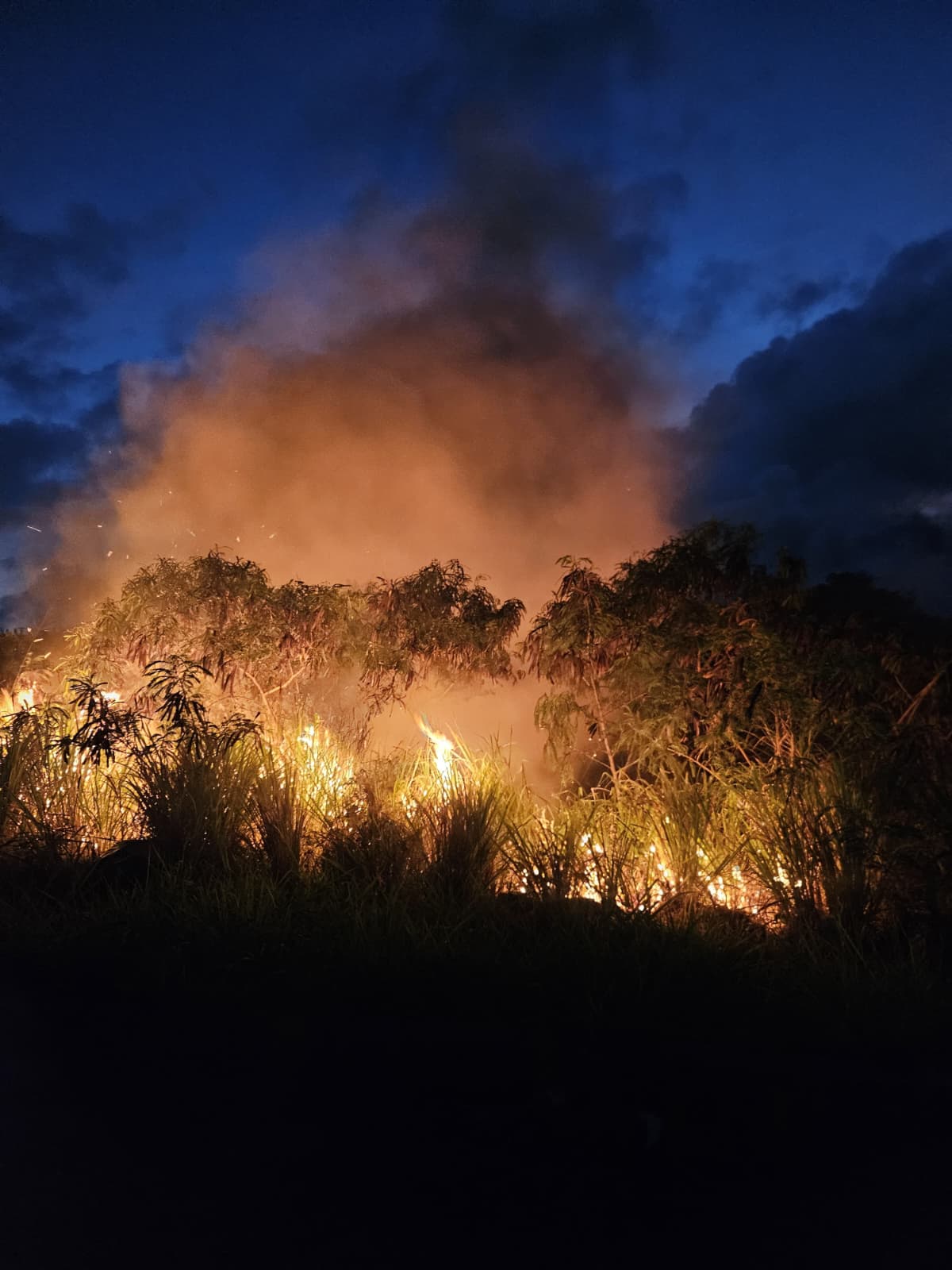
    Each dry season, residents of St George and St John parishes brace for smoke, ash, and disruption. This year, however, a relentless wave of blazes that blanketed both communities in toxic haze this week has pushed frustrated locals to speak out, demanding officials finally address the root causes of the annual crisis instead of only responding to emergencies after they break out.

    At the center of the problem lies vast stretches of abandoned and under-managed agricultural land across the island’s rural agricultural heartland. For decades, dozens of fallow plantations once used for sugar cane and vegetable cultivation – including the Pool, Henley, Wakefield and Todds properties, formerly owned by the defunct insurance conglomerate CLICO – have been overrun by invasive, fast-growing species: cow itch vine and river tamarind. These dense, dry plants act as perfect fuel for seasonal brush fires, creating massive blaze zones that spread quickly and generate thick, acrid smoke that drifts into residential and commercial areas.

    For long-time St George resident Brad Harper, the severity of this year’s fires hit him unexpectedly while driving through Middleton. What he first assumed was a mechanical fault in his car’s air conditioning system quickly revealed itself to be dangerous air pollution. “The smoke was very irritating to the sinus,” he recalled. “I was driving with the AC on, and at first I thought something was wrong with the vehicle, so I checked all the instruments and everything looked fine. It wasn’t until I rolled down the window that I realized just how hazy the outside air had become.” That evening, a return trip to the area with a friend confirmed his worst fears: conditions had grown even worse, with smoke thick enough to cause persistent respiratory irritation. Having lived in the region for most of his life, Harper said he has never seen smoke levels this high, even as local fire chiefs have already acknowledged a steady increase in the frequency and scale of these fires in recent years.

    The blazes are far more than a minor inconvenience: they pose a direct, daily threat to vulnerable community members. Susan, an asthmatic woman in St George, described this week’s smoke as suffocating, with a strange oily quality that triggered persistent coughing fits. “It wasn’t pleasant because the ashes and the smoke from the ashes had me coughing a lot, and I’m asthmatic too,” she explained. “It feels like burning tires, that thick black smoke. Then after it fades, everything gets covered in a white coating of ash. It’s not good at all.”

    Local small businesses have also suffered direct financial losses. Taylor, who owns a mini-mart in St Judes, St George, was forced to close her shop early and throw away contaminated stock after soot and ash blew into her store, covering fresh produce and other goods. “It was really bad,” she said. “It even got on the vegetables. We had to pack up early because the ashes and dust were blowing right past the place. It’s terrible for people with sinus issues. They’ve got to get rid of the cow itch – it’s affecting all of us, even small children. I just hope they find a way to stop these huge smoke plumes from impacting our daily lives.”

    In St John, local farmers have a front-row seat to the growing crisis. Maria Simpson, who farms land in Wakefield, says the constant cycle of fires means emergency fire crews are spread thin across the parish, with new blazes breaking out almost daily. “This is ridiculous,” she said, gesturing to the charred, blackened horizon stretching across the former plantation. “Every single day there’s at least one fire truck out from the station. If you have one fire here, another breaks out behind it, and you hear sirens nonstop. This is a real public health crisis. It’s unbelievably hard.”

    Simpson points out that the common practice of controlled burning to clear cow itch only makes the problem worse during the dry season. When the invasive plants are burned, dry particles of cow itch blow across the region, worsening respiratory irritation, and the infestation has already grown out of control, alongside unmanaged brush and even wild monkey populations on the abandoned land. Instead of reactive burning, she says officials should focus on early intervention: “Deal with them from early. If they could remove the plants before they start to flower and spread, that’d be real good.”

    For long-time St John resident Mavel Knight, the fires came right to her doorstep this week, forcing her to lock herself inside her Massiah Street home from mid-afternoon through the entire night as a blaze on Donkey Hill poured smoke into her neighborhood. “Last night there was so much smoke because there’s just so much unmanaged bush, that’s what creates all that smoke,” she said. “I had all the windows closed. To be truthful, I didn’t open the house at all. I told my daughter I was buckling down, I wasn’t moving, I kept the door locked.”

    The frustration with years of inaction is most palpable in Cherry Grove, where resident Marcia Clarke says the community has been stuck in a repeating cycle of cleaning ash and dealing with coughing fits for decades. She traces the problem directly to failed land management: what were once productive sugar cane fields are now neglected tinderboxes waiting to ignite. “Yesterday, I had to wash my clothes three times,” she lamented. “And then you have to close all the windows in the house. Years ago, when this area out front was sugar cane, we didn’t have this problem. But from the time the grounds got out of hand, this is what we get. We’ve told our member of parliament, but nothing ever happened. It’s terrible up here in St John.”

    As this week’s smoke begins to clear, residents of both parishes are left with the same unresolved problem, and their call for action has never been louder. With local fire services pushed to their breaking point and community public health at severe risk, locals are demanding a comprehensive, long-term plan to manage overgrown abandoned farmland and break the annual cycle of devastating seasonal bush fires. Until that plan arrives, as Simpson puts it, residents remain trapped in a “ridiculous” cycle of fire, smoke, and disruption.


  • LISTEN: Law Degree Confirmed for UWI FIC In Antigua and Barbuda, PM reveals

    LISTEN: Law Degree Confirmed for UWI FIC In Antigua and Barbuda, PM reveals

    In a campaign address delivered Thursday evening to supporters in St. John’s Rural West, Antigua and Barbuda Prime Minister Gaston Browne made a landmark announcement: the University of the West Indies (UWI) Five Islands Campus will officially launch a full law degree programme, marking the most significant expansion of the country’s tertiary education sector in recent history.

    Browne framed the new programme as a cornerstone achievement of his administration, which has made expanding accessible higher education a central policy priority since the establishment of the Five Islands Campus. For Antigua and Barbuda, which gained independence decades ago, Browne argued that the widespread access to university education enabled by the campus represents one of the most transformative national developments since sovereignty was achieved.

    Today, the Five Islands Campus draws students not just from across Antigua and Barbuda, but also from member states across the Organisation of Eastern Caribbean States (OECS), positioning it as a regional hub for tertiary learning. Browne emphasized that expanding affordable, local access to higher education is a foundational driver of both social mobility and long-term economic growth. “One of the best ways to lift people out of poverty is to give them access to education,” he noted, adding that the new law degree is tailored to equip young Antiguans and Barbudans with the specialized professional skills needed to drive ongoing national development.

    Beyond the new tertiary programme, Browne highlighted additional ongoing education-focused infrastructure projects underway in the St. John’s Rural West constituency, including the construction of a new Five Islands primary school. These investments, he said, are part of a broader effort to revitalize local communities and improve public services for residents across the region.

    The introduction of a local law degree is expected to deliver far-reaching benefits for the country. Currently, most students seeking legal training must pursue their degrees abroad, a barrier that imposes significant financial burdens on families and limits access for many talented young people. A local programme will eliminate that barrier, and over time, it is projected to strengthen Antigua and Barbuda’s domestic legal sector and broader professional economy by increasing the pool of locally trained legal professionals.

    The announcement came as Browne hit the campaign trail ahead of the country’s upcoming general election, urging voters to re-elect the Antigua and Barbuda Labour Party. He closed his remarks by drawing a contrast between his administration’s track record and opponents’ policy pledges, noting that the education expansion and infrastructure projects delivered under his government are proof of a record of “performance, not promises.”

  • Another harvest delay could finish off sugar industry – planters

    Another harvest delay could finish off sugar industry – planters

    Barbados’ centuries-old sugar sector, a foundational part of the island nation’s agricultural and economic landscape, is on the brink of total collapse if the 2026 harvest does not proceed as scheduled this Friday, private cane growers have warned. The urgent alarm comes amid a fresh, intractable disagreement between factory management and the Unity Workers Union (UWU) that has already delayed operations and put thousands of livelihoods at risk.

    The stark warning was delivered Thursday by Mark Sealy, chairman of Barbados Sugar Industry Limited (BSIL) – the cooperative that supplies 65 percent of all cane processed annually at Portvale, Barbados’ only remaining sugar mill. The conflict ignited after UWU threatened to pull its members from Portvale this weekend if management proceeds with plans to implement a mandatory shift system for workers.

    UWU General Secretary Caswell Franklyn has taken the firm stance that Portvale falls under the island’s Shops Act, meaning it must operate like a standard retail establishment with no structured shift scheduling. However, the Barbados Energy and Sugar Company (BESCO), the cooperative that oversees Portvale’s daily operations, argues that the facility is legally classified as a factory, falling under the 2013 Safety and Health at Work Act (SHAW), which permits shift-based work arrangements.

    This is not the first disruption to hit the 2026 harvest. Earlier this week, Agriculture Minister Dr. Shantal Munroe-Knight announced that limited grinding operations had resumed using cane that was delivered to the factory before UWU workers launched a prior strike. That industrial action was called to protest working conditions, wage levels, and BESCO’s refusal to recognize UWU as the workers’ official collective bargaining agent.

    For small-scale cane farmers, who form the backbone of BSIL’s membership, any further delay to harvest operations could be catastrophic. Cane already standing in fields is beginning to degrade, and extended delays will push marginal producers – who lack the financial reserves to absorb extended interruptions – out of business entirely, Sealy explained. That would leave the factory unable to meet its required daily processing target of 2,000 tonnes of cane, putting the entire annual quota at risk and triggering irreversible collapse of the industry.

    “People need to understand now that this is crunch time,” Sealy told Barbados TODAY in an exclusive interview. “This is now April 9, and we have hardly harvested any cane. We can’t continue with that; timing is of the essence. We have been trying to sustain the sugar industry for quite some time now. If we have any other drop out of marginal farmers, it will be very difficult to recover from that, because even the larger farmers will not be able to deliver 2,000 tonnes of cane to the factory per day.”

    Sealy added that small-scale producers without sufficient cash flow and reserve resources could be forced to exit the industry permanently if the 2026 crop is entirely lost to delays, creating a gap that cannot be quickly filled by remaining growers.

    Complicating the timeline further is the narrow harvest window before the arrival of the annual rainy season in June. Once soils become saturated, farm equipment cannot access fields to harvest remaining cane, making it impossible to salvage the crop. Sealy pushed back on UWU’s legal classification of the mill, noting that the facility’s function as a factory makes its classification under SHAW unambiguous. “Anybody can see that a factory is a factory. We need to get the whole thing sorted out because we can’t afford any more delays,” he said.

    On the contentious question of union recognition, Sealy threw BSIL’s support behind the Barbados Workers’ Union (BWU), which he says has been the recognized bargaining agent for sugar sector workers for nearly a decade. “For the past eight years and even before I was chairman of BSIL, we have been sitting down in negotiations with the BWU and BAMC, which is now BESCO, and going through the issues with mutual respect,” he said.

    Already, the weeks-long delay to the harvest, which was originally scheduled to begin February 15, has caused measurable damage. Standing cane has degraded, leading to lower sugar quality and reduced overall tonnage. Any additional delays will erode the economic benefits the sugar industry delivers to Barbados, pushing the centuries-old sector over the edge, Sealy warned. He called on all parties to negotiate an immediate resolution to allow the 2026 harvest to proceed for the benefit of workers, the general public, and the broader Barbados economy.

  • Jean Suriel forecasts prolonged rainy period and flood threat nationwide

    Jean Suriel forecasts prolonged rainy period and flood threat nationwide

    Residents across the Dominican Republic are preparing for an extended stretch of severe wet weather that is set to kick off this Saturday, according to a leading meteorological analyst. Jean Suriel, a prominent weather expert, has issued a formal warning that the forthcoming period of intense precipitation will linger between five and seven days, pushing the threat of dangerous flooding to elevated levels across every region of the country.

    Suriel detailed the combination of climate factors that will trigger this prolonged disruptive weather event. He explained that the unstable pattern stems from the convergence of three key atmospheric elements: Frontal System No. 35, a newly developed low-pressure trough, and unusually high volumes of moisture carried from adjacent ocean waters. This confluence creates ideal atmospheric conditions for sustained heavy rainfall and other hazardous weather phenomena that can impact daily life and public safety.

    Before the worst of the rain arrives, the Dominican Republic will first face a period of sweltering, uncomfortable conditions. Warm, moisture-saturated air moving in from the Caribbean will push heat index readings sharply higher in the days leading up to the main storm system. Afternoon high temperatures are forecast to climb into the range of 37°C to 39°C, putting residents at elevated risk of heat-related illness before the precipitation begins.

    Once the rains get underway, they are expected to steadily ramp up through the weekend. Torrential downpours will rapidly increase the danger of sudden flash floods, which can catch communities off guard with little time to evacuate. Suriel emphasized that wet, stormy conditions will not clear before early next week, extending the period of risk for multiple major weather-related hazards. Along with widespread flooding, authorities are warning of elevated potential for river overtopping and landslides in hilly and steep terrain across the nation. In closing, Suriel urged all Dominican residents to stay alert, closely monitor official weather advisories from government agencies, and follow any emergency guidance issued to protect themselves and their property.

  • Fear, security costs rise as murder numbers increase

    Fear, security costs rise as murder numbers increase

    As rising violent crime in Barbados sparks growing alarm over its cascading harm to national livelihoods and community stability, a leading Caribbean academic and behavioral specialist has issued a urgent call for enhanced, focused law enforcement intervention in high-crime hotspot areas. Professor Dwayne Devonish, a management and behavioral science lecturer at the University of the West Indies Cave Hill Campus, put forward his policy recommendations in the wake of two back-to-back fatal shootings that claimed the lives of a 22-year-old father of two from Gall Hill, Christ Church, and a 50-year-old resident of St John. These two killings have pushed the island nation’s total murder count for the current year to 18, amplifying long-simmering public anxiety over violent crime.

    Professor Devonish emphasized that the steady rise in violent offenses is placing unanticipated and severe economic strain on Barbados, a country still recovering from recent economic shocks and relying heavily on tourism and small business activity. He explained that the human cost of these killings translates directly to widespread financial hardship for impacted families, many of whom have lost their primary breadwinners to violence. “When a person is killed or seriously injured in a criminal attack, the entire family is left to absorb the long-term financial and economic consequences of that loss,” he noted. “For households where the victim was the main source of income, that burden can be crippling.”

    Beyond household-level economic harm, the academic warned that rising violent crime in public spaces is already inflicting measurable damage on Barbados’ commercial sector, particularly local businesses that rely on social and leisure activity. The most recent shootings all took place in widely accessible public areas: one in a residential neighborhood on St Stephen’s Hill, St Michael, one in the aftermath of the popular annual Oistins Fish Festival in Christ Church, and a third near the well-known Brownes Beach bar and restaurant Lazy Lizard. Because of these brazen, open attacks, Professor Devonish said growing public fear is keeping many Barbadians inside their homes rather than patronizing local businesses, social venues, and tourist hubs.

    “This pervasive societal fear that stems from public attacks is hitting local commerce directly,” he explained. “If people are scared that they could be caught in the wrong place at the wrong time just by going out to meet a friend or grab a meal, they will choose to stay home. That means less foot traffic for shops, restaurants, entertainment venues and other businesses that depend on public gatherings to survive.” He projected that commercial areas that normally see high levels of public foot traffic will see a sharp drop in patronage in the coming months, if the current trend of violent crime in public spaces continues.

    The specialist also pointed to a secondary economic cost: a sharp uptick in private security spending across both residential and commercial properties. As residents and business owners lose confidence in public safety, they are diverting limited income and revenue toward private protective measures including surveillance cameras, alarm systems, reinforced gates and security fencing, and private guard services. This reallocation of capital takes away money that could otherwise be spent on local consumer goods, business expansion, or household essentials, further dragging on broader economic growth.

    Beyond economic impacts, Professor Devonish highlighted a deep, ongoing breakdown in trust between the Barbados Police Service and local communities, a barrier that he says prevents effective crime prevention and solving. He noted that widespread public distrust keeps many people from reporting crimes or sharing information with law enforcement, allowing violent actors to operate with impunity in hotspot areas.

    To address these interconnected challenges, the professor outlined a multi-pronged strategy centered on more aggressive, targeted policing in high-crime zones. “Law enforcement agencies need to be far more proactive in the areas that have been hit hardest by violent crime, the persistent hotspots where violence has become a regular occurrence,” he said. “We need to double down on community protection to make residents feel safe again.” In addition to increased visible patrols, he stressed that police must prioritize repairing fractured relationships with local communities, to encourage greater cooperation.

    A key part of this effort, he argued, is strengthening the country’s anonymous crime reporting systems, to eliminate the fear of retaliation that keeps many witnesses from coming forward. He also called on local media outlets to take responsibility for rebuilding public trust by improving their protocols for protecting the identities of crime witnesses and victims, noting that past failures to protect vulnerable sources have eroded public confidence in the safety of reporting.

    “Media outlets have a critical role to play here,” Professor Devonish said. “Some organizations have failed in the past to properly protect people’s identities, even when those people are children. It is essential that media put the right protocols in place to support the anonymous reporting systems that are critical to solving and preventing crime.”

  • Where’s the relief? Opposition Leader asks GOB

    Where’s the relief? Opposition Leader asks GOB

    As skyrocketing global oil costs send domestic fuel prices soaring in Belize, the country’s political opposition is pressing the sitting administration to roll out immediate relief measures for struggling households and businesses — a call that has so far gone unanswered by policymakers.

    Opposition leader Tracy Panton has issued two formal statements this week hammering the government for its inaction as price hikes hit just ahead of the Easter holiday, one of the busiest travel periods of the year for the Caribbean nation. The latest price adjustments pushed premium gasoline up by 86 cents per gallon and regular gasoline by 80 cents per gallon, bringing benchmark prices in the capital of Belize City to $14.62 and $13.82 per gallon respectively.

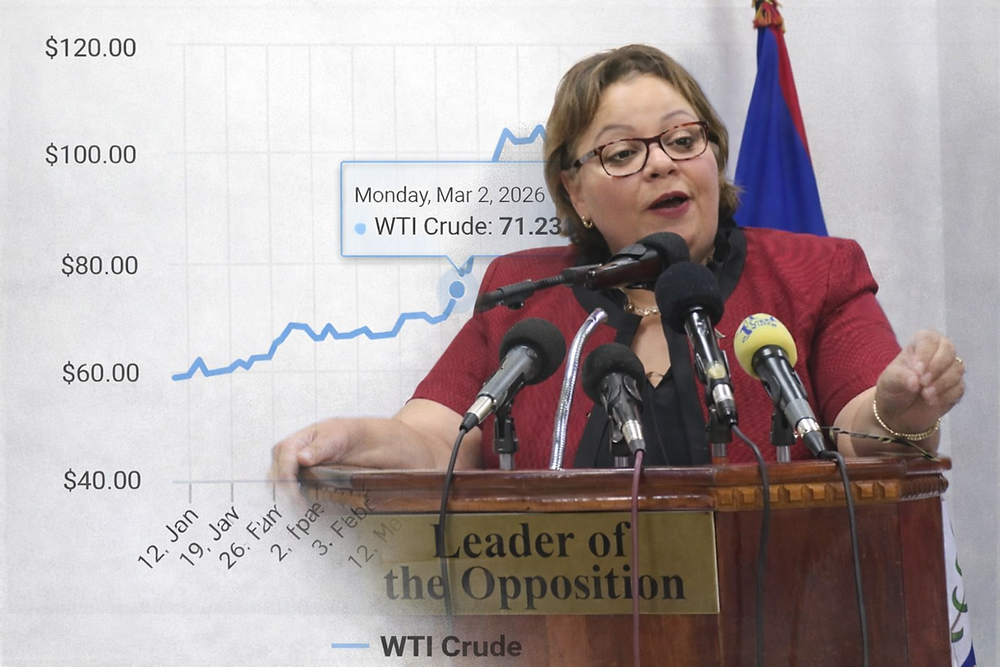
    Panton has contextualized the current crisis as the product of mounting global energy market instability, pointing to two major geopolitical flashpoints that have disrupted supply chains: escalating tensions in the critical Strait of Hormuz shipping lane and the escalating conflict involving the United States, Israel and Iran. These global shocks have sent international crude prices skyrocketing in recent weeks: official market data shows West Texas Intermediate (WTI) crude climbed to $98.57 per barrel on April 9, marking a nearly 40% jump from the $71.23 per barrel recorded at the start of March, a surge that unfolded over just five weeks.

    The opposition leader warns that the ripple effects of these fuel price increases are already spreading across every corner of Belize’s domestic economy. Higher fuel costs have directly pushed up transportation fares, grocery prices and operational overheads for small businesses and key productive industries. Panton emphasizes that the government’s failure to implement any temporary tax cuts, fuel subsidies, or targeted financial support has placed an unfair, overwhelming burden on the country’s lowest-income households and most vulnerable populations.

    To back up its call for action, the opposition points to the government’s own previous response to economic crisis during the COVID-19 pandemic. At that time, the administration rolled out broad fiscal interventions and targeted social support programs to protect household incomes and prevent widespread economic collapse. Panton argues that the current fuel crisis demands a similarly bold, targeted policy response to shield the public from market volatility.

    As the primary opposition United Democratic Party’s parliamentary caucus pushes for concrete steps including a full review of domestic fuel taxation and the launch of targeted relief mechanisms to soften the blow for affected groups, the Belizean government has yet to release any public announcement of planned interventions to address the rising cost of fuel.

  • Banreservas Cultural Center opens exhibition featuring unpublished works by Minerva Mirabal

    Banreservas Cultural Center opens exhibition featuring unpublished works by Minerva Mirabal

    SANTIAGO — A landmark new exhibition showcasing never-before-seen creative works from Dominican revolutionary icon Minerva Mirabal has opened its doors to the public, launched jointly by the Banreservas Santiago Cultural Center and the Mirabal Sisters Foundation to mark 100 years since Mirabal’s birth. Titled “A Century: The Artistic Dimension of Minerva Mirabal,” the show pulls back the curtain on a little-documented side of the national heroine, inviting visitors to engage with her legacy beyond her renowned political activism.

    The exhibition’s collection spans a range of mediums: intimate personal photographs, hand-executed paintings, and textured sculptural works that explore Mirabal’s artistic sensibilities. Across landscapes, formal portraits, and everyday genre scenes, the displayed pieces demonstrate Mirabal’s experimentation across multiple artistic movements, from the soft color palettes of Impressionism to the bold experimental forms of abstract art.

    For event organizers, the exhibition serves a dual purpose: it stands as a heartfelt tribute not only to Minerva, but to all four Mirabal sisters — Patria, María Teresa, and Dedé, who alongside Minerva became iconic symbols of resistance against dictatorship in the Dominican Republic — and creates a rare public space to recognize Minerva’s long-overlooked identity as a creative producer.

    Curated by established art scholar Guadalupe Casasnovas, the show pairs 16 original works created by Minerva Mirabal with nine additional pieces from contemporary and fellow Dominican artists, creating context that connects Mirabal’s creative practice to the broader Dominican art ecosystem. The exhibition is hosted at the Banreservas Santiago Cultural Center, housed in the historic former Hotel Mercedes building, and will run for public viewing through June 5 of this year.

  • Monitoring of the Reform of public finances and economic governance in Haiti

    Monitoring of the Reform of public finances and economic governance in Haiti

    Against the backdrop of over 20 years of incremental but uneven efforts to overhaul Haiti’s public financial and economic management systems, a high-stakes working session was convened this week to assess progress, address persistent bottlenecks, and map out the next phase of reform. Hosted by Sandra Paulemon, Haiti’s Minister of Planning and External Cooperation, the gathering brought together senior members of the country’s Commission for Public Finance Reform and Economic Governance (CRFP-GE) to align stakeholders around a renewed push for systemic change.

    Opening the session, CRFP-GE coordinator Charles Cadet offered a retrospective on the decades-long reform trajectory that Haiti has pursued in the public finance and economic governance space. He walked attendees through the commission’s core priority areas, and summarized the outcomes of years of implementation efforts, which he characterized as mixed — acknowledging incremental gains while noting major unmet goals that have held back broader progress.

    Much of the session was dedicated to technical, in-depth discussions centered on the reform initiative’s six foundational pillars. These pillars cover critical domains of public financial management: boosting domestic revenue mobilization to reduce reliance on external funding; upgrading integrated systems for statistics collection, strategic planning, program development, and public budgeting; modernizing public treasury operations and standardizing public accounting practices; strengthening governance and oversight of local public finances; enhancing regulatory control, increasing government transparency, and expanding anti-corruption enforcement; and advancing the development of the national State Finance Information System.

    In addition to progress updates on each pillar, technical leads outlined an ongoing comprehensive review of the entire national reform strategy, a process that is being carried out with targeted technical and financial support from the European Union. This review is intended to address existing gaps in the current framework and align the reform agenda with Haiti’s pressing economic and governance challenges.

    In her closing remarks to the working group, Minister Paulemon outlined clear expectations for accelerated, tangible outcomes from the reform process. She emphasized that a well-defined, structured, and impact-focused action plan is non-negotiable for driving meaningful change, and called for far stronger coordination across all public and private stakeholders involved in the initiative.

    Paulemon specifically advocated for improved synchronization across all public institutions that play a role in public finance management, stressing that systemic reform depends on enhanced connectivity and interoperability between agency systems and workflows. “Sustainable, long-lasting results from this reform simply cannot be achieved without effective alignment across all actors,” she noted, pushing for the creation of integrated institutional mechanisms that streamline information sharing, unify policy action, and create a more cohesive, harmonized governance framework for Haiti’s entire public finance system.

    The working session concluded with concrete next steps to advance the reform agenda, most notably the announcement that the first statutory meeting of the reform’s Strategic Steering Committee (COPIL) will be held in the near term to formalize the revised strategy and approve the new action plan.

  • Oversight Funding Climbs, But Share Remains Thin

    Oversight Funding Climbs, But Share Remains Thin

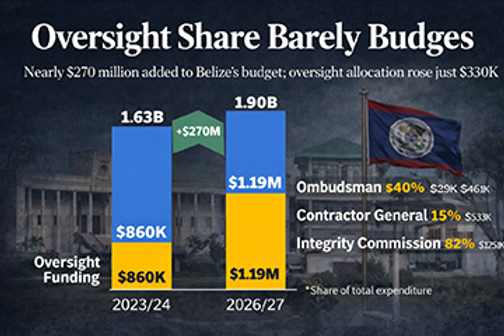
    Over the four-fiscal-year period spanning 2023/24 to 2026/27, Belize’s total government expenditure is set to grow by nearly $270 million. However, the three core institutions that form the backbone of the country’s legislative oversight framework have secured only a marginal combined budget increase that barely moves the needle on their share of overall public spending, new budget data confirms.

    Under the recently approved 2026/27 national budget, the Office of the Ombudsman, the Office of the Contractor General, and the Integrity Commission will collectively receive $1,190,825 in public funding. This marks a $330,399 rise from their combined 2023/24 allocation of $860,426. For comparison, total government spending over the same window will climb from $1.633 billion to $1.903 billion, a total increase of approximately $269.5 million.

    As a result of the uneven growth, the combined share of total public expenditure allocated to the three oversight bodies has only inched up from 0.053 percent to 0.063 percent – a gain of just 0.010 percentage points across four years. While the nominal budget for the three offices has risen by roughly 38 percent, their proportional footprint in Belize’s overall government budget has not seen any meaningful expansion, highlighting the limited priority given to oversight spending in the country’s medium-term fiscal planning.

    A breakdown of individual allocations shows uneven growth across the three institutions. The Integrity Commission, which leads in overall growth, will see its budget jump from $179,073 in 2023/24 to $325,222 in 2026/27 – an $146,149 increase that equals roughly 82 percent nominal growth. This single office accounts for more than 44 percent of the total combined budget increase for all three oversight bodies.

    The Office of the Ombudsman follows, with its allocation growing from $328,631 to $461,446 – a $132,815, or 40 percent, nominal increase. The smallest growth by far goes to the Office of the Contractor General, which will see its budget rise by just $51,435 (15 percent), from $352,722 to $404,157. When added together, these adjustments sum to the total $330,399 increase across all three oversight institutions.

    Each of these three bodies plays a non-substitutable role in upholding governmental accountability and transparency in Belize. The Ombudsman’s core mandate is to investigate complaints submitted by ordinary citizens who claim they have faced abuse, unfair treatment, or improper conduct from public authorities. It acts as an independent channel for residents to challenge state administrative actions and secure impartial review of official behavior.

    The critical nature of this role was highlighted in a high-profile case from last year. Public-interest litigant Jerry Enriquez turned to the Ombudsman for support after the Attorney General’s Ministry denied his Freedom of Information Act request. After the Attorney General challenged the Ombudsman’s involvement, the case moved to appellate courts. The existing process demonstrates the gap in accountability that would exist without the Ombudsman’s function, as any halt to its work would leave citizen-led oversight of public administration stalled.

    The Office of the Contractor General fulfills a separate but equally critical public duty: it oversees all government contracting and public procurement processes, working to ensure public bids are awarded fairly and that taxpayer funds used in contracts are spent openly and appropriately. In a governance landscape where public contracts often involve multi-million dollar sums and far-reaching policy impacts, this office acts as a key bulwark against procurement irregularities and opaque decision-making.

    For its part, the Integrity Commission is tasked with monitoring mandatory financial disclosures from all elected and senior public officials. Its core goal is to identify cases where public servants have accumulated wealth that cannot be reasonably accounted for by legitimate income or publicly declared assets. By mandating and reviewing these disclosures, the commission forms a central pillar of Belize’s national anti-corruption framework.

    These budget figures raise urgent broader questions about Belize’s commitment to public accountability. Despite all three institutions being central to upholding governmental accountability, ethical public conduct, and transparent procurement, their combined funding still makes up less than one-tenth of one percent of total national expenditure. Even as overall public spending grows by hundreds of millions of dollars over the four-year period, the 0.063 percent share allocated to these oversight bodies in the 2026/27 budget falls far short of what would match the critical importance of their mandates for building public trust, ensuring administrative fairness, and upholding government transparency.

  • Hormuz slowdown signals prolonged pressure on fuel prices

    Hormuz slowdown signals prolonged pressure on fuel prices

    Nearly a week after a regional ceasefire was announced to de-escalate tensions around the Strait of Hormuz, one of the world’s most critical energy chokepoints, global oil and gas shipments through the waterway have failed to stage any meaningful recovery. Shipping data collected in the first full day after the ceasefire went into effect paints a stark picture of ongoing disruption: just one oil products tanker and five dry bulk vessels completed transits through the corridor, a dramatic drop from the typical daily average of 140 vessels.

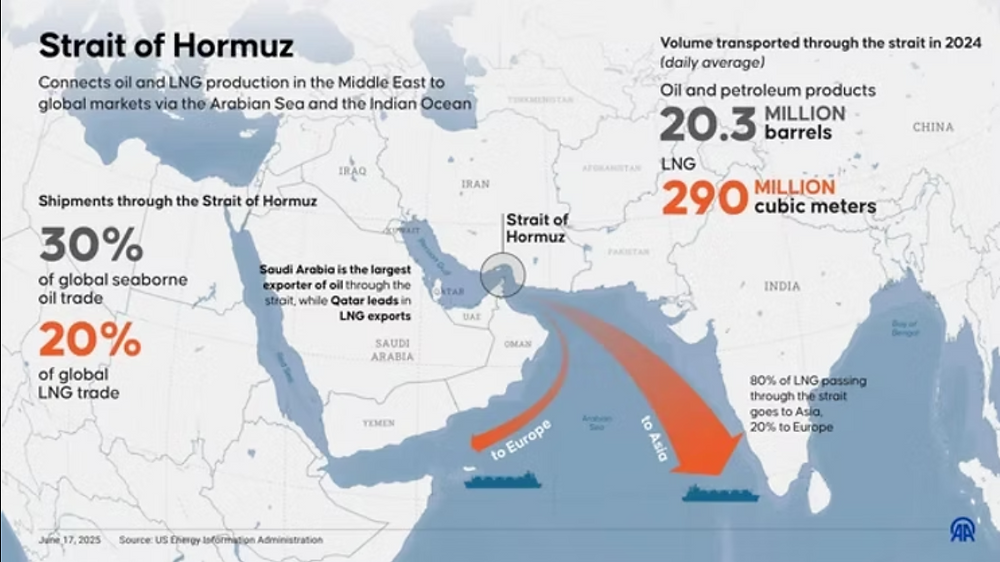
    The strategic strait handles roughly 20% of the world’s total daily shipments of oil and liquefied natural gas, making even minor disruptions to its operation ripples across global energy markets. The massive gap between pre-crisis traffic volumes and current activity underlines a key reality: formal diplomatic announcements of de-escalation have not yet translated into the large-scale resumption of energy supply movement that markets have been waiting for.

    Ongoing geopolitical uncertainty is the primary driver of the continued slowdown. Iran has retained strict oversight and restrictions on vessel passage, pointing to unresolved tensions stemming from ongoing Israeli military operations in Lebanon. This de facto bottleneck has been maintained even as formal ceasefire agreements have been announced, keeping global energy supply constrained against a backdrop of tentative diplomatic progress.

    The economic fallout of this disruption hits small, import-reliant open economies like Belize hardest. Unlike larger industrialized nations with strategic reserves and more diversified supply chains, Belize’s domestic fuel prices are directly tied to global benchmark pricing, which reacts not just to current supply levels but also to market expectations of future disruption. When a critical energy artery like the Strait of Hormuz operates at less than 10% of its normal capacity, markets price in inherent supply scarcity, which has already contributed to a sharp recent uptick in global crude prices.

    The scale of the current disruption cannot be overstated. A collapse from 140 daily transits to fewer than 10 effectively brings activity at the chokepoint to a near standstill. Even if the disruption proves temporary, the sudden contraction has injected significant volatility into global energy supply chains, throwing off shipping schedules, reducing consistent inputs for refineries worldwide, and putting sustained upward pressure on retail fuel prices.

    For Belize, where nearly every core sector of the domestic economy relies on imported fuel, the shock propagates rapidly. Higher global crude prices translate immediately to increased prices at the pump, which in turn push up costs for public and private transportation, electricity generation, food distribution, and nearly every goods and service across the country. The knock-on effects can quickly erode household purchasing power and strain small business operations.

    The slow pace of traffic resumption also suggests that price pressures may last longer than initially hoped by many market observers. Until vessel transits return to near-normal, consistent volumes, global energy markets will remain hypersensitive to any new development in the region. While ceasefire announcements and diplomatic negotiations can trigger temporary dips in oil prices, sustained market stabilization and normalization will only come when the secure, unimpeded passage of energy shipments through the strait is fully restored.