作者: admin

  • From Cuba, to T&T then Venezuela

    From Cuba, to T&T then Venezuela

    A Hong Kong-flagged fuel tanker at the center of Caribbean energy tensions has undertaken another unexpected diversion, now heading toward Venezuela after initially changing course from Cuba to Trinidad and Tobago. Maritime tracking data from MarineTraffic indicates the Sea Horse oil/chemical tanker is scheduled to arrive at Puerto Cabello on March 23rd at 4:30 p.m., marking the latest development in a complex geopolitical energy saga.

    The vessel’s redirection comes amid a severe energy crisis in Cuba that culminated in a nationwide blackout lasting over 29 hours beginning March 16th. Although Cuban authorities managed to restore power grid connectivity and reactivate the country’s largest thermal electricity plant by Tuesday, officials warned that continued U.S. restrictions on fuel supplies could trigger further outages.

    According to maritime intelligence reports, the Sea Horse loaded its diesel cargo earlier this year through a ship-to-ship transfer in the Mediterranean before sailing toward the Caribbean. The Russian-origin fuel had been idling in the Atlantic Ocean since late February, creating a floating storage scenario that reflects the complexities of global energy logistics under sanctions regimes.

    The U.S. Treasury Department recently revised previously issued waivers covering sales of Russian-origin petroleum products, specifically excluding transactions involving North Korea, Cuba, and Crimea. This policy adjustment occurs as the Trump administration attempts to balance containing rising crude and gasoline prices amid Middle East conflicts while maintaining pressure on Cuba’s Communist government by restricting oil supplies to private entities only.

    Meanwhile, Russia’s state-run TASS news agency reported that Moscow is engaged in discussions with Havana regarding potential aid options, though specific details remain undisclosed. Cuba’s energy infrastructure remains critically dependent on imported fuel oil and diesel for electricity generation, with the country having received only two tankers carrying imported oil cargoes so far this year according to LSEG data.

    The situation has created a severe gasoline shortage in Cuba, with sales strictly rationed and black market prices reaching approximately $8 per liter—six times the official government rate. Attempts to reach Trinidad and Tobago’s Energy Minister Dr. Roodal Moonilal and Works and Infrastructure Minister Jearlean John for commentary on the tanker’s diversion were unsuccessful.

  • Cuba kampt met water- en energiecrisis; Rusland start olietransport

    Cuba kampt met water- en energiecrisis; Rusland start olietransport

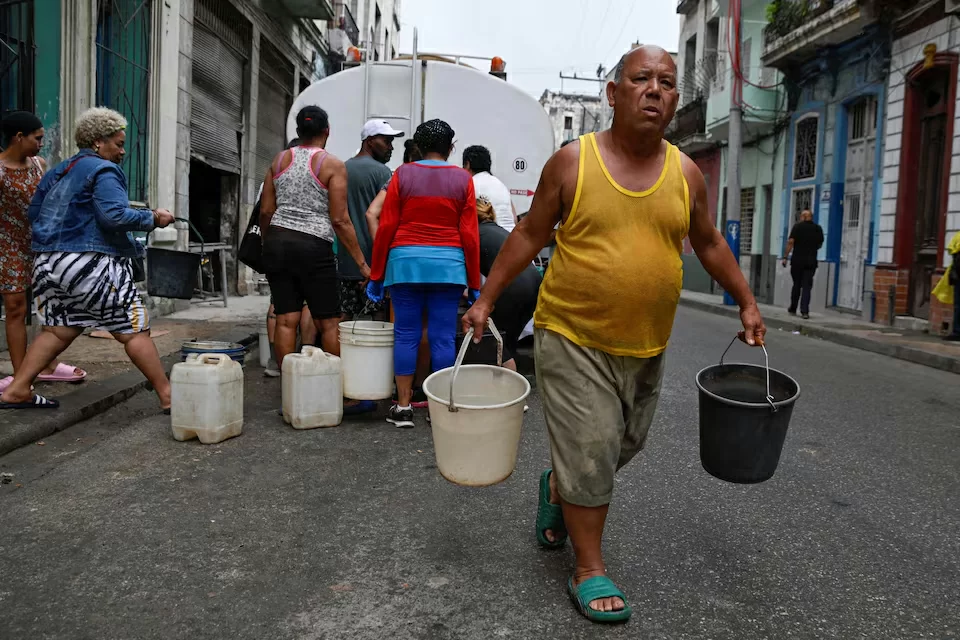
    Havana residents are enduring extreme water shortages as severe fuel deficits and electrical grid instability cripple the Cuban capital’s water distribution networks. Citizens wait in extensive lines to collect water from tanker trucks, with thousands of households left without running water due to paralyzed pumping systems.

    The state water company Aguas de La Habana confirms that power outages, directly linked to fuel shortages, have disrupted pumping schedules. “Without oil imports, electricity generation halts and the pumping systems fail,” explained resident Lazaro Noblet. This crisis is not new—many Cubans have faced persistent water shortages since 2021. Individuals like Maria de Jesus Rusindo must carry heavy water containers to meet basic family needs.

    This energy and water emergency follows intensified U.S. economic pressure. After the arrest of Venezuelan President Nicolás Maduro—Cuba’s key ally and oil supplier—in January, Washington drastically reduced oil shipments to Cuba and threatened sanctions against other nations supplying fuel to the island. This ‘maximum pressure’ campaign has triggered severe power failures, including a recent nationwide blackout.

    In response, Mexico has initiated a humanitarian aid operation, dispatching boats loaded with food, medicine, and essential supplies from its southeastern ports to Cuba. Mexican President Claudia Sheinbaum emphasized national sovereignty and Cubans’ right to self-determination without foreign interference.

    Cuban President Miguel Díaz-Canel expressed gratitude for international support, calling it ‘warm solidarity.’ However, the government firmly denies any willingness to make political concessions, including Díaz-Canel’s resignation, despite speculation that the U.S. seeks such outcomes.

    A significant recent development is Russia’s commencement of oil shipments to Cuba to alleviate acute fuel shortages. As a Cuban ally, Russia may provide temporary relief, yet energy warnings and critical water shortages persist.

    Cuba’s aging energy infrastructure remains heavily reliant on fossil fuels. Long-term challenges are exacerbated by the longstanding U.S. embargo, dating to the Cold War, and internal economic mismanagement.

    Díaz-Canel accuses the U.S. of waging ‘economic warfare’ aimed at forcing a violent regime change and warns that foreign intervention will be met with fierce resistance.

  • The country consolidates its position as a strategic partner of the U.S. at the Miami Security Forum

    The country consolidates its position as a strategic partner of the U.S. at the Miami Security Forum

    At the inaugural Miami Security Forum hosted by the Heritage Foundation, Dominican Interior and Police Minister Faride Raful delivered a comprehensive address on her nation’s remarkable security achievements and regional cooperation efforts. Representing President Luis Abinader at the Trump National Doral venue, Raful presented compelling data showing the Dominican Republic’s homicide rate plummeted to a historic low of 8.15 per 100,000 inhabitants in 2025—marking a substantial 15% reduction from 2024 figures.

    This dramatic improvement positions the Caribbean nation as the second safest country throughout Central America and the Caribbean region. Minister Raful attributed this success to three key strategic initiatives: evidence-based management through the Citizen Security Data Analysis Center, the significant expansion of police forces with 9,503 new officers, and comprehensive institutional reforms currently under legislative consideration in the Senate.

    The minister further highlighted extraordinary progress in combating drug trafficking, revealing that narcotics seizures have increased fivefold since 2019, reaching an impressive 48.3 metric tons in 2025. On economic matters, Raful emphasized the robust trade relationship with the United States, which surpassed $18.9 billion, complemented by substantial diaspora remittances exceeding $11.8 billion.

    Beyond bilateral relations, the forum facilitated crucial regional discussions. Minister Raful engaged in substantive dialogue with Puerto Rico Governor Jenniffer González Colón regarding Caribbean security modernization and coordinated crime prevention strategies. The minister also addressed the ongoing Haitian crisis, characterizing it as a hemispheric challenge demanding collective international response rather than isolated national solutions.

  • Boek over oorsprong schaafijs gepresenteerd in Tori Oso

    Boek over oorsprong schaafijs gepresenteerd in Tori Oso

    PARAMARIBO – In a culturally significant event at the well-attended Tori Oso venue, illustrator Hedy Tjin and writer Zindzi Zevenbergen officially launched their award-winning children’s book “Manie Schaafijs” in Suriname on Wednesday evening. The work creatively documents the little-known story of how Tjin’s great-grandfather, Francisco de Freitas, introduced shaved ice desserts to Surinamese culture generations ago.

    The publication event, organized in collaboration with Schrijversgroep ’77, featured insightful discussions about the production process and live readings from the book. Distinguished attendees included John Dos Ramos, president of MadeiSu (Association of Madeiran Descendants in Suriname), historian Mildred Caprino, and Winston Tjin—grandson of the historical figure Manie Schaafijs and father of illustrator Hedy Tjin.

    Tjin expressed emotional significance in finally presenting the book in her family’s homeland. “When publishing a book, you never know how it will resonate. We released this three years ago, yet educational demand continues to surprise us,” she noted during the thematic evening.

    Zevenbergen, returning to Suriname after two decades, shared how the creative process reignited her connection to the country. “This project made me reconsider why I stayed away so long. The recognition of cultural elements here creates a different reading experience than in the Netherlands.”

    The authors emphasized their primary goal of reaching young readers, with school visits already planned. Through Stichting Skrifi, a children’s book writing workshop will further promote cultural storytelling. The literary visit received support from Literatuur Vlaanderen.

    Historically, the book fills a gap in Surinamese narrative tradition by highlighting Madeiran immigration history beyond dominant slavery narratives. Its previous recognition includes the prestigious Thea Beckmanprijs for best historical youth literature in the Netherlands.

  • Principal highlights inclusive education progress at Grantley Adams Memorial School

    Principal highlights inclusive education progress at Grantley Adams Memorial School

    The Grantley Adams Memorial School in St Joseph is receiving acclaim for its transformative approach to inclusive education, with Principal Major Andrew Skeete highlighting the institution’s successful restructuring of its educational framework. During a recent visit by Dr. Nwachukwu Anakwenze, Regent of Igboland, school officials detailed their pioneering educational model that has reshaped student development strategies at the 70-year-old institution.

    The school’s educational philosophy centers on creating adaptable learning environments that accommodate diverse learning abilities and needs. “We have established ourselves as an institution committed to inclusive education, with particular emphasis on special education requirements,” Skeete explained. The curriculum has been intentionally designed to permit students to advance according to their individual learning paces while maintaining academic rigor.

    Core academic requirements include English, Mathematics, Social Studies, Integrated Science, and computer-based subjects, regardless of certification pathways. This foundational approach enables students to pursue various qualification routes including CSEC, CCSLC, or City and Guilds certifications based on their individual strengths and capabilities.

    Academic results demonstrate the effectiveness of this approach, with alternative certification tracks consistently achieving pass rates between 60-80 percent. While CSEC outcomes remain an area targeted for improvement, the school’s overall academic performance shows steady enhancement across all programs.

    Beyond classroom instruction, the institution provides comprehensive student support through partnerships with external agencies. These collaborations offer wraparound services including counseling and national programs specifically designed for at-risk youth. “We recognize our students’ diverse needs and provide multifaceted support systems,” Skeete emphasized.

    The school has also witnessed remarkable growth in extracurricular engagement. For the first time in recent history, the institution has successfully fielded complete teams for football, basketball, cricket, and cross-country competitions. Athletic achievements include notable performances at the Barbados Secondary Schools’ Athletic Championships (BSSAC), where male students secured sixth position and female students achieved eighth place in their respective categories.

    Cultural education forms another critical component of the school’s holistic development approach. Ongoing initiatives focus on instilling awareness of African heritage and building cultural pride among students. “We strive to educate our students about their royal heritage and cultural identity,” Skeete noted, referencing recent discussions with visiting dignitaries.

    Practical skill development receives significant emphasis through innovative programs like the cafeteria work initiative. Students participate in formal application processes submitting CVs and required documentation, followed by scheduled work assignments with actual compensation. This program provides valuable real-world experience and professional skill development.

    While celebrating these achievements, school leadership acknowledges ongoing opportunities for improvement. “We believe we can further enhance our outcomes,” Skeete stated, reaffirming the institution’s commitment to continuous advancement.

    The school will highlight its cultural programming with an African Day fair celebration on March 31, positioning Grantley Adams as one of the few educational institutions hosting such an event.

  • Vrachtkosten stijgen: extra toeslagen raken Surinaamse exportsectoren

    Vrachtkosten stijgen: extra toeslagen raken Surinaamse exportsectoren

    Rising geopolitical instability in the Middle East has catalyzed a chain reaction across global logistics networks, with maritime and air freight carriers implementing emergency surcharges that threaten export-dependent economies. Suriname’s seafood industry now faces the materialization of its worst-case scenario as transportation costs escalate dramatically.

    International logistics corporations are rapidly deploying new financial mechanisms to offset operational risks. Air France KLM Martinair Cargo has announced a War Risk Other Charge, scheduled for further increases by late March. This surcharge directly responds to diverted flight paths, soaring fuel prices, and heightened operational expenditures.

    Simultaneously, cargo carrier Amerijet instituted a Fuel Escalation Fee effective March 23rd, adding $0.04 per kilogram for standard shipments and $0.02 for perishables. This levy supplements existing fuel charges and applies specifically to shipments originating from the Caribbean and South America.

    The maritime sector mirrors these developments, with shipping companies passing along additional costs driven by volatile fuel markets and intensified international uncertainty.

    Udo Karg, President of the Suriname Seafood Association, confirms the industry’s fears have become reality. ‘What the fisheries sector feared has already begun this week. First the shipping companies, and now aviation,’ Karg told Starnieuws. He emphasized the disproportionate impact on smaller economies: ‘Major nations like Japan and EU states maintain reserves to buffer such developments, but countries like ours must improvise coping strategies.’

    While transport firms characterize these measures as temporary and contingent on global developments, Surinamese entrepreneurs anticipate severe consequences for their export competitiveness. The fisheries sector—a critical component of the nation’s economy—faces particular vulnerability to these logistics cost inflations that could reshape trade dynamics in the region.

  • Firefighters tackle late-night blaze at old Massy building in Pierhead

    Firefighters tackle late-night blaze at old Massy building in Pierhead

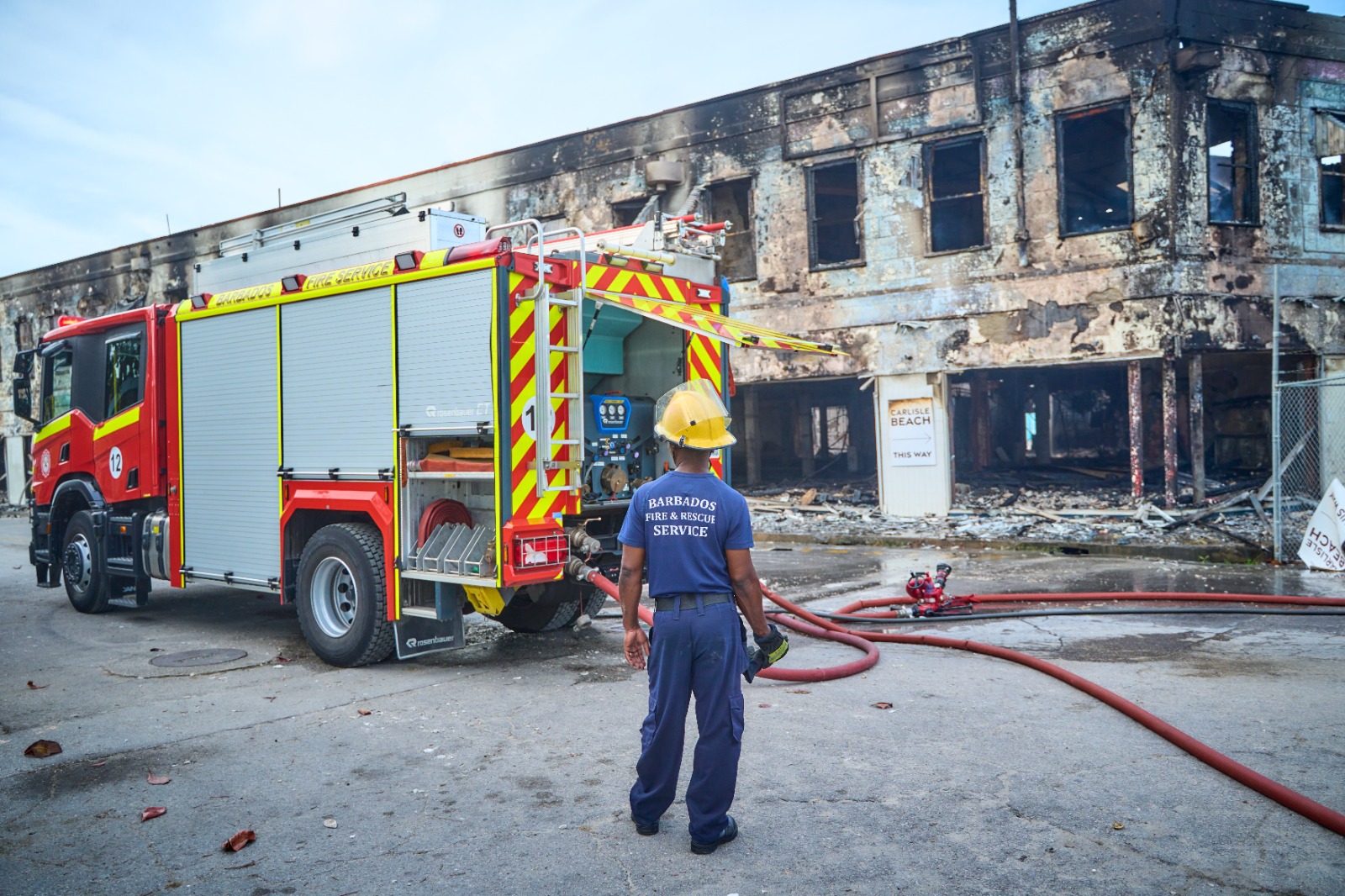
    A devastating fire engulfed the historic Massy building at Bridgetown’s Pierhead late Thursday, triggering a massive emergency response that continued through Friday morning. Firefighters successfully rescued two individuals from the burning structure while battling to prevent the aged limestone building’s complete collapse.

    The blaze, first reported at 11:41 PM, required a coordinated effort from multiple fire stations. Station Officer Roger Bourne confirmed that sixteen fire officers responded to the emergency, with crews from Bridgetown Port Station, Bridgetown Fire Station, and Worthing Fire Station supported by Tanker One. The fire was officially brought under control by 4:08 AM Friday, though crews remained on scene extinguishing persistent hotspots.

    Bourne emphasized the structural dangers posed by the intense heat on the soft stone construction. “We have cordoned off the area because it’s an old soft stone building and we want to protect the public from imminent collapse,” he stated, explaining the ongoing safety measures.

    The two individuals rescued from the building included one who left the scene independently and a 63-year-old man who required ambulance transport to hospital for treatment. No injuries were reported among emergency responders.

    The building, which previously housed the original Manning, Wilkinson and Challenor dry goods and hardware store before becoming a Massy Stores branch, held significant historical value in the area.

    In a related development, developers of the nearby Pierhead Project construction site confirmed their property sustained no damage from the adjacent blaze. In an official statement, they expressed relief that their site remained unaffected while extending wishes for the recovery of those hospitalized. The developers additionally praised emergency services for their rapid response to the dangerous situation.

  • Tripartite Agreement : Master’s Degree in Land Use Planning

    Tripartite Agreement : Master’s Degree in Land Use Planning

    In a significant move to address urban planning challenges, Haiti’s Ministry of the Interior and Territorial Communities (MICT) has forged a strategic alliance with the National Federation of Mayors of Haiti (FENAMH) and the University of Technology of Haiti (UNITECH). The partnership, formalized through a memorandum of understanding signed this week at the Ministry headquarters, establishes a specialized graduate program in spatial planning.

    The agreement will fund ten professionals—including local authorities, territorial staff, and MICT managers—through a two-year Master’s degree program. The curriculum, developed through an academic partnership between UNITECH and Canada’s University of Quebec at Chicoutimi, will culminate in an internationally recognized qualification.

    This initiative directly addresses critical capacity gaps in local development expertise across Haitian territories. The program aims to equip officials with technical skills to implement effective public policies for population distribution, infrastructure planning, and territorial organization. Beyond immediate training objectives, the partnership seeks to build sustainable technical capacity within local governments for long-term land management solutions.

    During the signing ceremony, UNITECH Rector Dr. Josselin Val emphasized the program’s transformative potential: ‘This agreement provides local government employees with tools for rational land use planning, enabling them to develop structured proposals that improve population living standards and balanced development.’

    Fernandel Georges, representing FENAMH, committed the mayors’ federation to active participation throughout the partnership, urging collaborators to develop model programs that build reliable skills for harmonious community development.

    Interior Minister Paul Antoine Bien-Aimé endorsed the program’s quality and challenged selected candidates to maximize their learning opportunity. He emphasized that their training should ultimately contribute to reducing spatial inequalities, anticipating demographic changes, and improving access to basic services for local communities.

  • Sprinters Nurse and Brewster chasing history

    Sprinters Nurse and Brewster chasing history

    In a display of emerging track and field excellence, young Barbadian athletes Aniya Nurse and Jahkye Brewster are redefining sprint standards while pursuing legendary milestones at the Barbados Secondary Schools Athletic Championships (BSSAC).

    Aniya Nurse, representing St Michael School, delivered an electrifying performance during the Dasani Frank Blackman and Sada Williams zone competitions that initially appeared to shatter one of Barbados’ most enduring athletic records. The rising star clocked a remarkable 11.41 seconds in the Under-20 girls’ 100m event, seemingly surpassing Yolande Straughn’s 41-year-old record of 11.64 seconds established in 1985. However, the exceptional time was ultimately invalidated due to an excessive tailwind measuring 5.4m/s, significantly exceeding the legal limit of 2.0m/s.

    Despite this setback, Nurse’s 2026 season has demonstrated consistent excellence with repeated performances in the 11.5-second range, including an official personal best of 11.53 seconds. The versatile athlete further showcased her capabilities by establishing a new zonal record in the 200m with a dominant time of 24.03 seconds during the championship’s final day.

    In exclusive comments to Barbados TODAY, Nurse revealed her ambitious objectives: “My races so far have been pretty good. I really wanted to focus on execution and form, and I believe I achieved that. My goals for BSSAC this year are to finish healthy and to break the 100m record.” Her aspirations extend beyond national competitions to include medal contention at the upcoming CARIFTA Games and ultimately competing at the World Under-20 Championships and Olympic level.

    Parallel achievements emerged in the boys’ division where Jahkye Brewster of Lodge School has dominated Under-20 sprint events. Training under coaches Glen Williams and Juquan Beckles at Extreme Velocity, Brewster has exhibited significant progression throughout the season, culminating in a personal best of 10.56 seconds at the AAB National Junior Championships.

    At the zonal level, Brewster commanded both sprint events, securing victories in the 100m (10.77 seconds) and 200m (22.00 seconds) with the fastest qualifying times. Following last year’s narrow miss at CARIFTA sprint finals, where he nonetheless contributed to Barbados’ bronze medal in the Under-17 boys’ 4x400m relay, Brewster now targets record-breaking performances and international recognition.

    The determined athlete stated: “I would really like to break the 200m record. The races I ran were satisfactory, though somewhat affected by wind conditions. This year at CARIFTA, I intend to reach the finals and earn a medal. My ultimate ambitions include becoming a professional athlete and competing in the Olympics.”

  • Exclusive: Student speaks of fear, uncertainty

    Exclusive: Student speaks of fear, uncertainty

    A deadly meningitis B outbreak at the University of Kent has triggered an exodus of international students, including several from Barbados, following two fatalities linked to the bacterial infection. Health authorities confirm 29 cases connected to the escalating outbreak, with 18 confirmed and 11 under investigation. Thirteen confirmed cases involve the particularly severe meningitis B strain, all requiring hospitalization.

    Barbados Chief Medical Officer Dr. Kenneth George advised citizens to maintain rigorous hand hygiene and ensure vaccination status is current, while emphasizing that the risk to the island nation remains low. Meningitis transmission occurs through respiratory droplets from coughing, sneezing, or close contact, often from asymptomatic carriers.

    First-year international business student Dent Thomas provided exclusive testimony to Barbados TODAY, describing a climate of fear on campus. The outbreak reportedly originated at Canterbury’s Chemistry nightclub on March 5th, though university administration delayed official communication until days later. “I knew about this outbreak from news sources before my own university,” Thomas expressed with evident disappointment.

    The Harrison College alumnus revealed that campus facilities have transformed into a “ghost town” as students rapidly depart. Several Barbadian students have already returned home or relocated within the UK, with Thomas himself planning evacuation to Spain. While authorities haven’t mandated evacuation, they’ve advised those capable of leaving to do so promptly.

    Medical officials note meningitis begins with flu-like symptoms but can rapidly progress to high fever, severe headache, light sensitivity, and neurological complications potentially resulting in coma or death. Survivors may experience permanent effects including memory impairment or vision loss.

    The UK Health Security Agency continues to monitor the situation daily as case numbers rise, providing regular updates on the developing public health response to the university cluster.