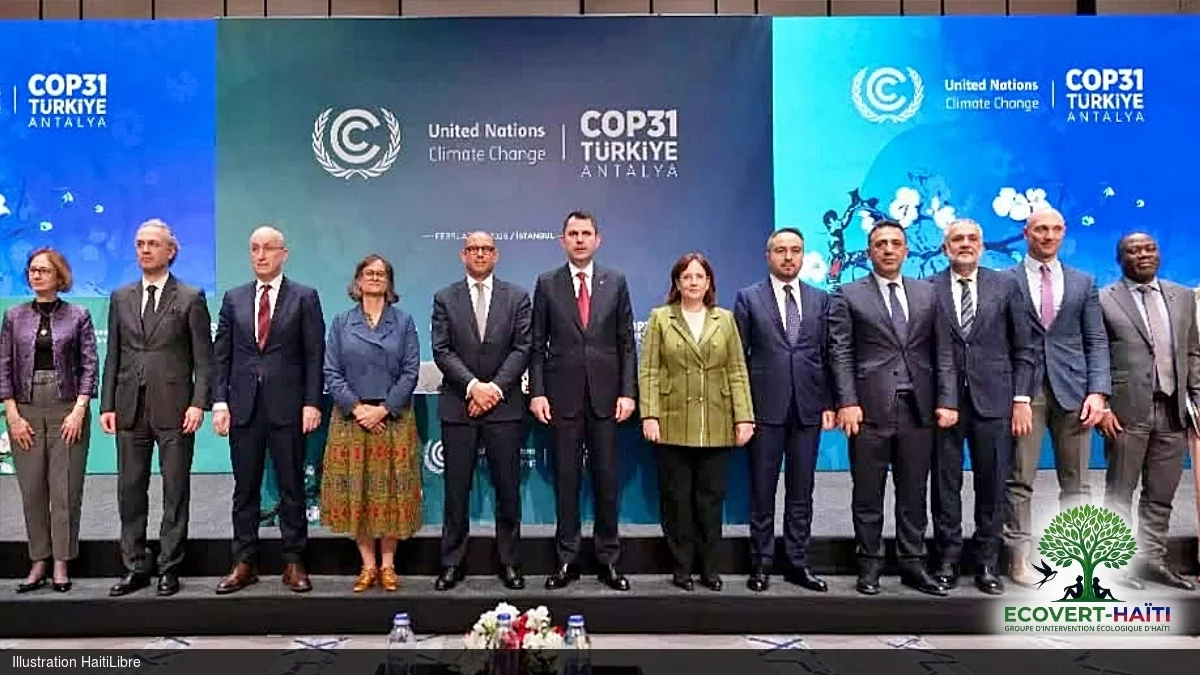
Port-au-Prince, November 28, 2026 — Leading Haitian environmental advocacy group Ecovert-Haïti has issued a formal public statement voicing profound dismay over the collapse of the 31st United Nations Climate Change Conference (COP31), which wrapped up in Antalya, Turkey, without a binding, consensus-driven political agreement to advance global decarbonization efforts. The breakdown of high-stakes multilateral negotiations was triggered by deep, intractable rifts between participating nations over the critical timeline for phasing out fossil fuels, as a bloc of countries rejected a late draft communiqué that omitted any explicit, binding references to curbing production and consumption of oil, gas, and coal. In its official communiqué, Ecovert-Haïti framed the failed summit outcome as a deeply troubling setback for global climate governance, arriving at a moment when leading climate research bodies have repeatedly sounded the alarm that accelerating planetary warming, more frequent and catastrophic extreme weather events, and the looming likelihood of crossing the 1.5°C warming threshold enshrined in the Paris Agreement are pushing vulnerable communities to breaking point. The organization emphasized that the lack of an ambitious, enforceable final agreement has severely undermined coordinated international action to mitigate the escalating climate emergency, noting that marginalized populations across the Global South are already enduring cascading harms from prolonged droughts, catastrophic flooding, powerful hurricanes, depleting freshwater reserves, and widespread food insecurity — crises that leave no room for further delays in rolling out policies to support a just global ecological transition. Ecovert-Haïti highlighted that fossil fuels remain the single largest contributor to global greenhouse gas emissions, stressing that any credible, science-aligned climate strategy must include unambiguous, quantifiable, and irreversible commitments to phase out fossil fuels and scale up renewable energy access. The group also drew sharp attention to Haiti’s uniquely precarious position as one of the world’s most climate-exposed nations, despite contributing less than 0.03% of total global greenhouse gas emissions. Already, Haitian communities are bearing the brunt of climate breakdown through a sharp surge in destructive hydrometeorological disasters, rapidly accelerating topsoil and coastal erosion, dwindling potable water supplies, widespread degradation of critical watershed ecosystems, and spiraling rates of food insecurity and extreme poverty. Against this backdrop, Ecovert-Haïti reaffirmed that climate justice must serve as the non-negotiable foundational principle of all future global climate negotiations, calling for drastically expanded, unblocked access to dedicated climate finance for low-income vulnerable nations to fund adaptation, build community resilience, and cover unmanageable loss and damage from climate impacts that can no longer be avoided. The organization further emphasized that the global climate crisis is fundamentally a global water crisis, noting that protecting underground aquifers, restoring degraded watersheds, implementing cross-sector integrated water resource management, building climate-resilient water infrastructure, and strengthening local institutional capacity to govern natural resources are non-negotiable strategic priorities for Haiti’s long-term environmental security and sustainable development. The group stressed that any meaningful, ambitious global climate policy must center the critical role of water in building territorial resilience and safeguarding at-risk populations. To prevent the COP31 failure from spiraling into a total collapse of global climate action, Ecovert-Haïti has issued a targeted call to action for all relevant stakeholders: national governments must revise and upgrade their national determined contributions to align with 1.5°C pathways, multilateral financial institutions must expand and simplify accessible financing mechanisms for climate adaptation, local and municipal authorities must embed climate resilience frameworks into all core public service policies, academic and research institutions alongside civil society groups must scale up public education campaigns and grassroots mobilization, and youth populations must sustain their longstanding advocacy for environmental protection and equitable sustainable development. “The failure of COP31 cannot be allowed to become the permanent failure of global climate action,” the organization stated in its closing remarks. “While top-tier multilateral governance continues to stall, vulnerable nations, local leaders, scientific communities, and civic groups must move forward in coordinated partnership to build climate-resilient communities, safeguard critical water resources, and speed up the just ecological transition. For Haitian people, the climate emergency is not a distant future risk — it is a daily lived reality that demands immediate, concrete, and collective action from every stakeholder.”