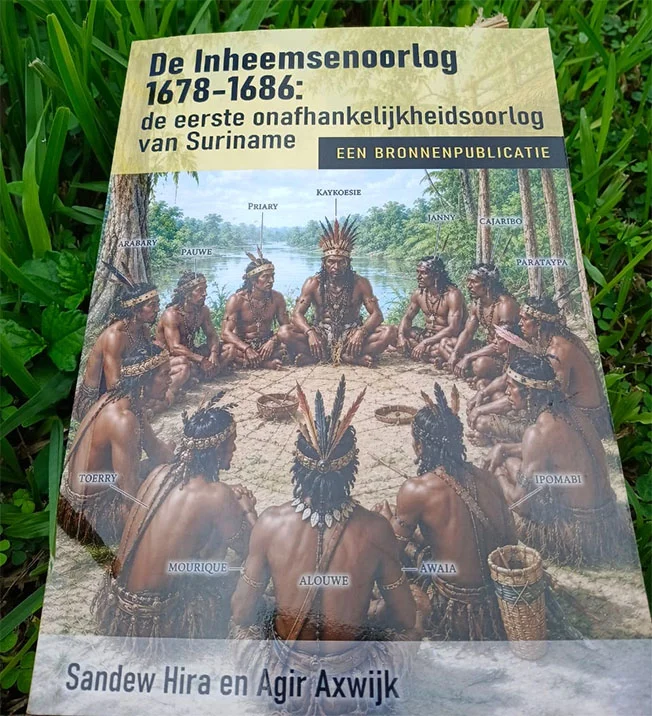
On November 24, leading Surinamese researchers and authors Sandew Hira and Agir Axwijk officially presented their newly published historical work *The Indigenous War 1678-1686: Suriname’s First War of Independence* to the Association of Indigenous Village Chiefs in Suriname (VIDS), a landmark milestone for centering long-overlooked Indigenous narratives in the country’s official historical record. Handed over just one day ahead of Suriname’s 49th independence anniversary on November 25, the publication documents a decades-long armed and social resistance movement waged by Suriname’s original Indigenous communities nearly 300 years before the nation formalized its separation from Dutch colonial rule in 1975, centering their centuries-long fight for sovereignty, territorial integrity, and collective self-determination that has been largely erased from mainstream history curricula for generations. During the official handover ceremony, VIDS Executive Director Cylene France, pictured flanked by the two authors at the event, emphasized that the new volume builds on years of collaborative work between Indigenous traditional leaders, community members, academic researchers, education specialists, and civil society groups to amplify the underrepresented histories and contributions of Suriname’s Indigenous populations. The organization frames access to this previously suppressed historical knowledge as a foundational pillar for strengthening Indigenous community cultural identity, upholding their collective legal and land rights, and constructing a far more inclusive, accurate account of Suriname’s full national heritage. Stakeholders at the event also mapped out concrete action plans to disseminate the book’s findings widely across the country: Hira and Axwijk have committed to hosting public lectures, community workshops, and educational outreach sessions to unpack the war’s historic significance, while VIDS is mobilizing targeted funding to distribute at least 60 free copies of the book to every Indigenous village across the nation. The partners also outlined plans to launch a broader oral history archiving project to record intergenerational stories passed down through Indigenous communities for centuries, filling critical gaps in existing formal historical archives. VIDS further highlighted that the text will serve as a vital educational resource for K-12 and university students as well as teaching staff, offering access to perspectives that have been systematically sidelined in standard Surinamese history textbooks for decades. Tying the launch to upcoming national preparations for Suriname’s 50th independence jubilee celebrations in 2026 (branded Srefidensi 2026, using the local Indigenous term for independence), VIDS called for a national cultural shift that makes space for every community’s narrative in the country’s shared origin story. “Suriname’s history did not begin in 1975, and it can never be fully told without centering the experiences of its original first inhabitants,” VIDS stated in an official release. “By bringing these long-hidden stories to light, we do not only honor the sacrifices of past generations: we build a more inclusive future where every single Suriname resident sees their own identity and heritage reflected in the nation’s shared public narrative.” The organization noted the new book is just one component of a long-running, sustained campaign to embed Indigenous histories, cultural knowledge, and centuries of community resilience as a core, respected component of mainstream Surinamese national consciousness.