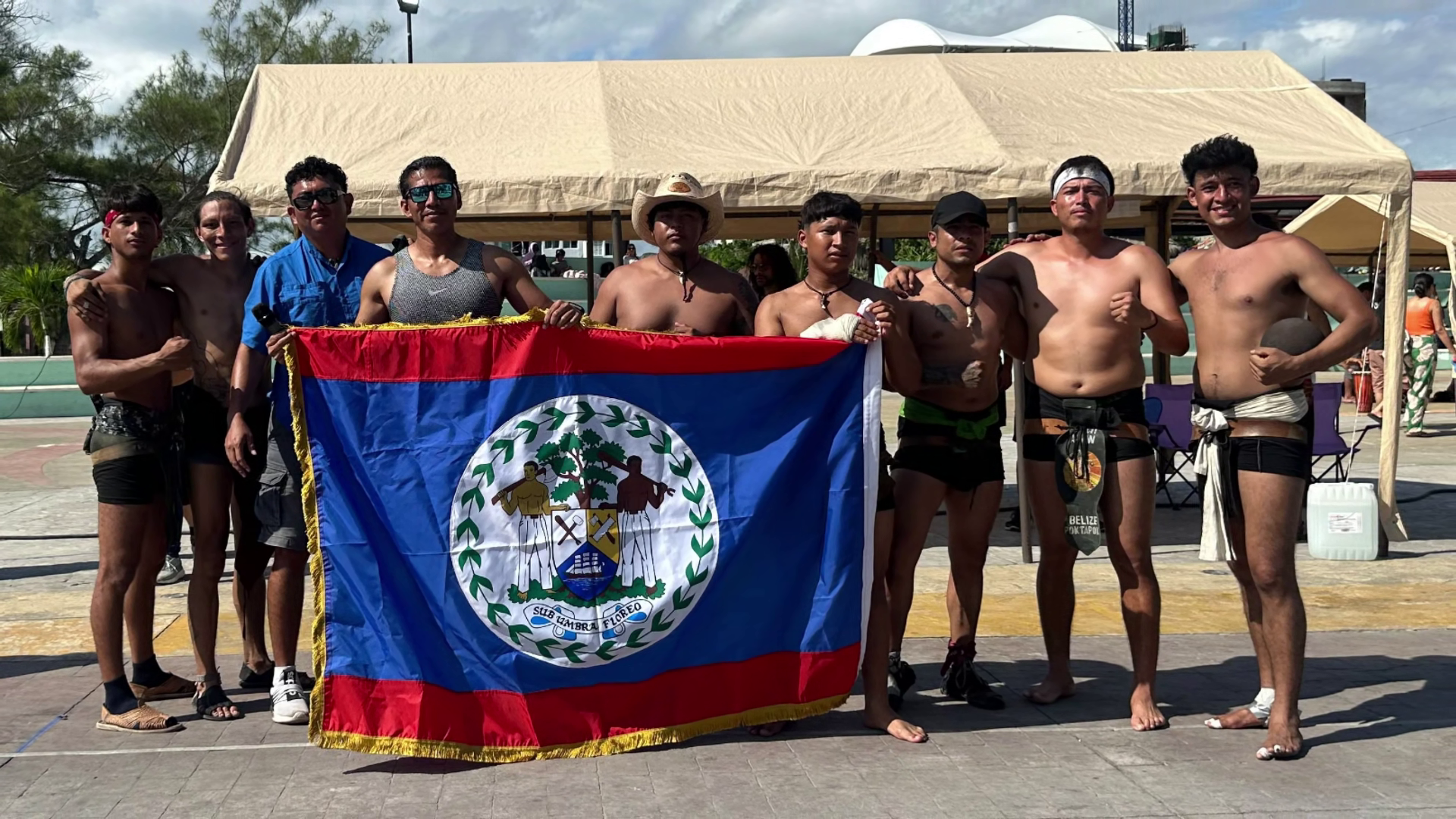
On November 23, 2026, Belize’s national ancient ballgame contingent, the eight-member Sak Xikim team, returned to their homeland as international champions after a grueling run at the 10th Mesoamerican Ballgame National Championship hosted in Mexico. While the squad has a long track record of success in traditional Pok Ta Pok, this year’s tournament pushed the athletes far outside their comfort zone: they competed in Ulama, a far more physically demanding iteration of the pre-Hispanic hip ball game that carries distinct rules and skill requirements.
Going head-to-head against elite Ulama rosters from host nation Mexico and Guatemala, the Belizean underdogs pulled off a tense, one-point victory in the final showdown, edging out Mexico’s top-ranked side 11-10 to claim the coveted crown.
Nelson Blanco, Vice President of the Belize Hipball Association and a former player and coach, emphasized the steep learning curve the team overcame in the lead-up to the competition. “Only one of the eight athletes we brought had any prior Ulama competitive experience; every other member of the squad had only ever played the local, rule-distinct version of Pok Ta Pok we practice domestically,” Blanco explained. “I spent weeks walking them through every nuance of Ulama’s regulations, and their ability to adapt in such a short window was nothing short of remarkable.”
First-person accounts from the competing players paint a vivid picture of the high-stakes atmosphere during the final. Angel Suchite, a seven-year veteran of both Pok Ta Pok and limited Ulama play, noted that the team leaned on their consistent training to perform under pressure. Erick Cawich, a newer team member, admitted he felt significant nerves heading into the deciding match, as gaps in his Ulama competitive experience left him uncertain how the high-level contest would unfold. Teammate Daniel Flota added that Belize’s athletes were at a natural disadvantage against seasoned Mexican competitors, many of whom play Ulama professionally and specialize in keeping the heavy rubber ball aloft for extended stretches, a skill set rarely prioritized in standard Pok Ta Pok play.
Blanco echoed that observation, noting that Mexico’s top players could reliably revive a low, dropped ball to keep rallies going in the air, a level of mastery far beyond what most casual Pok Ta Pok athletes encounter. Belize Hipball Association President Eric Cal also highlighted the rigorous physical demands of the sport, noting that new recruits often face significant bruising and soreness in their early training phases, a barrier the organization addresses by emphasizing the “no pain, no gain” ethos to keep young aspirants motivated.
The Belize Hipball Association is now putting out a public call for new participants and community sponsors to support the historic team’s future competitions. Aspiring players based in Yo Creek, Orange Walk Town, and neighboring rural villages are explicitly invited to reach out via the official Sak Xikim Facebook page to inquire about joining the program.
Belize’s Pok Ta Pok Players Take Ulama Crown in Mexico