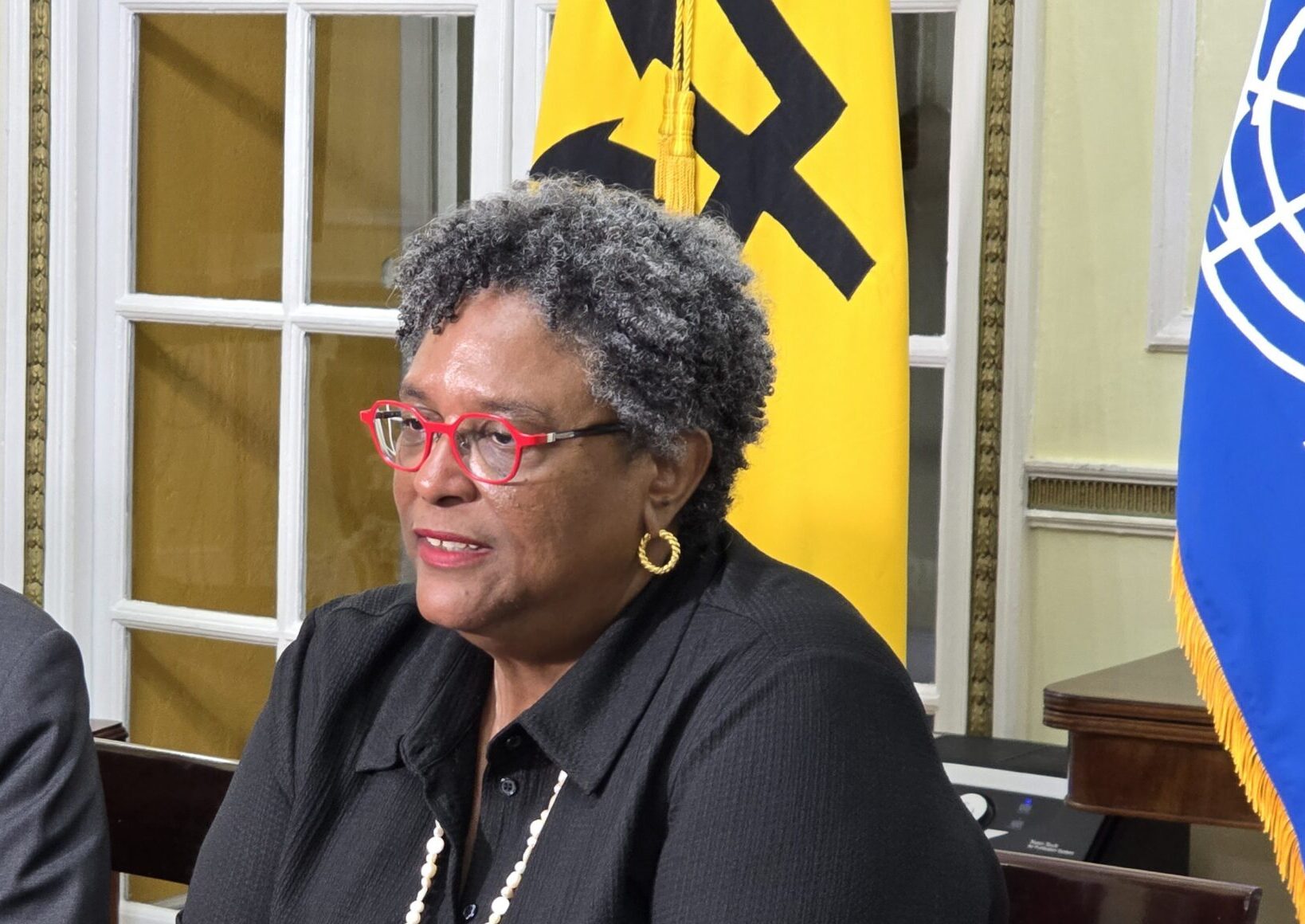
Hours after the 31st UN Climate Change Conference (COP31) wrapped up in Antalya, Turkey, without a binding overarching agreement, United Nations Secretary-General António Guterres and Barbadian Prime Minister Mia Mottley held an emergency joint press briefing at Barbados’ Ilaro Court on Sunday, sounding a stark alarm over the catastrophic risks of stalled global climate action for frontline Small Island Developing States (SIDS).
Guterres opened his remarks by voicing profound disappointment at the collective failure of national delegations to match the accelerating pace of the climate crisis with commensurate ambition. He emphasized that SIDS including Barbados, which have contributed barely a fraction of historical greenhouse gas emissions, now bear the brunt of worsening climate chaos: catastrophic Category 5 hurricanes, steadily rising sea levels that erode coastal land, crippled local economies, and soaring public expenditure on emergency disaster response and protective infrastructure. Pointing to cascading record-breaking global temperature readings, he warned that current global emission trajectories put the world on a direct path to overshoot the critical 1.5°C warming threshold outlined in the Paris Agreement. To avoid irreversible, civilization-altering climate breakdown, Guterres stressed that nations must directly confront the root driver of the crisis: global fossil fuel dependency. He rejected the contradictory logic of attempting to extinguish a fire while dousing it with gasoline, calling for a just, equitable and orderly phase-out of coal, oil and gas, paired with massive scaled investment in renewable energy that would unlock energy independence, lower utility costs and more resilient domestic economies for vulnerable nations. He also pressed wealthy historical polluting nations to fulfill their long-overdue commitments to deliver targeted climate finance, especially for adaptation projects in high-risk regions, framing the demand as a non-negotiable tenet of climate justice that prevents low-emission vulnerable states from bearing the costs of a crisis they did little to create.
Prime Minister Mia Mottley, a longstanding global advocate for SIDS climate rights, acknowledged the deep letdown of the COP31 impasse but rejected any narrative of surrender in the global climate fight. She singled out the absence of binding global commitments to cut methane emissions as one of the conference’s most damaging oversights, noting that rapid methane reductions could slow near-term warming enough to buy critical time for the global rollout of next-generation decarbonization technologies. Critically, Mottley outlined that methane mitigation could deliver mutual financial benefits even for fossil fuel corporations: ending routine gas flaring and repairing leaky pipeline infrastructure, which can now be precisely tracked via advanced satellite monitoring, would allow operators to capture and sell previously wasted gas, turning emission cuts into a revenue stream. She cited peer-reviewed scientific estimates that targeted methane reductions could shave 0.3 to 0.5°C off projected global peak warming, a substantial buffer for at-risk island nations.
Mottley also condemned the deliberate omission of any explicit references to coal, oil and gas in the final non-binding COP31 declaration, noting that the physical climate crisis does not bend to geopolitical horse-trading or diplomatic omissions: no political negotiation can stop intensifying hurricanes, catastrophic flooding or coastal inundation. For Caribbean nations in particular, she warned that spiraling climate risk is rapidly driving up insurance premiums to unaffordable levels, and rendering large swathes of territory uninsurable – which in turn makes those territories uninvestable, trapping local economies in a cycle of stagnation and vulnerability. She emphasized that the failed COP31 negotiations do not invalidate existing binding national obligations under the Paris Agreement, and noted that the 2023 advisory opinion from the International Court of Justice on climate change responsibilities creates a clear legal framework for further accountability action if diplomatic processes continue to stall. Mottley backed her point with on-the-ground economic data, revealing that Barbados’ fossil fuel import bill surged by 246 million Barbados dollars in the first nine months of the year, a direct reminder of how fossil fuel dependency exposes small nations to volatile global commodity price shocks and erodes national wealth.
Looking ahead to the upcoming COP32 summit hosted in Addis Ababa, Ethiopia, Mottley laid out a grassroots global mobilization plan that aims to rally 1.5 billion ordinary people across the world over the next 12 months to raise their collective voices and demand bolder action from their national leaders. She closed her remarks with a stark, uncompromising framing of the 1.5°C threshold: “1.5 is not simply a number; it represents for us the ability to survive.”