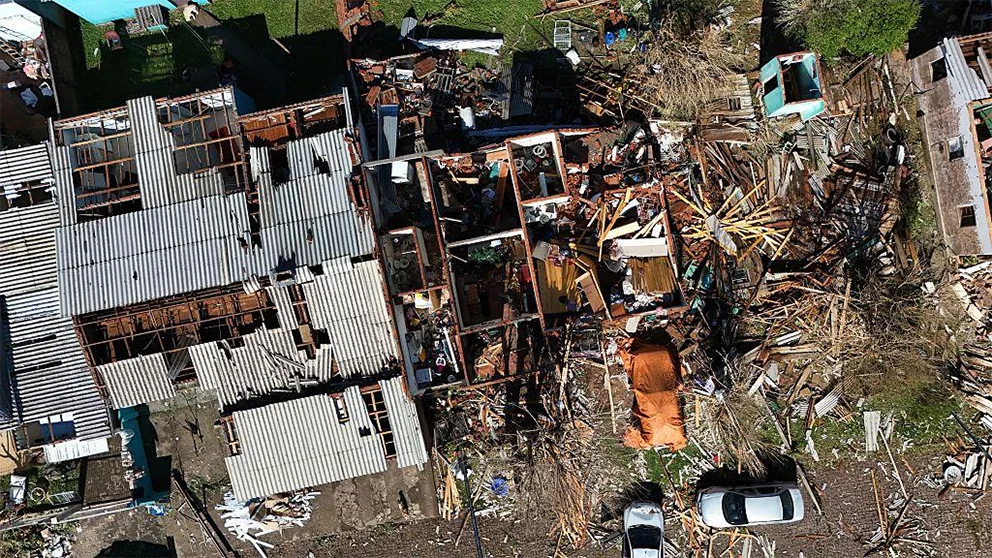
A ferocious supercell storm swept through the southern Brazilian municipality of Tupanciretã, in the Rio Grande do Sul state, in the early hours of a recent Friday, laying waste to nearly the entire urban area in just 40 minutes of unrelenting destruction. Meteorological officials confirmed the weather event qualified as a supercell, a rare, high-intensity thunderstorm system defined by a rotating updraft that can spawn extreme wind gusts and even tornadoes, though ongoing investigations have not yet formally verified if a tornado touched down during the incident. Peak wind speeds hit 114 kilometers per hour, tearing roofs off residential and public buildings, uprooting hundreds of mature trees, and crippling large swathes of the city’s electrical grid. Preliminary casualty counts from local civil protection authorities confirm at least 5 fatalities, with an additional 265 people sustaining storm-related injuries. The scale of property damage is staggering: nearly 7,800 private residences have been damaged or completely destroyed, alongside 20 local schools and a primary community health facility. Critical public infrastructure including paved roads, water pipelines, and communication lines have also suffered extensive harm, bringing daily life in the once-quiet agricultural city to a complete standstill. More than 20,000 local residents have been directly impacted by the disaster, with thousands forced to evacuate their uninhabitable homes to seek shelter with relatives, friends, or designated municipal emergency reception centers. Local authorities swiftly designated Tupanciretã an official disaster zone, deploying 200 military personnel to lead debris clearance operations, reopen blocked arterial roads, and support on-the-ground recovery efforts. Emergency response teams and state public service agencies are working around the clock to distribute food, potable water, and essential relief supplies to displaced households. Both federal and state governing bodies have mobilized dedicated funding for the recovery: the Rio Grande do Sul state government has allocated 7 million Brazilian reals in immediate relief funds, while the federal government has formally recognized the municipality’s state of emergency, unlocking access to additional national-level disaster relief resources for long-term reconstruction. This destructive weather event is part of a broader wave of extreme weather that has pummeled dozens of municipalities across Rio Grande do Sul since November 16, with widespread reports of torrential downpours, large hail, wind damage, and fallen trees across the region. Tupanciretã remains the hardest-hit location by a significant margin, recording the highest number of casualties and the most extensive physical damage of all affected areas. For the immediate future, local emergency operations are prioritizing the safe sheltering of displaced residents, the rapid restoration of essential utilities, and the prevention of secondary public health risks for communities left without adequate housing.