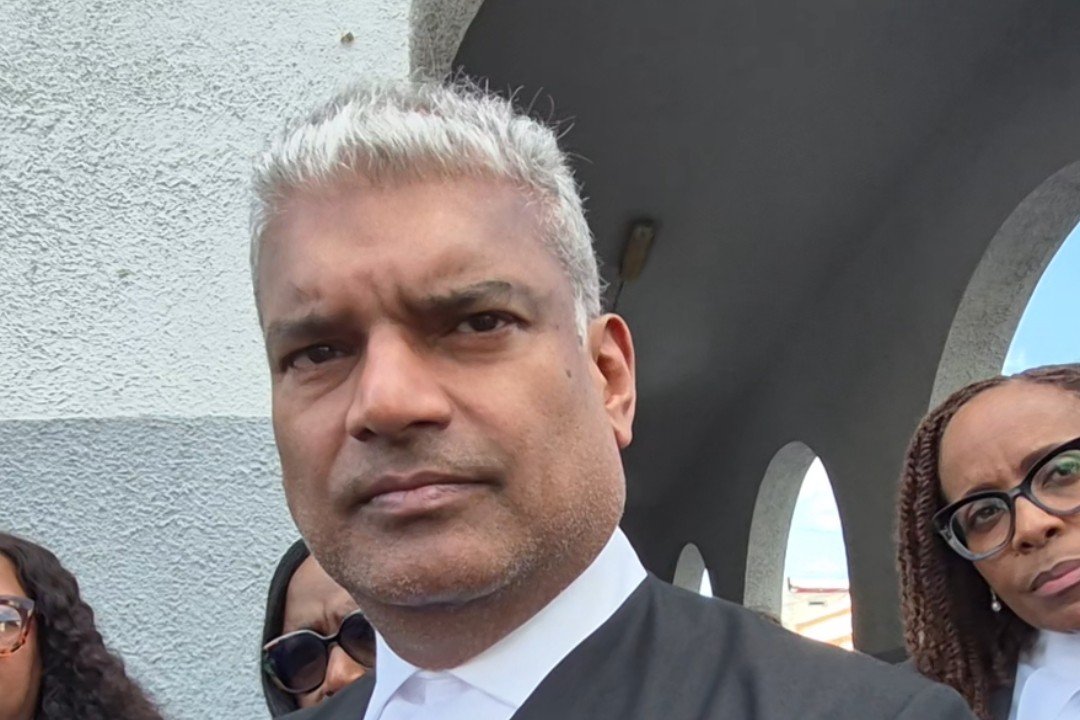
As closing arguments wrapped up on November 12 before High Court Justice Thom — who has reserved her ruling for the upcoming new law term, with a public decision slated for early 2026 — lead defence counsel Anand Ramlogan laid out a robust, precedent-backed case defending the eligibility of two incumbent winning candidates in St. Vincent and the Grenadines’ 2025 general election, against petitions filed by losing opposition Unity Labour Party candidates Carlos Williams and Luke Browne.
Williams, who was defeated by sitting Prime Minister Godwin Friday in the Northern Grenadines constituency, and Browne, who lost to Foreign Affairs Minister Dwight Fitzgerald Bramble in East Kingstown, are seeking to have their respective election results nullified, on the grounds that both victorious officials hold Canadian dual citizenship, which they claim disqualifies them from parliamentary office.
Ramlogan’s core argument centered on the logical coherence of the SVG Constitution’s drafting, posing a pointed rhetorical challenge to the court: he asked why the nation’s constitutional framers would explicitly enshrine Commonwealth citizens’ eligibility to run for public office in one section of the governing document, only to immediately invalidate that right in a subsequent clause, a pairing he labeled legally and philosophically impossible to reconcile. He described the petitioners’ proposed interpretation as a contradictory “give with the right hand, take away with the left” arrangement that could never have been the clear intent of the legislature that drafted the independence-era constitution.
To highlight the practical, absurd edge cases created by the petitioners’ legal framework, Ramlogan walked Justice Thom through a series of targeted hypothetical scenarios. One example detailed a Canada-born resident who settles in SVG, marries a Trinidadian national, and gains naturalised Trinidad and Tobago citizenship: under the petitioners’ reading, this fully eligible Commonwealth citizen would be barred from running for office, despite meeting all other residency requirements. A second scenario outlined an 80-year-old Canadian national who had never even heard of SVG, who gains Vincentian naturalisation and resides in the country for just 12 months, who would qualify to contest a seat under the petitioners’ logic, while a lifelong SVG resident who obtained Canadian citizenship solely to access critical life-saving medical care would be disqualified — a discrepancy Ramlogan framed as a fatal flaw in the opposition’s case.
He further emphasized that a naturalised Canadian citizen with no SVG citizenship only qualifies to run for parliament by virtue of their Commonwealth status, meaning that renouncing Canadian nationality would strip them of their Commonwealth citizenship and thus their eligibility entirely, a outcome he argued cannot have been intended by drafters. Ramlogan also cited regional comparative precedents, noting that Grenada and Jamaica allow Commonwealth citizens to contest parliamentary elections without holding local citizenship, while Barbados only removed that provision via explicit, targeted 1966 constitutional amendment, and several other Caribbean jurisdictions permit non-citizen Commonwealth nationals to serve as senators even when elected seats are restricted to local citizens.
Tying the argument to SVG’s pre-independence legal history, Ramlogan noted that all Vincentians held British citizenship and travel documents before the nation achieved sovereignty, only gaining formal SVG citizenship at independence — making it illogical that the framers would have deliberately created a two-tier system where some citizens could run for office while others were only permitted to vote.
He further submitted that determining whether a citizen owes allegiance to a foreign state is a question of external foreign law, and that no regional court has ever formally ruled that all Canadian passport holders automatically owe permanent allegiance to the Canadian state. Drawing on established regional judicial precedent, Ramlogan cited the 2001 Trinidad and Tobago general election deadlock, where an 18-18 seat tie left no party with a House of Representatives majority: courts there upheld the unwritten, implied right of MPs to receive salary payments, even though no explicit clause existed for that benefit in the constitution, based on the document’s overarching democratic foundational principles. He argued that this same interpretive standard applies here, requiring the court to resolve any ambiguity around candidate eligibility in favour of the expressed democratic will of the voting public, and their fundamental right to select their chosen representatives. Ramlogan stressed that any removal of a legislatively granted democratic right must be done via explicit, unambiguous statutory language, rather than implied contradictory clauses, and dismissed the petitioners’ legal reasoning as requiring unnecessary, “great intellectual contortions” to stand up to scrutiny, concluding that if the court accepts the defence’s reading of the constitutional text, the entire petition case collapses.
Friday’s lawyer suggests Constitution would not grant right, then nullify it