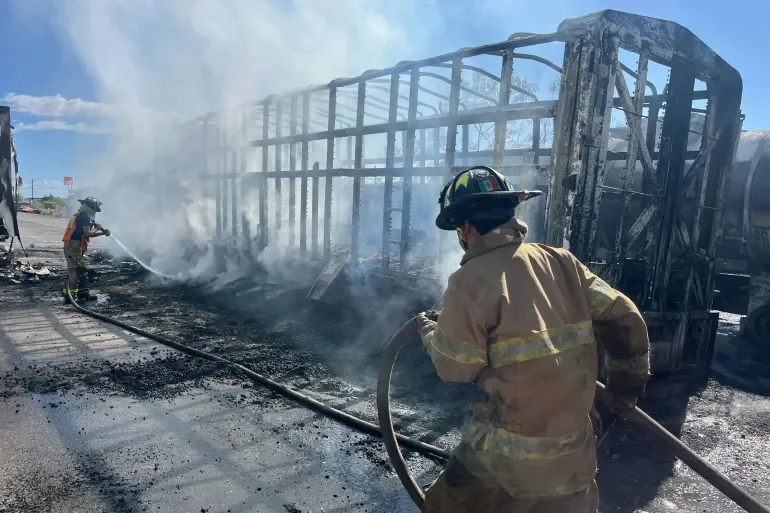
On November 21, 2026, emergency responders in Sinaloa, Mexico, worked to extinguish a burning cargo truck on the highway linking Guamuchil and Guasave, a scene that unfolded amid widespread, coordinated violent unrest triggered by the high-profile arrest of notorious cartel kingpin Fausto Isidro Meza Flores, widely known by his alias “El Chapo Isidro.” The operation to detain the fugitive, carried out jointly by Mexican security forces and U.S. intelligence agencies, left 11 people dead in total: 7 suspected cartel operatives and 4 military personnel, marking one of the deadliest confrontations in the region in recent months.
Meza Flores, who ranked among the FBI’s 10 most wanted fugitives, was apprehended during a targeted raid in the city of Guasave on the evening of November 20. U.S. authorities had offered a $5 million reward for information leading to his capture, as he faced formal charges of large-scale international drug trafficking and illegal firearms possession. Following his arrest, the kingpin was transported alongside two senior members of his criminal network to Mexico City on November 21, where they were formally handed over to federal judicial authorities. The two detained associates were identified as Germán N., alias “Serafín,” the reported second-in-command of the group, and José N., the organization’s lead financial operator.
The cartel launched immediate retaliatory attacks across Guasave and surrounding rural areas within minutes of the arrest being confirmed. Armed clashes between criminal operatives and security forces erupted across residential and commercial zones, with gang members setting dozens of vehicles ablaze and erecting improvised roadblocks to paralyze regional transit. The unrest spilled over into a local professional baseball game, where stray gunfire sent thousands of attendees into a state of panic; widely shared social media footage showed crowds scrambling for cover and fleeing stadium grounds in disarray. Mexican military forces deployed helicopters and surveillance drones to regain control of the area, after Sinaloa state officials announced by Saturday that security operations had cleared all roadblocks, restored partial traffic flow, and deployed permanent security patrols across urban and rural zones to prevent further outbreaks of violence.
A long-time affiliate of the Beltrán Leyva Cartel, Meza Flores later founded his own transnational criminal network, the Meza-Flores Transnational Criminal Organization, and built close operational ties with Los Mayos, a powerful faction of the Sinaloa Cartel. His arrest represents a major tactical win for Mexican President Claudia Sheinbaum’s administration, which has ramped up anti-cartel enforcement amid mounting pressure from U.S. President Donald Trump to crack down on cross-border drug trafficking networks. Mexican government data reports that national homicide rates have fallen during Sheinbaum’s tenure, but independent security analysts have issued stark warnings that detaining top cartel leaders rarely dismantles entire criminal operations. Power vacuums created by the removal of senior kingpins often spark brutal turf wars between rival factions and internal successors vying for control of smuggling routes, territory, and billions in annual illicit revenue. Sinaloa, which is already roiled by ongoing infighting between competing Sinaloa Cartel factions, remains at high risk of a new, broader wave of violence in the aftermath of the high-profile operation, leaving local communities bracing for further disruption even as officials tout the arrest as a landmark victory against organized crime.