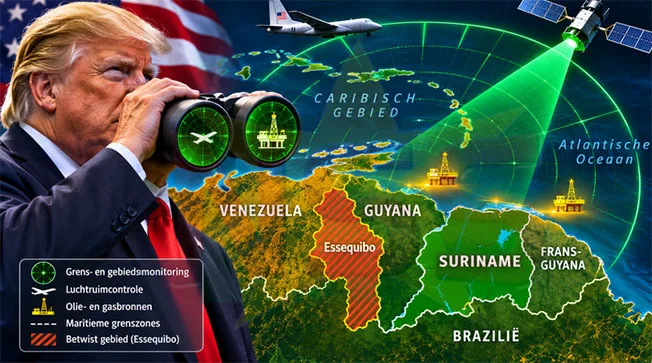
A wave of expanding U.S. security and diplomatic involvement across the Caribbean and northern South America has ignited fresh scrutiny over regional nations’ sovereign authority, unfolding against a broader Washington push to curb transnational drug trafficking while navigating long-running territorial disputes and fast-growing energy interests. The latest series of developments, first flagged in a November 19 Reuters exposé, centers on two closely watched scenarios in neighboring Guyana and Suriname, alongside newly formalized cooperation in Jamaica, all unfolding as U.S. ties to the region deepen at an unprecedented pace.
The most explosive revelation stems from exploratory talks led by former senior U.S. State Department official Jeremy Lewin, who remained in his post through the end of October 2024. Acting on explicit White House direction, Lewin floated a tentative proposal to Guyanese representatives that would cede partial administrative control over the resource-rich Essequibo region to Venezuela, a vast swathe of territory that makes up roughly two-thirds of Guyana’s total landmass. The overture came in response to a formal request from Venezuelan interim president Delcy Rodríguez to U.S. President Donald Trump, asking Washington to mediate the century-old border dispute between the two nations. The suggestion triggered immediate alarm in Georgetown, where officials have repeatedly reaffirmed they will not entertain any negotiations that involve surrendering Essequibo, and remain fully committed to the ongoing legal proceedings at the International Court of Justice in The Hague to resolve the long-running row. U.S. officials have since moved to clarify that their formal policy on the Guyana-Venezuela border has not shifted, noting that Washington continues to fully back the 1899 arbitral border demarcation that awarded full control of Essequibo to Guyana, and that any future boundary change could only be legitimized via a competent legal body or with the explicit mutual consent of both nations. Guyana’s Foreign Minister Hugh Todd reaffirmed his government’s unwavering position on Saturday, stressing that no solution outside of the ICJ judicial process will be considered. Once a little-noticed regional territorial disagreement, the Essequibo dispute has surged in strategic and economic value in recent years following the discovery of massive offshore oil reserves beneath its adjacent coastal waters.
Parallel to the diplomatic firestorm in Guyana, Suriname’s national parliament is currently reviewing a proposed bilateral agreement with the United States that would formalize U.S. support for intercepting civilian aircraft suspected of participating in illicit drug trafficking operations within Surinamese airspace. The framework would cover technical assistance, shared radar surveillance data, and coordinated information sharing to disrupt transnational narcotics smuggling networks, but has prompted pointed questions from legislators over the extent to which Suriname will retain full independent decision-making authority over sensitive security data and the execution of operational activities on its sovereign territory.
Further regional cooperation was formalized on November 19, when Jamaica and the United States signed a new bilateral accord to deepen collaboration between their respective customs agencies, focused on information sharing, tracking of suspicious cargo flows, and joint efforts to combat cross-border smuggling of drugs and weapons. While the Jamaican agreement is focused specifically on customs regulatory cooperation, it falls under the broader U.S. strategy to strengthen perimeter control over transnational criminal activity across the entire Caribbean basin.
Across all three nations, overlapping U.S. interests are at play beyond counter-narcotics enforcement: Guyana has rapidly emerged as one of the world’s fastest-growing new oil producers, with major U.S. energy firms including ExxonMobil holding multi-billion-dollar investments in its offshore energy sector, while Suriname is on the cusp of launching its own large-scale offshore oil and gas production operations. The combination of untapped energy reserves, critical international shipping lanes, and the Caribbean’s longstanding status as a key transit hub for global drug trafficking has elevated the region’s strategic priority for Washington significantly in recent years.
Analysts and regional policymakers note that while U.S. security cooperation can deliver tangible benefits including upgraded border surveillance technology, enhanced capacity to disrupt criminal networks, and expanded economic investment, small Caribbean nations face a persistent, delicate balancing act to ensure that such partnerships include robust safeguards to protect national sovereignty. The recent Essequibo overture has laid bare the unforeseen diplomatic risks that can emerge even between longstanding security partners, demonstrating how great power interests can ripple into and reshape long-simmering territorial disputes between smaller sovereign states. Across the region, governments now face the core challenge of leveraging the advantages of international security collaboration without ceding final decision-making control over their land, airspace, and core national security priorities.