On Saturday, November 21, 2026, Guyanese President Irfaan Ali issued an official public statement addressing a crippling, more than 45-hour unplanned power outage that left all residents of Region Six (East Berbice-Corentyne) without grid electricity, a disruption the head of state labelled “wholly unacceptable” for local communities. Ali confirmed that while the immediate operational priority for state-owned utility Guyana Power and Light (GPL) remains full, expedited restoration of service across the affected area, a comprehensive independent review will be launched once power is fully back online.
The scope of that formal review, Ali outlined, will cover every contributing factor that triggered the cascading system failure, a full audit of the adequacy and timeliness of GPL’s emergency response protocols, and the drafting of enforceable new safeguards to ensure no similarly prolonged outage impacts the region in the future. Notably, East Berbice-Corentyne has long been a core traditional electoral stronghold for President Ali’s ruling People’s Progressive Party Civic (PPPC) administration.
Earlier that same Saturday, the fully state-operated, heavily taxpayer-subsidised GPL had initially communicated that technical teams had isolated the root fault at the critical Canefield sub-station, with a public target of 1 PM to begin phased, gradual power restoration for all connected households and businesses. But less than three minutes before that scheduled deadline, the utility issued a hasty update scrapping that timeline entirely, stating that no firm restoration window could be provided to customers until further diagnostic work was completed. As of the time of the president’s 5:21 PM Facebook statement, neither the national government nor GPL’s senior leadership had hosted a public press conference to answer media and constituent questions about what marks the longest unplanned outage recorded on the Demerara-Berbice Interconnected System in more than three decades.
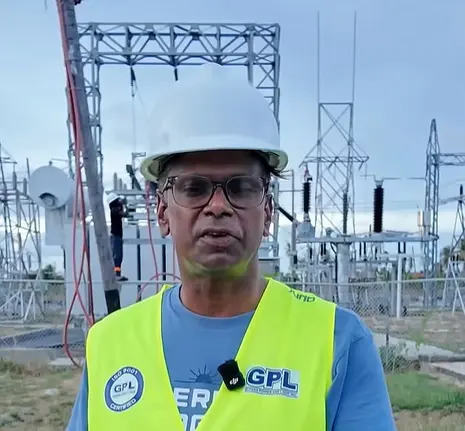
The only formal on-the-record update from GPL’s executive team came later that evening at 5:48 PM, via a 1 minute 59 second unscripted Facebook video from Bharat Harjohn, the utility’s Deputy Chief Executive Officer of Strategic Operations, who explained that a previously undetected secondary fault had derailed earlier restoration efforts. Harjohn noted that after technicians had fully repaired documented defects in the substation’s control room switchgear, a dangerous electrical arc suddenly formed beneath the protective ducting of a heavy-duty power cable running from the main transformer to the switchgear panel room, triggering an immediate automatic breaker trip that forced teams to shut down all work temporarily. Harjohn added that fully repairing the damaged original cable would take an unacceptably long period of time that would extend the outage for many more hours, so field teams had pivoted to rerouting power via a pre-existing spare backup cable, a technical process estimated to take roughly 45 minutes to complete. He stated that on-site crews were fully confident the workaround would be successfully completed before the end of Saturday, but declined to share a specific minute-by-minute timeline for when full power would be flowing back to residential and commercial users.
Closing his public address, President Ali extended a formal, unreserved apology to all affected East Berbice consumers, acknowledging that GPL had mobilised every available technical resource to resolve the cascading faults, but stressed that local residents deserved far more than generic verbal assurances. “The public is fully entitled to a clear, unvarnished, honest explanation of exactly what circumstances led to this unprecedented prolonged shutdown, and why restoration efforts dragged on for so many hours,” Ali affirmed in his official statement.
Ali plans review of “wholly unacceptable” 45-hour long blackout in Region Six