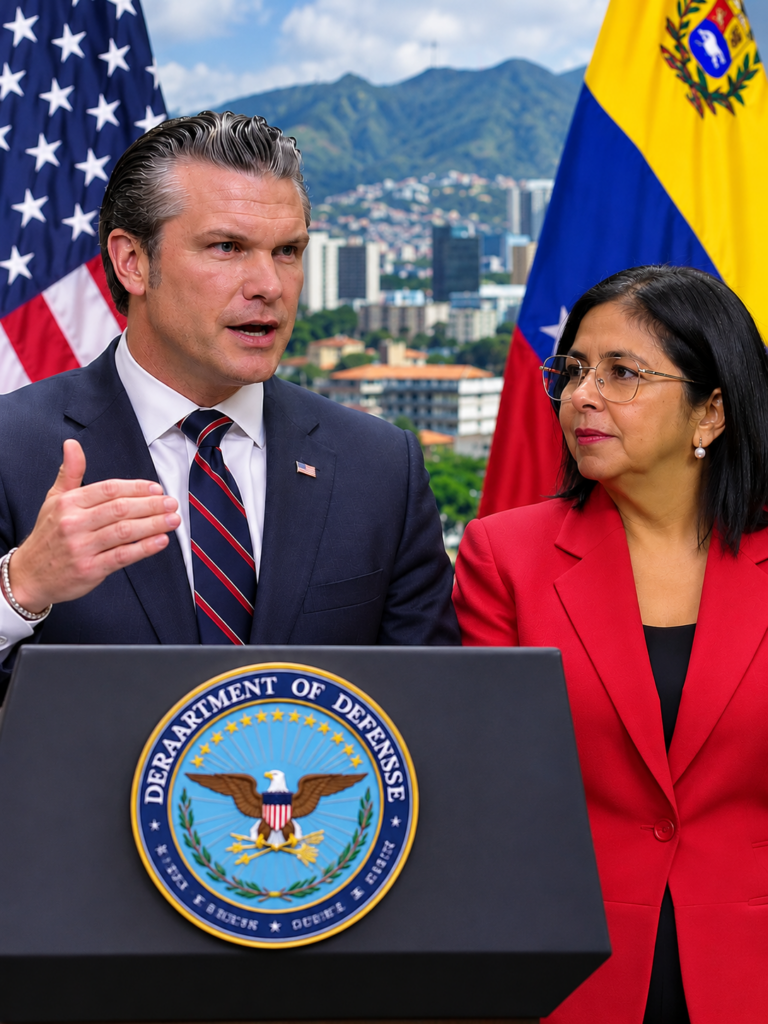
On November 19, U.S. Defense Secretary Pete Hegseth formally announced the conclusion of active hostilities between the United States and Venezuela, capping a lightning-fast diplomatic pivot that unfurled less than 11 months after U.S. special forces carried out a high-stakes January 3, 2026, raid in Caracas that removed long-time Venezuelan leader Nicolás Maduro from power and transferred him to U.S. custody to face pending criminal charges. The landmark declaration came just 24 hours after Hegseth touched down in the Venezuelan capital, where he and his Venezuelan counterpart Defense Minister Gustavo González López signed a sweeping bilateral defense cooperation framework at a ceremony hosted at the U.S. Embassy in Caracas. The pact lays out a roadmap for deep, sustained security collaboration spanning joint military training programs, real-time intelligence sharing, coordinated counter-narcotics operations, and U.S.-supported upgrades to Venezuela’s national armed forces hardware and technical capabilities. For decades, the two nations operated as bitter ideological and geopolitical adversaries, with Caracas regularly positioning itself as one of the most vocal critics of U.S. regional policy in the Western Hemisphere. Hegseth framed the rapid transformation of that dynamic during his embassy remarks, noting that Venezuela had evolved from being labeled Washington’s most aggressive regional threat to a formal, trusted security partner, with joint efforts already underway to rebuild the South American nation’s military institutional capacity. He singled out acting Venezuelan President Delcy Rodríguez, who assumed executive leadership immediately following Maduro’s capture, for her constructive, collaborative approach to resetting bilateral ties. Rodríguez, in turn, hailed the new defense pact as a historic opportunity for both nations to lay decades of mutual animosity to rest, emphasizing that expanded access to U.S. military training, cutting-edge equipment, and advanced defense technology would strengthen Venezuela’s national sovereignty and deliver tangible safety and economic benefits for ordinary citizens across the country. The rapprochement extends far beyond security cooperation, however. Following the January 2026 intervention, the Trump administration moved swiftly to expand U.S. economic footprint in Venezuela’s lucrative energy sector, sealing a deal in August with North American firm Blue Energy Partners that granted the consortium operational access to 17 major Venezuelan oil fields, with the U.S. federal government holding a direct financial stake in the company’s parent entity. Hegseth emphasized during his Caracas trip that unlocking Venezuela’s vast domestic oil reserves would drastically reduce North and South America’s collective energy vulnerability to supply chain shocks originating in the volatile Middle East. The new security partnership also aligns with ongoing U.S. regional counter-narcotics campaigns that target suspected drug trafficking vessels operating across the Caribbean and Eastern Pacific, a controversial initiative that has already resulted in hundreds of fatalities and drawn widespread international scrutiny over Washington’s broad interpretation of permissible military force in international waters. Critical open questions remain unaddressed in the wake of Hegseth’s announcement, however. Venezuelan authorities have yet to release a formal timeline for long-promised new presidential elections, with domestic opposition factions continuing to organize public pressure for sweeping democratic institutional reforms in the post-Maduro era. The full text of the bilateral military cooperation agreement, including explicit implementation milestones, multi-year funding commitments, and the scope of planned combined operations, has not been declassified or released to the general public. Regional stakeholders across the Caribbean Basin are closely monitoring the unfolding developments, as decades of political volatility in Venezuela and periodic spikes in U.S.-Venezuela military tensions have long posed tangible spillover security risks for small island nations in the Caribbean. Analysts note that while Hegseth’s “end of war” declaration marks a dramatic break from the recent past, it does not constitute a formal legal peace treaty, as the United States never issued an official congressional declaration of war against Venezuela prior to the January 2026 special forces operation. Even so, the rapid reset of ties signals a clear shift in Washington’s regional strategy, which now prioritizes consolidating U.S. influence in Venezuela through structured military and economic partnership rather than further direct military confrontation.