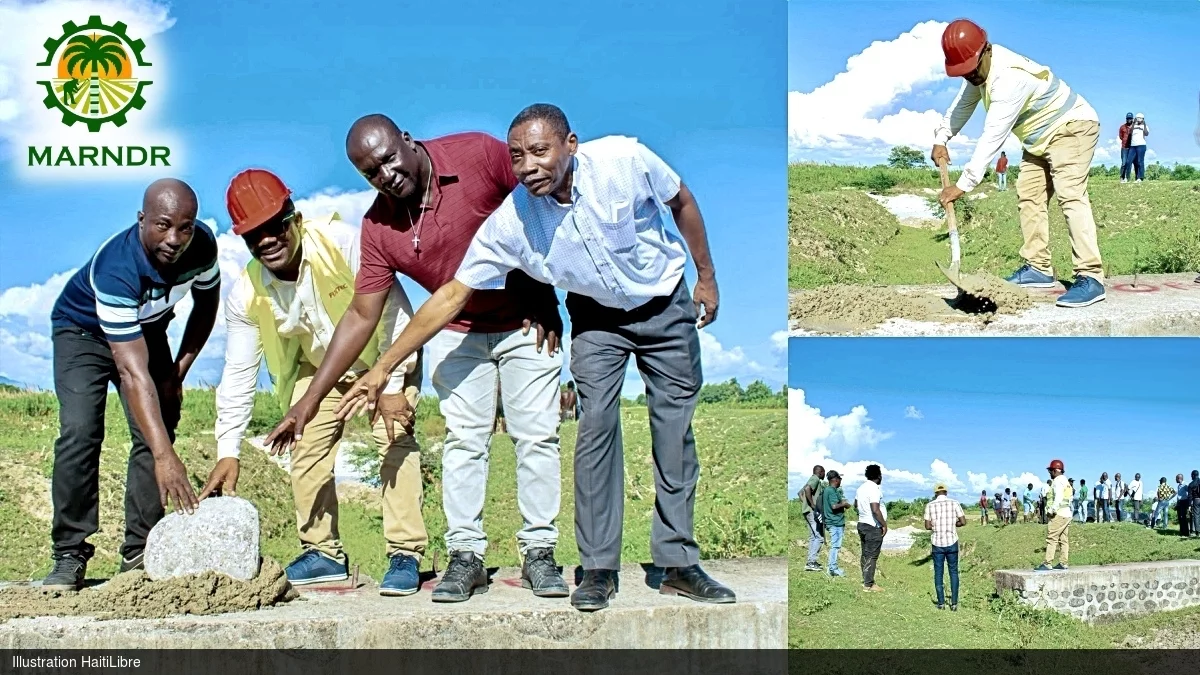
On November 20, 2026, Haitian Minister of Agriculture Marcelin Aubourg presided over an official groundbreaking ceremony in the Torbeck commune, marking the start of construction and full rehabilitation of critical irrigation systems serving the Périgny and Charlette agricultural zones. This initiative forms a core component of the South Region Irrigation Support Project, known by its French acronym PAIS, a 15-month targeted investment designed to expand reliable water access for more than 500 hectares of arable farmland across the area. During the event, Minister Aubourg framed the milestone as the delivery of a longstanding promise he first made when leading the South’s Departmental Directorate of Agriculture, noting the work directly aligns with Prime Minister Fils-Aimé’s administration-wide agenda to deliver durable, long-term solutions to chronic drought challenges that have suppressed local agricultural output for years. The minister emphasized that scaling up domestic agricultural production is the most effective, sustainable strategy to mitigate Haiti’s widespread food insecurity crisis, noting that secured access to irrigation water is the non-negotiable foundational requirement to intensify farming operations and lift national food self-sufficiency. The PAIS Torbeck project is structured around two complementary, interconnected work streams that cover both water capture infrastructure and downstream distribution networks to create a fully integrated, resilient hydro-agricultural system. The first work lot centers on upgrading and building new water intake and flow regulation structures along the Torbeck River, including a 50-meter reinforced concrete weir paired with an 11-meter wide energy dissipation basin to control water flow safely. Additional works for this segment include a valve-equipped scouring sluice gate, an intake structure with two gated access openings, and a 60-meter masonry desilting channel. Project coordinator and agronomist Jean Matus Lucien confirmed that this lot also includes a dual-gated discharge structure serving both the desilting channel and the stagnant terminal section of the main canal, plus 50 meters of retaining walls and bank stabilization works on the river’s left bank, 60 meters of equivalent protection on the right bank, and 50 linear meters of gabion erosion control structures downstream of the new weir to prevent riverbank degradation. The second work lot focuses entirely on rehabilitating and modernizing the sprawling Périgny irrigation distribution network: crews will reconstruct 150 meters of the canal’s stagnant terminal section, renovate stretches of the main canal spanning from kilometer marker 120 to kilometer marker 850, and add concrete lining to the upstream segment of the main canal to reduce water loss from seepage. Additional components of this lot include the installation of raised diversion weirs, lateral farm intakes, pedestrian canal crossing structures, shared public laundry facilities for local residents, and dedicated livestock watering troughs, alongside 50 linear meters of gabion reinforcement along the main canal to extend the system’s operational lifespan. When fully completed, the dual-component project will eliminate longstanding gaps in water capture, distribution, and management for local smallholder farming operations, secure hydro-agricultural facilities against extreme weather and erosion risks, and unlock the full untapped productive potential of the fertile Périgny plain.
Torbeck : Laying of the foundation stone for new hydro-agricultural infrastructure