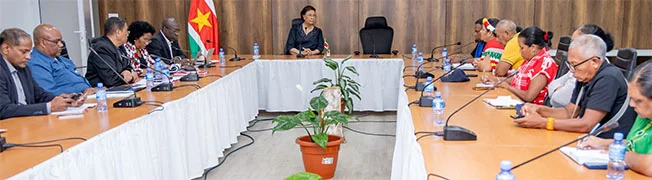
On November 21, Surinamese President Jennifer Simons formally announced during a closed-door consultation with the Association of Indigenous Village Heads in Suriname (VIDS) at the Presidential Palace that the national government will formally launch the Kali’na and Lokono Community Development Fund in January 2027, a core deliverable tied to the implementation of the historic Kali’na and Lokono court ruling. The establishment of the fund will be followed immediately by the disbursement of its first tranche of dedicated financial resources, following consultations with advisors seated on the national Land Rights Commission. As a next step, VIDS will first host community-wide deliberations to share the proposed fund framework with its grassroots constituents, after which the Presidential Working Group on Decentralization and Land Rights will reconvene with the indigenous leadership to refine the fund’s operational details, per a public statement from Suriname’s Government Communication Service. No specifics on the total size of the fund, the value of the initial disbursement, or its long-term governance structure were disclosed during the bilateral meeting, with officials noting these details will be finalized in subsequent collaborative sessions.
The high-level discussion also centered on the planned large-scale modernization of the Johan Adolf Pengel International Airport, Suriname’s primary international aviation hub. President Simons laid out a binding new requirement for incoming investors on the airport project: all proposed development plans must first deliver targeted, tangible upgrades for the four nearby indigenous communities of Wit Santi, Hollandse Kamp, Mata, and Cabendadorp before core airport construction works can break ground. The president’s vision for these community benefits includes a specialized vocational training campus tailored to local youth, designed to equip participants with industry-aligned skills for direct employment across aviation sector roles, from ground operations to hospitality and aircraft maintenance. A formal community benefit-sharing framework will also be mandated, ensuring surrounding indigenous populations capture a sustained share of the economic gains generated by the airport’s expanded operations, a policy designed to prevent extractive large-scale development that excludes the people living on adjacent lands.
VIDS leadership also presented a formal list of longstanding unaddressed grievances facing Kali’na and Lokono communities to the head of state, ranging from unresolved formal recognition of collective indigenous land rights, mass fish die-offs linked to unchecked river pollution, unregulated settlement by Mennonite communities on indigenous territories, and systemic infrastructure and social service gaps in remote indigenous villages. Edgar Dikan, the Presidential Advisor for Decentralization and Land Rights, confirmed that the national government has mapped out a structured, multi-stakeholder roadmap to resolve long-simmering land rights disputes in full partnership with affected indigenous groups. The two sides also reviewed outstanding ambiguities surrounding the Protection of Residential and Living Areas Act: Dikan noted that President Simons reaffirmed the law’s core purpose during the meeting, emphasizing that tangible, incremental action to safeguard indigenous ancestral territories must begin without further delay. VIDS Chair Muriel Fernandes acknowledged that significant unresolved questions about the law’s specific provisions and downstream impacts remain among member communities, and that VIDS will only be able to share full guidance with its constituent villages once all operational details are clarified by the government. Fernandes added that decision-making within indigenous communities follows traditional, consensus-driven governance protocols that require input from all traditional authority holders and village assemblies, a process that demands sufficient time for full deliberation. Both Fernandes and Dikan explicitly reaffirmed the central, non-negotiable role of Free, Prior and Informed Consent (FPIC) for all state policies and private sector projects that impact indigenous rights, lands, and livelihoods.
Following the three-hour consultation, Fernandes noted that she left the meeting with a strongly positive outlook for future collaboration, and that VIDS will now circulate all the draft proposals discussed with its member communities to gather feedback ahead of follow-up bilateral negotiations with government representatives. The two parties formally agreed that the Presidential Working Group on Decentralization and Land Rights will hold regular, scheduled consultation sessions with VIDS moving forward, with the working group submitting periodic progress reports directly to President Simons to ensure accountability for all agreed-upon action items.