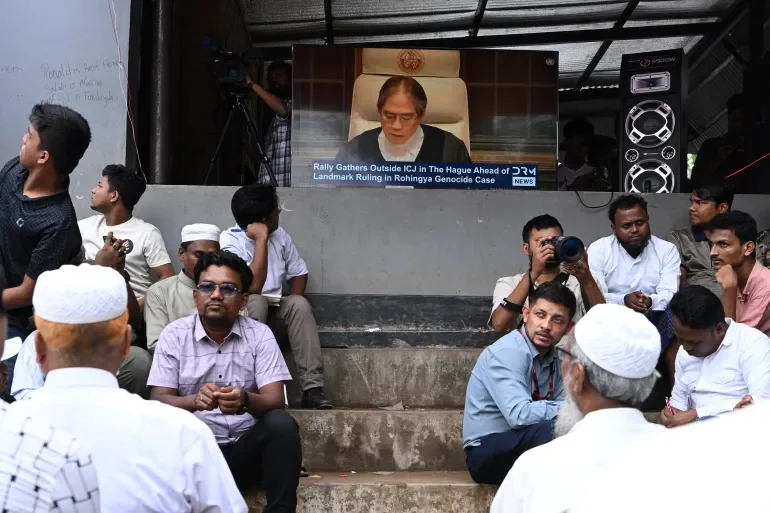
On November 20, global communities reacted to a landmark, unprecedented ruling from the International Court of Justice (ICJ) in The Hague, which formally determined that Myanmar committed genocide against the predominantly Muslim Rohingya ethnic minority during 2017 military operations. This marks the first time the UN’s highest judicial body has ever held a sovereign state legally responsible for the crime of genocide. The case was originally filed in 2019 by the West African nation of Gambia, with backing from the Organisation of Islamic Cooperation (OIC), under the framework of the 1948 Genocide Convention. The legally binding, non-appealable verdict mandates Myanmar to implement targeted remedial measures and provide financial and restorative compensation to affected Rohingya populations, with detailed implementation terms to be finalized in subsequent proceedings. Across Cox’s Bazar, the sprawling refugee camp in Bangladesh that hosts more than a million displaced Rohingya, families gathered around shared screens to watch the live verdict broadcast, many weeping as the ruling was translated into their native language after decades of unacknowledged suffering. Gambia’s government hailed the decision as a transformative milestone for international jurisprudence, emphasizing that the obligation to prevent and prosecute genocide falls on every signatory state of the Genocide Convention, not just Myanmar. Banjul has formally called on Myanmar to comply with the ruling immediately without delay, and urged the United Nations, OIC, and broader global community to coordinate cross-border support to enforce the verdict. UN Secretary-General António Guterres framed the ruling as a powerful rebuke to impunity for the world’s most severe crimes, confirming the court’s documented findings that over 10,000 Rohingya were killed during the 2017 crackdown, alongside widespread systematic sexual violence and other gross human rights abuses. Guterres noted the ruling is a critical step to break the cycles of unaccountable violence that have destabilized Myanmar for generations, and pave the way for sustainable, inclusive peace. UN High Commissioner for Human Rights Volker Türk added that the formal confirmation of Myanmar’s state responsibility for one of the 21st century’s worst atrocities marks a stain on global humanity that can no longer be ignored. The United Kingdom announced the most concrete immediate punitive measures in response to the ruling: it ordered the expulsion of Myanmar’s military defense attaché, summoned the country’s interim chargé d’affaires for a formal reprimand, and pushed for an emergency UN Security Council session to discuss enforcement of the verdict. British Foreign Secretary Ed Miliband confirmed the UK will expand existing sanctions targeting Myanmar’s ruling military junta, with additional targeted punitive measures to be announced in the coming days to ensure perpetrators face full accountability. Myanmar’s National Unity Government (NUG), the opposition shadow administration formed from elected officials ousted in the 2021 military coup, released a statement affirming its full respect for the ICJ’s authority and ruling, noting it will carefully review all mandated remedial measures to uphold accountability and prevent future mass atrocities. For Rohingya activists and community leaders, the verdict is a long-awaited validation of decades of lived trauma, but far from the final goal of their struggle. Nay San Lwin, co-chair of the Arakan Rohingya National Council, explained that true justice requires far more than legal recognition: it must include full restoration of Rohingya citizenship, official state recognition of their ethnic identity, and guaranteed conditions for safe, dignified, voluntary return to their ancestral homelands in Rakhine State. Prominent Rohingya human rights activist Wai Wai Nu added that the ruling dismantles years of deliberate disinformation from Myanmar’s military regime, which had spent decades attempting to erase Rohingya identity, deny the community’s existence, and downplay the scale of the 2017 atrocities. Major global human rights organizations have framed the ruling as a historic breakthrough. Amnesty International called it an authoritative, long-overdue recognition of the Rohingya’s unthinkable suffering, offering survivors a rare moment of redress after years of total impunity for their abusers. Human Rights Watch described the verdict as a turning point in the Rohingya’s multi-decade fight for justice, urging the international community to ramp up coordinated diplomatic pressure to force Myanmar’s ruling junta to comply fully. While global reaction has been overwhelmingly supportive of the ruling, significant practical hurdles remain for enforcement: the ICJ operates no independent enforcement apparatus of its own, meaning compliance will rely on coordinated diplomatic pressure, targeted global sanctions, and potential binding action from the UN Security Council. Beyond delivering redress to the Rohingya community, the verdict sets a groundbreaking new precedent for the global international legal order, strengthening the global framework to hold states accountable for genocide and dismantle long-standing systems of impunity for the world’s most severe crimes.