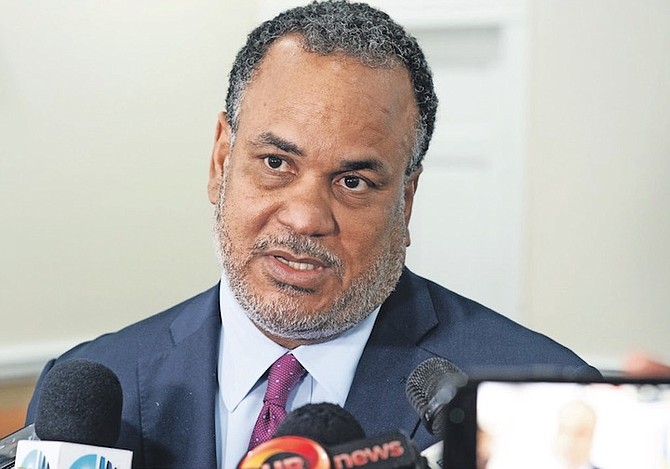
Bahamas Minister of Finance Michael Halkitis has reaffirmed the administration’s commitment to halting repeated delays to its long-planned Oracle-powered public sector payroll and human resources platform, indicating a full launch could proceed as early as January, even as a major trade union coalition’s pending Supreme Court challenge is scheduled for a December hearing.
During a recent media briefing, Halkitis noted that officials had initially targeted a December full rollout, but a small number of additional coordination meetings could push the timeline to early January, emphasizing that continuous indefinite postponement of the long-overdue system upgrade posed unacceptable operational risks for the public sector. “We cannot keep pushing this critical modernization down the road,” he stated.
The minister’s remarks followed public claims from Bahamas National Alliance Trade Union Congress head Belinda Wilson, who alleged government legal representatives had notified union parties that the full Oracle system launch had been pushed back two full years to 2027, a timeline Halkitis explicitly rejected. The trade union congress has filed a Supreme Court injunction petition to block the planned shift from monthly to biweekly salary disbursements, with the full substantive case scheduled to be heard next month. The new Cloud Bahamas platform will cover payroll, human resources administration and related services for more than 23,000 civil servants and public sector employees nationwide.
Halkitis pushed back against repeated union allegations of insufficient consultation, noting that formal discussions with labor representatives had stretched over a two-year period, and that the phased rollout model currently in use was originally a recommendation from one of the country’s umbrella union groups. He noted that the system is already fully operational at three public sector entities: the University of The Bahamas, the Public Hospitals Authority, and the Bahamas Department of Tourism, with no major negative feedback reported to date by technical implementation teams.
However, labor leaders across multiple public sector unions have raised a series of active concerns. Bahamas Nurses Union president Muriel Lightbourn confirmed that frontline nursing staff using the new system have reported widespread pay discrepancies, including delayed overtime compensation, unpaid work-related allowances, and net salary amounts that do not align with expected earnings. Commonwealth of The Bahamas Trade Union Congress president Obie Ferguson KC has warned that core functionalities of the new platform, including digital clock-in and attendance tracking rules, may conflict with existing binding industrial labor agreements and official civil service General Orders governing working hours and employee attendance. Bahamas Union of Teachers leadership, meanwhile, has advised all its members to refrain from creating accounts or logging into the Cloud Bahamas platform until the government addresses outstanding union concerns over data security and unaddressed technical glitches.
When asked about circulating social media complaints over the system’s digital clocking procedures, Halkitis acknowledged he had not reviewed those specific allegations and could not offer a formal response to unvetted claims, but confirmed that internal technical implementation teams had not flagged any critical systemic failures that would justify pausing or abandoning the full rollout. He emphasized that the decades-old, unsupported legacy manual payroll and human resources system is the root cause of longstanding public sector employee grievances, including multi-month delays in processing promotion adjustments, retirement benefits, and end-of-service gratuity payments for departing civil servants.
Halkitis framed the platform as a core 21st century public sector modernization initiative, noting that the integrated Cloud Bahamas system will allow public servants to access their full employment records, submit leave requests, update personal documentation, and view real-time salary breakdowns via a self-service online portal, while creating a unified linked system connecting payroll, public finance, and government procurement operations. He added that the government has structured the transition to allow employees who prefer to remain on the existing monthly payroll schedule to opt out of the biweekly pay shift, rather than forcing all workers onto the new payment model.
Govt won’t delay Oracle payroll any longer