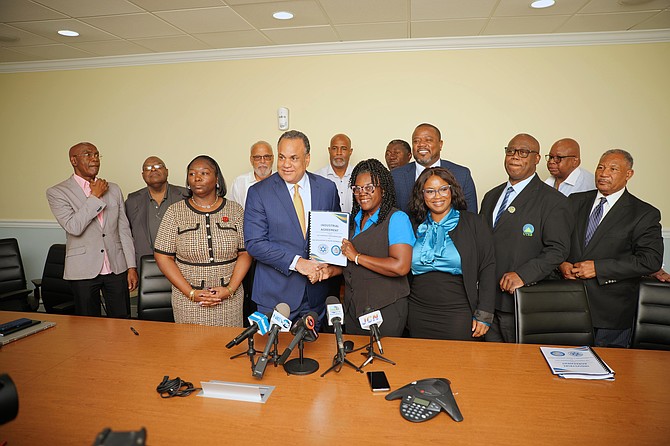
After nearly 12 months of tense, drawn-out negotiations, frontline staff at The Bahamas’ Financial Intelligence Unit (FIU) have formally signed a five-year industrial bargaining agreement, retroactively effective January 2026, marking a major milestone for the anti-money laundering agency’s workforce. The final signing came just two months after the Regulatory and Allied Workers Union (RAWU) – the official certified bargaining representative for FIU staff – publicly accused agency leadership of intentionally delaying the finalization of the nearly complete deal.
Crafted to address longstanding pay inequities between the FIU and peer domestic regulatory bodies, the new framework delivers restructured salary scales, expanded workplace benefits, and strengthened job security protections for eligible personnel, according to statements from Minister of Finance Michael Halkitis during the signing ceremony. Halkitis emphasized that the revised terms are designed to recognize the FIU’s critical, central function in safeguarding The Bahamas’ reputation as a compliant, trustworthy international financial services hub, noting that the agency’s staff are tasked with receiving, vetting, and analyzing thousands of suspicious financial transaction reports each year to disrupt money laundering and illicit finance flows. He extended formal gratitude to the FIU workforce for their consistent contributions to upholding national financial sector integrity.
For RAWU president Nicole Francis, a 20-plus year veteran FIU employee, the finalized agreement represents an unprecedented win for the unit’s dedicated staff. “This is a genuinely historic moment for every hardworking person on this team,” Francis remarked at the signing event. “For decades we have lacked clear, consistent structure and long-term workplace stability, so seeing this come to fruition after years of advocacy is deeply meaningful for someone who has grown with this agency for more than two decades.”
The comprehensive terms of the new contract include tiered additional vacation time scaled to employee tenure, updated flexible work policies that accommodate caregiving and personal needs, targeted adjustments to total compensation packages, and formal new provisions for workplace mental health support. Neither the union nor the Ministry of Finance released the total estimated cost of the multi-year agreement, nor did they share specific percentage figures for individual salary hikes.
The path to the final deal was far from seamless. As far back as September 2025, Francis confirmed that the draft agreement was 98% finalized, with only a single unresolved point of contention: the restoration of two paid personal days per employee that had been abruptly revoked in January 2025, when staff were instructed to use their standard accrued vacation leave for any unplanned personal absences. At the time, Francis publicly called out the FIU’s director for unnecessary foot-dragging on the signing process, even with nearly all terms already mutually agreed.
“Any collective bargaining process is going to have points of friction and disagreement, that is only natural,” Francis noted during the official signing, as she extended specific recognition to two agency representatives, Ms. Bain and Mr. Evans, for their collaborative approach that helped clear final hurdles and deliver a smooth conclusion to talks.
RAWU was formally certified as the exclusive bargaining agent for all permanent, pension-eligible FIU staff on July 29, 2025, with formal negotiation sessions launching less than four months later on November 14. The FIU currently employs a total of 53 personnel across secondment placements, fixed-term contracts, and permanent roles, with 34 of those employees falling under the union’s represented bargaining unit.