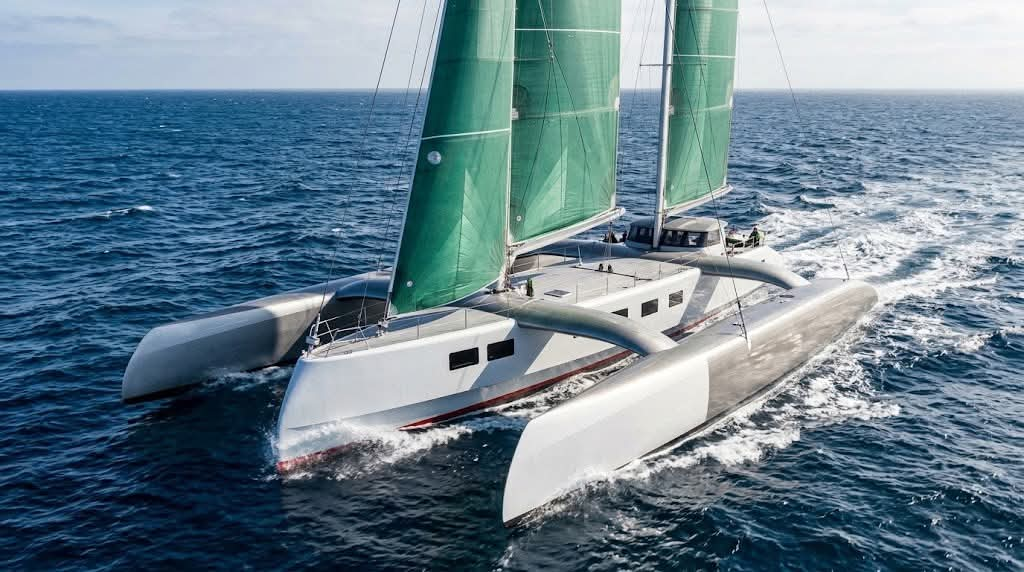
In an exclusive reveal to Barbados TODAY, local Barbadian maritime enterprise Champion Maritime Limited, operating under the brand name Alpha Zulu RoPAC, has laid out a transformative proposal to build a regional fleet of wind-and-battery-powered vessels, a project that is projected to create dozens of local jobs while resolving one of the Caribbean’s longest-standing trade bottlenecks: the chronic unreliability of inter-island passenger and cargo transit. Unveiled publicly on a Tuesday by company leadership, the initiative extends far beyond conventional shipbuilding, as it is engineered to deliver tangible, on-the-ground connectivity that has long eluded the Caribbean Single Market and Economy (CSME) despite decades of regulatory and institutional framework building. The pilot demonstration route under the proposal will initially connect Barbados, Dominica, and Antigua and Barbuda, with additional island linkages rolled out incrementally as user demand materializes. Ian Dash, director of Champion Maritime, noted that the firm’s expertise in constructing eco-friendly vessels on Barbadian soil stems directly from its 2014 successful launch of the schooner SV Ruth from Browne’s Beach, a vessel that operated extensively across the Eastern Caribbean for years. That real-world operating experience served as the foundational catalyst for the team’s conceptualization of a new generation of small, schedule-driven, wind-prioritized maritime craft, Dash explained. Dash emphasized that for nearly 40 years, CARICOM has dedicated substantial resources to constructing the legal and institutional architecture for regional economic integration, but the seamless, affordable, frequent, and reliable movement of small volumes of goods and people between the region’s scattered small island economies remains a persistent, unaddressed challenge. The operational insights gained from the SV Ruth project over the past 12 years have now evolved into the fully fleshed Alpha Zulu RoPAC program: a plan to manufacture a new class of modern, wind-primary, battery-electric vessels in Barbados, purpose-built to align with the Caribbean’s unique island geography, typical small cargo volumes, and regional economic constraints. Dash argued that for years, regional stakeholders have been overcomplicating a relatively simple logistical problem, and the Alpha Zulu RoPAC model offers a targeted, low-cost solution that leverages the Caribbean’s most abundant, untapped marine energy resource: the free, endlessly available trade winds that blow consistently across the region. Unlike imported fossil fuels, trade wind energy requires no purchasing, no cross-border transport, no on-island storage, and no costly refueling infrastructure. The RoPAC acronym stands for roll-on palletized cargo and passenger transport, while Alpha Zulu signals the project’s core non-negotiable target of absolute zero fossil fuel use across the entire fleet. Each vessel in the planned class will integrate combined wind and electric battery propulsion, on-board solar generation, refrigerated cargo capacity for perishable goods, and smart digital logistics coordination, operating on fixed, publicly accessible weekly, biweekly, or even daily schedules for direct island-to-island routes. Dash stressed that consistent, guaranteed reliability is far more critical to unlocking regional trade growth than occasional, ad-hoc cargo capacity, noting that a small-scale Dominican farmer cannot safely expand crop acreage for the Barbados market if there is no way to confirm when the next available vessel will dock. Similarly, a Barbadian small manufacturer or emerging entrepreneur cannot build a stable customer base in St. Kitts, Saint Lucia, or Grenada if small shipments are forced to wait indefinitely for irregular container ship services to prioritize their cargo. Producers of perishable goods including livestock, dairy, and fresh seafood also cannot plan for cross-regional sales without full certainty of timely, dependable delivery to end customers. One of the core hurdles facing the initiative is a longstanding financing puzzle: traditional freight data cannot accurately measure volumes of cargo that are never shipped at all, precisely because no reliable inter-island transport service currently exists to move it. This challenge is amplified by the historically risk-averse culture of Barbadian local entrepreneurs and domestic financiers, who are often hesitant to back projects that rely on projected, not existing, demand. To resolve this gap, Champion Maritime is bypassing incomplete historical freight datasets and launching a direct outreach campaign to Barbadian businesses across all sectors, including manufacturers, farmers, distributors, and wholesalers, with a simple targeted survey asking: “If a scheduled ship arrived at your port every week, what volumes of goods would you ship out, or bring in?” The goal of the survey is to collect concrete, route-specific evidence of existing unmet, suppressed, and new induced demand for inter-island transport. Dash’s long-term vision for the project far exceeds a small handful of routes centered on Barbados: he ultimately aims to commission six new vessels per year from the Barbadian shipyard, building a fleet of 100 Alpha Zulu RoPAC ships that operate not as isolated linear ferry routes, but as a fully interconnected maritime mesh spanning the entire Caribbean basin. This network would link the Greater and Lesser Antilles, including Cuba, Jamaica, the Cayman Islands, Belize, the Bahamas, Aruba, the southern Caribbean territories, the British Virgin Islands, the Leeward Islands, the Windward Islands, and extend south through Trinidad and Tobago to Guyana and Suriname. Under this interconnected model, individual vessels would not need to make long, cross-basin voyages from one end of the Caribbean to the other; instead, cargo and passengers would move via a network of short, well-coordinated inter-island corridors, with all schedules and connections synced and optimized via a centralized digital logistics platform.
Exclusive: Firm proposes wind-powered vessel factory to create jobs, build inter-island transport links