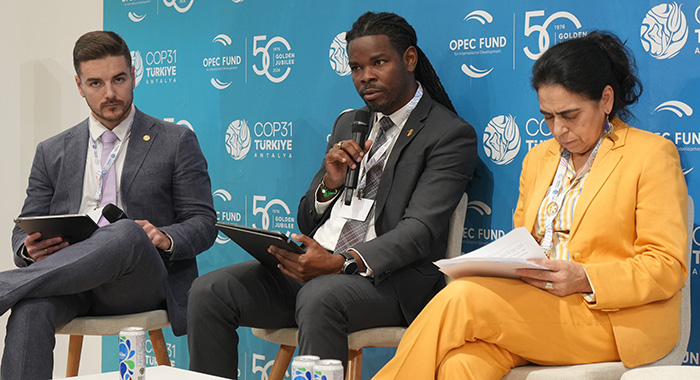
ANTALYA, Türkiye — As global climate negotiators gather in Antalya for the ongoing UN COP31 climate summit running through Friday, St. Vincent and the Grenadines (SVG) has brought the urgent, on-the-ground reality of small island developing state (SIDS) climate action to a high-profile global forum. Kevin Hope, SVG’s Ambassador for Finance, Climate and Investments based in the Office of the Prime Minister and head of the national COP31 delegation, delivered the country’s actionable resilience framework during a special high-level panel hosted by the OPEC Fund for International Development, themed “Climate Policy as Development Policy,” held on the summit’s dedicated Finance Day.
During his remarks, Hope extended formal gratitude to the OPEC Fund on behalf of SVG’s government, its entire population, and Prime Minister and Minister of Finance Godwin Friday, recognizing the institution’s decades of consistent partnership with the Caribbean nation. The OPEC Fund’s longstanding support has spanned critical rural road infrastructure upgrades, and most recently, a $20 million 2024 policy-based loan targeted at national disaster risk management. This dedicated funding stream is already driving tangible improvements across three key areas: enhanced national disaster preparedness protocols, updated rigorous land-use safety standards, and greater transparency in public climate-related spending.
Hope emphasized the non-negotiable link between climate action and national economic survival for SIDS, stating plainly, “For a small island state like ours, climate policy is fiscal policy.” He contextualized this reality for the panel’s global audience by citing the catastrophic impact of Hurricane Beryl, which struck SVG in July 2024 and inflicted an estimated $230 million in total damages — a figure equivalent to roughly 22% of the country’s entire gross domestic product. More than 90% of all buildings across the Southern Grenadines suffered severe structural damage or total destruction in the storm, a blow that landed on top of two consecutive, crippling national crises: the multi-year economic fallout of the COVID-19 pandemic, and the 2021 explosive eruption of the La Soufrière volcano.
Against this backdrop of cascading shocks, Hope laid out five core, government-endorsed pillars that SVG is using to turn abstract climate plans into tangible, daily benefits for all Vincentian residents. At the foundation of the framework is centralized, top-tier leadership: Prime Minister Friday, who concurrently serves as Minister of Finance, has anchored every national priority area — including water security, universal affordable energy, upgraded transportation networks, resilient local agriculture, sustainable tourism, and the blue economy — as a formal climate action priority, eliminating silos between government departments. Second, all climate-related public projects are held to the exact same strict debt sustainability limits as every other public sector investment, preventing unmanageable debt burdens from derailing long-term resilience goals. Third, targeted regulatory reforms are directly tied to international development financing, ensuring all new construction and land development adheres to strict safety codes that reduce disaster risk. Fourth, SVG has established a “one front door” coordination mechanism for all international climate partners, and is collaborating with the Green Climate Fund on a national Country Platform to align all external donor support behind a single unified national climate plan, eliminating fragmented, duplicative projects. Finally, the government is fully transparent about its existing administrative and technical capacity gaps, and is actively requesting grant-based international support rather than high-interest loans to speed up project preparation and delivery timelines.
Hope stressed that every component of this framework delivers immediate, tangible quality of life improvements for ordinary citizens: updated building codes requiring reinforced roofs protect family homes from extreme weather, accelerated renewable energy rollouts are cutting household electricity bills, and restored coral reef and mangrove ecosystems safeguard the livelihoods of thousands of workers in the tourism and commercial fishing sectors. “We cannot borrow our way to resilience,” Hope told the panel. “But with the right reforms and the right partners, we can build our way to it.”
Beyond the high-profile panel appearance, SVG’s full COP31 delegation — including environment and climate change consultant Edmund Jackson, and Shaffique Sam, Project Officer for the Zero Hunger Trust Fund — is continuing a packed schedule of bilateral meetings with global sustainability agencies, multilateral development banks, and international climate partners to secure targeted support for the country’s national climate and development priorities.
SVG tells its climate resilience story at COP31