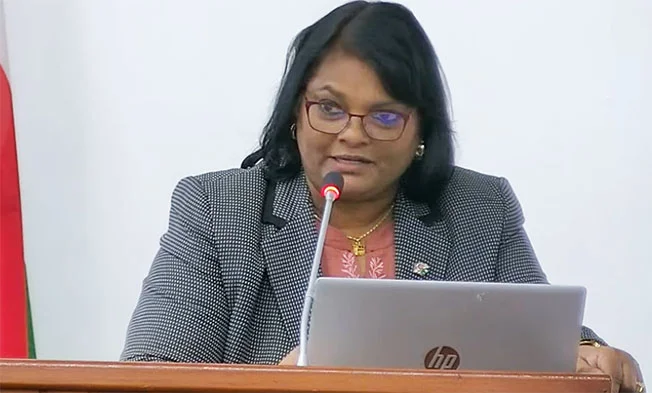
Two members of Suriname’s National Assembly (DNA) from the Progressive Reform Party (VHP), Krishna Mathoera and Marciano Dasai, pressed the national government for actionable clarity on the Suriname Police Corps (KPS)’s operational readiness to combat a rapidly escalating wave of violent criminal activity during a formal security interpellation session held on Friday, November 14. Mathoera opened her line of inquiry by flagging a critical crisis within the KPS’s specialized intervention units: she revealed that all but 2 to 3 members of the national arrest team are currently facing criminal prosecution in an ongoing drug trafficking case, a development that has effectively gutted the unit’s core capacity to take on high-risk operations. She demanded explicit confirmation on whether a fully trained new arrest team has been assembled and deployed for active duty, and a firm timeline for when a fully functional specialized intervention unit will be operational if no such team is yet in place. She further called for the government to outline concrete regulatory safeguards to prevent members of elite police units from being drawn into organized crime networks in the future, alongside plans to strengthen internal oversight and command structures for these specialized teams. For his part, Dasai painted a stark picture of pervasive public anxiety gripping communities across the country, noting that residents no longer feel safe even waiting at traffic intersections, as armed robbers increasingly resort to extreme, unprovoked violence to steal low-value items ranging from mobile phones and gold necklaces to small sums of cash. His independent on-ground analysis estimates that 5 to 6 armed robberies take place across Suriname every single day, and he pushed the government to release verified, unadjusted official crime statistics to the public. He noted that many residents now intentionally run red lights to avoid being targeted by robbers, stressing that the public has grown tired of vague official statements and is demanding tangible proof of action to improve safety. Dasai went on to deliver scathing criticism of the government’s flagship Safe City surveillance camera network, questioning why law enforcement still relies heavily on privately owned camera footage from households and businesses to track down suspects, despite the millions invested in the government-run public monitoring system. He also demanded clarity on the timeline for rolling out body cameras to frontline officers, and details of planned future investments in technological public safety infrastructure. He further highlighted the near-invisibility of police patrols in high-crime neighborhoods, commercial districts and busy intersections, asking for exact figures on how many officers are deployed on street duty per shift, and a timeline for the return of dedicated evening patrols to high-risk areas. Additional requests from Dasai included official data on the police’s average emergency response time to armed robbery calls, and the government’s formal performance target for cutting that response time to acceptable levels. Mathoera, meanwhile, submitted a series of targeted questions on the government’s organized crime mapping efforts, asking for the total number of identified criminal gangs tracked by police, and how many of those groups have been fully dismantled in recent months. She also pushed for confirmation on whether law enforcement maintains a public list of most-wanted suspects, and whether a fully operational anonymous tip line exists to allow residents to share intelligence on criminal activity safely. Her line of inquiry extended to the use of DNA evidence in criminal investigations, formal partnerships between the public police force and private security firms, and a formal government investigation into potential links between the current surge in violent crime and recent presidential pardons granted to incarcerated individuals. Both lawmakers emphasized severe, long-unaddressed gaps in the KPS’s logistical and material resources: Dasai demanded a specific, allocated budget figure for forensic equipment and personal protective gear for frontline officers, rejecting vague statements of intent to fund these supplies. Mathoera noted that the police corps requires a minimum of 50 new vehicles every single year to function effectively, asking for exact procurement figures for new patrol vehicles, speed detection devices, two-way radios and protective vests purchased over the past 18 months, alongside data on fire service vehicle acquisitions. She also questioned the allocation of public funds for a recent charter flight operation to deport a group of Mennonite residents, noting that the millions spent on the controversial, allegedly unlawful deportation mission could have been far better invested in strengthening under-resourced police units. To conclude, both parliamentarians outlined a series of actionable policy demands, including measurable 1-month and 3-month public safety performance targets to allow independent evaluation of the government’s crime-fighting progress, targeted cross-border operations to crack down on illegal firearms smuggling, community-based prevention programs run in partnership with local schools to divert minors from criminal activity, improved traffic safety enforcement, and a centralized national command structure to coordinate the government’s response to the ongoing public safety crisis. The pair stressed that they will not accept vague public announcements from the administration, and are demanding full transparency on available public safety budgets, police deployment rosters, and verifiable results from ongoing anti-crime operations.
VHP-fractieleden wil opheldering over verzwakt Arrestatieteam en veiligheidsaanpak