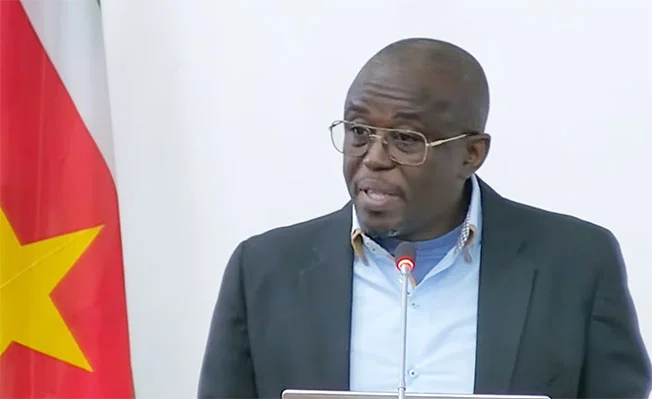
During a public safety interpellation session held on Friday in Suriname’s National Assembly (DNA), ABOP parliament member Stanley Betterson laid out a comprehensive set of immediate, medium and long-term policy proposals aimed at modernizing national crime-fighting frameworks, addressing long-unaddressed gaps that have allowed criminal networks to expand across the country.
Betterson opened his remarks by highlighting a widely exploited loophole in local criminal operations: unregulated heavily tinted vehicles that allow suspects to move through urban areas completely unidentifiable by law enforcement. He called on the administration to implement a strict zero-tolerance policy for non-compliant tinted windows, a low-cost, immediately enforceable measure he argues will drastically boost apprehension rates for suspects linked to violent and organized crime.
Shifting focus to technological upgrades for public safety, the assembly member emphasized that outdated surveillance infrastructure is no longer sufficient to counter sophisticated criminal networks. He formally inquired whether Suriname’s existing network of Safe City public cameras is equipped with automatic facial recognition capabilities to speed up the identification and apprehension of wanted suspects, and proposed mandatory installation of dash and body camera systems across all active police patrol vehicles to improve real-time detection of suspicious groups and individuals. Betterson stressed that these technological investments are not discretionary luxuries, but non-negotiable requirements for effective 21st century crime prevention.
Next, Betterson turned his attention to reforming the country’s firearms permitting system, calling for far stricter eligibility criteria to limit legal private gun ownership exclusively to individuals with verifiable, legitimate need for a weapon. His proposal mandates compulsory psychological evaluations and full medical screenings not just for initial permit applications, but for every subsequent renewal, a policy designed to reduce the risk of legally owned firearms falling into unsafe or malicious hands. He also raised urgent concerns about rampant illegal arms trafficking and porous border security in Suriname’s interior, pushing for increased government investment in high-precision scanning equipment at all border crossings and internal checkpoints to detect and seize unregistered illicit weapons.
The parliament member also pushed for permanent, structured collaboration between the national police force and the military, rather than the ad-hoc, temporary joint deployments that are currently only activated during spikes in violent crime. He argued that sustained coordinated operations between the two security bodies would create consistent, nationwide deterrence that intermittent emergency deployments cannot match. Betterson further requested official comparative data on Suriname’s public safety performance relative to peer nations across the Caribbean, Latin America, and global benchmarks, to inform evidence-based tiered security planning across short, medium, and long-term timelines.
Additional reform proposals included enhanced monitoring systems for former detainees, including individuals released on conditional parole or granted official amnesty. Betterson advocated for the targeted deployment of electronic ankle monitoring bracelets for high-risk released individuals, to reduce recidivism rates and prevent re-entry into criminal activity post-release. He also called for updated, targeted legislation to penalize individuals who knowingly shield criminal operations or fail to report suspicious illegal activity to authorities, noting that widespread community silence has long hindered law enforcement investigations.
In closing his address, Betterson emphasized that decades of underinvestment in public safety by successive prior administrations, not just the current governing body, are responsible for the cumulative security challenges facing Suriname today. He framed meaningful, sustainable crime reduction as a shared collective responsibility requiring coordinated action from government agencies, all security services, and ordinary civilian communities, rather than a burden assigned exclusively to law enforcement personnel.
Betterson wil strengere controle op geblindeerde auto’s en vuurwapenbezit