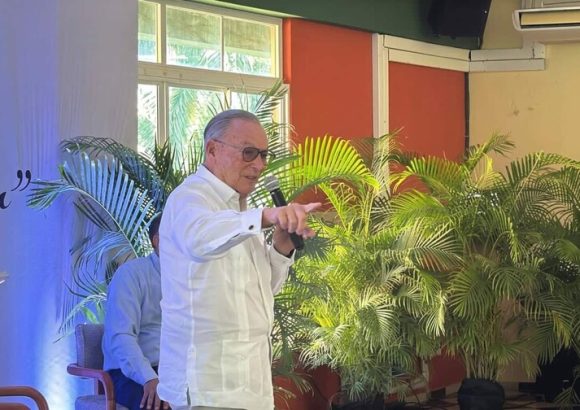
Against the backdrop of the Dominican Republic’s northwestern border region, where untapped growth potential is often overshadowed by long-standing structural economic hurdles, legendary tourism entrepreneur Frank Rainieri delivered a rousing call to local private sector stakeholders to take ownership of their communities’ development trajectory, rather than waiting for external forces to deliver progress. Rainieri, the visionary founder of the globally recognized Puntacana Group, shared his decades of hard-won industry insights during a keynote luncheon hosted at the San Ignacio de Loyola Technological Institute in Dajabón, a border city positioned on the Dominican-Haitian frontier. During the address, he walked attendees through the unlikely origin story of his flagship tourism enterprise, which launched as a humble, small-scale operation with just 23 guest rooms, a single small aircraft, and a makeshift private airstrip, and grew over decades of deliberate, unwavering effort to become one of the Dominican Republic’s most economically impactful and world-renowned tourism destinations. Addressing a packed room of regional business leaders from Dajabón and surrounding northwestern provinces, Rainieri emphasized that the region holds all the inherent assets required to catalyze sweeping, inclusive economic transformation — but warned that this outcome will remain nothing more than an unfulfilled aspiration if local business owners and industry figures do not step forward to lead proactive, action-oriented initiatives. Citing reporting from Dominican outlet Diario Libre, the veteran entrepreneur pushed back against the pervasive local narrative that frames national government intervention as the sole path to regional prosperity, noting that overreliance on state support often stalls grassroots growth. “Every human being is born with the innate tools to build value in life,” Rainieri told the audience. “Some of us recognize those tools, put in the work to refine them, and push through setbacks to turn ideas into reality; far too many others never spot those opportunities, or abandon their goals at the first sign of hardship.” He went on to clarify that Puntacana’s meteoric rise was never a stroke of random good fortune, nor a process free of crippling early obstacles, limited infrastructure, and widespread external skepticism. The landmark project, he stressed, only succeeded because its founding team clung to a long-term, unshakable vision, and chose to keep advancing even when market conditions, regulatory hurdles, and logistical challenges appeared insurmountable. Drawing directly from that decades-long experience, Rainieri invited border-region entrepreneurs to reframe their perspective on local barriers, and recognize that every large-scale regional transformation begins when a small group of stakeholders chooses to take the first unprompted step. “I have never subscribed to the idea that building walls or waiting for others to solve our problems moves communities forward,” he stated. “I have always believed that consistent, collaborative work is the only path to lasting progress.” To close his address, Rainieri laid out three non-negotiable core principles he identifies as foundational for any regional business success: first, taking full end-to-end ownership of proposed projects rather than passing off execution responsibility to third parties; second, prioritizing continuous learning and access to accurate, up-to-date market information to make data-driven, sound strategic decisions; and third, fostering cross-business collaboration to align around shared community goals rather than operating in isolated silos. For more on-the-ground coverage of Dominican Republic north coast and border region developments, readers can visit DominicanScope.
Rainieri to business leaders in the Northwest: “Development must be built”