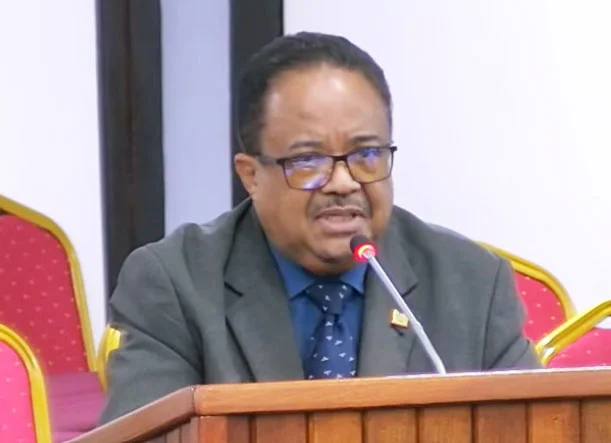
On November 13, officials confirmed that Suriname’s national cabinet delivered only a preliminary, high-level response to a wide set of parliamentary concerns over a recent sharp spike in armed robberies, fatal robbery assaults, and broader public safety gaps during a formal security interpellation session held in De Nationale Assemblee (DNA, the national parliament) the preceding Friday. Vice President Gregory Rusland openly acknowledged that the administration could not provide immediate, granular answers to every submitted query, noting that he and Defense Minister Uraiqit Ramsaran only walked lawmakers through the recently announced suite of public safety interventions, with full detailed responses scheduled to be submitted at a mutually agreed future date. The session, presided over by Rossellie Cotino, second deputy to the parliament’s vice chair, had been formally requested by six members of the opposition VHP political party, and drew questions from both ruling coalition and opposition legislators covering the full scope of the nation’s deteriorating security landscape.
Lawmakers pressed the executive branch for verified data including the exact number of reported armed heists and robbery-linked homicides, the share of cases that have been successfully closed, and the total count of suspects formally prosecuted for these violent offenses. They also demanded transparency around under-resourcing in the national police force, including critical shortages of patrol vehicles and operational equipment, public accessibility of the national 115 emergency hotline, and average police response times to active distress calls. Additional lines of inquiry addressed the performance of the country’s existing Safe City public surveillance camera network, enforcement efforts targeting illegal firearms, border security protocols, coordinated crackdowns on organized criminal networks, and formal protections for crime victims and witnesses. Multiple legislators called on the government to roll out a binding national security action plan with clearly defined measurable targets, dedicated budget allocations, and regular scheduled progress reporting to parliament to verify the effectiveness of deployed measures. Several speakers also highlighted the root social drivers of rising crime, including steep youth engagement in illegal activity, high secondary school dropout rates, widespread youth unemployment, and pervasive household poverty, urging the administration to prioritize long-term preventive intervention programs alongside short-term law enforcement actions.
During his opening remarks, Vice President Rusland referenced the full slate of security measures first unveiled by President Jennifer Simons on November 9, noting that national police units would conduct expanded patrol operations supported by the National Army, blending both overt high-visibility deployments and plainclothes unmarked surveillance to disrupt criminal activity. He added that national intelligence agencies and regional security teams are currently cross-referencing data to map the full structure of active criminal networks, with that analysis set to inform targeted, precision raids and enforcement actions coordinated through a newly activated Joint Operation Center. The administration also confirmed it has approved funding to repair and significantly expand the national Safe City camera network, with upgrades scheduled to be fully operational by 2027 to give law enforcement far greater real-time visibility across high-risk areas. A former Military Police outpost near the historic Fort Zeelandia site will be refurbished as a permanent joint operations base for both police and military personnel, and a special coordinated holiday season public safety plan is currently being drafted to mitigate crime risks during the upcoming peak festive travel and shopping period.
Defense Minister Ramsaran clarified that all military support deployed to assist civilian law enforcement will operate strictly within the bounds of existing national legal frameworks, with all actions requiring specialized civilian law enforcement authority remaining exclusively reserved for formally trained, sworn police officers. He noted that military support will not be limited to the capital city’s downtown core, and will be extended to high-risk rural and interior regions across the country as determined by joint operational assessments from security agencies. Ramsaran also emphasized that long-term structural improvements to public safety will require sustained public investment in new equipment, transport fleets, and other critical operational resources, confirming that President Simons has directed all relevant security agencies to submit full inventories of unmet resource needs as quickly as possible to identify additional funding allocations.
Following the opening general remarks, parliamentary representatives pushed back, stating that the interpellation process was explicitly designed to secure specific, evidence-based answers rather than high-level policy announcements, and demanding clear timelines for the delivery of requested crime statistics, performance metrics, and accountability frameworks. Rusland responded that while many straightforward queries could be answered in short order, compiling verified, complete historical crime datasets would require additional cross-agency coordination, so he declined to commit to a fixed public deadline to avoid missing a promised delivery date, and confirmed his office would coordinate directly with parliamentary leadership to schedule the follow-up session for full detailed responses.