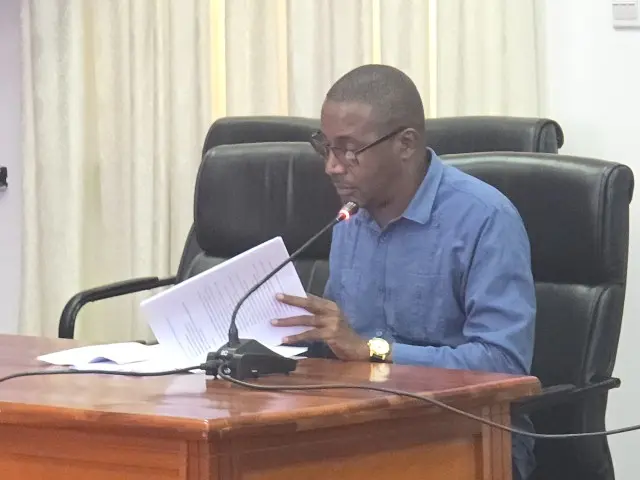
The ongoing Commission of Inquiry (COI) probing the catastrophic July 18 capsizing of the MV Barima ferry — a tragedy that claimed over 100 lives, marking Guyana’s deadliest maritime disaster on record — has flagged systemic gaps in independent safety oversight at the country’s Maritime Administration (MARAD), following testimony that revealed state-owned vessels are permitted to self-police defect remediation without third-party verification. Appearing before the five-member COI panel on Thursday, MARAD’s Director of Safety, Captain Courtney Mc Donald, laid out the agency’s longstanding operating protocol, explaining that on-site inspectors hold full discretion to assess a vessel’s seaworthiness, and once the Transport and Harbours Department (T&HD) — the operator of state-run ferries — confirms identified defects are resolved, the craft is automatically cleared to resume operations without mandatory follow-up audits from MARAD. “The standard process is that once an inspection report is shared with T&HD, all flagged issues are corrected, and the vessel is cleared to depart,” Mc Donald stated. When repeatedly pressed by commissioners to confirm whether the MV Barima had received a passing or failing grade on its pre-capsizing inspections, Mc Donald evaded a direct answer, noting only that the vessel was listed as being under maintenance in official records. Retired Trinidad and Tobago Rear Admiral Hayden A. Pritchard, one of the COI’s lead commissioners, pushed back sharply on this arrangement, warning that the framework effectively requires T&HD to regulate its own operations, creating a dangerous conflict of interest with no independent checks to prevent unfit vessels from sailing. “You have given us no assurance whatsoever that there are binding rules stopping non-compliant vessels from putting to sea, or that owners are ever formally notified of a pass or fail inspection outcome,” Pritchard told Mc Donald. “The core flaw here is that you are implying T&HD is responsible for policing itself, and that carries enormous, unacceptable risks — not least of which is the inherent failure of any entity to reliably enforce rules against its own operations.” Pritchard, a veteran maritime safety expert, added that MARAD, with its specialized training and dedicated regulatory mandate, is uniquely positioned to verify defect remediation and enforce no-sail orders, rather than delegating that critical authority to the ferry operator. In response, Mc Donald argued that T&HD employs a full dedicated marine safety division, including a certified marine superintendent and support staff, to handle its own internal compliance checks. The panel also reviewed key inspection timelines for the MV Barima: MARAD completed a full inspection of the ferry in November 2025 and submitted its full defect report to T&HD immediately afterward, but Mc Donald confirmed he never directed any MARAD staff to conduct a follow-up verification check, claiming the vessel was marked as being under scheduled maintenance. When questioned about classification of high-priority “no-sail” defects that would mandate a vessel be barred from operating, Mc Donald said that determination is left entirely to the discretion of the on-scene inspector, and he never reviewed the November 2025 report to identify any critical safety gaps, relying solely on the inspector’s unrecorded judgment. He went on to outline MARAD’s formal defect ranking system: missing radar, no functional Emergency Position-Indicating Radio Beacon (EPIRB), lack of distress signal capability, unserviceable life rafts, insufficient life raft capacity, and non-functional emergency generators are all categorized as high-priority no-sail defects, while missing crane operation documentation and absent stability data for cargo vessels are ranked as low-priority issues. The proceedings grew tense when the panel referenced a separate February 2025 inspection report for the MV Barima. Mc Donald initially claimed he could not recall ever seeing the document, even though he had referenced its existence in his pre-filed witness statement. When pressed by COI Chairman Retired Justice Godfery Smith to clarify whether the February 2025 report’s findings should have barred the vessel from sailing, Mc Donald repeatedly evaded a direct response, drawing a public rebuke from the chair. “You are prevaricating. You are obfuscating our work,” Smith told him. “As the director of maritime safety, we are asking you to help us interpret this document: does it mean the vessel should not sail? Does it list low-priority issues? What does it actually mean?” After sustained pressure, Mc Donald finally conceded that the on-site inspector had not marked the vessel for a no-sail order, and that the February 2025 report contained no findings that would render the MV Barima unfit for passenger and cargo operations. Pritchard later raised a separate concern about Mc Donald’s leadership approach, noting that the safety director had repeatedly deferred all judgment to junior inspectors rather than leveraging his decades of professional maritime experience to review and validate inspection findings. “If I had an inspector working under me, and I was the one legally responsible for signing off on vessel safety, I would independently qualify and verify every one of their assessments, because I bring more senior experience to the role,” Pritchard said. “I do not see you doing that here, and that is a major source of concern for this commission.”